Rio Tinto’s ERA Ranger uranium mine doomed by Climate Change?
Today’s Australian newspaper covers the very drastic threat now posed to Kakadu National Park by by flooding and sea level rises.
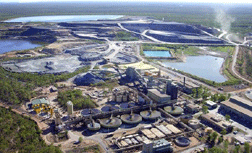 These climate changes mean that Kakadu is further threatened by radioactive waste leaks from theRanger uranium mine.
ERA’s uranium mine is surely no longer viable, and it is high time that RioTinto closed it down permanently and stopped this charade of Northern Territory uranium mining having an economic future – Christina Macpherson
Kakadu treasures ‘at mercy’ of climate-change floods * Sid Maher : The Australian * June 03, 2011 KAKADU faces more flooding and a loss of freshwater flora and fauna as a result of sea-level rises caused by climate change.
A report released yesterday by the Climate Change Department predicts that over the next 20 to 60 years, there will be more large floods on the South Alligator River, which is in Kakadu National Park.
The predictions are based on models predicting 143mm of sea-level rise by 2030 and 700mm of sea-level rise by 2070…… Kakadu treasures ‘at mercy’ of climate-change floods | The Australian
They still don’t know how to clean up Rum Jungle’s uranium wastes
A RUM MATTER, Brisbane Times, Damien Murphy and Aaron Cook June 1, 2011 Still glowing in the dark after all these years, the Rum Jungle uranium mine, 100 kilometres south of Darwin, needs another $7 million report to find out how to clean it up 40 years after it closed. The Greens’ Scott Ludlam told the Senate the money would be spent over four years just to determine how to deal with the defunct uranium mine’s toxic legacy. “The government can’t tell us yet what the final cost will be. The multi-million-dollar, publicly funded assessment is just the beginning.

Forty years after this mine closed, it continues to be an environmental graveyard for the Northern Territory. How many decades and how many millions of dollars will it take to clean up Ranger mine, or Olympic Dam?” The Girl with the Dragon Tattoo trailer finds its way out
Uranium mine expansion to damage marine life, leave huge radioactive wastes
 plans for the desalination plant would pose a major risk to local marine life……..”Under no circumstances should the governments
  involved in the assessment of the supplementary EIS approve of this desalination plant,”
it will dump more than two cubic kilometres of radioactive tailings over an area measuring up to 44 square kilometres,” Senator Ludlum said.
“The new open pit proposed will leak over eight million litres of radioactive liquids every day.”
OLympic Dam Mine Expansion ‘Staggering’ ninemsn news, 31 May 11 BHP Billiton’s proposed expansion at its Olympic Dam mine in South Australia would make it the biggest mine in the world. The figures involved are simply staggering……….the whole site, with its production and support facilities, will cover an area of about 30 square kilometres, a fair chunk of Adelaide’s metropolitan area…… Continue reading
Future rainfall will determine if Ranger uranium mine has any future
“This is highly dependent on future rainfall,” the company [ERA – subsidiary of Rio Tinto] said.
Leading Australian uranium mine remains suspended, Mineweb.com -The heavy rains that have kept much of N. Australia waterlogged for months have also resulted in the suspension of one of theworld’s largest uranium mines – Ranger Ross Louthean , 14 Apr 2011 PERTH – Continue reading
Australian company faces Malaysian opposition to radioactive waste dumping
crucial questions remain unanswered especially regarding the safe disposal of radioactive waste…… officials from the nuclear watchdog would be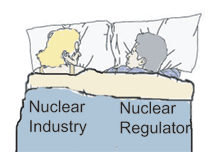 pro-nuclear and therefore fail to produce a fair assessment of the Lynas plant.
Calls for local and environmental groups to be represented in the monitoring team have also gone unheeded…’Whatever their findings, our final agenda – which is our ultimate goal – is to stop Lynas.’..
Malaysia’s new rare earth plant provokes radiation fears – Monsters and Critics, By Julia Yeow May 29, 2011, Kuala Lumpur – In the quiet town of Gebeng in Malaysia’s central state of Pahang, a new rare earth plant has evoked fears of radiation contamination as residents desperately seek to stop the construction of the world’s largest such refinery. Continue reading
Gigantic scale of BHP’s planned uranium mine expansion
 It’s the end of the world as we know it The Drum, Ben Eltham23 May 11,“……If you want to understand the impact of the “China and India story” on Australia’s economy, one way to do so is to have a quick glance at BHP Billiton’s plans for Olympic Dam.
This month, when the South Australian government announced it was giving a provisional go-ahead to the expansion of Olympic Dam, some of the provisional figures about this development were released. This astonishing feat of human ingenuity will see the excavation of a kilometre of rock in order to mine an ore body with the chimerical value of $1 trillion. Just getting to the ore body will take four years of digging, and at its peak, the mine will consume more electricity than the city of Adelaide – in fact, it will eventual consume about 60 per cent of South Australia’s entire electricity supply.
It will require so much water that BHP is building a huge desalination plant in the upper Spencer Gulf that will make 200 mega-litres of water every day.
The mine will operate for 100 years, producing mainly copper, a key raw material for the hungry Asian factories that make your laptops and phones. So important is it to South Australia’s economic fortunes that South Australian premier Mike Rann told The Australian Financial Review recently that that Olympic Dam was the single biggest demand on his time…..http://www.abc.net.au/unleashed/2725060.html
Point Lowly desalination plant – profit for BHP, destruction to environment
the Rann Government’s lack of foresight is being clouded by the short term financial windfall created by the mine. “It’s just the cheapest, nastiest alternative,” said Melville-Smith. “There is no planning for the future of South Australia,
 The Point Lowly desal plant that’s got SA squabbling Crikey Esther Ooi 23 May 11: BHP Billiton refuses to back down from its controversial plans to build a desalination plant at Point Lowly, South Australia. The plant forms part of the proposed Olympic Dam mine expansion, but fears are growing over the possible risk of significant environmental damage.
“The fact is, it is just the worst place you could put a desalination plant,” Dr. Andrew Melville-Smith, chairperson of the Save Point Lowly group, told Crikey. He also says there will be severe ecological damage on Point Lowly’s recreational, coastal and living areas. Continue reading
Warning on expansion of Olympic Dam uranium mine – report from the ground
“Recent research from Monash University has demonstrated that the mine could operate profitably exporting copper, gold and silver but not uranium. We would like to see the radioactive risks left out of this mine expansion. It is incredibly disappointing that BHP continues to peddle the fiction that uranium export is necessary and unavoidable.”
ROXBY EIS CONCERNS ENVIRONMENTALISTS FROM THE NORTH TO THE SOUTH 23 May 11, The annual Friends of the Earth’s Radioactive Exposure Tour has visited the Olympic Dam mine a week after BHP Billiton‘s Supplementary EIS was released.
The expansion plans which include a 3.5km X 4.1km open pit mine have triggered concerns with environmentalists from Darwin to Melbourne. Continue reading
The enormity of Olympic Dam’s planned nuclear waste mountain, and its cost
 “………Mineweb has been detailing the enormity of this project of transforming a large underground mine into a massive open cut – particularly with there being a sterile cover of between 300-400 metres. However, the price for the development has escalated in the past eight years from original projections of about US$S3 billion, in itself a daunting figure for many mining companies….It has been long known that removal of the overburden and rock will create “mountains” in a landscape that is virtually a pancake. Now, Gottliebsen said the rock storage facility covers 6,720 hectares and eventually will be 150 metres high. “By 2050, when the mine has not even completed half its life, the pit will be 4.1 kilometres long, 3.5 km wide and 1 km deep,” …”. Mineweb, 18 May 11
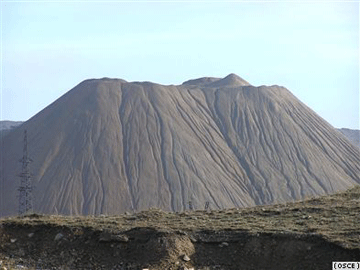
Olympic Dam uranium mine waste pile – 6720 hectares,150 metres high
 BHP’s Olympic Dam uranium mining expansion “……In all it will remove a 350-metre thick layer of overburden and the rock taken out will be transported to a rock storage facility that covers 6720 hectares and will eventually be 150 metres high. By 2050, when the mine has not even completed half its life, the pit will be 4.1 kilometres long, 3.5 kilometres wide and one kilometre deep……” – Robert Gottliebson, Climate Spectator
BHP’s uranium mine project will create a mountain of radioactive wastes
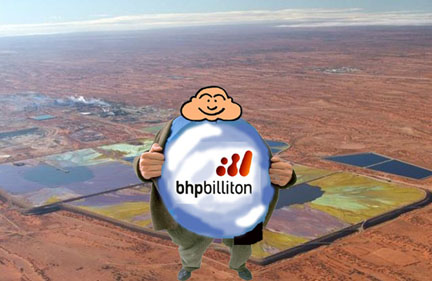
“This EIS shows the company has designed Olympic Dam to leak up to eight million litres of liquid radioactive waste per day. BHP Billiton plans to dump radioactive tailings on the surface and leave them there forever, rather than pay to isolate the toxic waste from the environment
BHP Final EIS & ACF Call to account for Olympic Dam’s international impact -BHP Billiton has released a multi-phonebook-sized environmental impact statement to support its proposal to make Olympic Dam the world’s largest uranium project, but the EIS does not address the risks that go along with Australian uranium when it is used in nuclear reactors overseas.
The Australian Conservation Foundation has challenged the company to re-do its environmental assessment to take account of disasters like Fukushima. Continue reading
BHP pushes ahead with uranium mine expansion: public will not be consulted
 Time to move beyond talking: BHP Billiton.Adelaide Now Christopher Russell May 14, 2011 THE public will be engaged, but not consulted, on the Olympic Dam expansion, BHP said yesterday. President of BHP’s uranium sector, Dean Dalla Valle, pledged yesterday to continue talking to the community but said the company had to move on to the next phase.

“The formal part is complete,” he said of public input.
Supplementary EIS released for Olympic Dam mine ABC News May 13, BHP Billiton is today releasing its supplementary environmental impact statement (EIS) for the expansion of the Olympic Dam mine. The 15,000-page draft document was handed to the state and federal governments in December.
It contains the mining giant’s response to more than 4,000 public submissions made to the company’s first EIS, released in 2009.The South Australian Government is expected to make a decision on the development later this year.http://www.abc.net.au/news/stories/2011/05/13/3215970.htm
Collapse of uranium industry affecting Cameco, BHP Billiton
 Cameco’s chief executive says “Germany’s ”weak political leadership” had prompted its decision to make an ”illogical and emotional decision to close a number of older nuclear facilities”.
BHP to feel uranium slide, Barry Fitzgerald, Sydney Morning Herald, May 9, 2011 THE partial meltdown of the Fukushima nuclear power plant in March has prompted leading uranium producer Cameco to cut its demand forecasts for the nuclear fuel. The cut has implications for BHP Billiton, which must find a home for the additional uranium it will produce with its planned $30 billion expansion of the Olympic Dam copper/uranium/gold mine in South Australia’s outback. Continue reading
Australian uranium mining shares tumble as Namibia wakes up to foreigners’ exploitation
 comments Minister of Mines and Energy Isak Katali made in parliament last week about the Namibian people deserving to benefit more from the country’s resources have set some investors’ nerves on edge.
Extract Resources shares drop onNamibia government plan, Apr 28,2011 MELBOURNE (Reuters)…http://af.reuters.com/article/investingNews/idAFJOE73R06E20110428
Namibia nationalisation anxiety knocks uranium miners TORONTO (miningweekly.com) 29 April 11, – Uranium miner Paladin Energy moved to calm investors after its shares tumbled 7,4% on the TSX over reports that Namibia’s state-owned mining company wanted to claim all uranium mining rights, as well as other “strategic” materials… Continue reading
South Australia putting all its eggs into uranium basket?
the proposed $21 billion Olympic Dam mine expansion as a future prospect……..”It is expected BHP Billiton will say yes in early 2012 despite the potential for recent developments to affect the future of Japan’s nuclear energy sector – then it would become the world’s largest mine,” the report says. “These prospects shimmer in the future.”
 State’s future in mining just became brighter, Greg Kelton , The Advertiser, April 27, 2011 SOUTH Australia will one day be “a titan of the global resource landscape” but is fighting to keep manufacturing jobs, an economic report says. Continue reading
1 This month

of the week – Australians for War Powers Reform (AWPR)
To see nuclear-related stories in greater depth and intensity
 Antinuclear