Australian govt names Whyalla, Port Pirie, South Australian Ports to impose nuclear waste shipments

Federal gov. names SA Ports to impose nuclear waste shipments Nuclear Brief (1st August 2018) by David Noonan, Independent Environment Campaigner
Amidst rising controversy, the Federal Industry Department (DIIS) has named proposed Ports in SA that may have to take shipments of irradiated nuclear fuel wastes to go on to a Federal dump site.
DIIS reports (p.179) two intended shipments of reprocessed nuclear fuel wastes into SA within the first 2 years of operations of a proposed National Radioactive Waste Management Facility (NRWMF).
A shipment of nuclear waste is due from Sellafield in UK and a shipment out of Port Kembla is planned from the ANSTO Lucas Heights reactor of nuclear waste received from France in 2015.
After years of secrecy over intended nuclear waste shipments to an SA Port, DIIS has now named Whyalla, Port Pirie, a new Eyre Peninsula commodities port (if built) and even Port Lincoln, as potential nuclear waste ports, in three “Site Characterisation, Technical Reports” released in July.
However, all of these ill-considered plans for nuclear waste ports face an array of serious obstacles
These targeted port communities are denied a say in Minister Canavan’s pending decision on siting a Federal dump in SA, they haven’t been consulted on use of their ports, and are excluded from ‘votes’ in the Hawker & Kimba districts over Aug-Sept on whether or not to locate a NRWMF in those areas.
The Federal gov. is in continued breach of advice of the Nuclear Safety Committee (NSC) to the nuclear regulator ARPANSA (Nov 2016) on the NRWMF, on transparency in decisions, and for:
“The ongoing requirement to clearly and effectively engage all stakeholders, including those along transport routes.” With the NSC stating that: “Such engagement is essential…”
Proposed indefinite above ground storage of nuclear fuel wastes compromises safety, is illegal in SA, and must not be allowed now. ARPANSA states these wastes require isolation for 10 000 years.
This was recognised by the previous SA State Liberal gov. that prohibited the import, transport, storage and disposal of nuclear fuel wastes under the Nuclear Waste Storage (Prohibition) Act 2000.
“The Objects of this Act are to protect the health, safety and welfare of the people of South Australia and to protect the environment in which they live by prohibiting the establishment of certain nuclear waste storage facilities in this State.”
The new SA State Liberal gov. under the leadership of Premier Marshall has a key responsibility to protect the public interest and to uphold the law in our State. These are fundamentally State issues.
The Howard Federal gov. targeted SA for nuclear dumping over 1998 – 2004 but had to abandon that “National Store Project” & associated shipping and transport of nuclear waste across SA.
This Federal dump plan poses reputational risks and material impacts to the Kimba & Eyre Peninsula agricultural region, to the iconic Flinders Ranges tourism region, and now to targeted Ports in SA.
Nuclear waste can pose serious Accident & Security Risks and Impacts:
“In the event of a major nuclear accident, adverse impacts on the tourism, agriculture and property sectors could potentially be profound.”
SA Nuclear Royal Commission: Tentative Findings, Risks and Challenges, Impacts on other Sectors (Feb 2016, p.28)
Key questions on safety & security in nuclear fuel waste transport and storage remain unanswered (see D Noonan submission to Senate Inquiry, p.10). Nuclear fuel wastes must not be allowed into SA
The UK Nuclear Free Local Authorities “Briefing: Nuclear security concerns – how secure is the UK civil nuclear sector?” (NFLA, May 2016) highlights key security threats including the risks from potential malicious attack on a nuclear waste transport or on a nuclear waste storage site.
NFLA (p.8) cites the views of nuclear engineer Dr John Large on safety as at the heart of its concerns:
“Movement of nuclear materials is inherently risky both in terms of severe accident and terrorist attack. Not all accident scenarios and accident severities can be foreseen; it is only possible to maintain a limited security cordon around the flask and its consignment; … terrorists are able to seek out and exploit vulnerabilities in the transport arrangements and localities on the route; and emergency planning is difficult to maintain over the entire route.”
NFLA Recommendations (p.15) call for real discussion on the aftermath of a nuclear security incident given the major emergency response issues that arise. SA is unprepared for any such consequences.
Any use of SA Ports for nuclear waste poses significant logistical & other constraints:
The DIIS “Site Characterisation, Technical Report – Wallerberdina” for a proposed Federal nuclear dump site near Hawker, Section 4.1 Transport (p.174-186), at “Proximity to Ports” (p.177) states:
“There is potential to have waste shipped from Port Kembla, NSW to key port locations such as Whyalla and Port Pirie. From here waste would either be shipped via road or rail to the site.”
Hundreds of Police were required for security at July nuclear waste shipment out of Port Kembla.
Use of Port Pirie to road would lock down the National Highway to Port Augusta with 130 tonne Nuclear Canisters on over dimension & over-mass special vehicles. To rail would require waste transfer onto national gauge alongside Port Pirie and a second transfer on to State gauge in Port Augusta, with rehabilitation of the disused Cotabena Railway (p.177 & 186), to go on to the Flinders.
Use of the Port of Whyalla to road would require upgrade of Yorkeys Crossing to bypass the Port Augusta Bridge and to try “to avoid occurrences of complete shutdown” (p.181) in Port Augusta.
The Iron Triangle cities of Whyalla, Port Augusta and Port Pirie are now openly targeted for nuclear fuel waste transport and should have a right to refuse these untenable Federal gov. nuclear plans.
Influential Port Lincoln may be able to defend itself: other Port communities shouldn’t have to do so.
The Marshall gov must protect all SA regional communities and reject a Federal nuclear dump in SA
Senator Matt Canavan wants a nuclear waste site chosen by November.
 Proposed nuclear waste facility has South Australian towns divided as locals prepare for ballot, ABC West Coast SA By Samantha Jonscher and Gary-Jon Lysaght, 3 Aug 18,
Minister Matt Canavan is a real dill: doesn’t know what he’s talking about re nuclear wastes
 Steve Dale Fight To Stop Nuclear Waste Dump In Flinders Ranges , 2 August 18, SA Canavan was also on ABC radio 891 Make sure you continue to listen to Victor Gostin. I have to re-listen but Canavan claims that the Vitrified Waste returning from France is “Low level”!
Here is Canavan talking about the Vitrified waste that returns from France
“when it comes back here the radioactivity of that material is not materially higher than the low level waste it does have a longer half life though, it will take thousands of years for that radioactivity to disappear… ” http://www.abc.net.au/…/prog…/mornings/mornings/1003697
Brett Burnard Stokes calling out just one of the lies involved in this massive bribery and deception operation led by Con Job Canavan.
In Queensland where Canavan comes from, they make nuclear medicines without making waste … and Con Job Canavan pretends that does not happen … Con Job Canavan says the waste is an essential byproduct from production of nuclear medicines.
Petition to South Australian Premier to block nuclear waste dump
 State government urged to block nuclear facility https://www.transcontinental.com.au/story/5562602/petition-pushes-for-nuclear-block/, Marco Balsamo 2 August 18 A petition calling on the state government to block the National Radioactive Waste Management Facility has attracted over 10,000 signatures.
The Australian Conservation Foundation (ACF) submitted the petition to state Member for Stuart Dan van Holst Pellekaan at a recent meeting.
The act was established to “protect the health, safety and welfare” of South Australians by prohibiting nuclear waste storage facilities in the state.
ACF Nuclear Free Campaigner Dave Sweeney urged Premier Steven Marshall to “stand up, honour and represent the state” by opposing the national facility.
“We wanted the South Australian government to know that there’s strong support and an expectation that they will respect and reflect about the existing Waste Prohibition Act,” Mr Sweeney said.
Wallerberdina Station near Hawker is one of three nominated sites for the national facility, with the other two both based in Kimba.
The selection process is coming to the pointy end, with a postal ballot commencing on August 20 to measure the community support for the three nominated sites.
Representatives from ACF, Conservation Council SA and the Adnyamathanha community attended the meeting with Mr van Holst Pellekaan.
Mr Sweeney described the sit-down as “constructive and respectful”, giving the groups an opportunity to present their concerns to the MP.
“This is being presented by the federal government as if it’s a local economic development issue, but it is Australia’s first ever purpose-built national radioactive waste dump,” he said.
“What it would receive is materials, some of which needs to be isolated and managed for 10,000 years. It is a national responsibility that has long-lasting implications that need a national approach, so we conveyed that to Dan and he understood that.
“We also conveyed our concerns about the process, how divisive it has been and how much stress it has caused on communities.”
Mr van Holst Pellekaan said he has spoken with federal Minister for Resources and Northern Australia Matt Canavan about local concerns regarding the facility.
“As a local MP, I believe it is important to meet with many people with a wide range of views on this topic and have been doing exactly that,” he said.
“I’ve had regular contact with federal Minister Canavan, have shared the opinions of our local people with him and will continue to do so.”
Mr van Holst Pellekaan confirmed the petition has been passed on to the Premier as promised at the meeting.
Is Minister Canavan lying about nuclear wastes, or is he just uninformed?
Susan Craig, Fight To Stop Nuclear Waste Dump In Flinders Ranges SA, 1 Aug 18, Mr. Canavan stated on ABC radio this morning that the radioactive waste dump proposed for South Australia was safe for both low level waste above ground storage and intermediate level waste above ground temporary storage. The ANSTO & ARPANSA report states that the low level waste be stored below the surface, however, the Federal Governments proposal is for above ground.
 surface.
 However, the intermediate level waste for South Australia will be stored in ZWILAG TN81 container, above ground which only lasts 40 years.
EXTRACT FROM INTERIM WASTE STORE OPERATING LICENCE SUMMARY SAFETY CASE FOR THE INTERIM WASTE STORE AT LHSTC
ARPANSA AND ANSTO DOCUMENT
“The Government is currently assessing the siting and construction of the NRWMF, a co-located near surface disposal repository for Low Level Waste (LLW) and an above-ground store for Intermediate Level Waste (ILW).
Joy Engelman Unfortunately Susan, nuclear waste is not safe which is exactly why the government is not keeping it at Lucas Heights but wanting to put it as far from major urban areas as possible. It will never be safe. There are so many nuclear waste facilities around the world now with huge problems, leaking canisters, isotopes becoming active in the biosphere etc etc. It is also not possible to store canisters containg the waste above ground in the temperatures experienced in the outback nor with the possibility of flooding. Not only that, the waste does contain high level waste from Australia’s propensity to try to develop weapons grade waste over the late 20th Century. Canavan needs to be properly educated about the nuclear industry before he opens his mouth and not just be another puppet.

France, USA, UK, Japan call it High Level Waste: Australia calls it Intermediate Level Waste

Steve Dale Nuclear Fuel Cycle Watch South Australia,
Funny. Spent fuel rods (which the USA and other countries would call High Level Waste (HLW)) leaves this country. Vitrified waste remnants will return one day (which the French, USA, UK, Japan would call HLW) – but at no time in Australia will this be honestly called High Level Waste.
“‘The spent fuel rods at Lucas Heights can only sensibly be treated as high level waste The pretence that spent fuel rods constitute an asset must stop” from the Research Reactor Review, Future Reactions: Report of the Research Reactor Review, 1993
Seems like the pretense at ANSTO has a longer half life than some of the isotopes they produce. https://www.facebook.com/groups/1021186047913052/
Processing of radioactive wastes at Woomera to take 5 to 10 years
 Woomera’s 10,000 nuclear waste barrels have ‘low levels’ of radiation, says CSIRO, ABC News 30 July18 Ten thousand barrels of radioactive waste stored at Woomera in South Australia’s far north have no significant levels of radiation, according to the latest assessment from Australia’s leading scientific research agency.
99% of South Australians are excluded from vote on nuclear waste dump for South Australia
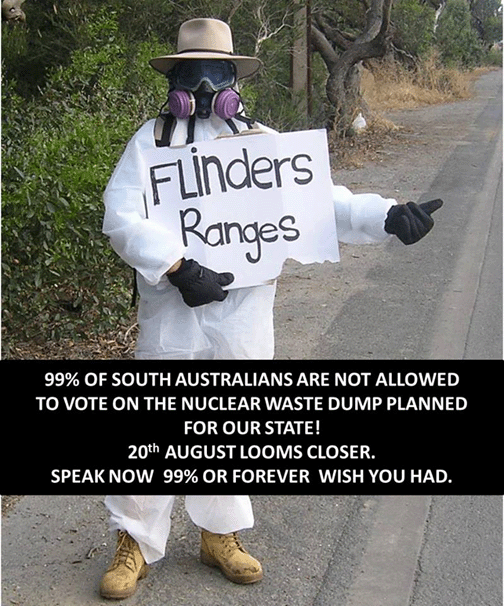
Susan Craig Fight To Stop Nuclear Waste Dump In Flinders Ranges SA, 24 July 18
• The proposed site is for an ABOVE GROUND temporary facility, stored in above ground bins, 40kms from Wilpena Pound and in our wheat farming land at Kimba.
• Both low level and INTERMEDIATE radioactive waste will be stored.
• INTERMEDIATE level is classified HIGH GRADE in France and has a half- life of TENS OF THOUSANDS OF YEARS. The containers proposed for storage only last for a few hundred years.
• ANSTO have the capacity (500 hectares) and the expertise to continue storage at Lucas Heights for another three decades.
• We should use this time to prepare a PERMANENT UNDERGROUND intelligent and cohesive solution to Australia’s burgeoning nuclear waste.
• Not just move it from one site to another.
• Mr. Canavan said and I quote: “It’s perfectly safe”. So why move it?
• ANSTO currently store 10 tonne of intermediate level nuclear waste at Lucas Heights NSW.
• Another similar quantity of intermediate level nuclear waste is arriving from Britain in a few years and proposed for South Australia.
• Current nuclear medicine using isotopes can be replaced with new technology using Cyclotrons which have a half-life of just hours rendering the waste benign. Awesome!
• Many countries around the world are moving to Cyclotrons for nuclear medicine and Australia should investigate this!
*ANSTO are developing a nuclear waste storage system called SYNROC it’s a synthetic casing for nuclear waste. However, this will only be used at LUCAS HEIGHTS and there is no intention of using SYNROC for the storage of nuclear waste proposed for South Australia.
The Federal Government is showing total disregard, disrespect and contempt for the people of South Australia, including the Adnyamathanha community of the Flinders Ranges. https://www.facebook.com/groups/344452605899556/
Nuclear reactor’s costly processes for medical isotopes: cyclotron production clean and cheaper
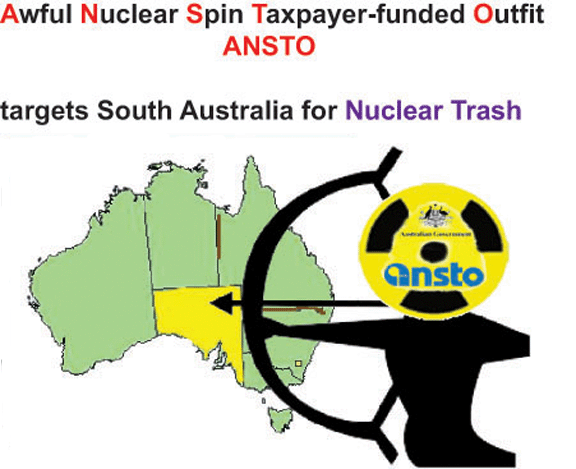 Steve Dale Fight To Stop Nuclear Waste Dump In Flinders Ranges SA 28 July 18 ANSTO ships most of its isotopes overseas, yet Australia has to deal with 100% of the large amount of waste produced from its messy isotope process.
PET/cyclotron isotopes give better imaging and no waste. If ANSTO was truly a commercial company and had to pay the true cost of its waste it would go broke immediately. https://www.facebook.com/groups/344452605899556/
Federal nuclear waste dump will have large storage for intermediate to high grade storage
The $31 million bribe to entice Hawker to become a nuclear waste sacrifice zone
 $31 million boost for nuclear location, The Transcontinental, Marco Balsamo -23 July 18 The Flinders Ranges community could receive up to $31 million through a Community Development Package if the Wallerberdina Station site is chosen to host the National Radioactive Waste Management Facility.
Initially touted to be about $10M, federal government has more than tripled the package to be awarded to the selected community.
“This enhanced package will ensure the successful community is ready and able to take advantage of the benefits of hosting this facility both during construction and the lifetime of its operation,” he said.
“What shipbuilding or aircraft bases do for some communities, and steel-making or mining does for other towns, the National Radioactive Waste Management Facility will do for its host town in terms of employment, opportunities for new careers in trades and university qualified positions and flow-on benefits.”
The package includes a $20M National Radioactive Waste Management Facility Community Fund, delivering infrastructure and development benefits to the community………
The announcement from federal government has been slammed by Australian Greens Senator Sarah Hanson-Young, who recently visited the Wallerberdina Station site.
“Resources Minister Matt Canavan should be ashamed of himself for trying to bribe the community in return for dumping radioactive waste on them,” Ms Hanson-Young said.
“Putting money on the table, just weeks before the Kimba and Hawker communities vote on whether they want a nuclear waste dump in their front yard smacks of desperation and bribery.
“Polling shows the majority of South Australians want our state to put a stop to this project. Nuclear waste is not welcome in Kimba or the Flinders Ranges, and the rest of the state is behind these two communities in their fight against this proposal.”
Ms Hanson-Young also questioned why the Liberal government has not revealed how much profit former Liberal Senator Grant Chapman, who owns the Wallerberdina Station site, would earn from a successful bid.
The Wallerberdina Station site is one of three nominated locations for the national facility, with the other two both based in Kimba.
A postal ballot is set to commence on August 20 to measure the community support for the three nominated sites.
Federal Member for Grey Rowan Ramsey said the successful community would have the opportunity to “create a long-term future for itself”.
“Now, coupled with the commitment of a minimum 45 jobs on site, it will really give the citizens of both communities something to contemplate before next month’s vote,” Mr Ramsey said.
“This facility will provide wonderful opportunities for either community if selected.” https://www.transcontinental.com.au/story/5540993/31-million-boost-for-nuclear-location/
Facts On How Holtec Spent Nuclear Fuel Canisters Are Substandard And Should Not Be Used, Parked, Or Buried Anywhere – Comment By July 30th, 11:59 PM ET — Mining Awareness +

Comment By Jul 30 2018, at 11:59 PM ET, ID: NRC-2018-0052-0058 on Holtec’s spent nuclear fuel facility in New Mexico: https://www.regulations.gov/docket?D=NRC-2018-0052 Documents here: https://www.nrc.gov/waste/spent-fuel-storage/cis/hi/hi-app-docs.html The Holtec spent fuel casks are huge, as can be seen in the photo below, but only one half (1/2) inch thick. And, yet, Kris Pal Singh’s Holtec spent fuel canister-casks […]
The Holtec spent fuel casks are huge, as can be seen in the photo below, but only one half (1/2) inch thick. And, yet, Kris Pal Singh’s Holtec spent fuel canister-casks lack the continuous monitoring of pressure, temperature and radiation which its thicker German competitor CASTOR has. Holtec’s canisters are welded shut and lack removable lids, so that spent nuclear fuel cannot be checked or removed without destruction of the canister.Welded shut and with no monitoring systems, India born and raised Kris Singh’s Holtec and France’s Areva spent fuel canisters stand in stark contrast to the German CASTOR which have two removable lids and where a “pressure sensor continuously measures pressure in the gap between the primary and secondary lid“, and the “system is wired to [the] Main Dosimetry Control Room“. There is a temperature sensor for continuous surface temperature monitoring, too. See “Operational Experience of Castor 440/84 Casks in Dukovany NPP” by Stanislav Kuba, 14th International Symposium on the Packaging and Paper # 022 Transportation of Radioactive Materials (PATRAM 2004), Berlin, Germany, September 20-24, 2004. http://www.iaea.org/inis/collection/NCLCollectionStore/_Public/37/088/37088667.pdf
As explained, below, not only is Holtec NOT the best standard available, but it fails to follow the requirements of the US Nuclear Waste Technical Review Board – that is, it is substandard (below the NWTRB standard, as well as below any common sense standard).
Waste dump for Kimba- nuclear bonanza or nuclear sacrifice zone?
Coalition’s Kimba nuclear dump exploits local area and puts nation at risk https://independentaustralia.net/politics/politics-display/coalitions-kimba-nuclear-dump-exploits-local-area-and-puts-nation-at-risk,11717 Noel Wauchope 23 July 2018,
How is a small rural town to cope with a proposition that may transform the community by providing an economic boon or be a long-term curse?
This is the dilemma facing the towns of Kimba and Hawker, both in the Eyre Peninsula, South Australia.
Individual landowners offered their land to the Turnbull Government for a radioactive waste storage site and the Government’s National RadioactiveWaste Management Facility (NRWMF) team swung into action.
There’s quite a hurry on, about this. Resources Minister Matt Canavan announced that, on 20 August, there will be a local ballot to gauge community support for a nuclear waste dump.
Following that, said Canavan:
“The decision will be made in the second half of this year … We do not want this overlapping with a Federal election.”
Much can be said about this plan, not least that it contravenes South Australian law. One might ask, too, why the inquiry stipulates South Australia when the waste to be stored would have to travel 1,700 km from the Lucas Heights nuclear reactor in Sydney? However, the most notable immediate ramifications concern its impact on Eyre Peninsula rural communities.
As one local resident put it:
‘Stress levels are through the roof for a lot of people within our communities. People are getting sick, and some are just sick and tired of hearing about it, with many wanting the dump to just go away!’
And in the words of another resident:
‘Before a nuclear waste dump came into our lives, people enjoyed cultural activities together … Today it isn’t like that, a once close family ruined and torn apart all because of a proposed nuclear waste dump that could be put on Adnyamathanha traditional lands, which will destroy our culture and … cause cultural genocide.’
Community division is obvious when one reads the submissions that local and Eyre Peninsula residents have sent to a Senate Committee of Inquiry. The Inquiry called for submissions, stipulating fairly narrow Terms of Reference (TOR), about the ‘Selection process for a national radioactive waste management facility in South Australia’.
Among the 40 supporters of the plan, most are local residents, enthusiastic about hosting the waste dump.
Repeatedly, their submissions include phrases like ‘no negative impacts’ and ‘comfortable and satisfied with the prospect of hosting the proposed nuclear waste facility’
Numbers below in brackets refer to the submission numbers listed on the Senate website.
John Hennessy( No 7), is “bubbling with enthusiasm” for nuclear waste dump in Hawker. “Hawker has “ a once in a lifetime opportunity”
Jessica Morgan, (no.37) ” I have stood [at ANSTO] next to and touched the canister containing the intermediate level waste with my 9 month old baby in a carrier on my chest, feeling totally confident of my own safety and that of my child.”
Annie Clements, (No 35) – happy to see nuclear waste dump “powering Kimba community into the future”.
And here we come to another aspect of their support for the waste dump plan. It’s not just that Kimba might be “powered into the future”. It’s the thought that Kimba might not have a future unless it hosts the dump.
Again and again this argument appears in the pro nuclear submissions:
This repository would ensure our towns survival – Ian Carpenter.( No 3 )
Kimba is struggling, population is declining,… we are in need of a life line …. The possibilities this facility could provide a small failing community is endless – Jodie Joyce (No 33)
this project will ensure the long term viability of this small country town – Janice McInnis, ( No 4 )
it will save Kimba ” for many more generations to come– Melanie Orman (No 77)
A third, much repeated, theme in these submissions is that this matter concerns only the local community.
This is frequently expressed with the dismissal of the opinions of people outside the immediate area and also, at times, with downright hostility to those who oppose the dump:
‘People outside our area could be influenced by anti-nuclear scare campaigns and wild allegations that have no relevance to this facility.’ ~ Annie Clements (35)
‘Activists and politicians who have been using [this] project as a vehicle for their anti-nuclear stance should not be entitled to any say …’ ~ Heather Baldock (64)
Outsiders do not care if Hawker dies a slow death due to lack of employment etc – Chelsea Haywood (No. 2)
‘We disagree that we need “broader community views” and the need to stretch the boundaries outside of our District Council. What is happening in our Community is exactly that: our community.’ As residents of Kimba for the last 43 years, plus ++ We see no reason that the rest of SA has a right to tell us what we can and can’t have. It is our back yard, not theirs. ….. . It’s a shame we have to have this inquiry. ~ Margaret and Charlie Milton (34)
These three themes – enthusiasm for the project, distrust of critics, and resistance to the involvement of outsiders, merge into a kind of strong local patriotism allied to trusting loyalty to the federal government, which has run a huge informational campaign in the towns.
As to the 58 submissions opposing the plan, at least half come from residents of the Eyre Peninsula. As with the rest of the opponents, they do express a variety of arguments, but local submissions are most often concerned with the local area.
Above all, they are dissatisfied with the community consultation process, and the lack of clarity about what is meant by “broad community support”. They want the wider community, Eyre Peninsula, South Australia, to be consulted, and, indeed they see the federal nuclear waste facility as a national issue. They also do not believe that the project has Indigenous support.
Readers of all 98 submissions can’t fail to notice that, on the whole, these 55 opposing ones have more comprehensive, detailed, and referenced writing, as compared with the pro nuclear ones. And this is certainly true of the very thoughtful and measured arguments of the farmers from the local areas concerned.
These raise some issues which are rarely mentioned on the pro-nuclear side:
- concern about co-location of low and intermediate level wastes, especially the prospect of stranded “temporary” wastes, with no plan for final disposal;
- transport dangers;
- seismic and flood dangers;
- impacts on agricultural markets and tourism; and
- the fear that this waste dump would lead to a full-scale commercial importation of nuclear waste.
Kay Fels, a Flinders Ranges farmer.(No 63) ‘s submission is representative of the concerns of many others:
our stock (sheep and cattle) may also be stigmatised by the proximity of the waste dump and our organic status compromised Agriculture and tourist industries will be jeopardised as the clean, green image of the Flinders Ranges is tarnished . The sites are located in an area where the underground water table is almost at surface level. This could lead to contamination of the underground water source, so vital to the region. The location is also on a piedmont plain and prone to flooding
Given that the proposal is to store low level waste in an above ground facility, and temporarily store intermediate waste in that same facility, it seems ludicrous that this is even considered given the geological and environmental features and risks involved.
The consultation phase was a tokenism with ANSTO telling us what will be happening, how safe it is and pushing the affirmative – not a true reflection of the community’s views and concerns. The consultative committee is a rubber stamp
Many are strongly sceptical of the consultations held by the Department of Industry Innovation and Science (DIIS), and of the information campaign by Australian Nuclear Science and Technology Organisation (ANSTO) . There is strong criticism of the nomination of Wallerberdina property by non-resident former Liberal Senator Grant Chapman, with close links to the nuclear industry. They also claim hypocrisy of DIIS in biased and misleading information, and dismissal and indeed, exclusion of critics.
‘
I am not against having a LLW facility in Australia. I am against the way in which DIIS have gone about finding a quick fix for something that will affect all South Australians for centuries to come. It should not be up to a small council area to overrule our Prohibition Act 2000, if we are to vote for something of such national importance.” My problem is a complete lack of trust with DIIS in the way in which they have treated ordinary people from Quorn, Hawker and Kimba – Leon Ashton (No 73)
there are far too many discrepancies in the information, consultation process and long term impacts to have such a facility based at Kimba (or Hawker). the consultation process has been an insult to the intelligence of rural people. – Leanne Lienert (No. 50)
Sue Tulloch (no 32) makes a scathing criticism of the federal nuclear waste dump process and “shambolic “Barndioota Consultative Committee.
Aboriginal voices are passionate, at the same time as providing factual information and references:
The Senate took a long time to publish this one – perhaps because they recognised it as the most important one? Regina McKenzie (No 107) , a very well informed traditional indigenous owner of the selected are at Barndioota, focuses on the cultural heritage rights and interests of identified traditional owners and the State/Federal obligations regarding those rights. The Department of Industry, Innovation and Science (DIIS) has ignored Australia’s commitment to United Nations Declaration on the Rights of Indigenous Peoples. DIIS has poorly assessed Aboriginal cultural heritage, and engaged inappropriate consultants. –
In this article, I have avoided the wider arguments expressed in the submissions, including the ones from organisations on both sides of the argument. Through studying 98 submissions, I have tried to get to the feelings of the communities involved – to what it must be like, to be part of a community caught in this dilemma.
Our biggest worry of this process is the detrimental effect it will have and is already having on the local community as a whole. Along with my family we have never seen an event in this area cause so much angst and division in a once very proud close knit community which was the envy of many other communities. – Philip Fels (No 84)
The mental health and well-being of communities is completely ignored in this process and this is a serious issue that needs to be addressed in future frameworks and guidelines. This process makes communities feel powerless – no support is given to those with opposing views, it is a process that is heavily favoured towards those pro-nuclear and when the rules keep changing to suit those in favour it really gives people a sense of hopelessness. Chloe Hannan, Kimba : (No. 61)
As an outsider, I can’t really gauge this social situation. But, whatever the outcome of the federal government’s plan, Kimba and Hawker communities will never be quite the same again
Kimba’s nuclear waste dump is planned to facilitate DOUBLING of nuclear wastes in Australia
 The Department has provided some updated info on estimated Intermediate Level Waste (ILW) volumes – set to double – and on the claimed period of proposed operations of the above ground ILW Store.
Scotland could help Australia deal with its nuclear waste
As Gary Cushway points out, under current arrangements, the waste produced in the reprocessing of spent Australian nuclear fuel which was sent to Dounreay in the 1990s will stay at Dounreay; the vitrified waste produced at Sellafield is only being sent to Australia to fulfil a contractual agreement. If the transfer from Sellafield was halted, and the waste currently stored at different locations in Australia was kept where it is, the case for a national radioactive waste management facility in Australia would be drastically eroded.
Cushway believes that the Scottish Government could cancel the 2012 joint waste substitution policy and come to an arrangement with the Australian Nuclear Science and Technology Organisation (ANSTO) regarding management of the reprocessed Australian waste at Dounreay.
At the very least, more pressure should be put on the UK Government to stop the transfer of waste until its final destination is known.
Can Scotland help stop nuclear waste being dumped on Aboriginal land? At the very least, more pressure should be put on the UK Government to stop the transfer of waste until its final destination is known. Scots are yet to fully reckonwith the role that we played in the brutal colonisation of Aboriginal Australia, but the Scottish Government now has an opportunity to offer meaningful solidarity to Aboriginal communities who are still fighting to protect their land and culture.
Linda Pearson @Pearson_LM Linda Pearson, anti-nukes activist and Common Weal policy officer, explains how nuclear waste due to be transferred from the UK to Australia could be dumped on Aboriginal land, and what role the Scottish Government could play in preventing another act of racist disregard of Australia’s indigenous population in what is a long and brutal history of discrimination
APPROXIMATELY 10,000 miles from Scotland in South Australia, Aboriginal traditional owners are fighting against plans to build a nuclear waste dump on their land. It is the latest phase in a struggle to protect land and culture which has lasted over 20 years. Continue reading
1 This month
7 April – WEBINAR – Australia and the Doomsday Clock – Preventing nuclear war through NoFirstUse and other policies
Online | Tuesday April 7, 4:00-5:30pm, Australian Eastern Time / 8:00-9:30am Central Europe Time
– Access the registration link
15 April – Zoom –Nuclear Power is Not the Solution
Apr 15, 2026 01:00 AM in Canberra, Melbourne, Sydney

Join the International Physicians for the Prevention of Nuclear War (IPPNW) on Tuesday, April 14th for a timely webinar exploring the risks associated with nuclear power and challenging the myth that it offers a simple, safe, carbon-free solution to the climate crisis

21 April Webinar: No Nuclear Weapons in Australia
Start: 2026-04-21 18:00:00 UTC Canberra, Melbourne, Sydney (GMT+10:00)
End: 2026-04-21 19:30:00 UTC Canberra, Melbourne, Sydney (GMT+10:00)
Event Type: Virtual
A virtual link will be communicated before the event.
Host Contact Info: australia@icanw.org

of the week – Australians for War Powers Reform (AWPR)
To see nuclear-related stories in greater depth and intensity
 Antinuclear