Taxpayers pay up for Kimba and Hawker residents to be “nuclear-educated” at Lucas Heights
 $350k of flights to get nuclear reactions
Taxpayers have coughed up nearly $350,000 to fly 225 Kimba and Hawker residents to Sydney to learn about nuclear waste, new figures reveal…(subscribers only)
https://www.adelaidenow.com.au/news/south-australia/federal-government-flies-225-country-residents-to-sydney-to-learn-about-nuclear-waste-ahead-of-august-20-ballot/news-story/432c509816a37f2918c6b7dd7ac85d9c
— Nuclear waste debate soars to nearly $350,000 in tax-payer funded trips – the Australian (subscribers only)
Planned nuclear dump sites – Access denied to Barngarla Native Title Representative Body.
 Everybody For A NUclear Free Future, 14 July 18, After claiming there was no aboriginal heritage issues at the proposed Kimba suppositories, DIIS denies entry to Barngarla Native Title Representative Body.
“We wrote to the department on 21 February requesting access for sites, for the purposes of that assessment being carried out, and advising that the DAC would contact the department after that assessment had been complete for the purpose of working a way forward for these consultation processes. The department advised that they couldn’t provide access to the sites. You’ve been provided a redacted version of the report. The material that was provided following our initial submissions—I think that was only provided to you in the last few days—is somewhat compromised, but it has identified that there are nine confirmed sites and nine potential sites that are affected.
As part of that assessment team, which included some of the DAC board members here. Mr Brandon McNamara, who’s a Barngarla elder, invited the department to come along to a board meeting on 3 March and that invitation was declined. There were also statements made to the assessment team that the engagement of Dr Gorring to carry out the assessment was premature, which we find quite surprising. If the department has already issued statements that there’s no heritage and not provided information about what heritage assessments of its own it has made, to then make a comment that for Barngarla to carry out its own heritage assessments was premature is a bit surprising.”
ENuFF[SA]
Office Admin
https://www.facebook.com/sanuclearfree/
Advancing responsible radioactive waste management in Australia.
 Australian Conservation Foundation (ACF Briefing note: March 2018
Overview:
Radioactive waste management in Australia has been a contested, divisive and ultimately non-productive area of public policy for decades. The timing and circumstances are now conducive for adopting a revised approach that is more likely to advance responsible national radioactive waste management and agreed and lasting outcomes.
This approach to responsible radioactive waste management in Australia is founded on not imposing any federal facility on an unwilling community, acting in a manner consistent with both existing state and territory laws and leading international industry practise and ensuring high standards of extended federal interim storage at the two secured sites where the majority of the waste is sited pending an inclusive and robust examination of the range of long term future management options.
Scale and current context:
Australia holds around 4250 cubic metres of low level radioactive waste and 655 cubic metres of longlived intermediate level waste. Around 95% of this material is currently stored at two secured Federal sites. Nearly all of Australia’s intermediate level waste is held where it was created at the Australian Nuclear Science and Technology Organisation’s (ANSTO) Lucas Heights nuclear reactor facility in southern Sydney. This material is Australia’s highest level radioactive waste and is the most significant management challenge. Most of the low-level waste is at the Defence Department’s Woomera site in South Australia.
The National Radioactive Waste Management Project:
The current preferred federal plan involves the emplacement and covering of containerised low-level radioactive wastes and the above ground storage of long lived higher level waste at a single regional or remote site. There is no intention to recover the low-level material – it would be disposed of in-situ.
There are plans to remove the higher-level waste for deep geological disposal at a location yet to be determined after a period of between 20 to 100 years. The current approach to intermediate level waste management is not best international practice. Instead it is based on unnecessary transport and doublehandling and replacing above ground interim storage at ANSTO for above ground interim storage at a far less resourced regional facility.
Since April 2016 South Australia has been the only region under active consideration as a site for a federal radioactive waste facility. Three sites, one at Barndioota in the Flinders Ranges and two near Kimba on the Eyre Peninsula, are under consideration. All sites are contested and there is considerable Aboriginal and wider community concern, opposition and division. Existing SA legislation, the Nuclear Waste Facility (Prohibition) Act 2000, makes the federal plan unlawful in SA. While the federal government could override any state legislative road-blocks doing so would be inconsistent with leading practise for facility siting and open to clear procedural and legal challenge.
The employment and economic opportunities provided by the federal radioactive waste plan are modest. There would be some short-term fencing and construction work and there are plans for twelve to fifteen (fte) security and maintenance jobs, an interim ‘disruption’ payment of two million dollars for community programs in the affected regions and a ‘community benefit fund’ of no more than ten million dollars (with no clear guidance on where, when or how the federal government would allocate this money).
Previous federal attempts over many years to impose a radioactive waste dump on multiple sites in regional South Australia and the Northern Territory have all failed.
The case for a revised approach: Extended interim storage and option assessment:
Leading civil society organisations including environment, public health, Indigenous and trade union groups all support an expert, open and independent Inquiry into the full range of radioactive waste management options.
Radioactive waste remains a concern for thousands of years and its management demands the highest quality decision making and information. Enhanced and extended interim storage at current federal facilities offers a policy circuit-breaker and, coupled with an options review, is the best way to identify and advance lasting and responsible radioactive waste management.
Extended interim storage, particularly at Lucas Heights given this site is already home to the most problematic wastes, is prudent and credible as:
ANSTO is already both the continuing producer of and home to virtually all of Australia’s higher level radioactive waste
ANSTO has certainty of tenure, a secure perimeter and is monitored 24/7 by Australian federal police
Storing the waste at ANSTO means the waste will be actively managed as operations at the site are licensed for a further three decades. It also keeps waste management on the radar of the facility/people with the highest level of nuclear expertise and radiation response capacity in Australia
After community opposition and Federal Court action ended an earlier proposed waste site at Muckaty (NT) ANSTO constructed and commissioned a new purpose built on site store dedicated to housing reprocessed spent nuclear fuel waste which returned from France in late 2015. This Interim Waste Store has a conservative design life of forty years, its license is not time limited and it has (if required) regulatory approval to store these reprocessed wastes ‘until the availability of a final disposal option’.
Extended interim storage at ANSTO helps reduce any political pressure to rush to find a ‘remote’ out of sight, out of mind dump site and increases the chances of advancing responsible management
Storage at ANSTO has been previously identified as a credible and feasible option by ANSTO, nuclear industry lobby group the Australian Nuclear Association and, most importantly, the federal nuclear regulator, the Australian Radiation and Nuclear Safety Agency (ARPANSA).
There is no regulatory or radiological impediment to extended interim storage at Lucas Heights. ANSTO’s facility is prohibited from becoming a permanent disposal site, however there are no comparable constraints on it as a site for extended storage.
Importantly, this approach also provides the ability to have a circuit breaker in this long running issue in the form of an evidence based and open review of the best long-term management options.
Nothing about the nuclear industry, especially nuclear waste, is clean or uncomplicated but extended interim federal storage – coupled with a wider robust public review of the full range of longer term management options – is the approach that is most likely to advance and realise lasting and responsible radioactive waste management in Australia.
Heather Baldock’s sycophantic submission supporting nuclear waste dump for Kimba

Heather Baldock (Submission No 64) to Senate Standing Committee on Economics Re – Appropriateness and thoroughness of the site selection process for a National Radioactive Waste Management Facility at Kimba
As a long term local farmer of the Kimba district who has been very active in many local and regional community organisations, I am very excited by the opportunities that hosting the National radioactive low level disposal and intermediate storage facility would bring to our area. I was born here and have raised my family in this community, and I have family still living in the Kimba District including grandchildren.
I wish to address the Terms of Reference for this inquiry and am happy for this submission to be made public.
A) The financial compensation offered to applicants for the acquisition of land under the Nominations of Land Guidelines:
The financial compensation for the acquisition of land to be paid to the landowner, who voluntarily nominated property, is reasonable and a long way from excessive.
Calculations suggest that 4 x the land value for 100 hectares would be equivalent to about 10 years of farm production on that amount of land. So after 10 years the landowners would be losing out with this arrangement. For the two Kimba landowners it would not even cover their input costs for one cropping season.
There is also the intrusion of media and people from far and wide, not always in a friendly manner.
This underlines the fact that the landowners nominated their land, not for personal gain, rather as an opportunity for our community to diversify and increase employment in our low rainfall marginal farming area which is experiencing ongoing population decline.
B) How the need for ‘broad community support’ has played and will continue to play a part in the process, including;
a. The definition of ‘broad community support’ and b. How ‘broad community support’ has been or will be determined for each process advancement stage; a) I believe ‘broad community support’ is the majority (more than 50%) of the Kimba District supportive of hosting the National Facility, supplemented by the support of the majority of immediate neighbours to the proposed sites. Having said that, there is no precedent for broad community support for other ventures (business, exploration, social, tourism, mining etc) on private land.
b) To move to Phase 3 of the project there is the intention of holding another Electoral Commission managed vote for Kimba district residents. The vote to move to Phase 2 was arranged by the Kimba District Council at the request of Kimba people. The District Council extensively advertised the opportunity for locals who had vested interests and not enrolled to vote in Kimba council elections to apply to be included on the ‘CEO’s roll’. I would expect this option to apply for any future vote re the Waste Facility
An interesting point about the level of scrutiny that this particular land use has attracted is that there is no practice in our district of neighbours advising neighbours of, or of seeking their agreement to, any permanent or semipermanent changes in land use, infrastructure, commodities, farm practices, or moves to sell or lease land.
I don’t believe there is call for organisations, politicians, or individuals, or others outside of our district who don’t contribute to our local social and economic viability being considered in the ‘broad community support’.
- how any need for Indigenous support has played and will continue to play a part in the process, including how Indigenous support has been or will be determined for each process advancement stage;
While we have no Indigenous groups active in the Kimba district I am aware that the Department of Industry, Innovation and Science (DIIS) has been liaising with the Barngarla people and that leaders visited the localities of the two Kimba sites in March this year. I have not heard of any issues resulting from this visit.
- whether and/or how the Government’s ‘community benefit program’ payments affect broad community and Indigenous community sentiment;
I strongly doubt that the Government’s Community Benefit Fund of $2million on moving to Phase 2 has influenced many people in their views. People publicly opposed, supportive, or keeping their own counsel, have seemed very keen to utilise the funding opportunity to support unprecedented social and economic benefits to our small rural community. The infrastructure and projects submitted to this Fund will be such that locals & visitors to Kimba will benefit. Many of these projects will also leverage employment opportunities when the successful projects are implemented.
I believe that people are only supportive of the NRWMF project if they feel firstly that the Facility poses no harm to their family’s and the district resident’s health or the environmental health of our region.
The economic and social benefits are secondary, albeit very attractive to have such benefits to our small declining community, heavily reliant on agriculture in a low rainfall area. The minimum $10million Community Capital Contribution, and other infrastructure and services that will be required as part of the project, will have influenced people’s consideration of the project. The NRWMF project provides a unique opportunity for our community to diversify its industry base, secure additional employment and services that the Government will need to provide in support of the Facility. Many in our community see this opportunity as very attractive and very supportive of the town’s long term sustainability.
There should be such benefits to any community prepared to make an informed decision to host a National Facility.
E) whether wider (Eyre Peninsula or state-wide) community views should be taken into consideration and, if so, how this is occurring or should be occurring;
The Kimba community has dedicated many months towards becoming informed about many aspects of the proposed Waste Facility. The wider Eyre Peninsula and even the state of SA have not had the same opportunities to become so learned. Therefore the community outside of Kimba is not in a position to make an informed decision as to whether Kimba should host a Facility.
Also the facility will have no impact on the wellbeing or lifestyles of wider communities. Kimba hosting a Facility would have no detrimental impacts on businesses in wider communities although it may be advantageous to some contractors outside of Kimba in the construction phase of a Facility.
Activists and politicians who have been using the NRWMF project as a vehicle for their anti-nuclear stance should not be entitled to any say in the vote of whether Kimba moves to Phase 3.
F) any other related matters.
The whole process from the time of the Federal Government advertising the opportunity for landowners to nominate land in early 2015 to now has been thorough with numerous chances for locals to become highly informed of the process, the opportunities, the science and the impacts.
We have had numerous experts, scientists, people who work in the industry, including speakers opposed, visit Kimba to support our information gathering. The Department of Industry, Innovation & Science (DIIS) regularly updates the community on progress via newsletters & Facebook. Locals have been encouraged to visit Lucas Height to further increase their understanding of the project. The DIIS has staffed an office and employed a local as the Community Liaison Officer for many months allowing easy face-to-face access to gain more information and have queries responded to. The Kimba community has become highly informed about the NRWMF project.
Prior to moving to Phase 2 of the Project to learn more about the proposed Facility and enable site characterisation to occur, we had a Kimba community vote instigated by the District Council of Kimba and managed by the Electoral Commission. This democratic process showed the very clear majority of 57.4% of the Kimba district in favour of moving to Phase 2. Politicians would be extremely pleased to gain that level of support in an election or any referendum they were supporting.
Since Kimba moved to Phase 2 the Australian Radiation Protection and Nuclear Safety Agency (ARPANSA) has made 2 visits to Kimba. I have found meeting with them and reading their fact sheets to have been very enlightening and reassuring that we have an independent body as Australia’s highest authority on radiation protection and nuclear safety.
In conclusion I believe that the site selection process has been appropriate and very thorough in the Kimba community with all people able to gain considerable knowledge about many aspects of the NRWMF project and have any concerns addressed if they choose to engage in the process
Hawker Community Development Board a staunch supporter of nuclear waste dump proposal
 Hawker Community Development Board Inc (Submission No. 47) to Senate Committe re Selection Process for Nuclear Waste Dump (Subnission No.47) Chairperson Janice McInnis Secretary Chelsea Haywood Treasurer Evelyn de Jong
The Hawker Community Development Board (HCDB) is a community representative organisation that aims to promote the town of Hawker and the surrounding district encouraging tourism, progress and the preservation of items relating to the physical, social and cultural heritage of South Australia. Also acting as a conduit to the local Council and Government Agencies The following is the HCDB response to the Waste Management Facility inquiry
a) The financial compensation offered to applicants for the acquisition of land under the Nominations of Land Guidelines
Regardless of where the repository is to be built it is only fair that the land owner been compensated accordingly for the land that is taken to be used. It is no different to a person receiving compensation, so a highway can be widened, or an over pass built on what was their property .
b) how the need for ‘broad community support’ has played and will continue to play a part in the process, including:
- the definition of ‘broad community support Broad community support means that most residents in the area considered the community are supportive of the project proceeding. The area considered community is not the entire state of South Australia nor the entire Country. This is a decision to be based on those that will be impacted the most if the facility does or doesn’t go ahead
- ii) how ‘broad community support’ has been or will be determined for each process advancement stage:
Moving forward onto the next stage will mean another community district vote will occur. The best way to truly ascertain the community support is to hold the vote with the electoral commission, this would allow residents in the area to vote without fear of recourse while ensuring it is the actual community voting and not outsiders
- how any need for indigenous support has played and will continue to play a part in the process, including how indigenous support has been or will be determined for each process advancement stage:
The HCDB has been informed that the indigenous community hold a broad community support for the project and can see the potential benefits the project holds for them should the project proceed. However, we believe that this is something best discussed by the government agencies responsible for the project with all the local indigenous in the community area as opposed to a select few
D) whether and/or how the Government community benefit program payments affect broad community and Indigenous community sentiment.
To date with round 1 of the program nearing full completion there has been no change in the people’s sentiment toward the proposal. Community groups both for and against applied for grants and succeeded however this has not swayed anyone’s decision to jump the ‘fence’. In round 2 once again people for and against have applied for grants but as the money is yet to be allocated we cannot judge the outcome at this stage.
Consensus among the community is that the community benefit program has assisted in the district getting some needed projects completed that may not otherwise occur.
It has always been publicised that the funds are being offered as a form of compensation to the area for any disruption that has occurred and may occur in the future while Barndioota is still being considered.
E) whether wider (Eyre Peninsula or state-wide) community views should be taken into consideration and, if so, how this is occurring or should be occurring;
At the end of the day the only people that will be truly affected by the repository going ahead or not is those local to the areas in question. State-wide are more concerned about the state government piggy backing off the Federal facility and bringing in high level waste (this has been publicised numerous times as not being able to occur) People in other areas will also not see their employment levels change, new residents moving into bringing families, more school teachers employed, and more hospital staff and so on. We are the ones that have looked at the potential benefits and negativity that the proposal brings and have chosen to support the proposal. State-wide lives will to continue as they currently are regardless of the facility occurring, whereas our lives have the potential to be enhanced.
Anything Else Our small country town that has been dwindling for years has the potential to harness this project and grow into the future. Those that have complained about the selection process seem to have forgotten that over 360 properties had been originally nominated and to have offered the idea as a potential life saver for the district so early in the process may have caused more heartache and problems than necessary. Our neighbours do not have to tell us if they are going to sell their house or rent it out to someone, so we fail to see how this is any different
Christine Scott rejects nuclear waste dump proposal – it’s against South Australian law, and will damage agricultural industry
 Christine Scott Submission No 14 Subject: Senate enquiry into site selection process for a national radioactive waste storage facility
To whom it may concern, I am writing this letter as a concerned member of the Kimba community. I reside in the township of Kimba and have a son, his wife and three young children living and working on the farm which has been in our family for over 100 years, and which is situated approx 17kms from our town centre.
In the 50 years I have resided in the Kimba district (coming here as a teacher in 1968) I have never before witnessed such a divided and hurting community. Before the selection process began I would have described our community as united and supportive of each other and the local businesses. Now many farmers are looking to buy their merchandise only from businesses that support their viewpoint on whether or not there should be a nuclear waste dump in Kimba, even preferring to shop out of town for farm goods, food and groceries than give their financial support to people who they feel have betrayed them and the whole agricultural export industry on which the existence of this town depends.
Resentment runs high towards those farmers who “volunteered” their land for the dump, when that “volunteering” comes with an incentive of 3 times the value of their land plus the original value. From my understanding a volunteer is someone who gives of their time, services or possessions for free, but these farmers are seen to be benefiting at the disadvantage of others.
I strongly reject the presumption implied by the Government that one, or in Kimba’s case two individuals have the right to decide that: –
(a) A nuclear dump can be placed in a grain growing area relying on export markets for its existence.
(b) Can ignore their own State Law prohibiting such a dump.
The present government, would no doubt argue that it is not just two individuals offering their land.They would say that 56.7% of the community are in favour as a result of a local council vote and thatthis shows “broad” community support for the nuclear dump to be placed in agricultural land.That 56.7% is considered to be broad community support is puzzling when 65% support was required at Hawker.
What is the figure representing broad community support? Surely when you are considering intermediate waste with a life of up to 1000 years, meaning that it could affect many, many, many generations to come, and that once the waste is “dumped” it will most likely not be shifted – so the decision is actually irreversible, surely broad community support should be at an absolute minimum 66%. This is the figure I understand is required for a constitutional change.
I have attended many “information” sessions over the time our town has been enduring this destructive process and my confidence in the process has decreased considerably: –
(Ed. I was unable to copy the rest of this): Here she lists problems about the jobs promised, the type of waste, the unsuitability of Kimba, as compared with Lucas Heights for a nuclear waste storage location, the effect not only on agricultural land, but on overseas customers‘ perception of agricultural produce from a nuclear waste dump area.
John Hennessy – bubbling with enthusiasm for nuclear waste dump in Hawker
John Hennessy Submission (No 7 ) on : Selection process for a national radioactive waste management facility in South Australia
Steven Taylor believes in nuclear waste dump, as ensuring a future for Hawker
Steven Taylor SUBJECT:- proposed Nuclear Repository – Submission No 5 SUBMISSION – Senate enquiry into the process of site selection for the Nuclear Repository in South Australia.
As a resident of the Hawker area I have no issue with the site selection and supply the following in support of my submission.
Janice McInnis – a nuclear waste dump will ensure the future for Hawker town
Janice McInnis Submission – site selection process for a national radioactive waste management facility in South Australia I am long term resident of over 40 years and have no problems with the site selection process for our area of Hawker.
Barry Wakelin asks those very hard questions about the Kimba/Hawker nuclear waste dump plan
request the Australian National Audit Office to examine the use of taxpayers’ money at Kimba and Hawker for the purpose of “encouraging” the locals to see things the government’s way on nuclear waste.
Any one who treated the government view with other than a YES was treated abysmally – and certainly with not one cent of taxpayer largesse to make the alternative case. It has been a disgrace to our democracy.
Is it reasonable for the government to claim as has been made within the process, that Kimba can become a 300 year government supported town based on nuclear waste?
the government moves their Campaign Office in to the Main Street, to promote the propaganda of the benefits of a dump, which no one else in Australia wants.
Barry Hugh Wakelin Submission TO THE SENATE ECONOMICS COMMITTEE REFERENCE COMMITTEE SUBMISSION TO SENATE ENQUIRY ON THE SELECTION PROCESS FOR A NATIONAL RADIOACTIVE WASTE MANAGEMENT FACILITY IN SOUTH AUSTRALIA. Senate Committee submission by Barry Hugh Wakelin Section 10 Hundred of Barna, County of Buxton from the District Council of Kimba, South Australia. (Submission No.23)
My name is Barry Wakelin, I was born at Kimba in 1946. Raised on a wheat/sheep farm at Kimba, Schooled to Year 10 at Kimba, first job as a bank clerk at Kimba, labourer, shearer, share-farmer, farmer and Federal MHR for 15 years in Kimba, W.A. and Australia. Have a farm with my wife a few kilometres from a nuclear dump site at Kimba. I am committed to Kimba and farming from a love of the place; local government backed us to have a reliable electricity supply when we had nothing other than their trust in us as collateral – and we turned our lives around from going not far to anywhere
The only comment I can make about the payment for the 100 Hectares of land “”volunteered ” is that it is worth noting that it is most likely that the cash paid is supporting the purchase of more land which is in turn ensuring less people in our community with the modern farming culture, while these same citizens lament the decline in our population as they ensure it occurs.
I oppose the case and process of placing a nuclear dump at Kimba and Hawker based on an abuse of government power, a cruel imposition on small communities and waste of taxpayer’s money.
PREAMBLE.
The current legislative approach needs to be examined by looking for impartial evidence of the factual reality for the need of a Dump away from Lucas Heights when the 60 year accumulation of Waste at Lucas Heights is evidence based.
In my 25 years of working with the issue in the Parliament, my electorate and subsequently until this day, I am not aware of any overwhelming evidence to justify moving this relatively small amount of waste from Lucas Heights. Continue reading
Greg Bannon demolishes the case for Kimba/Hawker nuclear waste dump, in a trenchant Submission
This is a National issue and a National problem. Small, remote communities, whether at Kimba, the Flinders Ranges or anywhere else, should never be expected to make the decision alone to accept the toxic by-products of one industry’s lifetime production.
Nuclear Medicine: It was impressed on the community that a primary reason for the NRWMF is the need to dispose of Australia’s radioactive medical waste. DIIS is the only official source of information, some of which implies that procedures such as CAT scans, X-Rays, and cancer treatments require the use of radioactive isotopes. Plain scans, X-Rays and a vast majority of cancer treatments do not use such isotopes.
It is a genuine and valid concern that ILRW may become stranded at this facility for any number of reasons.
ILRW has been the “elephant in the room” from the Day 1 of this process. The emphasis has been on Low Level Radioactive Waste and, even today, people in our community say “it is a low level waste dump”.
Submission from: Greg Bannon, Resident of Quorn, Flinders Ranges Council Region, Barndioota Site to SENATE ECONOMICS REFERENCES INQUIRY – National Radioactive Waste Management Facility (Submission no. 85) 13 attachments
I have connections to this region that go back to the late 1950’s. My family first visited Wilpena Pound on a holiday in 1958. The following year, on a return visit to Wilpena with some overseas friends, my younger brother became lost and died. He is buried at Hawker. I worked on Partacoona and Warrakimbo Stations in the 1960’s. Warrakimbo shares a boundary with Wallerberdina. Later, I worked for a corporate farming company in Esperance, WA, for over 30 years. During that time I made many visits to this region.
My partner and I purchased land on the outskirts of Quorn in 1999 and came here in 2003 to renovate a building, live and retire. We chose the region because of a long affinity to it, a love of the landscape, a connection to the community and friends who live here. We have tried to contribute by involving ourselves in community life and activities.
It was a great disappointment to hear that the region had been nominated to accept a radioactive waste facility. We had never considered this as a possibility. This proposal is completely at odds with everything that is promoted for our region. We believe that on many grounds, set out below, it should never have been nominated, let alone made it on to the short-list.
Addressing the Terms of Reference:
- a) Financial compensation offered to applicants for the acquisition of land under the Guidelines.
There is considerably more to the issue of site selection than the compensation offered to the successful nominator. The process to select a site for the National Radioactive Waste Management Facility (NRWMF) has been problematic since this current search was announced by Senator Ian McFarlane in March, 2015. All previous attempts to establish a facility have met with resistance from local communities and/or State Governments and have not been successful. Legislation was enacted in a number of States to prohibit the establishment of certain types of nuclear waste storage facilities in direct response to the Federal Government’s actions.
The Department of Industry, Innovation and Science (DIIS) nomination process started in March, 2015, with an invitation to landholders to offer land for the NRWMF. This was claimed to be “international best practice”, however, there was no requirement for the nominator to consult or inform his community, or even his nearest neighbours. That would have been “best practice”.
Housing a radioactive waste management facility on a pastoral property is a major departure from the accepted land use for the area and contrary to conditions of operating a pastoral lease. It would seem a serious omission of compliance has been committed in proposing this facility without consulting State land use regulators. Once established, the facility will be actively accepting low level radioactive waste (LLRW) for 100 years and will require oversight and management for a further 300. Co-located on the same site will be an unspecified amount* of intermediate level radioactive waste (ILRW), to be temporarily stored for an unspecified time*.
(*unspecified amount – ANSTO is planning increased production of radioactive isotopes for medical use to potentially supply an international market. Increased production must increase waste.
*unspecified time – “Temporary” has been defined variously as from 20, 30, 40, even up to 100 years .)
ILRW can only be stored at this site on a temporary basis. DIIS has stated that for permanent disposal it requires deep burial in geologically stable conditions – no such site exists in Australia today and there is currently no plan to develop one.
It is not clear how widely the invitation to submit nominations was advertised. Site nominations closed on the 5th May, 2015. 28 were received, 25 were assessed and a short list of 6 was announced by Minister Frydenberg on 13th November, 2015. One of three in SA was named as Barndioota, in the Flinders Ranges region. This was the first time I became aware that my region was being assessed to accept radioactive waste. Research was required to find where “Barndioota” actually was.
It is not clear why the name “Barndioota” was used as the location of the site instead of by the well-known property name “Wallerberdina”. “Barndioota” was not a name in regular local use and very few people knew where it was. Only a landowner paying rates in that section of the Flinders Ranges Council (FRC) region would know of the “Hundred of Barndioota”. In fact, the area of Wallerberdina that is currently being assessed for the NRWMF is in the neighbouring “Hundred of Cotabena”. This area is classified as “Out of Districts”, outside local government boundaries, and under the jurisdiction of the Outback Communities Authority.
Prior to the November 2015 announcement, nearly nine months after the call for nominations, very few of the community if any, were aware that Barndioota/Wallerberdina had been nominated to house radioactive waste. Not even the Flinders Ranges Council was informed of the nomination.
(See attachment #1 – The Flinders Ranges Council Community Newsletter, November, 2015)
By contrast, the nominator was fully informed on the entire history and scope of the project. A partner in the lease of Wallerberdina for a relatively short time, he does not live on the property. He is a former South Australian Federal Senator and served on three Senate Select Committees related to this industry – Dangers of Radioactive Waste, 23/03/95 to 24/04/96 (Chair from 30/03/95); Uranium Mining and Milling, 08/05/96 to 15/05/97 (Chair from 23/05/96); and Lucas Heights Reactor, 17/08/00 to 24/05/01.
- b) How the need for “broad community support” has played and will continue to play a part in the process, including:
- i) Definition of “broad community support”.
Submission from Australian Nuclear Science and Technology Organisation (ANSTO) tells how good ANSTO is
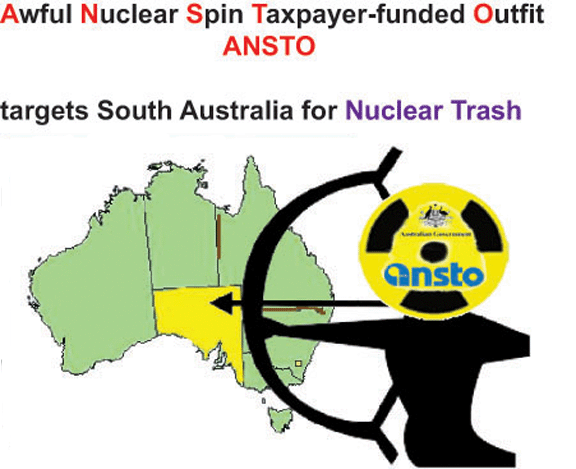
The Australian Nuclear Science and Technology Organisation (ANSTO) Submission to the Senate Economics References Committee Inquiry into the appropriateness and thoroughness of the
site selection process for a national radioactive waste management facility at Kimba and Hawker in South Australia (Submission No 58)
(This submission does not seem to address the Terms of Reference directly. )
The Australian Nuclear Science and Technology Organisation (ANSTO) is Australia’s national nuclear research and development organisation, and the centre of Australian nuclear expertise. ANSTO operates a large proportion of Australia’s landmark research infrastructure, including the OPAL multipurpose reactor, the Australian Synchrotron, the Australian Centre for Neutron Scattering, and the Centre for Accelerator Science. This infrastructure places Australia at the forefront of research and innovation for the benefit of public health, industry and the environment, and is used by universities, researchers andindustry from around Australia and internationally.
ANSTO applies its unique expertise to the production of lifesaving nuclear medicine as well as research into areas of national importance. Research areas include the environment, climate change, water resource management, materials engineering and human health.
ANSTO welcomes the opportunity to contribute to the Senate Economics References Committee’s inquiry into the appropriateness and thoroughness of the site selection process for a National Radioactive Waste Management Facility (NRWMF) at sites near Kimba and Hawker in South Australia. Through this submission, ANSTO seeks to describe its\involvement in the process to date, as well as how the process aligns with international best practice. Given the focus of the inquiry’s terms of reference is on community consultation and consent aspects of the process, ANSTO has not commented on the technical aspects of site selection in this submission.
ANSTO’s involvement in the site selection process
ANSTO has been closely involved in the process to establish the NRWMF through the provision of technical support and expert advice to the Department of Industry, Innovation and Science (DIIS). ANSTO’s capabilities stem from decades of experience in safely managing its own radioactive waste and producing lifesaving nuclear medicines.
ANSTO has applied its dedicated expertise in community consultation and collaboration, having developed strong supportive relationships with the communities surrounding its facilities and other stakeholders across Australia and the world. ANSTO has drawn on this expertise, and its links with leading international nuclear bodies, including the International Atomic Energy Agency (IAEA), to support the process, helping ensure it continues to be managed in accordance with international best practice.
Since late 2015, ANSTO staff have made more than 20 visits to the communities of Hawker and Kimba and the surrounding areas to share information on radiation and radioactive materials, and how the latter can be safely stored. ANSTO has made its expertise available to all community members. ANSTO’s activities in the Hawker and Kimba communities have included:
Conducting outreach to local businesses;
- Delivering science workshops in all major local schools;
- Participating in information booths at the Kimba, Quorn and Hawker community shows;
- Participating in multiple meetings of the Kimba and Hawker Community Consultative Committees, which act as the conduit between the government and the communities (each Committee is comprised of around 12 people with a variety of views, and who represent a cross section of the area – including agriculture, business and young adults);
- Supporting the Department’s consultation with the Traditional Owners by participating in meetings with the ATLA Traditional Landowners Association, the Villiwarina Yura Aboriginal Corporation, and other groups of traditional owners from the Hawker area1;
- Meeting with landowners and the local councils; and
- Attending ‘town hall’ meetings to help answer questions from the community.
Over this same period, ANSTO has welcomed members of the Kimba and Hawker communities to its campus in Lucas Heights, New South Wales, to tour the OPAL multipurpose reactor and nuclear medicine and radioactive waste management facilities, and to speak to people who live and work with radioactive materials. To date, more than 100 community members have visited Lucas Heights, including landowners, community members, Traditional Owners, neighbours and other key stakeholders. Continue reading
Regional Development Australia Far North sits fairly firmly “on the fence” regarding nuclear waste dump sit selection

“There are approximately 1,770 residing in the ‘broader community’ area, and this original survey result now only represents 16.5% of the population.”
“the views of the wider population who visit, pass through and stay in these areas could be considered in the overall picture as an element in a broad consultation process.”
“whilst a Statewide viewpoint has a role, it should not be a deciding factor”
Regional Development Australia Far North (RDA Far North) SUBMISSION FOR SELECTION PROCESS FOR A NATIONAL RADIOACTIVE WASTE MANAGEMENT FACILITY IN SOUTH AUSTRALIA Submission No 41
Background Regional Development Australia Far North (RDA Far North) is a not-for-profit incorporated association governed by a volunteer Board comprised from local people with a skills mix across industry, business, government and community.
Our role is to foster and enhance a robust, diversified, vibrant and growing economy across Far North SA through the timely and professional provision of economic development services.
RDA Far North maintains a neutral position in regards to the National Radioactive Waste Management Facility proposal being considered within the region we cover. The Far North SA Region The Far North region of South Australia, as per Regional Development Australia Committee boundaries, covers approximately 65% of South Australia. The area has a land mass of just under 650,000km2 with a population of 127,629 and incorporates the Anangu Pitjantjatjara Yankunytjatjara Lands.
The region takes in the iconic Flinders Ranges and Outback region, popular and well visited tourism destinations in the State. The Flinders Ranges is also now going through the process to be recognised as a World Heritage site. The main townships in the region include (but are not limited to) Port Augusta, Quorn, Hawker, Leigh Creek, Copley, Lyndhurst, Marree, Innamincka, William Creek, Oodnadatta, Marla, Mintabie, Coober Pedy, Glendambo, Pimba, Woomera and Roxby Downs. Some of these remote townships are between 800 – 1,000 kilometres from Port Augusta, the largest city in the region (population of 113,808). Barndioota (Wallerberdina Station) is in the RDA Far North region.
Terms of Reference The appropriateness and thoroughness of the site selection process for a national radioactive waste management facility and Kimba and Hawker in South Australia, noting the Government has stated that it will not impose such a facility on an unwilling community, with particular reference to: Continue reading
Kimba District Council seems mainly concerned about getting finances and services, in return for hosting nuclear wastes
District Council of KIMBA Submission to Senate Inquiry on Selection process for a national radioactive waste management facility in South Australia (Submission No.19)
(I was not able to copy this submission, so have just put an excerpt here with the main points. )
Kimba council addresses Term of Reference e) Whether wider Eyre Peninsula or Statewide community views should be taken into consideration, and if so, how this is occurring or should be occurring.
“Council remains of the view that its Local Government area represents the best reflection of the wishes of its community.”
“Kimba has been visited by a multitude of experts..” “Associate Professor Geoff Currie believed that Kimba was now one of the most educated communities in the country on radioactive waste….”
“Council would expect that the Australia Government would provide specificity on what financial and service benefits it will provide, and how these will be administered through the National radioactive waste Management Act (2012) before a final ballot occurs.”
Without this information available, Council does not believe the community would be in a position to make an informed decision that addresses the questions and concerns identified during phase two of the site selection process.
Council acknowledges the Australian Government is committed to undertaking community engagement as it selects a site for the NRWMF, and believes that by continuing to provide detailed information about the process, it will allow those participating in the final ballot the opportunity to make a considered decision which factors in both the impacts and benefits of constructing the facility in their region.
Debra Larwood Chief Executive Officer
T: 08 8627 2026 E: council@kimba.sa.gov.au
F: 08 8627 2382 www.kimba.sa.gov.au
South Australian Branch Australasian Radiation Protection Society seems unaware of Intermediate Level Waste for planned dump
South Australian Branch Australasian Radiation Protection Society (ARPS) Submission to Senate Inquiry: Selection process for a national radioactive waste management facility in South Australia (Submission No 66) __________________________________________________________________________________ The Australasian Radiation Protection Society is a professional society that promotes the principles and practice of radiation protection. It establishes and maintains professional standards amongst its members and advises on safe use of radiation for its many applications in industry, research and medicine.
Until now the Society has not had direct input to the National Radioactive Waste Management Project. It has viewed the public consultation process as one carried out between the Federal Department of Industry, Innovation and Science and the local communities who have put forward sites for consideration under the project.
This submission relates to points (b) and (e) of the Terms of Reference, ie in relation to the discussion around the definition of broad community support and the question as to whether the community views of the whole the Eyre Peninsula or the whole of South Australia should be taken into consideration.
While the Terms of Reference of the Inquiry are narrowly targeted to the site selection process it is important that this process is viewed in the light of two major aims of the Project:
- For Australia to meet its responsibilities to manage its own radioactive wastes including those originating from South Australia;
- To manage waste radioactive materials produced as a by-product of beneficial use of radiation in Australia: medical research, diagnosis and treatment of diseases, industrial processes and scientific research.
Our Society believes that it is appropriate that consultation occurs at the level of the local community. However, if it is decided from the deliberations of this Inquiry that public consultation will be extended to the wider South Australian community, the SA Branch of ARPS requests community views should be sought from:
1) South Australians who utilise radioisotopes in medicine, industry and research, particularly those who are responsible for management of waste radioactive materials
2) (where practicable) the many tens of thousands of South Australians from all parts of the community who have benefitted from diagnosis or treatment of life-threatening medical conditions using radioisotopes produced in Australia at the Lucas Heights facility.
These groups from the community are not organised into lobby groups of any form and therefore their views may be overlooked or undervalued in the consultation process.
Regarding point (1) above, many of our members advise on the safe management of radioactive materials. Over a period of decades legacy radioactive wastes used in industry, research and medicine have accumulated in South Australia (and Australia more broadly). The quantity of legacy radioactive materials is not substantial, and storage at multiple sites in South Australia is safe and compliant with current regulations.
However, radioactive materials are classified as hazardous materials and some represent a security concern. Hospitals and university campuses are not the place for storing unwanted hazardous materials. It is clearly more desirable to have a centralised managed facility which is purpose-built for the management of radioactive materials as there are for chemical or physically hazardous materials. After decades without progress, this National Project offers room for optimism that our waste material can be removed from the many individual sites across Australia and managed in accordance with international best practice.
On point (e) of the Terms of Reference, we comment that compared to any other small scale semiindustrial operation or a hazardous waste disposal or management process being proposed, the level of consultation with the local community is exceptional. The public consultation process in this case of radioactive waste materials may be contrasted with the process followed when asbestos or hazardous chemical waste disposal sites are established. Asbestos, for example, is a carcinogenic material with no half-life: once disposed of it persists in the environment forever. Radioactive materials will eventually decay away.
We note that the Inquiry website quotes the undertaking by the Government that it will not impose a facility on an unwilling community. We also note that the Government has indicated that no individual or group has an automatic right of veto.
Our concern is that in meeting demands from special interest groups who may not be from the local community and do not necessarily represent the local community, the requirements for demonstrating public acceptance will become unreasonable. Given the important service that this facility will provide to South Australia and Australia it is important that the project be given a reasonable opportunity to succeed. Should consideration of the current sites in South Australia fail, South Australians must then rely on other states or territories to accept the radioactive wastes from our hospitals and universities.
In summary, the Australasian Radiation Protection Society holds that the views which are the most important are those sought from the local community. The public consultation process should take into account the benefits enjoyed by all the South Australian and Australian community from past and future operations of the Lucas Heights reactor, and the use of radionuclides more broadly in science, medicine and industry. Any local community which accepts the establishment of a facility is providing a valuable service to the Australian community with minimal associated risk. Consultation should take place with a constructive intent, allowing the opportunity for fair input from the community while giving the facility every opportunity to succeed.
I Furness Chair, South Australian Branch Australasian Radiation Protection Society
1 This month
7 April – WEBINAR – Australia and the Doomsday Clock – Preventing nuclear war through NoFirstUse and other policies
Online | Tuesday April 7, 4:00-5:30pm, Australian Eastern Time / 8:00-9:30am Central Europe Time
– Access the registration link
15 April – Zoom –Nuclear Power is Not the Solution
Apr 15, 2026 01:00 AM in Canberra, Melbourne, Sydney

Join the International Physicians for the Prevention of Nuclear War (IPPNW) on Tuesday, April 14th for a timely webinar exploring the risks associated with nuclear power and challenging the myth that it offers a simple, safe, carbon-free solution to the climate crisis

21 April Webinar: No Nuclear Weapons in Australia
Start: 2026-04-21 18:00:00 UTC Canberra, Melbourne, Sydney (GMT+10:00)
End: 2026-04-21 19:30:00 UTC Canberra, Melbourne, Sydney (GMT+10:00)
Event Type: Virtual
A virtual link will be communicated before the event.
Host Contact Info: australia@icanw.org

of the week – Australians for War Powers Reform (AWPR)
To see nuclear-related stories in greater depth and intensity
 Antinuclear