When talking about nuclear waste and radioactivity, blurring the figures is a good pro nuclear strategy!
Kazzi Jai Fight to stop nuclear waste dump in South Australia , 3 Oct 21, · Something which really ticks me off is when percentages are quoted WITHOUT giving the actual figures involved AS WELL!
Case in point – Hef Griffiths is quoted in the latest minutes (August 2021 Kimba City Council) as saying….
“Mr Griffiths said that there is a lot of information about ILW remaining radioactive for 10,000 years, however the material that remains from synroc and reprocessing that’s returned from France indicates that after 300 years 99% of the radioactivity will have decayed away. After 600 years, 99.9% will have decayed away.”
Okay – let us assume that the highest upper level of ILW classification is 10^4 TeraBequerels/m3….which is the same as 10^16 Becquerels/m3.
Now it is IAEA and ARPANSA who choose to use Becquerels, so we will stick with those units. Becquerels are the International Unit (SI Unit) for radioactivity activity. It is defined as the number of times each second a nucleus in radioactive material decays and releases radiation. The higher the number of Becquerels, the more radioactive the material is. However, it is a very small unit.
37 billion Becquerels = 1 Curie. It can be written as 3.7 x 10^10 Becquerels or disintergrations per second…… Be mindful that 1 Curie of any radioactivity – alpha, beta or gamma – will fry you.
Okay….so let’s use some easy figures to get my point across.
Let us use hypothetically for example 100 TeraBecquerels as the nuclear waste in question for ease of mathematics. This would technically fall within the category of ILW in Australia, under Australia’s criteria.
It is sitting there, in its shielded cask.
What Hef Griffiths is saying is that in 300 years (approximately 12 generations of future people from us today – or looking back BEFORE European Colonization of Australia – to put it in perspective) that 99% of that waste would have decayed away. I will give him the benefit of the doubt, since AGAIN this information IS NOT REFERENCED, but that means that 1% activity REMAINS! So….that 100 TeraBecquerels of nuclear waste now measures 1 TeraBecquerel!! That is by no means SAFE to handle without shielding EVEN AT THAT STAGE….AND IS NO WHERE NEAR BACKGROUND LEVELS!!
Hopefully that puts this type of PRESENTATION IN CONTEXT!!
Percentages are OFTEN used to HIDE REAL TIME FIGURES!
This is NOT unique to the Nuclear Industry – it is a ploy often used in Politics to HOODWINK people to thinking that the figures ARE NOT IMPORTANT AT ALL – when in fact THEY ARE!!
ALWAYS ASK FOR EXACT FIGURES, WHEN PERCENTAGES ARE QUOTED!!
This was the SAME CASE when it came to the “Community Support” assessment – PERCENTAGES AGAIN ONLY QUOTED!
When they do this – THEY ARE TRYING TO GET AWAY WITH SOMETHING!! https://www.facebook.com/groups/344452605899556
The giant question: is Australia able to deal with submarine nuclear wastes?
So, what are the parts of the submarine that require dismantling and does Australia have the capability?
Retired submarines generate three levels of radioactive material, which raises challenges for how parts can be handled, transported and stored. The NAO report summarises the submarine parts as:
- Irradiated fuel from within the submarine’s reactor core. As it continues to generate heat, fuel will be stored under water at the Nuclear Decommissioning Authority’s (NDA’s) Sellafield site.
- Intermediate-level waste, primarily the Reactor Pressure Vessel (RPV) and other parts from within the reactor compartment, which had been close to the nuclear fuel. This waste comprises about 1 per cent (50 tonnes) of the boat; and
- Low-level waste that needs to be handled and disposed of within the regulatory framework but does not meet the criteria for intermediate-level waste. This covers the remainder of a submarine’s reactor compartment such as pipework and comprises around 4 per cent (176 tonnes) of the boat, to be disposed of in a low-level waste repository…………………
The giant question mark over SA’s role in nuclear submarine push, InDaily, Kevin Naughton, 30 Sep 21, Australia’s nuclear submarine ambition has few knowns and many unknowns – and one of these casts a giant shadow over South Australia’s role. Kevin Naughton analyses the uncertainties and responsibilities that come with owning a set of submarine-encased nuclear reactors and more than 220 tonnes of nuclear waste per boat.
The UK is one of the three partners in the recently announced AUKUS alliance, whose first major initiative will be to “deliver a nuclear-powered submarine fleet to Australia”, as Prime Minister Scott Morrison trumpeted on Thursday, September 16.
No solution to submarine nuclear waste. Australia would be crazy to take on this mess.
Donna Gilmore, SanOnofreSafety.org 30 Sep 21,
There is no solution for the submarine nuclear waste. It’s a forever storage cost. I wonder who will pay for that?
In the U.S. the spent fuel is stored in Idaho in spent fuel pools or dry storage in unsafe thin-wall steel canisters with steel lined thick concrete casks. The concrete casks have air vents for convection cooling so the thin-wall canisters are the only real barrier. The thick concrete is need to reduce gamma rays and neutrons since the 316L stainless steel canisters are too thin to stop those.
There is no way to maintain those thin-wall canisters or detect or repair cracks before the canisters crack. No repair or inspection technology exists once loaded with fuel. If you hear otherwise, it’s a lie.
Each canister contains about one ton of spent nuclear fuel.The rest of the contaminated submarine is stored in trenches at Hanford, Washington.
Each transport cask (holding one canister) costs $20 million.
Europe and the rest of the world use maintainable thick-wall metal casks 10″ to over 19″ thick — with no air vents and no cracking problems.
In essence, there is no good short or long term solution to store the nuclear waste since geological repositories are not technically feasible even for the short-term.
The best the world has is maintable thick-wall bolted-lid metal casks stored in hardened buildings. They will last much longer than the thin-wall canisters, but are not considered a permanent solution.
Australia would be crazy to take this mess.
Sutherland Shire doesn’t want any more nuclear waste stored at Lucas Heights in their Shire
Council calls on Hughes MP to take stand against ANSTO nuclear waste expansion plan St George and Sutherland Shire Leader
Sutherland Shire Council is calling “in the strongest terms” for Hughes MP Craig Kelly to take a stand against a proposed new nuclear waste facility at ANSTO, Lucas Heights.
Mayor Steve Simpson told this week’s council meeting, “I would like to see less of his medical skills [COVID comments] and much more of an assertion that the [nuclear] waste should not be kept in his electorate”.
Mr Kelly hit back, accusing councillors of “scaremongering”.
The council unanimously resolved that, while continuing to support research and innovation at ANSTO and its benefits for treatments for cancer and in nuclear medicine, a submission be made to the independent regulator ARPANSA opposing the construction of an Intermediate Level Waste Capacity Increase (ILWCI) facility at the Lucas Heights campus.
A letter will also be written to the federal Minister for Resources and Water Keith Pitt, requesting the matter of the establishment of a National Radioactive Waste Management Facility be given urgent priority.
The final part of the motion stated: “Council puts in the strongest term Cr Michael Forshaw, a former senator, said previous MPs for Hughes, Robert Tickner and Danna Vale, “were strong on this issue in pushing the need for a permanent repository, or store, for our nuclear waste”…………. https://www.theleader.com.au/story/7435883/updated-council-challenges-craig-kelly-over-nuclear-waste/?fbclid=IwAR1dY5en839aPPJMae32D-5ivaPFQR7CWpn0sLX2lih3slzz4
Napandee radioactive waste dump plan – a nuclear waste of money.
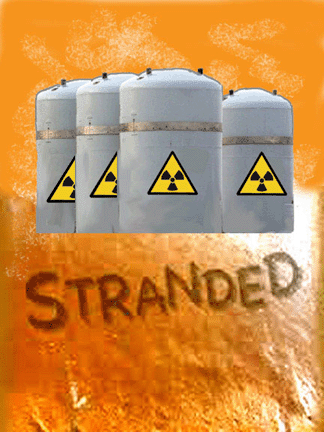
“A Nuclear waste of money – Greenies”The Advertiser 14Sept 2021 p.9 MICHELLE ETHERIDGE
RADIOACTIVE waste should be stored at an expanded nuclear medicine production site in Sydney, rather than shipped to Kimba, opponents of the Eyre Peninsula project say.
The federal government has set aside $59.8m over four years for an expansion of “temporary” nuclear waste storage at Lucas Heights, NSW. During a parliamentary committee hearing on Monday, conservation groups argued the project rendered unnecessary a plan to move intermediate-level waste to a new facility near Kimba, where it is to be stored for several decades.
The federal government says space for some types of nuclear waste at Lucas Heights will be exhausted by 2027 and the expansion will provide at least a further 10 years’ capacity until the new national radioactive waste site planned for Napandee, near Kimba, is operational about or after 2030. Conservation SA chief executive Craig Wilkins, said his organisation supported keeping the waste at Lucas Heights until a longterm deep geological (underground) repository was found.
“I and others are genuinely scratching our heads as to why this waste from ANSTO (Australian Nuclear Science and Technology) is being transferred from one temporary place that’s safe and secure to another place on an interim basis. This is … a phenomenal waste of money,” he said.
The Australian Conservation Foundation’s Dave Sweeney said waste could become stranded at Kimba in the absence of a long-term plan. ANSTO staff said the new Lucas Heights facility would have a life of about 50 years
Radioactive waste dump plan puts the Eyre Peninsula’s reputation at risk, lacks genuine community consent
Stock Journal, Terry Schmucker, Cootra 2nd September 2021 The radioactive waste site at Napandee does not have genuine community support. Farmers and farmland within as little as 20 kilometres from the radioactive waste dump at Napandee were not included in the official community vote.
Voting was centred on the Kimba local government area, which splits the community near the waste dump by the local council boundary. The vote also excluded Native Title holders because their traditional land extends beyond the council area and they live outside the district.Temporarily storing intermediate level waste at the headwaters of the Eyre Peninsula will seriously impact on the reputation of our prime food production from our agriculture and fisheries. https://www.facebook.com/groups/344452605899556
Agricultural land deserves protection from radioactive pollution
Barry Wakelin, Kimba. Stock Journal 2nd September 2021. The decision to place intermediate level waste at Kimba for a temporary period of a few decades makes it sound like the national green movement versus 54 per cent of the total Kimba community who said yes to a huge amount of taxpayer funding per vote.
There is just one farmer beneficiary for material that the Department of Defence says is too dangerous for its Woomera prohibited area and which 70pc of South Australians say no to .
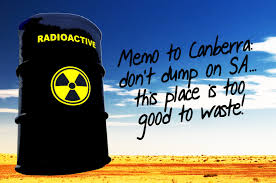
A 400-strong group with a focus on respect for and representation of agriculture to achieve no nuclear waste on SA agricultural land has fought a six-year campaign against Australia’s most powerful political machine, known as the Australian federal government, who are yet to explain why they are in defiance of their own National Health & Medical Research Council guidelines of placing nuclear waste on agricultural land, which is 4.5pc of SA
.
Why, never on their own federal government-controlled land? The federal parliament now has two “temporary sites” for Intermediate Level Nuclear Waste (ILW) , one at the government-owned nuclear reactor site until 2037 and one at Kimba, while never seeking a permanent disposal site for ILW, even though a promise was made to find that permanent site, prior to commissioning the OPAL nuclear reactor almost 15 years ago at Lucas Heights in Sydney. https://www.facebook.com/groups/344452605899556
Napandee nuclear waste site is in fact on farming land, and all too close to the town of Kimba
 |
Roni Skipworth No nuclear waste dump anywhere in South Australia , 2 Sept 21,
Not many people know where the nominated site ‘Napandee property’ is. Let me assist with showing you where this property is, there is a purple cross showing this property on a map. The land is not a flat unproductive site as stated in many reports as last time we travelled pass there were many sheep eating its grass https://www.facebook.com/groups/1314655315214929

Scrutiny on possible fraud in the process of the government bribery grants for South Australian communities to accept a nuclear waste dump

Recently information has become available that has indicates a new path of attack against the planned nuclear waste dump in South Australia.
It is is being reported to the Federal Police Fraud Investigation Branch that several individuals made application for a
community grant fraudulently. These individuals participated in a conspiracy with a “resource agency” who
assisted in making application for the grant fraudulently on behalf of an “Aboriginal Corporation” that does not meet the requirements or criteria for the grant.
Grant approval was obtained successfully and was publicly announced. What this proves is that the entire process was rushed and the money grab that divided and separated local communities was able to be manipulated so easily that some unscrupulous people could illegally take advantage.
The federal police will have all the available evidence shortly (there is a lot) and the corporation and persons involved
in the fraudulent funding application will be held to account and prosecuted under federal law. A win for transparency in the local area.
But it will be a bigger win for the overall fight because it would put the entire grant bribery process and purpose under scrutiny. Hopefully it will lead to very publicly broadcasted news stories following the progress of the investigation and prosecution proceedings.
20 reasons why the Lucas Heights unviable production of medical isotopes is a sham and a dud.

The claim by Australian Nuclear Science and Technology Organisation (ANSTO) that it requires additional storage
capacity for intermediate level nuclear or radioactive waste at its Lucas Heights operations is completely false and consequently unjustified in all respects.
REASONS
- The present storage capacity at Lucas Heights is more than adequate for many years and even decades – this is the view of the Australian Radiation Protection and Nuclear Safety Agency (ARPANA) as the regulator and licensing authority
- The main undertaking representing 80% of its total operations and activity by ANSTO at Lucas Heights is the
production of nuclear medicineThe main undertaking representing 80% of its total operations and activity by ANSTO at Lucas Heights is theproduction of nuclear medicine - Only some 10% of this production annually is for local use in Australia
- The remainder is sold overseas but it is a very limited market
- The predominant purchasers of this production of nuclear medicine are third world countries
- These countries cannot afford to pay ANSTO for this nuclear medicine and hence it is treated as additional foreign aid by Australia
- The manufacture of nuclear medicine even in fully and proper commercial circumstances is a large loss making proposition
- It is estimated from authoritative overseas research that revenue from isotope production for nuclear medicine would likely offset only approximately 10% to 15% of the costs of the reactor used for the production and this does not include all the other costs associated with the production
9. Added to this ANSTO is regarded by world standards as an extremely high cost manufacturer of nuclear medicine
- ANSTO is fully funded as to its existence and operations by the federal government
11. On top of this ANSTO has proved to be a less than efficient producer of nuclear medicine due to the instances of shutting down of its reactor at Lucas Heights
- When this has occurred ANSTO purchased the nuclear medicine isotopes from overseas which has proved to be more efficient and cheaper than local production
- It was reported that ANSTO received $238 million last year as its annual funding from the federal government
- ANSTO because of this funding has no incentive or need to achieve profitability particularly in its production of nuclear medicine which represents its major undertaking and operational activity
- In any case there is a strong move in medicine throughout the world away from using nuclear medicine in all diagnosis and treatment due to its harmful nature
- Some countries are virtually banning nuclear medicine both in its manufacture and its use locally and for export because of its inherent dangerous nature
- An alternative permanent disposal would be better.
- The indisputable conclusion internationally is that the use of nuclear medicine generated by reactors is rapidly declining to a level where its future production will no longer be viable
- In view of the foregoing there are no justifiable or valid reasons or pretext for :
(a) the continued production by ANSTO of nuclear medicine by using a nuclear reactor for whatever reasons at Lucas Heights or elsewhere in Australia;
(b) the continuing loss making production of nuclear medicine by ANSTO at Lucas Heights for export overseas;
(c) the need to increase the storage capacity at Lucas Heights for intermediate level waste generated by the production of nuclear medicine; and
20 No pretext for the establishment whatsoever of the nuclear waste management facility by the federal government at Napandee
Inaccuracy on the land area for Napandee nuclear waste dump
After a somewhat shaky attempt by the Editor to recant the very convincing result in the Stock Journal last week, another Stock Journal article has just been released supposedly showing both sides of the argument regarding the proposed nuclear dump. Seems Mr Baldock doesn’t actually know how much land is involved- 158 hectares is NOT the size according to OFFICIAL DOCUMENTS – so what ELSE is being said which is considered being “flexible with the truth” do you think, putting it nicely? Good interview again however by Peter Woolford.
Farmer Jeff Baldock excited at prospect of nuclear waste dump on his land. Other nearby farmers not impressed

Lobbyists get ready to fight site approval, Stock Journal , Vanessa Binks, 28 Aug 2020 AFTER more than six years of deliberation, a regional radioactive waste storage site is less than 60 days away from potential approval and the site’s owner believes the long road has been “worth it”. The site at Napandee, near Kimba, was selected for final approval by federal Resources Minister Keith Pitt earlier this month.Landowner and mixed farmer Jeff Baldock said the approval of the site could save the town, and found the announcement of further consultation “frustrating”. The 158-hectare property is less than 2 per cent of Mr Baldock’s arable farming land [this figure is disputed] and the development is expected to provide a $8.5-million benefit to the community.”There is nothing else to consult about. The proposal has already survived two Senate inquiries and been scrutinised by a Parliamentary Committee and through a court process,” he said.”There has already been multiple rounds of consultation and another one will just cause delays.” Mr Baldock said offering his land to store radioactive waste was “not about money”…….. “Country towns are diminishing and Kimba has an opportunity to invest in its future and keep families or attract more residents,” Mr Baldock said. Site construction could begin by 2024. Lobbyists get ready to fight site approval A DIVISION within the Kimba community about whether or not a local radioactive waste site should be approved has spearheaded a response from the No Radioactive Waste on Agricultural Land in Kimba group to challenge the final approval in a judicial review process. The committee will be meeting in the coming weeks to discuss the next stages after the recently announced further 60-day consultation period has lapsed. Lobby group president Peter Woolford said all options would be examined going forward.”We are another step closer to SA becoming a dumping ground and one step closer to another court case,” he said. Mr Woolford was pleased about the announcement of further consultation and hoped those who disapproved of the site would voice their concerns.”I hope that people outside of the Kimba District Council are allowed to have their say this time – particularly neighbouring councils at Cleve and Wudinna who are also affected,” he said. Mr Woolford also said agriculture’s economic benefit to the region far exceeded the benefit from the development.”About $60 million worth of income is generated from agriculture in the district each year – this development will not even come close to that and it could impact agriculture’s future in the area as well,” he said.”The risk is too unknown. |
Stock Journal poll found that the overwhelming majority wanted more consultation on the government’s plan for Kimba nuclear waste dump
Is more nuclear consultation needed? | POLL
20 Aug 2021,
YES 74.8%
NO no 25.2%
Australia’s nuclear waste is best managed in interim storage at Lucas Heights, with an independent review on permanent disposal.
Australian Conservation Foundation overview comments on ANSTO Iintermediate Level Waste transport, 24 Aug 21,
The movement of long lived intermediate level waste from the reprocessing of spent nuclear fuel via multiple (rail-ship-road) transport platforms and across half the world is a significant logistical exercise with environmental and security risks and the proponent accepts (2.10) that the planned activity is a nuclear action under the EPBC Act.
This is a matter of high public interest and elevated scrutiny is important given that ANSTO is the proponent and not a disinterested party.
ANSTO’s assurances of ‘negligible impact’, a ‘very unlikely’ impact probability and ‘high levels’ of certainty and reliability need to be assessed, not merely accepted.
The proponents commitment to public consultation (1.13) is not consistent with the clear security limitations (1.2) and further places information control with the proponent, without a wider transparency mechanism.
The 2015 shipment of waste saw controversy and allegations of deficiencies in the transport ship (see attachment). ANSTO’s assertion that this will be ‘conducted by an experienced nuclear transport logistics provider’ (1.2) requires further scrutiny and verification. A June 2021 report (see attachment) iby the UK based NFLA (Nuclear Free Local Authorities) found that: The International Maritime Organisation should consider improved regulation on shipping that is transporting nuclear materials as part of other mixed shipments. The level of accidents in this area is alarming, and the NFLA is really concerned a major accident could cause significant and dangerous implications for communities…
ANSTO is not accurate in stating that the proposed action is not part of a staged development or a component of a larger project (1.15). The Australian Radioactive Waste Management Framework (April, 2018) confirms that the Commonwealth is the only jurisdiction in which spent fuel is managed. Clearly this ILW is a key component of the federal government’s current, and contested, National Radioactive Waste Management Project and should be seen in this wider framework.
This is a complex operation with multiple variables and exposure/risk pathways that requires enhanced attention
- ANSTO is the proponent and its assumptions need to be tested
- The 2015 shipment was dogged with controversy around the credibility and adequacy of the transport ship and this area needs further attention
- The planned activity is part of a wider project – the National Radioactive Waste Management Project
- The high level of public interest and concern is best addressed through increased scrutiny and transparency
- If this ILW transfer occurs this material should remain secured at ANSTO until a credible future management approach is agreed
The best environmental outcomes would be facilitated through enhanced assessment consistent with the environmental protection intent of the EPBC Act. ACF strongly supports an open, wholistic and independent review of Australia’s radioactive waste strategy.
ACF maintains that Australia’s ILW is best managed through extended interim storage at ANSTO, coupled with a dedicated options review into future management options. In the absence of a clear future management pathway there is no radiological or public health rationale for moving this ILW from a facility with high institutional control assets to a less resourced regional facility.
The status of two current federal processes related to radioactive waste and the Kimba plan
(i) In the latest federal budget around $60 million was allocated to ANSTO explicitly to upgrade their storage capacity for ILW. This approach fully aligns with the civil society call for ILW waste to be kept in extended interim storage at Lucas Heights prior to a final decision on future management options. This allocation is the focus of a current review by parliament’s Public Works Committee (see: https://www.aph.gov.au/Parliamentary_Business/Committees/Joint/Public_Works/ANSTOLucasHeights/Submissions ). There is no fixed reporting date but the direction to the Committee is to report “as expeditiously as possible”. The Committee is likely to hold at least one public hearing and to approve the planned expenditure and works will advance.
The Australian Consewrvation Foundation will be calling for this – and any future government – to use the breathing space provided by this extra capacity as the game changing circuit breaker in the waste debate.
(ii) ANSTO have recently made an EPBC Act referral around its plan to bring reprocessed spent nuclear fuel waste back from the UK to Lucas Heights: Referral: EPBC 2021/8998 – Return of Australian Intermediate Level Radioactive Waste from the UK, NSW
This ILW waste would travel by road, rail and ship from the Sellafield nuclear plant in Cumbria in a purpose built 7m long, 3m high transport and storage container. The shipment would take place between December 2021 and July 2022. ACF’s view is that this material should be stored at ANSTO pending a final management option – it should not be double-handled and moved to Kimba in the absence of an agreed further plan.
1 This month
15 April – Zoom –Nuclear Power is Not the Solution
Apr 15, 2026 01:00 AM in Canberra, Melbourne, Sydney

Join the International Physicians for the Prevention of Nuclear War (IPPNW) on Tuesday, April 14th for a timely webinar exploring the risks associated with nuclear power and challenging the myth that it offers a simple, safe, carbon-free solution to the climate crisis

of the week – Australians for War Powers Reform (AWPR)
To see nuclear-related stories in greater depth and intensity
 Antinuclear