Federal court rules against Aboriginal group who wanted inclusion in nuclear waste dump ballot
 Federal Court dismisses bid to stop ballot on nuclear storage facility near Kimba, ABC, By Candice Prosser, Claire Campbell and Sara Garcia 12 July 19, A South Australian Aboriginal group has lost a bid to stop a council ballot on whether a nuclear storage facility should be built on the Eyre Peninsula.
Key points:
- The Kimba District Council planned to hold a vote to gauge support for the waste dump
- Representatives of the Barngarla people were excluded from the ballot
- They argued it contravened the Racial Discrimination Act, but the Federal Court dismissed the application
The Barngarla Determination Aboriginal Corporation launched legal action against the District Council of Kimba, arguing it contravened the Racial Discrimination Act by excluding native title holders from the ballot.
The council planned to hold a vote to gauge community support among its ratepayers for having radioactive waste stored in their area, after the Federal Government shortlisted two sites near Kimba as possible locations for the facility.
A third site in Hawker, near the Flinders Ranges, has also been shortlisted.
The native title holders won an injunction to halt the ballot last year, while the legal challenge was being heard.
Justice Richard White ruled that no contraventions of the Racial Discrimination Act had been established, and dismissed the application.
SA Greens leader Mark Parnell said he was disappointed with the court’s decision.
“Here we are in NAIDOC week, celebrating Aboriginal culture, and the court has determined it is not a breach of the Racial Discrimination Act to deny traditional owners a vote on whether a nuclear waste dump can be built on their land,” he said.
“Clearly in this country we have a very long way to go before we achieve anything like reconciliation.
“The Aboriginal traditional owners have legitimate rights over this country, yet they’ve been denied a right to vote on whether a nuclear waste dump can be built.
“The Federal Government is obviously keen to get their project up but they only want to ask people who are going to say yes.”
In a statement the Barngarla people said they respected the Federal Court’s decision, but said their lawyers were considering an appeal.
“The Barngarla respects the decision of the Federal Court, as the court has to interpret complicated legislation,” the statement read.
“However, more generally we consider it sad that in the 21st century we are required to take legal action to allow us to have the right to vote on the major decision of the day.
“This case has been about standing up for the right of Aboriginal people to vote on important issues which affect their rights.”……….
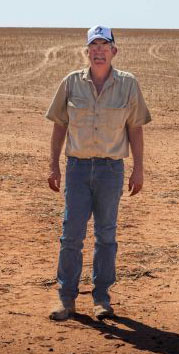
Landholder Jeff Baldock [at left] has volunteered a portion of his property in Kimba for the proposed facility and said he welcomed today’s decision.
“Now hopefully we get to have our democratic vote … if there’s nothing else that gets in the road,” he told ABC News………
The proposal has the community divided, with Kimba resident and former Liberal MP Barry Wakelin also opposing the facility. …….
The latest Federal Government proposal is to build a single facility in regional South Australia for all of the nation’s waste. https://www.abc.net.au/news/2019-07-12/bid-to-stop-ballot-on-nuclear-storage-facility-in-sa-dismissed/11302852
South Australian communities DID NOT voluntarily enter into process for hosting nuclear wastes
 Katrina Bohr No Nuclear Waste Dump Anywhere in South Australia, 12 July 19
However please take note of the wording at the finish:
‘The department will examine the decision in detail in the coming days, before advising the communities who voluntarily entered into the process, of the next steps.’
When did the communities Voluntarily enter into the process?
The landholders volunteered their land, but the communities didn’t voluntarily enter into the process. https://www.facebook.com/groups/1314655315214929/
Is Napandee, (Jeff Baldock’s property) near Kimba the govt’s chosen site for expanded nuclear waste dump?
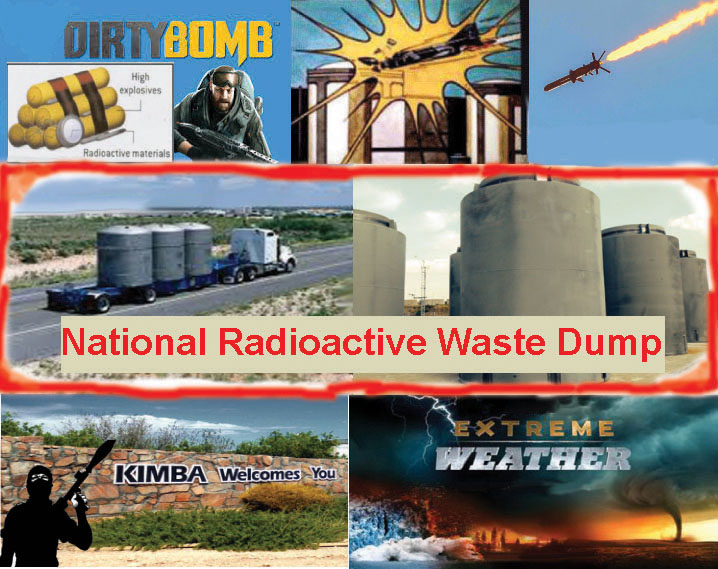
Federal Government denies claims it has a preferred site for radioactive waste storage in South Australia, Advertiser, 8 July 19,
A Kimba property is allegedly the frontrunner for a future nuclear waste dump, a source claims – but it’s disputed by the Federal Government which says no favoured site has been picked.
The Federal Government says it is yet to select a favoured site for its proposed radioactive waste facility, rebuffing claims that a Kimba property is the frontrunner.
A spokesman for the Department of Industry, Innovation and Science also says the Government is not bound to wait until a court case on the issue is finalised before selecting the best place for the contentious development.
A source close to the project has claimed the waste storage site is now likely to be at least 60 per cent bigger than previously envisaged.
The Government is considering three sites for the radioactive waste facility – two near Kimba and one near Hawker.
A Kimba-based consultative committee is due to meet next month to discuss the project.
The source believes Napandee – a property 25km northwest of Kimba – is the Government’s preferred site and next month’s meeting will discuss revised requirements for the proposed waste site.
“There’s a rumour getting around town that Napandee is the one they’ve chosen and it seems to align with this revelation over the last week that they suddenly have to increase the size of the land from 100ha to 160ha or 170ha,” the source said.
“Whoever gets the site is going to get 70 per cent more money because it’s a bigger parcel.
“They’ve always said that there would be cropping and agricultural trials at the (land) that’s not being used for the buildings. Apparently now the safety regulator has said that is not going to happen.”
Various stakeholders The Advertiser spoke to believed there would be little progress on the project until after a legal challenge was complete.
The Barngarla Determination Aboriginal Corporation took Kimba Council to court in January over its plan run a community ballot to determine the level of support for the dump, arguing it was discriminatory.
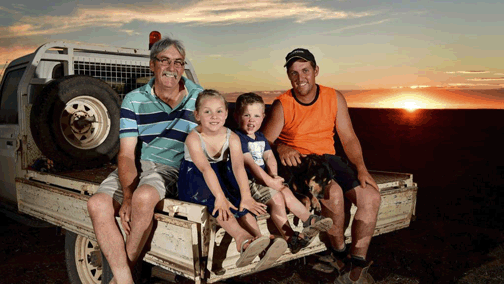 Napandee owner Jeff Baldock said the Kimba community was awaiting the court ruling.
“There’s not much happening – obviously things are still ticking along quietly in case it happens,” Mr Baldock said. (Baldock and family at left)
Once a court decision was made “we can get our vote and get on with it”, he said.
Kimba chief executive Deb Larwood said the community was “in a holding pattern” until the case was finalised.
A spokesman for the Department of Industry, Innovation and Science said community ballots were suspended last year because of the court challenge, but the department was also aware “the community would like to see a decision as soon as possible”.
The Government was not required to wait until the court process was complete.
“The National Radioactive Waste Management Act 2012 provides the (Resources) Minister (Matt Canavan) with discretion to make decisions in relation to nominations and site selection,” he said.
“That said, it has been stated consistently that if there is no broad support for the facility then it will not be imposed on a community.”
The Government had no strict definition of “broad support” for the proposed site, which would measure at least 100ha.
That would be determined by a range of factors, including submissions, feedback from the community in meetings, conversations with neighbours and “the results of any ballot if one proceeds”.
The spokesman said it had been agreed the site could include “community-led agricultural research and development” but the exact nature of this was yet to be determined.
Have the Nukunu Aboriginal people been consulted about proposed Wallerberdina nuclear waste suppository?
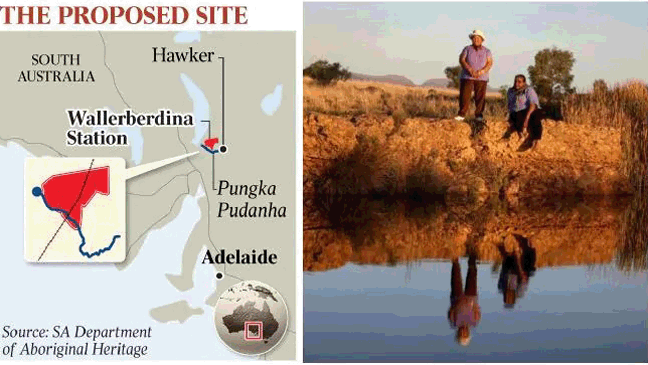
On June 21 2019, the Nukunu Native Title Claim achieved Consent Determination. Their traditional country includes Quorn &, according to the Federal Court Map, extends north up to Wallerberdina.
Well within a 50k radius of the proposed national suppository; & also includes much of the Flinders Ranges District Council precinct. Therefore entitled for consultation.
HAVE THE NUKUNU BEEN CONTACTED BY DIIS & INCLUDED WITHIN THE SO-CALLED ‘NRWMF COMMUNITY CONSENT ASSESSMENT PROCESS’? Procedural fairness requires such…..
ENuFF[SA] Office Admin https://www.facebook.com/sanuclearfree/
BHP’s Olympic Dam uranium mine: tailings dump to larger than Adelaide and up to 30 metres high

All BHP Olympic Dam radioactive toxic mine tailings waste must be isolated from the environment for over 10,000 years…
Please consider making a submission to the federal government who are inviting comments on the BHP Olympic Dam Tailings Storage Facility (TSF) 6 project – but only up to cob Friday 28th June, with no extensions (scroll down for info). Tell the fed’s they must not just approve this TSF 6 on the basis of the vested interest BHP Referral documents.
Key Recommendations are provided along with two Briefing papers prepared for Friends of the Earth Australia (FoEA) and available on-line:
“BHP seek a Toxic Tailings Expansion without a full Safety Risk Assessment” (DN, June 2019, 3 pages)
https://nuclear.foe.org.au/wp-content/uploads/ODM-Tailings-Briefing-22June2019.pdf
and
“Migratory Birds at Risk of Mortality if BHP continues use of Evaporation Ponds” (DN, June 2019, 3 pages)
https://nuclear.foe.org.au/wp-content/uploads/ODM-Migratory-Birds-BHP-Evaporation-Ponds-22June2019.pdf
A set of Key Recommendations on these issues to put to the federal government:
1. The Olympic Dam operation be assessed in its entirety with the full range of project impacts subject to public consultation
Given that uranium mining at Olympic Dam is a controlled “nuclear action” and Matter of National Environmental Significance (NES) under the federal Environment Protection and Biodiversity Conservation Act 1999 (EPBC Act), the integrity of environmental protection requires that the entire Olympic Dam operation be subject to impact assessment so that regulatory conditions can be applied “to consider impacts on the whole environment”. Continue reading
Veteran of Chernobyl nuclear clean-up: HBO TV episode was very accurate
Chernobyl Episode 4 Scene | HBO | Graphite Clearing
This man knows what it’s really like shovelling radioactive debris on top of Chernobyl’s reactor ABC News , 21 June 19
Key points:
- At age 32, Jaan Krinal was forced to go to Chernobyl and clean the roof of the reactor
- He says men were initially enthusiastic to help eliminate the radiation
- One-third of the men of his town he served with in Chernobyl have died
When he left his wife and two children on May 7, 1986 and went to work, Jaan Krinal didn’t know he would be one of those people.
The 32-year-old was working on a state-owned farm in Soviet-occupied Estonia.
Because he’d been forced to complete the Soviet military’s retraining a year before, he was confused when officers surprised him at work and said he’d been called up again — immediately.
Jaan and 200 other men were taken to a nearby school. Once they’d walked through the door, no-one was allowed to leave.
The men’s passports were seized before they were loaded onto buses and taken to a forest, where they were told to slip into brand new army uniforms.
“That’s when I first questioned what’s really going on here,” Jaan recalls………
Workers told radiation could have health benefits
It all happened fast.
Hundreds of men boarded a Ukraine-bound train on May 8. By the next evening, they were setting up camp on the edge of Chernobyl’s exclusion zone.
They were just 30 kilometres away from the site of the world’s worst nuclear disaster — the still-smouldering wreckage of a reactor torn apart by a series of explosions and spewing radiation in a plume across Europe.
Jaan was among the first group sent to clean up in the aftermath of the catastrophe.
Tasked with hosing down radiation on the houses in nearby villages, he was thrown into the thick of it……
Despite the apparent uselessness of the job, they continued to work 11-hour days without a day off until the end of June. After that, they had two days of downtime a month.
As the weeks rolled on, suspicions grew.
“We started to have doubts. But all the officers said, ‘Why are you fretting, the radiation levels aren’t that high.”
In a cruel irony, the commanders told the men that being exposed to radiation would actually have health benefits.
“They joked that whoever has cancer can now get rid of it — because the radiation helps,” Jaan says.
Men unaware of deadly reason behind roof time limit
By the end of September, whatever enthusiasm the men initially felt had faded.
As many developed a cough, concerns grew about whether they were being lied to about the radiation being harmless. The respirators the men were given wouldn’t stay on because of the heat and were used until they got holes in them.
Later they found they should have been replaced every day…….
A rumour had it that the very last leg of the assignment was going on the roof of the reactor to clean up as much debris as possible.
Humans were going to be given a task that remote-control robots had previously attempted, but failed. The machines simply stopped working due to the unprecedented levels of radiation.
“When they told us, ‘You have to go to the roof’, we thought, ‘Oh, this means we can go home soon’,” he says.
On the day, he changed his army uniform for a protective suit, glasses and a gas mask, and a metal groin guard.
“We were all lined up and told, ‘who doesn’t want to go on the roof, step forward’. But only a couple of us did,” he says.
“There was no mass rejection. Most people went up there.
“It had to be done. We couldn’t just leave it. I think everyone realised the longer the reactor would have stayed open, the more dangerous it would have become.”
Jaan was shown on a small screen exactly which piece of debris he had to pick up with a shovel and throw off the roof of the reactor, but strictly warned against going too close to the edge.
He had two minutes to complete the assignment — a bell would ring to tell him when to run back.
The two-minute timeframe was to limit exposure to radiation, which could kill a man.
But this wasn’t communicated to the men at the time.
Jaan says the roof-cleaning scene depicted in HBO’s mini-series Chernobyl mirrored real life events…….
A staggering one-third of the men of his town who went to Chernobyl have died.
The average age of death has been 52.
“Over the past couple of years, just a couple of us have died. But not too long ago it was around 10 men a year,” he says.
“There have been cancers. There have been suicides too, but thankfully not too many.”……
he hopes tourists won’t start flocking to the ghost city.
“I hope they’ll never start sending large groups of tourists there. It’s still a dangerous zone,” he says.
He hasn’t seen the mini-series, but welcomes the attention Chernobyl disaster is getting — he thinks it acts as a warning to the human kind. https://www.abc.net.au/news/2019-06-22/chernobyl-what-it-was-really-like-on-top-of-reactor/11223876
Tailings dams at Olympic Dam uranium mine are in the “extreme risk” category.
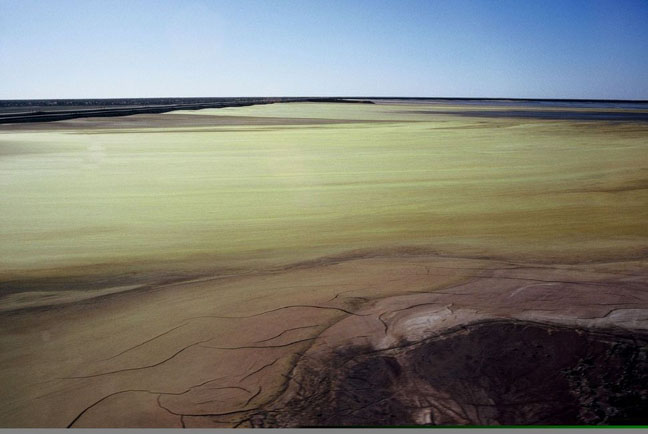
it is deeply disturbing that BHP recently confirmed that three of the tailings dams at Olympic Dam are in the “extreme risk” category.
This is the highest risk status according to what is often regarded as the best global industry benchmark – the Canadian Dam Association’s safety standards – and relates less to the likelihood of collapse and more to the severity of the resulting human and environmental impacts if a failure did happen.
The environmental threat of tailings dams https://independentaustralia.net/business/business-display/the-environmental-threat-of-tailings-dams,12805
AWAY FROM THE airbrushed corporate head offices, staged media events and slick communications products, the reality of the mining trade is pretty basic and very intrusive.
An orebody is identified, extracted, processed and removed and while the clothing might be high-visibility, many of the industry’s impacts tend to stay pretty low on the wider world’s radar.
Right now, the world’s biggest mining company, BHP, has formally applied to expand the massive Olympic Dam mine in northern South Australia.
This plan deserves serious attention and scrutiny for three key reasons: it involves the long-lived and multi-faceted threat of uranium, it proposes to use massive amounts of finite underground water and the company is in trouble globally over the management of mine wastes and residues currently stored in multiple leaking – and sometimes catastrophically failing – tailings dams.
BHP has recently commissioned a “tailings taskforce” to conduct a high-level review of the management of the company’s tailings dams or tailing storage facilities.
The move comes in the literal wake of the collapse of a tailings dam at the Samarco iron ore operation in Brazil in 2015 that saw 19 deaths along with widespread and continuing environmental damage.
The mine was a joint operation of BHP and Vale, a Brazilian mining multinational that is a major player in global iron and nickel production, promoting its mission as ‘transforming natural resources into prosperity’.
Or maybe not after an estimated 40 million cubic metres of toxic sludge from the collapsed dam poisoned the Doce River and utterly devasted the lives of the local Krenak people.
Nothing quite focuses the corporate mind as a high profile and high cost legal action and in May, BHP was served with a multi-party damages claim for over $7 billion on behalf of around 235,000 claimants.
The memory of Samarco and the dangers of large-scale tailings dam failure were tragically highlighted in January this year when another Vale tailings dam at the Brumadinho mine failed, resulting in terrible loss of life with a death toll of between two and three hundred people and massive environmental impact.
In this context, it is deeply disturbing that BHP recently confirmed that three of the tailings dams at Olympic Dam are in the “extreme risk” category.
This is the highest risk status according to what is often regarded as the best global industry benchmark – the Canadian Dam Association’s safety standards – and relates less to the likelihood of collapse and more to the severity of the resulting human and environmental impacts if a failure did happen.
In preparing to contest the new Olympic Dam expansion, environmental groups have commissioned a detailed analysis that clearly shows the tailings present a significant, near intractable, long-term risk to the environment.
However, there are serious concerns that BHP is seeking this major tailings expansion without a full Safety Risk Assessment — such an approach is inconsistent with modern environmental practice and community expectation.
Olympic Dam tailings contain around 80 per cent of the radioactivity associated with the original ore as well as around one-third of the uranium from the ore.
Since 1988, Olympic Dam has produced around 180 million tonnes (Mt) of radioactive tailings. These are intended to be left in extensive above-ground piles on-site forever.
BHP’s radioactive tailings at Olympic Dam are extensive and cover 960 ha or 9.6 km2, an area one-third larger than Melbourne’s CBD.
They have reached a height of 30 metres, roughly that of a ten-storey building, at the centre of tailings piles where water sprays are used to limit tailings dust release and potent radioactive radon gas is released to the atmosphere.
Critics of the planned expansion are calling for safety to be comprehensively and transparently assessed across all tailings at Olympic Dam, without any restrictions, exemptions or legal privileges to the company, before any decision on new storage facilities or more radioactive tailings production.
In the public interest, a full comprehensive tailings Safety Risk Assessment is required from BHP in the expansion Assessment Guidelines and this must be subject to public scrutiny in the EIS Assessment process.
Environment groups are demanding that the EIS Guidelines adopt the Federal Government’s Olympic Dam Approval Condition 32 Mine Closure (EPBC 2005/2270, Oct 2011) as a requirement on BHP for a full Comprehensive Safety Assessment, covering all radioactive tailings at Olympic Dam including that the tailings plan must:
‘…contain a comprehensive safety assessment to determine the long-term (from closure to in the order of 10,000 years) risk to the public and the environment from the tailings storage facility.’
In recognition that tailings risks are effectively perpetual, Condition 32 on Mine Closure requires environmental outcomes:
‘…that will be achieved indefinitely post mine closure.’
The SA Government’s Guidelines and the full comprehensive tailings Safety Risk Assessment must also incorporate the higher environmental standards set by the Federal Government in 1999 to regulate the Ranger Uranium Mine in Kakadu in the Northern Territory:
‘to ensure that:
- The tailings are physically isolated from the environment for at least 10,000 years;
- Any contaminants arising from the tailings will not result in any detrimental environmental impact for at least 10,000 years.’
There is an obligation for these Guidelines to mandate the application of the ‘high environmental standards’ set out in Object D of the Commonwealth-SA Assessment Bilateral Agreement.
BHP must demonstrate a plausible plan to isolate radioactive tailings mine waste from the environment for at least 10,000 years, in line with the Federal Government’s environmental requirements at the NT’s Ranger uranium mine.
And the South Australian and Federal Governments have a clear duty of care to make sure they do. After Brazil, no one in industry or government can ever say they didn’t know.
Why is UK govt covering up the records on nuclear bomb tests in Australia in the 1950s?
|
It was a clusterfuck,” says Elizabeth Tynan, an Australian historian, and the award-winning author of Atomic Thunder: The Maralinga Story. “The disregard was partly driven by the fact they were in a rush. They cut corners. They did it on the cheap – and it showed. They had very little regard for safety. Cavalier. They knew about the risks. There were international protocols. Many were disregarded. I met one man, he was a technician with the British effort in Australia, and he said of Indigenous Australians that they were ‘nothing to do with us – it was the Australian government’s responsibility’.”
For Susanne Roff growing up in Melbourne in the 1950s was uneventful. But later, living in Scotland with her husband, William Roff, an eminent historian, she developed a dogged, almost obsessive interest in this chapter of British history that remains cloaked in secrecy.
Once a month, Roff takes the train south from her home in a Scottish fishing village – to archives in London, Birmingham and Cambridge. She’s still looking for answers. “Why was the purportedly Australia-controlled Atomic Weapons Tests Safety Committee so ineffective?” she asks. “Why was the UK able to continue testing at Maralinga until barely six weeks before opening of the 1956 Olympics despite the known hazards to east coast populations? Why didn’t [Sir Mark] Oliphant ever speak out against the tests and contamination, including when he was governor of South Australia?” Late last year, Roff had another question: Why, more than 60 years after the last nuclear test in Australia, had the British government suddenly vanished previously declassified documents about the tests from its national archives? Roff wasn’t alone in her surprise. The Campaign for Freedom of Information, a British not-for-profit organisation, described it as worrying. All that was certain was that the files had been removed on the order of the Nuclear Decommissioning Authority. “WE CAN BUT WONDER WHY THE WORLD’S THIRD ATOMIC AND THERMONUCLEAR POWER HAS SUDDENLY BECOME SO NERVOUS ABOUT EVENTS THAT HAPPENED DECADES AGO.”“The secrecy is arguably even worse today,” Tynan tells me. She is working on a second book about the British tests. “British service personnel have run into brick walls at every turn [in seeking compensation and acknowledgement]. One of the clues to the attitude of the British government is that it has not really ever properly acknowledged what they did. They were nuclear colonialists and they buggered up a part of our country. One former British personnel I met burst into tears when he thought about how Britain had never said sorry. The secrecy … seems incomprehensible. They continue to be secretive.” But not all documents are closeted. Susanne Roff has some, which she shared with me – British intelligence files on Dr Eric Burhop, an Australian physicist who had worked on the Manhattan Project, which ran from 1939 to 1946. ……. Robert Menzies agreed to the testing immediately, without bothering to consult cabinet. For a time, only three people in the country knew of the agreement: the prime minister, treasurer and defence minister. He asked few questions of the British. “But it wasn’t pure patriotic sycophancy,” Tynan says of Menzies’ decision. “The pragmatic response was: vast reserves of uranium in Australia. It’s central to weaponry and power. It was completely valueless until the Manhattan Project. Then it became a valuable commodity. Australia had a lot of it. That was a very significant part of his reasoning. The other thing that would’ve informed Menzies’ thinking was that he was anxious to ensure Britain and America would protect Australia.” They were also without the counsel of the Australians who had worked on the American tests – notably, Mark Oliphant and Eric Burhop. Both Susanne Roff and Elizabeth Tynan agree Oliphant would have been a strong head of the safety authority, which was otherwise feckless. Both men were long suspected of being Communist spies, and may have been excluded to mollify US doubts about British security. The files on Burhop that I’ve seen are voluminous. The FBI, MI5 and ASIO all had records on him. In England and America, he was aggressively surveilled. His phone was tapped. Even Joseph Rotblat had his doubts about his former colleague. The British intelligence historian Andrew Brown has written: “Rotblat remained convinced that Burhop and other left-wing scientists … opposed the [proposed nuclear] moratorium not for their stated reasons but because it would perpetuate the USA’s monopoly and place the USSR at a dangerous disadvantage.”…… In 1984, Australia held a royal commission into the British tests. It found a litany of negligence and cover-ups. “Britain had to be dragged, kicking and screaming, to it,” Elizabeth Tynan says. Today, their attitude is much the same. In 2015, Fiji – frustrated by Britain’s refusal to compensate its people who suffered radiation poisoning during the Pacific tests – declared it would compensate citizens itself. “We are bringing justice to a brave and proud group of Fijians to whom a great injustice was done,” Fiji’s prime minister said. “Fiji is not prepared to wait for Britain to do the right thing.” Meanwhile, in Britain’s national archives, the nuclear files are still gone. “The UK government has always [downplayed] risks to the servicemen who took part in the tests, the Aboriginal community in the immediate vicinity of them, and the general population downwind … as well as possible genetic effects on subsequent generations,” Susanne Roff says. “We see similar responses in relation to Fukushima in Japan. All the operational and scientific documents relating to the Australian tests that have been on open access in the National Archives have suddenly gone walkabout. We can but wonder why the world’s third atomic and thermonuclear power has suddenly become so nervous about events that happened decades ago.” https://www.thesaturdaypaper.com.au/news/law-crime/2019/05/18/unusual-secrecy-around-1950s-nuclear-testing/15581016008158 |
|


Resources Minister Matt Canavan has failed to comply with an order to process information about the nuclear waste dump plan
Susan Craig
 THE CANBERRA TIMES MAY 16 2019 Resources Minister could avoid FOI request come Saturday’s election.
Duplicity of the Australian government on nuclear waste dump (“Temporary” means “Indefinite”

Susan Craig Fight To Stop Nuclear Waste Dump In Flinders Ranges SA, 10 May 19,
I wonder how they will feel if one of their children/grandchildren become contaminated in the future due to lack of duty of care to their constituents that voted them in. This reads a lack of care, lack of understanding of the gravity of the situation and a lack of understanding of the time frame.
Kazzi Jai Oh, they will continue to promise “the world” if they can manage to SHAFT the NUCLEAR WASTE ONTO SOUTH AUSTRALIA, SO IT BECOMES SOLELY SOUTH AUSTRALIA’S PROBLEM!!
NO MEANS NO!
Lucas Heights is the First to say Not in My Backyard…and they generate over 90% of the non-mining nuclear waste!
They generate it – their problem – particularly after THEY decided to build OPAL – which we did not really need as we had already shown we could access imported isotopes when the reactor was down for months at a time, and our usage has not increased since that time, but in fact decreased!
According to Adi Paterson at Budget Estimates 2017, Australian hospitals use 28% medical isotopes and rest – 72% – are exported overseas (2017 figures).
And they now intend ramping up production from 550,000 doses per annum to 10 million doses per annum – to become one of the leaders in export of medical isotopes!!
Leave the waste there on site at Lucas Heights – they have ample space to accomodate it – they are licenced for many decades yet to hold it – it is safe there, monitored professionally there, and it is secure there. That is the way the world is now heading with nuclear waste – storing it close to the site it is generated – until a solution can be found for dealing with it properly once and for all, which does not involve burying it and effectively abandoning it – which means it remains a liability for future generations to deal with!
Noel Wauchope A glaring example of the duplicity which pervades this entire nuclear lobby push . It is surely aimed at making South Australia a “nuclear hub” for the world. This whole crooked enterprise will make a few individuals rich and famous, while ensuring South Australia a prominent place in radioactively poisoning the planet. more https://www.facebook.com/groups/344452605899556/
Australian rare earths company Lynas is determined to keep its radioactive trash in Malaysia
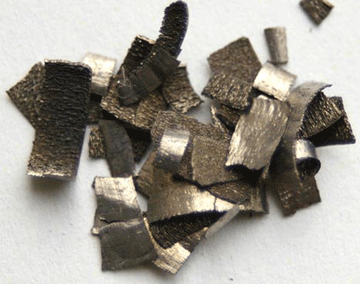 Lynas backs Malaysian waste solution despite removal order, Fin Rev Brad Thompson 6 May 19, Lynas Corporation is pushing ahead with plans to build a permanent disposal facility for low-level radioactive waste in Malaysia despite a contested ultimatum to export about 450,000 tonnes of residue already stockpiled by September.
The Wesfarmers takeover target said on Monday it was confident of meeting conditions outlined by Malaysian prime minister Mahathir Mohamad to ….. (subscribers only) ..https://www.afr.com/business/mining/rare-earths/lynas-backs-malaysian-waste-solution-despite-removal-order-20190506-p51kh2
After a while, the planned South Australian would by more aptly called “A Nuclear Abandonment Site.”
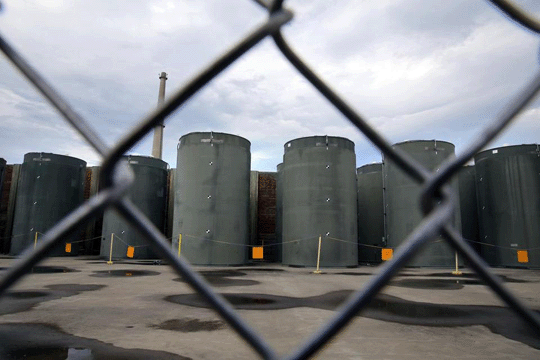 Paul Waldon Fight To Stop Nuclear Waste Dump In Flinders Ranges SA, 6 May 19,
 It is left to rural South Australians to oppose the misguided national plan for nuclear waste dumping
 Dump opponents meet on ‘country in
  between’ https://www.eurekastreet.com.au/article/dump-opponents-meet-on–country-in-between Michele Madigan, 02 May 2019
We are the joy, the sadness, the anger and the peace.’ With these moving words, Adnyamathanha Elders Aunty Enice Marsh and Geraldine Anderson opened a significant gathering in Port Augusta last month. People from the Flinders Ranges and the Kimba farming region, still threatened by the federal government’s plans to deposit the nation’s radioactive waste, met again ‘on the country in between’.
Peter Woolford is the chairperson of the aptly named ‘It Goes Against the Grain’ group of farmers and townspeople of the Kimba region who oppose the dump and its threat to their international grain markets. From his long interview for the 7.30 Report on 28 March, only a few brief words survived the final cut, but he was pleased it was his main point: ‘We’re not activists — I’m a third generation farmer.’
His report to the Port Augusta gathering spoke of much activity, notably that the anti-dump farmers’ stand at the Cleve Field Days had attracted 1000 petitions. Meanwhile, farmer colleague Tom Harris, now on the Kimba Council, provides ‘some balance’ to the otherwise pro-dump farmers/townspeople councillors.
How can serious environmental matters in South Australia become as important in the national consciousness as those in the eastern states?”
Also in April, Friends of the Earth associates, Mara Bonacci and Dr Jim Green, travelled to Port Pirie, Port Augusta, Whyalla and Port Lincoln to meet with councils, election candidates for the Division of Grey, trade unions and Traditional Owners. Months after independent environmental expert David Noonan’s careful study of government documents revealed the ports named to possibly receive the nuclear waste, local people including council members of proposed port towns, still had no idea of this reality.
Younger members of the areas affected are speaking out. Adnyamathanha Candace Champion is standing for the Greens in the coming election. The Kimba young people are asking why they have been given no voice. As Adnyamathanha law student Dwayne Coulthard declares: ‘South Australia is being smashed right now — UCG [Underground Coal Gasification], the Bight and the Nuclear Waste Dump. How do we make this a reality for people?’
Good question! How can serious environmental matters in South Australia become as important in the national consciousness as those in the eastern states? Australia’s intermediate nuclear waste will be dangerous for 10,000 years. As Mara Bonacci explains, ‘It’s Australia’s waste, it’s a national issue, the burden of responsibility shouldn’t fall on two small regional communities.’
The SA Catholic Church recently suffered a great loss at the sudden passing of a key priest, Denis Edwards. Author of many internationally known books on a Christian response to the ecological crisis, Edwards had no hesitation in becoming a No Dump Alliance member: ‘I believe we are called by God to love and to respect this land as a gift, and to protect its integrity for future generations.’Good question! How can serious environmental matters in South Australia become as important in the national consciousness as those in the eastern states? Australia’s intermediate nuclear waste will be dangerous for 10,000 years. As Mara Bonacci explains, ‘It’s Australia’s waste, it’s a national issue, the burden of responsibility shouldn’t fall on two small regional communities.’
The SA Catholic Church recently suffered a great loss at the sudden passing of a key priest, Denis Edwards. Author of many internationally known books on a Christian response to the ecological crisis, Edwards had no hesitation in becoming a No Dump Alliance member: ‘I believe we are called by God to love and to respect this land as a gift, and to protect its integrity for future generations.’Good question! How can serious environmental matters in South Australia become as important in the national consciousness as those in the eastern states? Australia’s intermediate nuclear waste will be dangerous for 10,000 years. As Mara Bonacci explains, ‘It’s Australia’s waste, it’s a national issue, the burden of responsibility shouldn’t fall on two small regional communities.’
The SA Catholic Church recently suffered a great loss at the sudden passing of a key priest, Denis Edwards. Author of many internationally known books on a Christian response to the ecological crisis, Edwards had no hesitation in becoming a No Dump Alliance member: ‘I believe we are called by God to love and to respect this land as a gift, and to protect its integrity for future generations.’
No Dump Alliance is a broad grouping from the SA community, Aboriginal and agricultural representatives. On 29 April, the third anniversary of the day the federal government named Wallerbina, Flinders Ranges as the preferred site, the Alliance called for the scrapping of the present site selection process and the establishment of an independent inquiry to thoroughly explore all the scientifically safe options for management.
The next day, members presented hundreds of petitions to this end to federal member Rowan Ramsey. As Peter Woolford said, ‘Our homes, our communities, our jobs are at risk from this unpopular and unnecessary plan.’
Concerned Australians can offer solidarity by making an online submission here or by writing their own.
Michele Madigan is a Sister of St Joseph who has spent the past 38 years working with Aboriginal people in remote areas of SA, in Adelaide and in country SA. Her work has included advocacy and support for senior Aboriginal women of Coober Pedy in their campaign against the proposed national radioactive dump.
Federal election candidates for Grey express their views on nuclear waste dump plan
 Battle lines drawn in radioactive waste debate, Transcontinental, Amy Green, 1 May 19
Radioactive waste plans have been a topic of contention in Grey for three years so it’s no surprise federal candidates were asked to clarify their views at an election forum at Central Oval on Wednesday.
Battle lines were drawn as current Member for Grey Rowan Ramsey continued with his support to locate a National Radioactive Waste Management Facility at sites in the Flinders Ranges……..
Centre Alliance candidate Andrea Broadfoot rejected plans for the facility to be placed at either of the current proposed sites, a decision welcomed by the Adnyamathanha Traditional Lands Association.
“It is Australia’s responsibility to take care of its own waste,” Ms Broadfoot said.
“We are calling for there to be broad community support … but we haven’t seen a definition of broad community support.
“Barndioota and Kimba are not the places and we need to go back to the drawing board.”
Candidate for Labor Karin Bolton and candidate for United Australia Party Alexander Warren echoed Ms Broadfoot’s sentiments.
Australia’s radioactive waste is currently stored at a purpose-built ‘Interim Waste Store’ at Lucas Heights in new South Wales and has been since 2015.
Nuclear Free Campaigner Dave Sweeney rejected claims by Mr Ramsey that the Australian Radiation Protection and Nuclear Safety Agency (ARPANSA) will no longer licence this facility unless there are plans to relocate the waste by 2022.
“ARPANSA have licensed this facility through to 2055, it requires periodic updates about the status of the government project, but its license is in no way in doubt and for Rowan Ramsey to suggest, state or imply that it is, is incorrect,” Mr Sweeney said.
“His motivation is his to clarify but that statement is incorrect and where it becomes a problem in the current situation is that it could further the pressure on people over saying yes or no to a national radioactive waste dump.
“The really important thing here from the view of the Australian Conservation Foundation is that nuclear medicine in Australia is secure with or without the proposed government facility.
“To create a situation where the person who is elected to represent the one electorate in Australia that is facing this challenge and this issue is putting out information which is demonstrably incorrect. It’s not helpful.”
The selection process for the National Radioactive Waste Management Facility will continue after the May 18 federal election. https://www.transcontinental.com.au/story/6101887/battle-lines-drawn-in-radioactive-waste-debate/?fbclid=IwAR0Pbmh2mUWat1wuglHeuXjIumwnNGD9Alk-Tz_CciFYlmBprO5LfCHJuEk
“Australia’s nuclear waste is a national issue and putting the burden on two semirural communities isn’t fair”
|
Thousands call for SA nuclear dump plans to be scrapped, as Labor remains silent on the issue, The Adelaide Advertiser , 29 Apr 19, More than 3000 people have signed a petition urging the Federal Government to scrap plans for a nuclear dump at Kimba or Hawker. It comes as Federal Labor remains silent on whether it would push ahead with the stalled plans, if it came to power next month. The Hawker and Kimba communities say they are in a “holding pattern” as they await progress on work to select a nuclear dump site, which has ground to a halt amid a legal battle. No Dump Alliance’s Mara Bonacci said campaigners would tomorrow give Grey MP Rowan Ramsey a petition calling for the Government to take sites at Hawker and Kimba off the table. Ms Bonacci said it should introduce “an independent process to look at the best place for waste in SA”. “Australia’s waste is a national issue and putting the burden on two semirural communities isn’t fair,” she said. “They haven’t consulted anybody properly. They’re looking for a postcode, and not the best process.”
However, it was unclear whether a potential change of government might result in an overhaul of the trouble-plagued planning process, as Labor did not respond to The Advertiser’s repeated inquiries about the issue. Aboriginal associations in Hawker and Kimba have opposed a move to set up a radioactive waste dump in their traditional lands. The Barngarla Determination Aboriginal Corporation complained that Kimba Council’s plan to run a community ballot about whether it supported the dump, was discriminatory. It launched Federal Court action, taking issue with the council’s plan to exclude native-title owners from the ballot because they did not live in the district. Kimba Council chief executive Deborah Larwood in January gave evidence in court, but since then, has heard nothing about future proceedings. From the council’s perspective we’re basically in a holding pattern,” Ms Larwood said.
In Hawker, Flinders Ranges Mayor Peter Slattery said his district, too, was “in limbo” until court action — both the Barngarla case and another flagged by the Adnyamathanha Traditional Lands Association (ATLA) — was settled. “I think we’re looking at a pretty long hiatus,” Mr Slattery said. The dump debate had been a “divisive” issue. “Regardless of what happens, there’s not going to be a decision in the next six months and it could be much longer,” Mr Slattery said. The protracted debate was generating “growing frustrations” on both sides of the fence. “Everyone is wearying of the process and the antagonism it’s generated,” Mr Slattery said. Maurice Blackburn senior associate Nicki Lees, representing ATLA, said the Hawker ballot would have excluded a significant number of Adnyamathanha people. The organisation in December lodged a complaint in the Australian Human Rights Commission and was awaiting conciliation. It also claims Commonwealth contractors carried out ground disturbing work in the area, which desecrated land sacred to Adnyamathanha women, causing them “great distress”. Ms Lees said it made sense to await the outcome of the Kimba case before potentially launching ATLA’s own court action. Resources Minister Matt Canavan said the Hawker and Kimba ballots were due last year. “As this matter is before the courts, the Government cannot speculate on when any community ballot may be held,” Mr Canavan said.
|


1 This month
Chernobyl: The Lost Tapes – A good documentary on Chernobyl on SBS available On Demand for the next 3 weeks– https://www.sbs.com.au/ondemand/tv-program/chernobyl-the-lost-tapes/2352741955560
15 April – Zoom –Nuclear Power is Not the Solution
Apr 15, 2026 01:00 AM in Canberra, Melbourne, Sydney

Join the International Physicians for the Prevention of Nuclear War (IPPNW) on Tuesday, April 14th for a timely webinar exploring the risks associated with nuclear power and challenging the myth that it offers a simple, safe, carbon-free solution to the climate crisis

21 April Webinar: No Nuclear Weapons in Australia
Start: 2026-04-21 18:00:00 UTC Canberra, Melbourne, Sydney (GMT+10:00)
End: 2026-04-21 19:30:00 UTC Canberra, Melbourne, Sydney (GMT+10:00)
Event Type: Virtual
A virtual link will be communicated before the event.
Host Contact Info: australia@icanw.org

of the week – Australians for War Powers Reform (AWPR)
To see nuclear-related stories in greater depth and intensity
 Antinuclear