Quietly, nuclear -powered USS Ronald Reagan to Brisabane to join massive Talisman military exercise
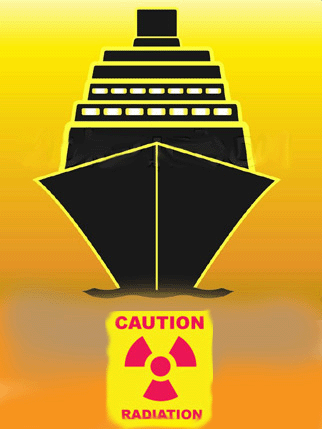 Nuclear-powered USS Ronald Reagan heads into Brisbane, Warwick Daily News Jodie Munro O’Brien, The Courier-Mail | 22nd Jul 2017 “….The USS Ronald Reagan, named after America’s 40th president, was commissioned in July 2003 and has been based in Yokosuka, Japan since late 2015.
The Nimitz class airline carrier – which towers 20 storeys above the waterline, is 334m long and 77m wide – is scheduled to pull into Brisbane for a port visit late Sunday, but no public tours are available.
The flight deck of the nuclear-powered ship is 1.82 hectares (4.5 acres) in size, which is where the approximately 65 aircraft are either parked, or taking off or landing at any time of the night or day at high speeds.
Aircraft attached to the ship, which was about 644km off the coast of Brisbane this week as part of Exercise Talisman Sabre, are US Navy F/A 18 Super Hornets, an E-2 Hawkeye, EA-18 G Growlers, MH-60 R/S Seahawk helicopters and a C-2 Greyhound.
Even with ear plugs, a helmet and additional ear protection on, the noise on the flight deck from the mostly hornets taking off every minute or two can still sound like a powerful, giant vacuum cleaner.
A steam-powered catapult system helps launch most aircraft off the ship in what feels like a human slingshot, sending a plane from zero to hundreds of km/hr in mere seconds…..
On top of being a mobile military airport, the USS Ronald Regan is its own floating city, with at least 5000 sailors on board at any time……
Talisman Sabre is a biennial joint Australia-United States military exercise that started in June.
This year it involves more than 33,000 mostly Australian and US troops, 20 ships and more than 200 aircraft, with the majority of the mock war taking place in and around Shoalwater Bay in Central Queensland. https://www.warwickdailynews.com.au/news/nuclear-powered-uss-ronald-reagan-heads-brisbane/3203549/
Australia should join UN nuclear weapons ban treaty, when it opens in September

 Aust on ‘wrong side’ of nuclear weapon ban http://www.heraldsun.com.au/news/breaking-news/aust-on-wrong-side-of-nuclear-weapon-ban/news-story/be98118f29f512aad05aac1134546ad4, Belinda Merhab, Australian Associated Press, July 8, 2017 Australia is accused of being on the wrong side of history after ignoring a United Nations vote to ban nuclear weapons.
If North Korea attacks USA with nuclear warhead, Australia will join US in fight – Deputy PM Barnaby Joyce
Australia will join US in fight against North Korea if war breaks out, Yahoo News, JULY 6, 2017 Australia would join military action against North Korea if the rogue nation fires a nuclear warhead at the United States, acting Prime Minister Barnaby Joyce has confirmed.
As Malcolm Turnbull heads to Germany for talks with other G20 leaders, Mr Joyce is ramping up pressure on China to step in and “stop this madness”.
His call comes after US ambassador to the United Nations Nikki Haley warned that America would use force “if we must” against North Korea, after Pyongyang tested an intercontinental ballistic missile (ICBM) with the potential to reach Darwin or Alaska.
“No one should ever go too far in testing the resolve of the United States of America,” Mr Joyce told Sky News on Thursday.
“If North Korea was to deliver a warhead into the United States of America then the ANZUS alliance would be called in.”……One of Australian’s most senior military commanders insists the risk of a strike on the country’s north by North Korean remains low.
Chief of Joint Operations Vice Admiral David Johnston says that despite Pyongyang’s aggressive demonstrations, the range and capability of the missile launched this week is still to be determined.
“There is very little risk at the moment to the northern part of our country,” he told reporters in Canberra……Given the low threat to Australia’s mainland, Vice Admiral Johnston says there hasn’t been an immediate focus on amassing a system to defend against missiles.
The focus now was on applying diplomatic pressure on North Korea to stop their nuclear program and the development of missile technology.
“Where there’s emerging issues that require military support, the ADF has the capability to provide the government (with) options and we’re able to do so.” https://au.news.yahoo.com/a/36295225/australia-will-back-us-if-nuclear-war-breaks-out-with-north-korea/#page1
PM Turnbull says THAAD anti- missile system is “not really suitable” for Australia
US anti-missile system THAAD ‘not really suitable’ for Australia http://www.afr.com/news/world/us-antimissile-system-thaad-not-really-suitable-for-australia-20170707-gx781e, 8 Jul 17 Australia is developing defences against missile attack but the US THAAD anti- missile system is “not really suitable” for Australia, Prime Minister Malcolm Turnbull says.
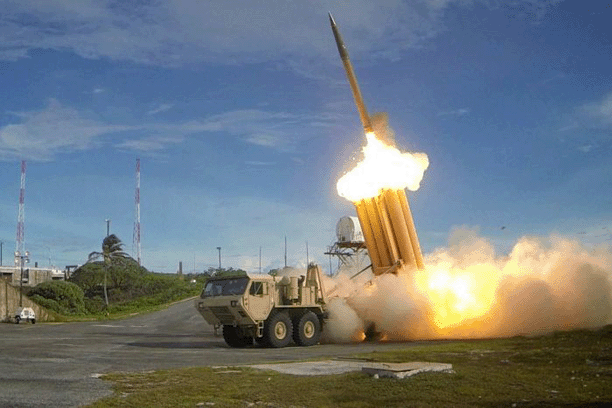 When asked about a possible Australian missile defence system against such threats as a North Korean intercontinental ballistic missile, Mr Turnbull said the Australian focus was on protecting deployed forces in the field.
Speaking to reporters in Hamburg, where he’s attending the G20 summit, the prime minister said the answer to the Korean threat was the denuclearisation of North Korea.
“We are developing missile defences … but the focus is on protecting our deployed forces in the field.”
Mr Turnbull said that in terms of a missile defence shield for Australia there had been talk of the THAAD system. “That’s not really suitable for our situation but I can assure you we are constantly examining how we can ensure that Australians are safe.”
Former PM Kevin Rudd now suggesting missile defence system for Australia
 Australia should consider missile defence to counter North Korea: Kevin Rudd, The Age, Peter Hartcher, James Massola, 8 Jul 17
Australia needs to consider deploying a missile defence system to defend against attack from nuclear-armed North Korea, according to former prime minister Kevin Rudd. Mr Rudd has reversed the position he held in office, saying that North Korea’s newly demonstrated ability to reach northern Australia meant it was time to consider homeland defence.
And top regional security and defence experts have backed that call, arguing Australia and its regional allies must invest heavily in missile defence as the “only alternative”.
A roll out of the US-made Terminal High Altitude Area Defense (THAAD) missile defence system began in South Korea but was suspended last month, amid objections from China and Russia.
North Korea’s recent provocative launch of an intercontinental ballistic missile potentially brings Darwin and the US states of Alaska and Hawaii in range – though their missile’s accuracy remains in question – and has prompted dire warnings from the United States ahead of the G20 meeting in Hamburg, where it is set to dominate discussions.
The Rudd government’s Defence White Paper of 2009 explicitly opposed missile defence for Australia, as “such a system would be at odds with the maintenance of global nuclear deterrence,” the paper said, though it signalled an annual review.
On Friday, the former prime minister said: “Given North Korean developments, Australia would be well advised to begin analysing ballistic missile defence needs, available technologies and possible deployment feasibility for northern Australia.”
On Friday, the former prime minister said: “Given North Korean developments, Australia would be well advised to begin analysing ballistic missile defence needs, available technologies and possible deployment feasibility for northern Australia.”……. http://www.theage.com.au/federal-politics/political-news/australia-should-consider-missile-defence-to-counter-north-korea-kevin-rudd-20170707-gx6t0u.html
Greens Senator Scott Ludlam at nuclear weapons ban treaty talks
Ludlam, not Australia, in New York for nuclear weapons ban treaty talks, Greens Senator Scott Ludlam has slammed Australia for not taking part in talks on a global ban on nuclear weapons. By Andrea Nierhoff, SBS News, 6 July 17, Senator Ludlam is in New York with delegates from 120 countries to discuss a treaty to ban nuclear weapons around the world.
UN poised to adopt nuclear weapons ban treaty today
 The United Nations is set to adopt a global treaty to ban nuclear weapons (Friday 7 July (New York time)) – a long-awaited historic event marred by Australia’s boycott of negotiations.
“This is the biggest step towards nuclear disarmament that we have seen since the end of the Cold War,”  said Associate Professor Dr Tilman Ruff, the Melbourne-based founding chair of the International Campaign to Abolish Nuclear Weapons (ICAN), who is attending the UN talks in New York.
“It comes at a time of growing international nuclear tension, where the risks of armed conflict escalating to the use of nuclear weapons is real and would be a humanitarian and environmental disaster,” he said.
“Pressure must now build on Australia to sign up to the treaty, as it has to treaties for the elimination of other weapons of mass destruction – biological and chemical, and other inhumane indiscriminate weapons such as landmines and cluster munitions.”
More than 130 nations are involved in the UN talks, including New Zealand and Indonesia, but Australia, at the behest of the United States, has boycotted the process. It is the first time ever that Australia has not participated in multilateral disarmament negotiations.
“If passed today, the treaty will stigmatise possession of nuclear weapons by any state, provide a source of legal, political, ethical, economic and civil society pressure on nuclear armed states to disarm, and encourage financial institutions to divest from companies that produce nuclear weapons,” said Tim Wright, Asia-Pacific director of ICAN.
“Of vital interest to Australia and the Pacific, it will also promote addressing the rights and needs of victims of nuclear use and testing, and of remediating contaminated environments,” he said.
“By failing to be involved in these negotiations, Australia has relinquished its responsibilities to its own Indigenous people, and to many others affected by nuclear testing in our region,” Mr Wright said.
Media please note:
Delegates at the UN will decide on Friday —by acclamation or vote—whether to adopt the treaty. If adopted, as is expected, it will open for signature on September 20, after which states will pursue ratification. Once 50 states have completed this process, the treaty will become binding international law.
ICAN Australia and Pacific representatives are available in New York and Australia for interviews, before and after the treaty’s expected adoption on Friday, New York time (likely Saturday morning, Australian time).
Video footage is available of addresses to the UN treaty conference plenary session (Thursday NY time) by: Australian Greens Senator Scott Ludlam, Vanessa Griffen (Fiji), FemLINK Pacific, ICAN Asia-Pacific director Tim Wright.
North Korea’ latest intercontinental ballistic missile would be able to hit Darwin
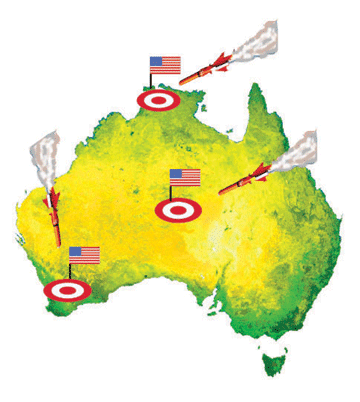 Australia now within range of new North Korean missile, as calculations show it could fly far enough to hit Darwin
- The ‘landmark’ test of a Hwasong-14 missile was overseen by leader Kim Jong-Un
- It was fired from a site in the North Phyongan province into the Sea of Japan
- It is believed to have reached an altitude of 2802 km and flew 933 km
- The North has long sought to build nuclear missiles capable of reaching the US
- Weapons analysts say the missile has the capability to travel up to 6,700km
- Darwin is only 5,750km from Pyongyang, putting Australia into the firing line
Experts say the missile could reach a maximum range of 6,700km on a standard trajectory, meaning it would be able to hit Darwin, which is 5,750km from Pyongyang.
David Wright, of the Union of Concerned Scientists, wrote on the organisation’s allthingsnuclear blog that the available figures implied the missile ‘could reach a maximum range of roughly 6,700 km on a standard trajectory’.
‘That range would not be enough to reach the lower 48 states or the large islands of Hawaii, but would allow it to reach all of Alaska.’ …………http://www.dailymail.co.uk/news/article-4664328/Australia-range-new-North-Korean-missile.html#ixzz4ltt8SE9M
Even pro nuclear THE AUSTRALIAN pours scorn on Tony Abbott’s nuclear submarine call
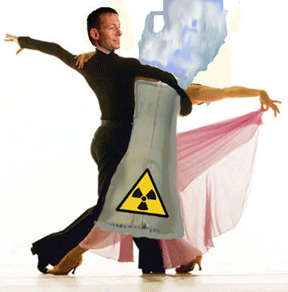 Idea of an Australian nuclear submarine fleet just won’t float, http://www.theaustralian.com.au/news/inquirer/idea-of-an-australian-nuclear-submarine-fleet-just-wont-float/news-story/dd5123c0be52dffb4ec161dd2789be3c, 29 June 17 “…..Abbott’s proposal is also completely unrealistic and, if it gains any traction, can serve only to inject yet new delay into the already insanely slow process of our acquiring new subs.
……..Nuclear-powered subs are vastly more formidable than conventionally powered subs. As Julia Gillard was occasionally wont to point out, submarines are so important in modern warfare partly because they are an asymmetrical weapon.
They can do enormous damage and they require enormous effort from an adversary to detect and destroy. The key to their lethality and their asymmetry is their stealth. You never quite know where the buggers are. Because nuclear subs have an almost infinitely greater submerged range than conventional subs, not to mention being able to carry a much greater payload, they pose a much bigger threat.
………With characteristic and refreshing directness, Abbott tells us what a sub’s main role is: “To inflict massive damage on an enemy’s ability to wage war.”
……. Abbott established definitively that, starting from a position of great strength, he could not sustain a project to buy subs that were built overseas. Now that Adelaide has been solemnly promised, by both sides of politics, that our new subs will be built there, what possible basis is there for imagining that any government could break this promise and survive? Nuclear subs could not be built in Adelaide.
……Even if magically we did make a national commitment to nuclear subs tomorrow, it would take 10 to 20 years for us to acquire the expertise and build the infrastructure, if the Americans would agree to supplying it at all, another initial hurdle that would take years to jump. If we did ever go down the nuclear sub road, it would involve very heavy reliance on the US for an extended period.
……Those in the Coalition who think a leadership change would save them are mistaken, just as the past leadership change did not save them. The Liberals need to rediscover their direction and their leader needs to reunite them. …. http://www.theaustralian.com.au/news/inquirer/idea-of-an-australian-nuclear-submarine-fleet-just-wont-float/news-story/dd5123c0be52dffb4ec161dd2789be3c
Australia’s Karina Lester at United Nations conference on a nuclear weapons ban treaty
 South Australian woman Karina Lester presents anti-nuclear speech to United Nations in New York http://www.adelaidenow.com.au/news/south-australia/south-australian-woman-karina-lester-presents-antinuclear-speech-to-united-nations-in-new-york/news-story/be7b9ecb4ae5e0f0c568908f117c4be9 Erin Jones, The AdvertiserJune 23, 2017
KARINA Lester’s family remembers the ground shaking and a black mist rolling towards them when nuclear tests were carried out at Emu Field, in the state’s Far North. The residents of Walatina community, 150km south of the explosion, were given no notice of the British tests, in 1953, but they would suffer from lifelong health affects.
Her father, Yankunytjatjara elder Yami Lester, became blind as a result of the testing, while others suffered skin infections, auto-immune diseases and severe vomiting.
Ms Lester shared the poignant story with world leaders in New York this month in a four minute address to the United Nations conference on a nuclear weapons ban treaty. “It was certainly a once-in-a-lifetime opportunity to present to the UN,” Ms Lester said. “It’s really important to be able to share these stories otherwise we forget. “We learn so much about world wars but we don’t hear the history of what happened here.”
The treaty talks have been supported by more than 120 countries, but Australia and those with nuclear powers, including Russia and the United States have boycotted the conference.
Countries which signed the treaty would be forbidden from developing or manufacturing nuclear weapons and they would need to get rid of any weapons they already possess.
“It was disappointing as an Australian person to speak about what happened in our own backyard, when your country wasn’t even in the room,” Ms Lester said.
“This is an opportunity for nations to get together and completely ban nuclear weapons, instead of spending trillions of dollars to improve their technology.”
Ms Lester, of North Plympton, also took part in sessions with Hiroshima survivors to further share stories of the how nuclear weapons affect humanity.
“You can’t help but be moved when you hear those stories from people who survived and what they remember from when the blast when off,” she said.
Talks on the global treaty to outlaw nuclear weapons conclude on July 7.
What tests go on at Woomera – ‘the largest land testing range in the world’ ?
What IS the army testing in the South Australian desert? Mysterious mushroom cloud erupts over historic Woomera range just after a drone flying near the secretive site was ‘forced to the ground’ http://www.dailymail.co.uk/news/article-4616616/Mystery-mushroom-cloud-erupts-Woomera-range.html By Bryant Hevesi For Daily Mail Australia
A man has captured image of ‘mushroom cloud’ near Lake Hart, South Australia Jason Wright said loud explosion occurred after his drone was forced to ground . The cloud formed over the Woomera Prohibited Area, used for military testing The prohibited area is known as ‘the largest land testing range in the world’
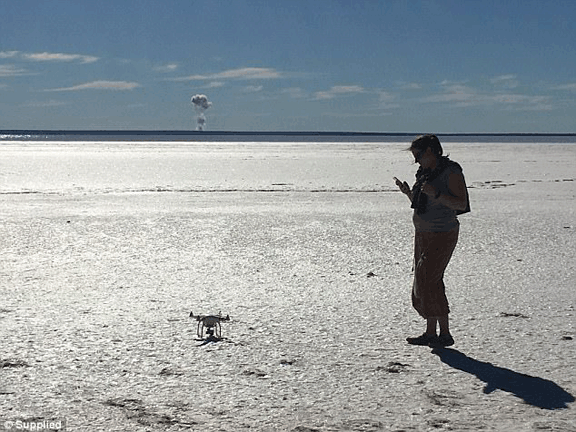
Jason Wright snapped images of the cloud shortly after he says his drone was forced to the ground prior to hearing a loud explosion while he was near the testing range.
Mr Wright told Daily Mail Australia he had stopped off along the Sturt Highway with his partner and children to see Lake Hart on Saturday when the unusual incident occurred. The experienced drone flyer had set-up his drone to take photos near the Lake Hart tourist rest area on the edge of the salt lake when he says it came down out of his control and made a hard landing.
Mr Wright, who lives in Coober Pedy, believes the drone’s GPS-based tracker may have been interfered with. About a minute after the drone fell, a ‘fireball’ erupted in the far distance, estimated to be as high as a 30-storey building, with the ‘mushroom cloud’ forming.
‘It was quite a spectacular explosion. It was very bright and there was a lot of heat in it,’ he said.
Mr Wright said despite criticisms he should not have been flying a drone in the area, he said the Civil Aviation Safety Authority’s ‘Can I fly there?’ app showed was able to have a drone up to 45 metres where he was standing.
The Woomera Prohibited Area ‘is used for the testing of war materiel’ and is ‘the largest land testing range in the world’.
Exclusion zones are in place at various locations within the prohibited area at different times of the year while military equipment is tested.
One is currently in place until June 30.
In a statement to Daily Mail Australia, the Department of Defence said: ‘No weapons were being tested; the activity was a demolition of war materiel’.
Defence did not carry out any action to impact the unmanned aircraft,’ the statement said.
‘Defence carries out operations for the testing of war materiel within the Woomera Prohibited Area. This includes capability being developed and tested for use for defence purposes. The photograph was the result of the demolition of war materiel.
‘An unauthorised person must obtain a permit or approval to enter the Woomera Prohibited Area.
‘In addition to the entry requirements, all unmanned aerial vehicle or remotely piloted aircraft operators must comply with the requirements of Part 101 of the Civil Aviation Safety Regulations 1998, this includes requirements associated with operating within a designated restricted area (for the purpose of regulation 6 of the Airspace Regulations 2007).
‘The Woomera Prohibited Area includes restricted areas for the purposes of the Airspace Regulations 2007 and these areas may be active during periods of defence testing activities.’
Senator Scott Ludlam asks inconvenient questions about Australia’s role in nuclear weapons ban negotiations
Senator LUDLAM: …I want to turn to the opening day of the nuclear weapons ban treaty negotiations, 27 March this year. Having failed to prevent these negotiations occurring, the Trump administration’s ambassador to the UN held a protest outside the UN General Assembly Hall. Did Australia participate in the protest?
Senator LUDLAM: So we just stood there in mute solidarity with the Trump administration? As 130 UN member states started serious work on negotiating a nuclear weapons ban treaty, we were outside the room in a protest?
It is a shame that there will be no Australian representatives at the UN because these talks are scheduled to conclude at the end of June or early July
 FOREIGN AFFAIRS, DEFENCE AND TRADE LEGISLATION COMMITTEE, UN – Nuclear Weapons Ban, 31st May 2017 http://parlinfo.aph.gov.au/parlInfo/download/committees/estimate/0a6ef7dd-2f88-423a-a01b-23b5c5b4e4c0/toc_pdf/Foreign%20Affairs,%20Defence%20and%20Trade%20Legislation%20Committee_2017_05_31_5055.pdf;fileType=application/pdf
Pg- 20
Senator LUDLAM: Can I speak to someone on the UN Conference to Negotiate a Legally Binding Instrument to Prohibit Nuclear Weapons?
Senator LUDLAM: Can I speak to someone on the UN Conference to Negotiate a Legally Binding Instrument to Prohibit Nuclear Weapons?
Mr Sadleir: Yes, Senator.
Senator LUDLAM: It is good that you are here, Mr Sadleir, because I want to ask a couple of questions about a meeting that occurred between 4 and 8 July 2016 that I understand you were present at. You and Ms Jane Hardy travelled to Washington, DC to meet with a range of, I understand, quite senior State Department and National
Pg – 21
Security Council people to discuss what was then referred to as the UN open-ended working group on nuclear disarmament. Can you confirm for us on the record that that meeting occurred and that you were in attendance?
[Here it took an extraordinarily long time for Mr Sadleir to admit that he was at this meeting]
‘……..Senator LUDLAM: I have not asked what you discussed yet. Were you in attendance at that meeting? Mr Sadleir
? Mr Sadleir: I was certainly in Washington. I would need to check my diary to get the precise dates but I was certainly there around that time.
Senator LUDLAM: I think that what will happen when you check the dates is that you will come back and confirm that you were in fact there. I will let you check the record. I would appreciate that. What was the purpose of those meetings? Continue reading
Australia’s diplomats called “weasels” on Australia’s stand against nuclear weapons ban treaty
Anti-nuclear campaigners are scathing.
“Australia’s disruptive behaviour at the working group only served to isolate us from the vast majority of nations who are now working to ban nuclear weapons at the United Nations,” said Gem Romuld from ICAN.
“Australia’s moves backfired when the working group voted overwhelmingly in support of a ban; it was a wake-up call for DFAT.
“Australia is standing with the Trump administration and clinging to the dangerous concept that these weapons of mass destruction make us safe
Australia’s stance on the nuclear weapons ban treaty – and why our diplomats were labelled ‘weasels’, ABC News By political reporter Stephen Dziedzic 3 June 17 Scott Ludlam ……….”Weasels. They called us weasels.”Did other delegates refer to the Australian delegates as weasels?”
It was an unusual question, but officials from the Department of Foreign Affairs and Trade (DFAT) sitting opposite the Senator did not look confused. They knew exactly what he was talking about.
And the exchange that followed briefly illuminated the most recent global negotiations to end nuclear weapons — and Australia’s role in them.
What’s the new agreement?Right now, more than 120 nations are trying to introduce a ban on nuclear weapons. A United Nations panel has now released a draft treaty. States who sign it would be forbidden from developing or manufacturing nuclear weapons. They would also have to get rid of any weapons they already possess.
The treaty’s champions argue the proliferation of nuclear weapons is an existential threat to humankind. And they say the woeful pace of global disarmament proves there is a compelling need for a new agreement that would exert moral pressure on states to disarm.
But there are plenty of problems.
First, none of the nine nuclear powers — including the US, Russia, China and the UK — support the new treaty.
Neither does Australia. The Federal Government has refused to take part in the treaty negotiations.
Why does Australia oppose the ban treaty? First, Australia argues that the treaty ignores geopolitical reality. Hardheads in the Government say that while everyone would like to see a world without nuclear weapons, the strategic environment is actually becoming more volatile and dangerous.They argue the US nuclear umbrella provides vital deterrence, and protects Australia.
For example, DFAT talking points obtained by the International Campaign to Abolish Nuclear Weapons (ICAN) say Australia “must be realistic about the environment in which we operate — North Korean provocations and nuclear tests are a case in point”……….
Why were we called the weasels? Continue reading
Australia’s nuclear lobby keen to have new submarines transformed to NUCLEAR submarines
 Did you wonder why the Australian government chose to buy the much more expensive French submarines, rather than the cheaper and probably more suitable German ones?
Well, what’s $50 billion from the public purse matter, if your government, kow-towing as always, to ANSTO and the nuclear lobby, can arrange to buy submarines that are designed as nuclear submarines, but have them “not nuclear” at the start, and then later transforfm them back to nuclear.
Not too late to fit nuclear power into Australian submarines, http://www.theaustralian.com.au/national-affairs/defence/not-too-late-to-fit-nuclear-power-into-australian-submarines/news-story/00cb486799368120ae592e737701beb9 THE AUSTRALIAN, Malcolm Davis, 15 May 17, Is it time to begin a discussion on nuclear-powered submarines (known as SSNs) for the Royal Australian Navy? Continue reading
The military connection to the push for advanced nuclear reactors in South Australia
With a nuclear waste dump in South Australia that accepts international shipments, the full range of the “nuclear industry” in the state would be complete, truly making it the “Defense State” that has become the state motto.[9]
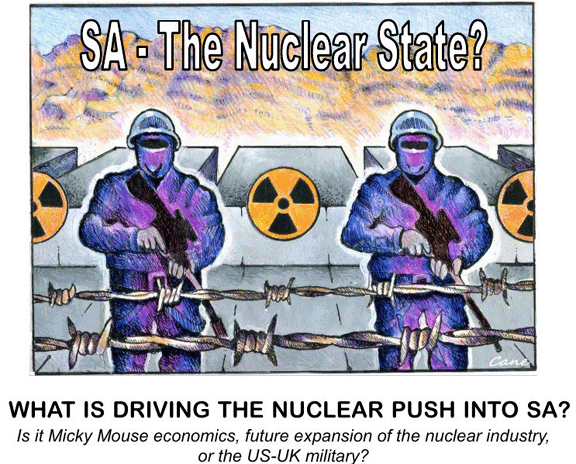
 SOUTH AUSTRALIA’S NUCLEAR MILITARY-INDUSTRIAL COMPLEX: THE GLOBAL CONTEXT, Spirit of Eureka ,Talk by David Palmer at “SA The Nuclear State” forum 03 May 2017 “……..If citizens – the people – whether they are in the Fukushima region of Japan or in Adelaide, South Australia – have a right to speak out on the dangers of the nuclear industry, then who are the elites promoting the nuclear industry? If we look at prominent figures in government the institutional linkages become all too clear. Consider the example of Kevin Scarce, Governor of South Australia until 2014, a Rear Admiral retired from the Royal Australian Navy, current Chancellor of the University of Adelaide, and Deputy Chairman of Seeley International, the largest air conditioning company in Australia that is known for energy-efficiency. Scarce led the Nuclear Fuel Cycle Royal Commission and was the primary author of the report that recommended the South Australian government accept a nuclear waste dump. All the links are there in Scarce’s connections and positions: military, university, corporate, and government.
Furthermore, the Royal Commission did not focus solely on a nuclear waste dump. It considered possible expansion of nuclear industries in the state that encompassed mining, enrichment, and power generation. The Royal Commission report states that “The activity under consideration is the further processing of minerals, and the processing and manufacturing of materials containing radioactive and nuclear substances (but not for, or from, military uses) including conversion, enrichment, fabrication or reprocessing in South Australia.”[3]
But during the time this Royal Commission report was being prepared and finally delivered, Adelaide became the focal point for naval shipbuilding contracts, particularly submarines. Both Labor and Liberal politicians sought to outdo each other in pushing for submarines to be built in Adelaide. They will be diesel powered, but the majority of submarines internationally use nuclear power propulsion. Potential overseas contractors also use designs geared for nuclear power. There are those in Australian naval circles who would like to see these Australian subs with nuclear, not diesel, power. And where will these submarines be used, and with what international interests? We know the answer to that question, as recent events in the Western Pacific have confirmed. The USS Carl Vinson, the nuclear powered air craft carrier, was on exercises in the Indian Ocean in early April with Australia’s HMAS Ballarat, when it was ordered to the Korean peninsula this month in response to the North Korean threat to explode a nuclear bomb.[4] This latest development is just one example of the escalating naval tensions on our side of the Pacific. Crises like this will potentially increase pressure for Australia to build submarines – and possibly other naval vessels – that are nuclear powered.
What does the corporate profile of the “nuclear industry” look like? Continue reading
1 This month

of the week – Australians for War Powers Reform (AWPR)
To see nuclear-related stories in greater depth and intensity
 Antinuclear