At a G7 summit high on ambition, nuclear disarmament takes a backseat to Zelensky’s diplomatic appeals

Picture above is from Zelensky’s previous visit to Washington, but it’s the same idea.
The Conversation, May 21, 2023 Donna Weeks, Professor of Political Science, Musashino University
Hiroshima, the site of this year’s G7 summit, is one of just a handful of places in the world that provides a stark reminder of the horrors of war.
The A-bomb Dome in the Hiroshima Peace Memorial Park, for example, is one of few structures left standing in the neighbourhoods that were flattened by the atomic blast in August 1945. Around the city, there are also “survivor trees” from the blast and burn marks on temple stoneware and statues – reminders of how far and wide it radiated.
It is no surprise that Japanese Prime Minister Fumio Kishida chose Hiroshima as the setting for the 2023 G7 meeting. Not only are his electoral constituency and family roots located here, he is also an advocate of a nuclear weapons-free world.
And there were hopes the meeting could spur further action towards this ultimate goal of global nuclear disarmament. Kishida said ahead of the meeting,
I believe the first step toward any nuclear disarmament effort is to provide a first-hand experience of the consequences of the atomic bombing and to firmly convey the reality.
Ukraine takes priority
It wasn’t to be. Though the final communique from the summit did make a vague commitment toward a “Hiroshima Vision” for nuclear disarmament, it took a backseat to the main headline from the weekend – the continued global support for Ukraine in its war against Russia.
An “unscheduled” visit by Ukrainian President Volodymyr Zelensky certainly raised the stakes for the summit at a critical time in the war.
On Friday evening, the leaders released a strongly worded, six-page statement on Ukraine, which reaffirmed their commitment “to stand together against Russia’s illegal, unjustifiable and unprovoked war of aggression against Ukraine” and condemned “Russia’s manifest violation of the Charter of the United Nations and the impact of Russia’s war on the rest of the world”.
But it was the potential impact of the in-person attendance that might amplify the otherwise rhetorical words of the summit leaders………………………
Zelensky’s opportunity to make a direct appeal to the leaders may end up being the key statement of the summit, distinguishing it from previous gatherings……………………………………………….
Inevitably, at each G7 Summit, there are calls for a review of its purpose. Originally an “informal” grouping of the world’s leading economies, it has become, like the UN Security Council, an institution of a different time. It is somewhat of an anachronism, no longer representative of today’s global economy.
…………………………………….. This summit will be most likely be remembered for Zelensky’s visit and the message it intended to send to Russia. But as leaders make their journeys home, wars will continue and all we are left with are the platitudes that will carry over to the next G7 Summit in 2024.
As for the ageing hibakusha, the survivors of the 1945 atomic bomb in Hiroshima, this may have been their last major opportunity to press for an end to nuclear weapons. https://theconversation.com/at-a-g7-summit-high-on-ambition-nuclear-disarmament-takes-a-backseat-to-zelenskys-diplomatic-appeals-205829
G7 Desecrates Hiroshima A-Bomb Memory With Warmongering Summit.

Strategic Culture Editorial May 19, 2023
The Group of Seven held a de facto war summit in Hiroshima, a place that is synonymous with the horror and evil of war.
The United States-led “Group of Seven” cabal held one of their increasingly meaningless jamborees this weekend in the Japanese city of Hiroshima. The posturing of solemnity by these warmongering elites in a place that represents the ultimate barbarity of American imperialism is not only sickening in its hypocrisy and profanity. The evident lack of awareness and shame of these charlatans is a sure sign that their privileged historical charade is coming to an end……………..
The proceedings began with a cynical and disingenuous “dedication” at the Hiroshima Peace Park whose centerpiece is the Genbaku Dome, the iconic spectral ruin caused by the U.S. atomic bombing in 1945. The very gathering of leaders at this sacred place is the same people who are criminally pushing the world toward another conflagration.
Biden and his cronies soon dispensed with hollow talk about “peace” and “nuclear disarmament” to make the G7 summit a rallying call for more hostility toward Russia and China………. There were pledges of supplying more weapons to the powder keg that the U.S. and its NATO partners have created in Ukraine. There were high-handed dismissals of international diplomatic efforts to resolve the conflict, which have been proposed by China, and Latin American and African nations.
The U.S.-led G7 camarilla also made their hate fest a forum for drumming up more hostility toward China, accusing Beijing of building up nuclear arms and threatening the world.
In short, the Group of Seven held a de facto war summit in Hiroshima, a place that is synonymous with the horror and evil of war.
Seventy-eight years ago, on the morning of August 6, 1945, at 8.15 am, the US Air Force Enola Gay B-29 bomber dropped the atomic bomb on the city. The resulting death toll would be 140,000, mainly civilians, many of them instantly incinerated, others dying from horrendous burns and radiation poisoning. A second bomb was dropped on Nagasaki three days later.
History has shown that there was no military need to use such weapons of mass destruction. Official American reasoning ostensibly about hastening the end of the Pacific War can now be seen as a flagrant lie. The bombs were deliberately used by the United States in a demonstration of state terrorism especially directed at its wartime ally, the Soviet Union. Arguably, these grotesque genocidal crimes sealed the beginning of the Cold War. This horrific demarcation was how the U.S.-led Western imperialist system would try to control the postwar world.
…………. The ideological projection also casts a narcissistic image of America and its Western allies as benevolent, peace-loving, democratic, law-abiding, and so on. It’s an almost incredible feat of global gaslighting and inversion of reality; made possible largely by mass disinformation via the Western corporate media/propaganda system.
Thankfully, that charade is becoming threadbare too.
One indicator this week was a study by the respected Brown University’s Cost of War project which estimated the number killed just over the past two decades from U.S.-led wars at 4.5 million. All told, since the end of World War Two estimates of deaths from American wars of aggression around the world are in the order of 20-30 million. No other nation in history comes close to the destructiveness of U.S. power, which laughably declares itself the “leader of the free world”, the “democratic upholder of rules-based order”……………………………………………………
In any case, the G7 is becoming a global irrelevance. It is a relic of former American imperial might. The “rich club” used to command half of the world’s economy, it is now down to 30 per cent and falling. The emerging multipolar world led by China, Russia, the Global South and many others, the BRICS, ASEAN, ALBA, EEA, SCO, are all testimony to the waning American Empire and its rapidly declining dollar dominance. The G7 doesn’t even make any pretence about helping the global economy and development. It has become a bellicose vehicle emitting desperate warmongering by a crumbling hegemonic system.
Only in the fairytale realm of Western media/propaganda could such a vile charade at Hiroshima be projected. To the rest of the world, it is utterly sickening. https://strategic-culture.org/news/2023/05/19/g7-desecrates-hiroshima-a-bomb-memory-with-warmongering-summit/
Ukrainians forced by Russia to retreat from Artyomovsk (Bakhmut) , their supposed ‘fortress’ in Donbass
RT.com By Vladislav Ugolny, a Russian journalist born in Donetsk 21 May 23
The battle for Artyomovsk (called Bakhmut by the Ukrainians) began in August 2022, and gradually turned into the epicenter of fighting between Russia and Ukraine. While other parts of the front remained relatively stable, both sides actively brought forces to this small city. For Kiev, which in May 2022 suffered a defeat at Azovstal that helped undermine its image, Artyomovsk became the new Mariupol. Ukrainian propaganda labeled it ‘the Bakhmut Fortress’, and attempted to give an air of heroism to those fighting there.
………………………………………………………. The importance of the city grew tremendously after the start of Russia’s military operation in February 2022. Initially, when Russian troops broke the first line of fortifications in the area of Popasnaya, Zolotoye, and the Lisichansk-Severodonetsk agglomeration, Artyomovsk was an important transport hub. It kept the Ukrainian front line connected with the rest of the country.
After the Russians managed to break this line of defense and completely removed Kiev’s forces from the territory of the Lugansk People’s Republic (LPR), Artyomovsk went from being a transport hub to becoming Ukraine’s second line of defense around the Bakhmutka River. This strip ran from Ukrainian positions opposite Gorlovka – since 2014 controlled by the Donetsk People’s Republic (DPR) – in the south up to Seversk in the north, running straight into the Seversky Donets, the main river in Donbass.
Artyomovsk could not have been taken without this line of defense being broken. Since July 2022, PMC Wagner fighters have been focused on doing just that, preparing the ground for a successful encirclement of the city.
………………………………………………………………………………………………………………………………………………………………… the more than nine-month-long battle for Artyomovsk permanently changed the perception of the conflict, forcing both Ukraine and Russia to abandon any ideas of a fast-paced campaign or deep breakthroughs.
The battles discussed in this article took place barely 30 kilometers deep into the frontlines. In conditions of summer heat, fall mud, and winter frost, it largely resembled the First World War. According to Prigozhin’s estimates, the liberation of the entire territory of the Donetsk People’s Republic will take another one and a half to two years.
However, significant Ukrainian forces still remain to the west of Artyomovsk, having seized a number of positions during the May counteroffensive. They have established a foothold in Chasov Yar and hold the line between Krasnoye and Minkovka, thus preventing Russian forces from stabilizing the front along the Seversky Donets-Donbass canal. With the Russian flag flying over Artyomovsk and Russian soldiers in full control of the battlefield, the Russian priority now is to inflict maximum damage on the Ukrainian forces massed for the counteroffensive, and drive them out to the western bank of the canal. https://www.sott.net/article/480462-Victory-Ukrainians-forced-by-Russia-to-retreat-from-Artyomovsk-their-supposed-fortress-in-Donbass
US hopes to snatch victory from jaws of defeat in Ukraine
Indian Punchline BY M. K. BHADRAKUMAR
The G7 Leaders’ 2700-word statement on Ukraine, issued in Hiroshima after their summit meeting glossed over the burning question today — the so-called counter-offensive against the Russian forces.
It is a deafening silence, since rumours are swirling about the disappearance of the commander-in-chief of Ukraine’s armed forces. Significantly, President Vladimir Zelensky himself is making himself scarce from Kiev touring world capitals — Helsinki, Hague, Rome, Vatican, Berlin, Paris, London and Jeddah and Hiroshima. It does seem that something is rotten in the state of Denmark.
As the G7 summit ended, the head of the Wagner PMC, Yevgeny Prigozhin announced on Saturday that the Russian operation to capture the strategic communication hub of Bakhmut in Donbass region of eastern Ukraine lasting 224 days, has been brought to a successful completion, overcoming the resistance by more than 80,000 Ukrainian troops.
It is a painful moment for Zelensky, who had boasted before US lawmakers in Capitol Hill last December that “just like the Battle of Saratoga (in 1777 during the American Revolutionary War), the fight for Bakhmut will change the trajectory of our war for independence and for freedom.”
Meanwhile, to distract attention, there is talk now about a subtle shift in the US policy regarding supply of F-16 fighter jets to Ukraine in an indeterminate future. In reality, though, no one can tell what the Ukrainian rump state will look like when the jets arrive. Unsurprisingly, the Biden Administration still seems to be in two minds. F-16 is a hot item for export; what happens if the Russians were to blow it out of the sky with their hi-tech weapons and rubbish its fame ?
The Russians seem to have concluded that nothing short of a total victory will make the Americans and the British understand that Moscow means business on the three objectives behind the special military operations that are non-negotiable: security and safety of the ethnic Russian community and their right to live in peace and dignity in the new territories; demilitarisation and de-Nazification of Ukraine; and a neutral, sovereign, independent Ukraine freed from the US clutches and no longer a hostile neighbour.
……………………………. the big question is about the Ukrainian counteroffensive. The Russian forces enjoy overwhelming superiority in every sense militarily. Even if the hard core of the Ukrainian forces who were trained in the West, numbering some 30-35000 soldiers, manage to achieve some “breakthrough” in the 950-kilometre long frontline, what happens thereafter?
……………. If past American behaviour — be it Vietnam, Afghanistan or Iraq and Syria — is anything to go by, Washington will do nothing. The well-known American strategic thinker Col. (Retd.) David MacGreggor couldn’t have put things better when he said earlier this week:
“I can tell you that Washington is going to do nothing. And I’ve always warned… we (United States) are not a continental power, not a land power anywhere but in our own Hemisphere. We are primarily an aerospace and maritime power, much like Great Britain. And what does that mean? When things go badly for us, we sail away, we fly away, we go home… That’s what we always do. Eventually, we just leave. And I think, that’s on the agenda now.” …………………………………………………………………. https://www.indianpunchline.com/us-hopes-to-snatch-victory-from-jaws-of-defeat-in-ukraine/
Lying is the new black

by beyondnuclearinternational https://beyondnuclearinternational.org/2023/05/21/lying-is-the-new-black/
And the nuclear industry is going for the fiction prize
By Linda Pentz Gunter
Lying is the new black. It is everywhere. It is in, and cool and entirely acceptable in the circles where judgement and ethics are permanently suspended. Disgraced (and now criminally charged) U.S. congressman, George Santos, is the poster child of this new fashion statement. Make up something outlandish and Santos has probably claimed to have said it or done it. None of it is true. And he is still in Congress.
In this (hopefully permanently) post-Trump era, lying with impunity has become precisely that: unpunishable, even applauded, as Trump was on his CNN debacle, which consigned that network to the dustbin of what once used to be called journalism.
It’s all about entertainment now, and clicks, likes, readership and ratings. And fiction. And the nuclear industry boosters are going for the Pulitzer Prize on that one. We used to say, “you couldn’t make this stuff up,” but the pro-nukers do. All the time.
So nuclear power is “the cheapest, safest, greenest” form of energy ever invented. It is “carbon-free.” No one ever died because of a nuclear accident. Irrational fear-mongering by the anti-nuclear movement killed off nuclear power growth in the United States. Renewables are a pipe-dream of the crunchy granola set and about as boring and superfluous. And so on and so on.
There used to be fact-checkers at media organizations. Not any more. Because all this twaddle appears in print and on the air, unchecked and unchallenged. Not only that, media outlets are no longer impartial and are, in fact, deliberately fanning the flames of deceit. Thus, Bloomberg could trumpet an article about the Vogtle 3 and 4 reactors in Georgia with this headline: Nuclear Power Makes Comeback with Massive Carbon-Free Vogtle Plant in Georgia.
This is a comeback? From what, exactly? A comeback is usually a triumphant return to greatness by a previously successful but then faded star. Actor Robert Downey Jr made a comeback. Basketball legend, Michael Jordan, made a comeback.
But Vogtle 3 and 4 are a nuclear comeback? The two reactors are more expensive than any previous reactors — far more — and will exceed at least $35 billion when both are finally operational. That’s over $21 billion more than originally planned.

Massive? That would be the bill paid by Georgia ratepayers. As Stephanie Cooke reported recently in Energy Intelligencer, ratepayers haver already “been charged for the financing portion — but not the actual capital costs — of Georgia Power’s construction bills since 2011.” This has now gone on six years longer than expected, and counting.
And, as Patty Durand, a candidate for the Georgia Public Service Commission, pointed out in a recent column in Utility, Dive, “if all construction costs for Plant Vogtle get moved into the rate base, Georgia Power bills will increase 20% for 60 years.”
Another $2.1 billion of capital costs will be folded into the rate base once Vogtle 3 is fully operational. There will likely be a similar rate hike once Vogtle 4 starts up.

As for carbon-free, do the Bloomberg writers imagine that these plants just magically dropped into place like manna from heaven? Did they really not notice all the cement and steel and other manufactured parts and the trucks delivering it all, and the construction activities on the site? Do they know what fuel these reactors use (uranium) and where it comes from and what kind of carbon footprint uranium mining, milling and enrichment leave behind? Apparently not. Or, maybe calling it “carbon-free” is just, well, a lie.
The Vogtle 3 and 4 project has been beset by numerous delays and technical flaws along with its cost over-runs. It began more than 16 years ago and is still incomplete. If this is a “comeback” then during its previous go-around it must have fallen at the first fence, broken its leg and been shot on the spot. Because it really can’t get much worse than Vogtle.
Unless you are French. Then it can get positively scandaleuse. The French flagship new reactor is called the Evolutionary Power Reactor (EPR), but unless time is running backwards it’s not evolutionary. Like its American AP1000 counterpart, it has suffered years of delays at construction sites in France, Finland and the UK, and run up enormous cost over-runs.
Cost estimates for France’s twin reactor EPR project, Hinkley Point C in the UK, are now predicted to reach at least $40 billion, making it second only to the Great Mosque of Mecca as the most expensive building in the world.
Undeterred, voilà, along comes the French small modular reactor (SMR) known as the “Nuward”. (Notice how a version of “new” has to creep into the branding here — like the “NuScale” counterpart in the United States.)

When asked about the timeline for Nuward’s first concrete pour, the company’s president and CEO, Renaud Crassous, stated blandly: “The constant timeline has been to focus on 2030 as the best compromise between the expectation of the potential market and our ability to grow quickly to deliver this new product.”
2030? Quickly? Hello? So seven years from now, if we continue along our current path of doing too few renewables too late, by which time we will be in grave climate chaos (arguably in some parts of the world we are already there), the nuclear industry will proudly point to, drumroll, a concrete pad. But no actual reactor.
Reality check anyone? Why aren’t the editors at Bloomberg and the New York Times asking questions about time at the very least? And cost? The carbon-free part — that dominated the Bloomberg headline and which isn’t even true — is entirely irrelevant if nuclear power is too slow and too expensive. Which it is.
No matter. The nuclear industry will instead try to distract us with what they call “science”. (In their Thesaurus, ‘science’ is a synonym for ‘alchemy’.) One such example of their “science” is a claim that new reactors will consume their own waste as fresh fuel! No need for uranium mining, they crow!
Except that the claim that a nuclear reactor could “burn” or “consume” nuclear waste is misleading. Reactors can only use a fraction of irradiated fuel as new fuel, and separating that fraction — which requires carbon-intensive and radioactively polluting reprocessing — increases proliferation and terrorism risks.
Undeterred by, heaven forfend, actual facts, those who claim that reactors can eat their own waste won’t eat their own words. Because that would be uncool. And ethical. And these days, embracing integrity and the truth is just so last year.
Linda Pentz Gunter is the international specialist at Beyond Nuclear and writes for and curates Beyond Nuclear International.
Albanese urged to take stand against nuclear weapons during G7 summit in Hiroshima

International Campaign to Abolish Nuclear Weapons wants Labor to send a ‘message to the region’ and sign and ratify a treaty to impose a ban on atomic weapons
Guardian Daniel Hurst 19 May 23
Anthony Albanese is being urged to take a firm stand against nuclear weapons when he attends the G7 summit in Hiroshima this weekend.
The prime minister has been invited to attend the summit in Hiroshima, which along with Nagasaki was devastated by the US atomic bombing in the closing stages of the second world war.
Albanese is due to arrive in the city on Friday afternoon and will join the mayor of Hiroshima for a visit to the Peace Memorial Park, including the ruins of the former industrial promotion hall now known as the A-bomb dome.
A Nobel prize-winning group, the International Campaign to Abolish Nuclear Weapons (Ican), has written to Albanese to urge him to make good on Labor’s promise to join a new treaty to impose an outright ban on nuclear weapons.
The party platform said a Labor government would sign and ratify the treaty, after taking account of factors including the need to work to achieve universal international support.
Ican cited Albanese’s speech championing the treaty in 2018 when he denounced nuclear weapons as “the most destructive, inhumane and indiscriminate weapons ever created”.
“At the 2018 National Labor Conference, you showed what strong leadership on this issue looks like,” said the letter from the co-chairs of Ican Australia, Dr Margaret Beavis and Associate Prof Marianne Hanson.
“You now have the unique responsibility to show the world once again what leadership on this critical issue looks like.
“We urge you to take the opportunity to advance Australia’s position on this treaty when you visit Hiroshima.”
The letter argued the acquisition of nuclear-propelled, conventionally armed submarines under Aukus “sharpens the need for a binding and permanent commitment that Australia will not possess, host or assist with the use or threat of use of nuclear weapons now or in the future”.
The Treaty on the Prohibition of Nuclear Weapons (TPNW) is a relatively new treaty that imposes a blanket ban on developing, testing, stockpiling, using or threatening to use nuclear weapons – or helping other countries to carry out such activities.
The TPNW now has 92 signatories, 68 of which have formally ratified it. But it is opposed by the United States and other nuclear weapons states, which argue it is out of step with international security realities.
The former Morrison government said the treaty’s terms were inconsistent with Australia’s obligations under the US alliance.
In November, the US embassy in Canberra warned that the TPNW “would not allow for US extended deterrence relationships, which are still necessary for international peace and security”.
Talei Mangioni, 29, who is a PhD candidate at the Australian National University’s School of Culture, History and Language, addressed a youth summit in Hiroshima late last month. She hopes Albanese makes progress on the issue.
The Ican Australia board member said she was touched to hear directly from hibakusha (survivor) Keiko Ogura about the “invisible scars” of the 1945 bombing and about visits to Japan by Pacific activists in the 1980s.
“At the moment Australia is really out of step with the rest of the region,” said Mangioni, who is of Fijian and Italian descent and whose research focuses on the Nuclear Free and Independent Pacific Movement.
“Most Pacific countries have either signed or ratified the Treaty on the Prohibition of Nuclear Weapons. If he were to commit to the TPNW, I think it would send a great message to the region. The nuclear test legacy is a very serious issue in the Pacific and also for Aboriginal communities in Australia.”
During the Albanese government’s first year in office, Australia has taken some cautious steps to engage with the TPNW, including sending a backbencher as an observer to the first meeting of the parties in Vienna last June.
Australia followed that up by shifting its position at a UN committee in October to “abstain” after five years of actively opposing the treaty under the Coalition.
But Albanese and senior ministers have avoided giving a clear timetable for joining the TPNW……………………………… https://www.theguardian.com/australia-news/2023/may/19/albanese-urged-to-take-stand-against-nuclear-weapons-during-g7-summit-in-hiroshima
Ukrainian diplomat fears ‘terrible summer’ ahead

 | |||
| |||
https://www.rt.com/russia/576550-terrible-price-ukraine-counteroffensive/
The country’s troops may have to pay a “terrible price” in a planned counteroffensive, envoy Vadim Pristaiko said
Ukraine could suffer heavy losses during its much-anticipated counteroffensive against Russia, Vadim Pristaiko, Kiev’s ambassador to the UK, warned on Thursday.
In an interview with British broadcaster ITV, the diplomat said: “I know that it can be a very terrible summer and the price is terrible.”
Pristaiko also said Kiev’s Western backers have piled “too much pressure” on Kiev and have built up “too much expectations” about the spring campaign.
When asked to comment on why Ukraine maintains its position on not revealing its losses in the conflict, Pristaiko replied: “internally, we understand how many of us are already killed and lost.”
“We understand that it will be extremely difficult to fight with a nation that is 16 times bigger than us,” the envoy said. “But we are determined to do it and we are not going to tell Russians how painful it is – they know it is painful and we know it is painful”.
The Ukrainian ambassador also acknowledged that while US President Joe Biden and his administration have emerged as one of Kiev’s most staunch supporters, his successor might prove to be less willing to help the country.
“One of the weaknesses of democracy is the cyclical nature, and we have the same… we have to take into account this cycle in politics,” he said.
“We understand that the time might come that we won’t enjoy such great support, that is why we have to put all the pressure right now”, Pristaiko said. “That is why we are asking our friends, can you bring everything to the table? Allow us to have a decisive push this time.”
For several months, Ukraine has been speaking about a counteroffensive against Russia to reclaim territories Kiev considers as its own, but some officials have complained about a lack of ammunition, weapons, and even adverse weather conditions.
Last week, Ukrainian President Vladimir Zelensky stated that his country is basically “ready” for its launch, but “still needs a bit more time” as it waits for more Western weapons.
Last month, The New York Times reported that there are no guarantees that the Ukrainian counteroffensive will succeed, adding that an underwhelming outcome would likely prompt Kiev’s backers to press it to negotiate for peace.
Hiroshima’s nuclear history sounds an urgent warning for G-7 summit
Democracy Now, Laura Kelly, The Hill: May 19, 2023
HIROSHIMA — The cost of war is ever-present in this nuclear-scarred city, which this week is playing host to a high-stakes summit of the Group of Seven (G-7) nations amid Europe’s bloodiest conflict since WWII.
The Atomic Bomb Dome, bearing its skeleton roof and partially remaining walls from when it was irrevocably transformed at 8:15 a.m. on Aug. 6, 1945, is a haunting testament to the horror wrought by man’s determination to pursue maximum destruction.
And it serves as the backdrop for a weekend summit at a time when the use of nuclear war is once again openly threatened on the world stage — from loose Russian talk, North Korean provocations, Iran’s nuclear buildup and China’s expanding arsenal………………………………………
President Biden, attending the summit, will not be issuing an apology on behalf of the United States for using the atomic bomb, the White House said ahead of the president’s arrival in Japan…………………………………………..
Just across from the Peace Memorial Park is the museum housing the testimonies of survivors and the victims of the atomic bombing — gruesome stories of people scorched by the heat of the blast, their skin hanging off their bodies just as their clothes hung like rags. An estimated 140,000 people died as a result of the bombing.
Among the museum’s displays include a 2010 photo of then-President Obama shaking hands with then-Russian President Dmitry Medvedev following the signing of the New START treaty, a watershed moment signaling a commitment from the two leading nuclear powers to reduce their nuclear stockpiles……………………………………………………
Kishida is overseeing a massive military mobilization in Japan in response to Russia’s invasion of Ukraine. Kishida visited Ukrainian President Volodymyr Zelensky in Kyiv in March, an extraordinary show of solidarity from an Asian nation.
…………………………………………. World leaders are gathering in Hiroshima at a time in which experts warn the risk of nuclear confrontation is at its highest since the Cold War.
……………………………..reinforcing solidarity among G-7 nations to support Ukraine pushing back against Russian aggression is sure to be the primary focus, with Putin’s nuclear saber-rattling and Hiroshima’s haunted legacy front of mind. https://www.democracynow.org/2023/5/19/headlines/biden_wont_apologize_for_1945_nuclear_attacks_on_japan_as_g7_leaders_gather_in_hiroshima
Biden Won’t Apologize for 1945 Nuclear Attacks on Japan as G7 Leaders Gather in Hiroshima
As the G7 summit gets underway in Hiroshima, Japan, world leaders agreed to new sanctions against Russia over the invasion of Ukraine. Ahead of their first joint meeting today, President Biden and the other leaders paid tribute to the victims of the world’s first nuclear attack — the U.S. bombing of Hiroshima on August 6, 1945 — laying wreaths at the Hiroshima Peace Memorial and planting a tree. President Biden did not issue an apology for the attack. A group of anti-nuclear activists rallied on the streets.
Niishima: “Biden is in Hiroshima, and he’s brought along with him a button to fire a nuclear missile. I cannot forgive him for this. He needs to apologize to the people in Hiroshima.”
At least 140,000 people died in the atomic bombing of Hiroshima, which leveled the city. Three days later, the U.S. dropped an atomic bomb on Nagasaki, killing another 74,000 people. Japan’s Prime Minister Fumio Kishida’s family is from Hiroshima, and he lost relatives in the city’s bombing. Kishida has pushed for the abolition of nuclear weapons, while leading the nation’s biggest military buildup since World War II.
Meanwhile, Oxfam reports G7 countries collectively owe poor nations in the Global South more than $13 trillion in development and climate assistance. But instead, these countries are saddled with daily debt repayments of $232 million, deepening the global chasm of inequality.
Coalition clown show on nuclear on full display in Senate inquiry

A Senate nuclear power inquiry held its only public hearing on Monday. For the most part it was an opportunity for Coalition Senators to express their furious agreement with misinformation fed to them by pro-nuclear witnesses.
Jim Green 17 May 2023 2023, https://reneweconomy.com.au/coalition-clown-show-on-nuclear-on-full-display-in-senate-inquiry/
And it was an opportunity for culture warriors Matt Canavan and NSW Senator Hollie Hughes (Shadow Assistant Minister for Climate Change and Energy) to compete with each other to see who could get the most column-inches in the Murdoch tabloids and the most air-time on Murdoch’s Sky TV.

Canavan said he is getting fitted out for a koala suit to protest the loss of habitat due to wind farms. His laptop was adorned with a ‘Proudly powered by Aussie coal’ sticker even though he was in the ACT, which is proudly 100 per cent net renewable powered.
Hughes insisted that federal legislation banning nuclear power is “ridiculous” and “embarrassing”. That would be the legislation introduced by John Howard’s Coalition government and left untouched by the Abbott, Turnbull and Morrison Coalition governments.

The Murdoch media dutifully parroted pro-nuclear nonsense from Monday’s hearing. But to his credit, News Corp’s national weekend political editor James Campbell noted that those “who seem keenest on nuclear energy as a solution to our climate change problems tend in many cases to be exactly the same people who up until five minutes ago were confidently telling us we didn’t need to worry about climate change at all.”
Hughes said last year that climate change is a “luxury issue”, that she opposed stronger emissions reduction targets, and that: “We could shut everything down tomorrow and all go live in trees.” As the Murdoch press noted, this was coming from the Coalition’s second most senior climate change spokesperson.
Public opinion
It was clear from Monday’s hearing that Coalition culture warriors are suffering under the delusion that nuclear power is popular, based on polls with loaded questions and/or tiny sample sizes.
The culture warriors are unaware of, or indifferent to, polls which find that support for nuclear power plummets if the question is posed as a local issue. A 2019 poll found that 28 percent of respondents “would be comfortable living close to a nuclear power plant” while 60 percent would not.
Another 2019 poll found that 19 percent of respondents would agree to a nuclear power plant being built in their area, 58 percent would be opposed and a further 23 percent would be “anxious”.
Inexplicably, Canavan said you “could call nuclear the great unifier”. In fact, the Howard government thought that promoting nuclear would be a great way to divide Labor and to divide the environment movement. It did neither, but it divided the Coalition with at least 22 Coalition candidates publicly distancing themselves from the government’s pro-nuclear policy during the 2007 election campaign.
More recently, Coalition members involved in a 2019 nuclear inquiry had to deal with submissions opposing nuclear power by the SA and Tasmanian Liberal/Coalition governments and the Queensland Liberal-National Party. Labor and environment groups were united in their opposition to nuclear power.
Each new generation of Coalition culture warriors needs to learn afresh that nuclear divides the Coalition, not Labor or the environment movement.
Small modular reactors
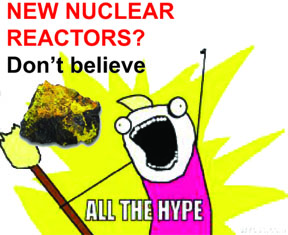
Attacking CSIRO for its GenCost nuclear cost estimates was a recurring theme at Monday’s hearing. CSIRO was accused of “cherry picking”, “misleading” the public, research which “doesn’t have much bearing on the real world”, and a “very incomplete process”.
Hughes said it is “misleading and deceptive” for CSIRO to cost small modular reactors (SMRs) but not large reactors. CSIRO doesn’t cost large reactors because the 2019 Coalition-led inquiry recommended retaining legislation banning large reactors. Ted O’Brien — chair of the 2019 inquiry and now the Shadow Minister for Climate Change and Energy — said “Australia should say a definite ‘no’ to old nuclear technologies”.
The Coalition culture warriors weren’t the least bit concerned about the difficulty of costing technologies which have no meaningful existence. Only two SMRs exist, one each in China and Russia, and those reactors don’t fit the SMR definition of serial factory construction of reactor modules.
The culture warriors were insistent that CSIRO should give much greater weight to ‘expert’ cost estimates, by which they mean vendor estimates. So let’s have a look at the track record of vendor estimates. The cost of China’s SMR was 2-3 times higher than early estimates. The cost of Russia’s SMR increased six-fold. The cost of the still-incomplete SMR in Argentina is more than 20 times higher than early estimates.
For large reactors, cost estimates for the only reactors under construction in the US have increased 12-fold. Cost estimates for the only reactors under construction in the UK have increased 8-fold. Cost estimates for the only reactor under construction in France have increased 6-fold. The current cost estimates for reactors under construction in those three countries range from A$25 billion to A$30 billion per reactor.
Yet the Coalition culture warriors think that vendor estimates should be taken as gospel and should underpin public policy making in Australia. CSIRO’s Paul Graham responded drily to the barrage of abuse: “We regard vendor estimates as the lowest quality data.
NuScale

One witness told the Senate committee that US company NuScale estimates a cost of $4,200 per kilowatt for its SMR. In fact, NuScale’s latest estimate is A$30,000 per kilowatt (A$14 billion for a 462 megawatt plant). Despite lavish government subsidies amounting to A$6.3 billion, NuScale is struggling to secure private-sector finance to get the project off the ground.
NuScale’s history can be traced to the turn of the century but it hasn’t even begun construction of a single reactor. Likewise, Argentina’s SMR project can be traced back to the last millennium but it hasn’t completed construction of a single reactor.
In 1990, the Coalition’s energy spokesperson claimed that “new-generation reactors … are now coming into use”. A third of a century later, and we’re still waiting.
James Voss, Managing Director of Ultra Safe Nuclear Australia Pty Ltd, falsely claimed at Monday’s Senate hearing that the company is building SMRs in North America (“our first two plants that we’re building now”). The company still needs licensing approvals and funding before it begins construction.
Voss claimed that the there should be no taxpayer subsidies to facilitate the introduction of SMRs to Australia — but the company would not have made the progress it has in North America without taxpayer subsidies and other forms of government support, and it will grind to a halt without further subsidies and support.
The British government in the mid-2000s insisted that new nuclear plants would not be subsidised. But the UK National Audit Office estimates that taxpayer subsidies for Hinkley Point — the only reactor construction project in the UK — could amount to £30 billion (A$52.5 billion) while other credible estimates put the figure as high as £48.3 billion (A$84.5 billion).
Minerals Council of Australia chief executive Tania Constable told the Senate committee there is no difference between SMRs and nuclear-powered submarine reactors. If that were the case the US and the UK — Australia’s AUKUS partners — would have plenty of SMRs given that they have nuclear-powered submarines. They have none.
History repeating itself

Historically, Coalition leaders have backed off nuclear power in the lead-up to elections. The Howard government wrapped up the Switkowski nuclear inquiry in unseemly haste in late-2006, and tried to avoid the issue in the 2007 election year.
The Morrison government didn’t even bother to respond to the December 2019 Coalition-led nuclear inquiry. Nor did the government act on the inquiry’s recommendation to amend legislation to allow for the construction of “new and emerging” nuclear power technologies.
When announcing the AUKUS agreement, Morrison insisted that nuclear powered submarines wouldn’t lead to a domestic nuclear industry in Australia.
But under Peter Dutton, who was spruiking SMRs in his budget reply speech, the Coalition has gone so far down the nuclear rabbit-hole that it will have little choice but to promise to repeal legislation banning nuclear power if it wins the next election.
The Coalition will lose the election, ditch the nuclear policy and probably ditch the leader as well – 2007 all over again.
Then the next batch of Coalition warriors will come up with the bright idea of dividing Labor and the environment movement by promoting nuclear power. Rinse and repeat.
Dr Jim Green is the national nuclear campaigner with Friends of the Earth Australia and lead author of a detailed submission to the Senate inquiry.
Pentagon seeks authority to transfer nuclear submarines (and costs) to Australia

Finally, the Pentagon is also asking Congress for permission to accept Australian payments to bolster the U.S. submarine industrial base. Australia has offered to make an undisclosed sum of investments in the U.S. submarine industrial base as part of AUKUS.
Defense News, By Bryant Harris and Megan Eckstein 17 May 23
WASHINGTON — The U.S. Department of Defense asked Congress to authorize the transfer of nuclear-powered submarines to Australia as part of the trilateral AUKUS agreement with the U.K.
Three legislative proposals, submitted on May 2 and first posted online Tuesday, would greenlight the sale of two Virginia-class submarines to Australia, permit the training of Australian nationals for submarine work and allow Canberra to invest in the U.S. submarine industrial base………………
“Importantly, the proposals spell out a clear path forward to facilitate the transfer of Virginia-class submarines to Australia while ensuring we have the necessary authorities to accept the Australian Government’s investments to enhance our submarine industrial base capacity and provide training for Australian personnel.” – Rep. Joe Courtney of Connecticut, the top Democrat on the Armed Services Committee’s sea power panel
AUKUS stipulates that Australia will buy at least three and as many as five Virginia-class submarines in the 2030s as part of phase two of the agreement, giving Congress more than a decade to authorize the sale. This year’s proposal, which the Pentagon hopes will become part of the fiscal 2024 National Defense Authorization Act, asks that Congress approve just two of those submarines “without a deadline to consummate the transfers and without specifying the specific vessels to be transferred.”
The proposal argues that this “small amount of flexibility is necessary” since the transfers depend on Australian readiness to operate the submarines, which will involve developing Australia’s submarine industrial base through training and appropriate shipyard infrastructure.
To that end, a second legislative proposal would authorize U.S. defense service exports directly to Australia’s private sector in order to train its own submarine workers……..
Finally, the Pentagon is also asking Congress for permission to accept Australian payments to bolster the U.S. submarine industrial base. Australia has offered to make an undisclosed sum of investments in the U.S. submarine industrial base as part of AUKUS.
The Pentagon states in the legislative proposal that those funds would be used to “add a significant number of trade workers” that will help address “the significant overhaul backlog” for the Virginia-class submarine. Australian monies would also be used for “advance purchasing of components and materials that are known to be replacement items for submarine overhauls” and “outsourcing less complex sustainment work to local contractors.”
Congress is also making its own investments to expand the U.S. submarine industrial base as the Navy ultimately aims to build two Virginia-class and one Columbia-class submarines per year. Courtney helped secure $541 million in submarine supplier development and $207 million in workforce development initiatives as part of the FY 23 government funding bill.
Austal USA, the American subsidiary of Australia-based Austal, plans to open a new facility at its shipyard in Mobile, Alabama to begin construction on nuclear submarine modules for General Dynamics’ Electric Boat shipyard in Connecticut, which produces both Virginia and Columbia-class submarines. Austal expects it will need 1,000 new hires in Mobile to staff that facility.
At Electric Boat, the prime contractor for the Virginia- and Columbia-class submarine programs, the hiring need will be even greater. The company currently employs more than 19,000 people, after hiring 3,700 new workers in 2022, according to local newspaper The Day. But the company needs to hire 5,750 new workers this year, to manage attrition and to help grow the workforce to about 22,000 to handle the increased workload.
The legislative proposal notes that Australian funds “would be applied to recruitment, training, incentivizing, and retention of key skilled trades, engineering and planning personnel in both nuclear and non-nuclear disciplines that are required by the additional AUKUS workload.” https://www.defensenews.com/congress/2023/05/17/pentagon-seeks-authority-to-transfer-nuclear-submarines-to-australia/
Ukraine’s neighbors ready to pay off Zelensky to stop conflict – Seymour Hersh

https://www.rt.com/news/576436-zelensky-poland-us-hersh/ 17 May 23
EU nations have privately urged the president of the war-torn country to end the fighting, a US official told the veteran journalist.
Poland is leading a group of European nations that are secretly urging Vladimir Zelensky to find a way to settle the conflict with Russia, veteran journalist Seymour Hersh has reported, citing a “knowledgeable” American official.
According to US intelligence, other EU countries that want to see an end to the fighting include Hungary, Germany, the Czech Republic, Lithuania, Latvia and Estonia, Hersh wrote in an article published on his Substack page on Wednesday.
“Hungary is a big player in this and so are Poland and Germany, and they are working to get Zelensky to come around,” the unnamed official claimed. Those countries have made it clear that “Zelensky can keep what he’s got if he works up a peace deal even if he’s got to be paid off, if it’s the only way to get a deal.”
By “keep what he’s got,” the source was referring to the Ukrainian president’s villa in Italy and interests in an offshore bank, Hersh clarified.
However, Zelensky has so far rejected the proposal, while other major European players – France and the UK – “are too beholden” to the Biden administration, which is continuing to back the Ukrainian leader, the official said.
One of the main reasons why Poland and the others want the conflict to end is because the burden of accommodating Ukrainian refugees has become too much for them, the Pulitzer Prize-winning journalist wrote.
The problem for those countries “is how to get the US to stop supporting Zelensky,” Hersh’s source suggested.
He claimed that US intelligence is well aware that “Ukraine is running out of money and… that the next four or months are critical. And Eastern Europeans are talking about a deal.”
However, he added that “it’s not clear to the intelligence community what the president and his foreign policy aides in the White House know of the reality.”
The US is “still training Ukrainians how to fly our F-16s that will be shot down by Russia as soon as they get into the war zone. The mainstream press is dedicated to Biden and the war, and Biden is still talking about the Great Satan in Moscow while the Russian economy is doing great,” the official explained.
Russia has repeatedly stated that it’s ready to resolve the conflict at the negotiating table. However, it did not receive any proposals from Ukraine and its Western backers that it could consider reasonable.
Zelensky has been promoting his ten-point peace plan, which calls for Russian forces to withdraw to borders claimed by Ukraine, to pay reparations, and to submit to war-crime tribunals.
Moscow has rejected the plan as “unacceptable,” saying it ignores the reality on the ground and is actually a sign of Kiev’s unwillingness to solve the crisis through diplomatic means.
How the West, and Zelensky, derailed the Minsk Agreements between Ukraine and Russia
Adonis Cirillo, commenting on Rt.com, 17 May 23
Everyone knows, or should know, that the ‘Western’ sponsored Maiden Revolution (coup d’état) KILLED Ukraine, and more than 14,000 of its own citizens since 18 Feb, 2014.
If you are undecided or uneducated to the events leading up to the West’s coup d’état, you may download & watch “UKRAINE ON FIRE” 2016 Oliver Stone documentary. (ED. note – Youtube has banned viewers from downloading this film, – but not pro-Ukrainian videos )
(you will see US Deputy Secretary of State for Political Affairs Victoria Nuland (the Maidan ‘midwife’), US Democrat & Republican Congressmen (e.g., Lindsey Graham), US Advisors (e.g., John Bolton), and NGO’s inside Ukraine before, during, and after the coup d’état)
If you continue to unwind history, you will discover that Ukraine of today is inextricably linked to the Bush/Gorbachev Agreements of 1989-90 and the subsequent Western Violations thereof (e.g., The continued expansion of US & NATO forces in Europe).
NOTE : Ex-Ukrainian President Petro Poroshenko said the Minsk Agreements “meant nothing” and claimed credit for giving Kiev enough time to militarize. – RT 17 June, 2022 | Ex-German Chancellor Angela Merkel said the Minsk accords were signed in order to “give Ukraine time” to make the country stronger – Zeit Newspaper 7 Dec, 2022 | Ex-French President François Hollande agreed with Merkel, saying that her comment was “right on this point.” … “It is the merit of the Minsk agreements to have given the Ukrainian army this opportunity,” – RT 30 Dec, 2022 | Ukrainian President Vladimir Zelensky took credit for derailing Minsk Agreements – RT 9 Feb, 2023 https://www.rt.com/news/576436-zelensky-poland-us-hersh/
Global heating is predicted to trigger more nuclear outages in France every year

extreme heat and droughts amid
climate change could impact nuclear plants, which use water to cool down.
EDF expects to lose 1.5% of its nuclear output, or about 5 TWh, annually
by 2050 due to the impact of global warming based on an average production
of 400 TWh, an executive said on Tuesday.
This compares with a current
average loss of nuclear power output caused by global warming of 0.3%, or
1.2 TWh, Cecile Laugier, head of environment at EDF’s nuclear branch,
told reporters. This echoes a report released in March by France’s Court
of Auditors, which said global warming could trigger three to four times
more outages than today. Increased risk of extreme heat and droughts amid
climate change could impact nuclear plants, which use water to cool down.
Montel 16th May 2023
https://www.montelnews.com/news/1499729/heat-to-cause-15-yearly-nuclear-output-loss-by-2050–edf
Nuclear Fusion breakthrough hits hurdles as five experiments fail

Japan Times, BY DAVID R. BAKER, BLOOMBERG 17 May 23,
The U.S. government lab that made a long-awaited breakthrough in fusion energy late last year has run five similar experiments since then without being able to replicate the results.
The milestone came in December as the the Lawrence Livermore National Laboratory near San Francisco reported achieving the first fusion reaction that produced more energy than it took to create — a threshold known as ignition. The achievement opened the possibility of power plants one day running on nuclear fusion, the same energy source as the sun.
Since then, the lab has run five similar experiments, shooting the world’s most powerful laser at small diamond capsules filled with hydrogen, said Lawrence Livermore Director Kim Budil. But so far, ignition hasn’t been achieved again…………….
Speaking at an event at the lab Monday celebrating December’s breakthrough, U.S. Energy Secretary Jennifer Granholm said the federal government would spend $45 million over the next four years to create a series of research hubs pursuing the kind of fusion achieved at Lawrence Livermore, known as inertial confinement. https://www.japantimes.co.jp/news/2023/05/09/business/nuclear-fusion-experiments-fail/
1 This month
17 October, Free Public Talk on Nuclear Issues in South Australia
David Noonan will speak on public interest concerns over the new Roxby Downs Indenture Act 2026 on BHP copper-uranium mining and ore processing in SA, and on how AUKUS may face SA with a High-Level nuclear waste agenda.
Dr Jim Green will discuss international developments in the field of nuclear power including ‘small modular reactors’ and Generation 4 ‘advanced’ nuclear reactor concepts.


Help Aunty Sue Protect Her Land and Sacred Sites From Destructive Rocket Testing.
.

Australians deserve the truth
about
AUKUS – https://aukuspublicinquiry.com/

PETITION – To: Prime Minister Anthony Albanese and the Australian Labor Government

of the week – Australians for War Powers Reform (AWPR)
To see nuclear-related stories in greater depth and intensity

