Covid-19 has cleared Australia’s path to zero emissions: Now is the time to act — RenewEconomy

It took a pandemic, but decarbonisation is firmly on the discussion table at last. What we need now is investment in innovation, favourable policy settings and bold action. The post Covid-19 has cleared Australia’s path to zero emissions: Now is the time to act appeared first on RenewEconomy.
Covid-19 has cleared Australia’s path to zero emissions: Now is the time to act — RenewEconomy
Green dreams: Managing the transition from rust to renewables — RenewEconomy

Port Augusta and Whyalla are in the middle of a renewable energy construction boom. But what does it mean for locals? Some workers are starting to lose faith. The post Green dreams: Managing the transition from rust to renewables appeared first on RenewEconomy.
Green dreams: Managing the transition from rust to renewables — RenewEconomy
Amy’s Balancing Act: How to explain the clean energy revolution to children — RenewEconomy

A new children’s story, Amy’s Balancing Act, uses a sunbaking goanna, an albatross, and a sugar glider to explain switch to renewables. The post Amy’s Balancing Act: How to explain the clean energy revolution to children appeared first on RenewEconomy.
Amy’s Balancing Act: How to explain the clean energy revolution to children — RenewEconomy
Seychelles Votes to Ratify a Treaty to Prohibit Nuclear Weapons,
Seychelles Votes to Ratify a Treaty to Prohibit Nuclear Weapons, allAfrica, 5 July 21,
Seychelles is set to ratify the Treaty on the Prohibition of Nuclear Weapons after the National Assembly overwhelmingly approved a motion in support of the treaty, which has gained significant support among non-nuclear nations.
The Leader of Government Business, Bernard Georges, presented the motion last Wednesday and said the aim is to see nuclear weapons completely eliminated in the near future.
Seychelles has always been vulnerable to nuclear weapons,” Georges said. “Ever since the island of Diego Garcia became a military base, Seychelles has been at the centre of nuclear weapons and with numerous other military bases being set up in the region, we are surrounded by a nuclear presence.”…………………..
The treaty entered into force on January 22, 2021, after Honduras became the 50th country to ratify it.
Signatories to the treaty are barred from transferring or receiving nuclear weapons and other nuclear explosive devices, control over such weapons, or any assistance with activities prohibited under the Treaty.
Member states are also prohibited from using or threatening to use nuclear weapons and other nuclear explosive devices. They also cannot allow the stationing, installation, or deployment of nuclear weapons and other nuclear explosive devices in their territory.
In addition to the Treaty’s prohibitions, States Parties are obligated to provide victim aid and help with environmental remediation efforts.
Read the original article on Seychelles News Agency. https://allafrica.com/stories/202107050623.html
July 5 Energy News — geoharvey

Opinion: ¶ “Green Dreams: Managing The Transition From Rust To Renewables” • Five years after the closure of South Australia’s last coal-fired generators, the Port Augusta region finds itself in the middle of a renewable energy boom. South Australia has a world-leading share of wind and solar, and that share is to jump even higher, […]
July 5 Energy News — geoharvey
Australia’s Chernobyl: Country That Will Never Heal
It’s NAIDOC Week 2021 and this year’s theme is Heal Country! Tragically for the Anangu people of South Australia, their country may never heal from a series of nuclear blasts carried out by the British in the 1950’s and 60’s.
The Quicky speaks to a local First Nations campaigner who comes from a long line of outspoken traditional owners, an academic on Australia’s dark nuclear past, and a nuclear engineer who was fired for trying to blow the whistle on a dismal clean-up effort, to find out why huge parts of SA will remain uninhabitable for millennia.
Worse still, we hear about the many disturbing medical conditions and premature deaths of countless local people, who were given no protection and no warning about the consequences of the atomic tests.Guests:
Glen Wingfield – A Kokatha man based in Port Augusta whose late parents Mrs Eileen Wingfield and Mr Raymond Wingfield campaigned tirelessly for the recognition and protection of their country – to read about Eileen Wani Winfield, grab a copy of Fantastically Great Women Who Saved The Planet by Kate Pankhurst – https://bit.ly/2TrQLP7
Associate Professor Liz Tynan – Academic and former science journalist who has researched British atomic tests in Australia for many years, and author of Atomic Thunder: The Maralinga Story
Alan Parkinson – Nuclear engineer who was the official adviser to the Maralinga clean-up project, but after he voiced his concerns about the dangers of the shortcuts that were being taken, he was removed from the project and told to be quiet
The episode is now available online, you can listen here for free: https://www.mamamia.com.au/podcasts/the-quicky/maralinga-nuclear-tests—
THE AUSTRALIAN newspaper sinks to a new low in pro nuclear propaganda.
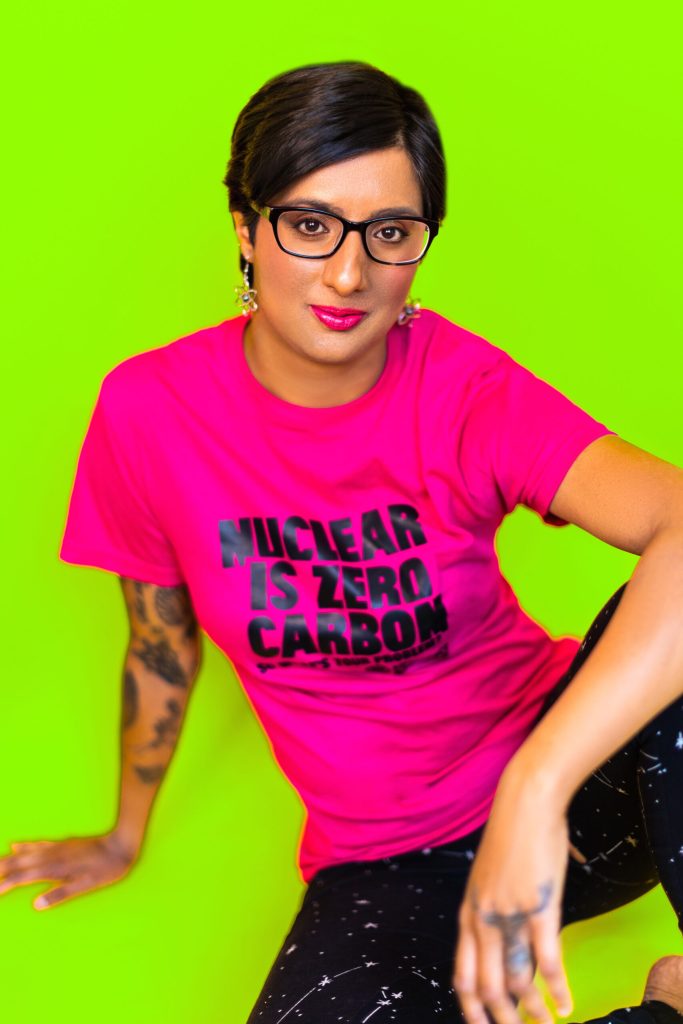
at left Zion Lights
Today’s THE AUSTRALIAN carries this article ”Savvy activists cast nuclear benefits in a fresh green light”. The article is by Claire Lehmann, who must be a real sucker to fall for such purile pro nuke spin, or , more likely, knows where the money is, in writing for News Corpse.
Claire Lehmann would appear to have swallowed the spin of Zion Lights. Zion Lights is certainly a talented self-propagandist, and is loved by the nuclear industry, because she pitches her pro nuke spin to young people, using popular media – Tok Tok and Instagram etc.
Below, on today’s Antinuclear, I’m republishing 2 articles which give some context to the background of Zion Lights.
Even nuclear executives must be embarrassed at the pro nuke propaganda aimed at young women

ISABELLE BOEMEKE IS THE NUCLEAR INFLUENCER THE WORLD NEEDS , High Society, BY PHILIP MAUGHAN 24 Apr 21,
”……… I think humans are the coolest thing, after nuclear energy
”New studies have shown how much cheaper it will be to build even expensive reactors than to secure the batteries needed to decarbonize the grid. The EU said it would label gas (not actually clean) and nuclear (actually very clean) as green energy for the purposes of investment — though that decision has now been deferred until later this year. ”
”If I had one PSA for Highsnobiety readers, it would be that we should stop shutting down nuclear plants, because when we do that, emissions always go up. And build more, so we can decarbonize our economy and move to a 100 percent clean energy future. To me, it’s a no brainer.”
And so Isodope was born, a glitchy vaporwave cyborg who spreads scientific knowledge of nuclear energy.
Exposed! Extinction Rebellion fact checks pro nuclear front, and Zion Lights.
Extinction Rebellion UK, released this statement as a press release on September 16, 2020.
Headline photo by Lorie Shaull/Creative Commons.
XR reveal climate-denying behind pro-nuclear front groups
Exposed! — Beyond Nuclear International
| Extinction Rebellion fact checks pro-nuclear front groups https://wordpress.com/read/feeds/72759838/posts/2936415505 Beyond Nuclear International, 28 Sept 20, The following is a statement from Extinction Rebellion, UK, in light of misrepresentations of their movement by a former team member now working for a pro-nuclear front group. It alleges that Environmental Progress, its new employee, Zion Lights, its founder, Michael Shellenberger, and the group’s predecessor, Breakthrough Institute (still operating as well) have ties to big corporations and to climate denial. There have been a number of stories in the press in the last few weeks with criticisms about Extinction Rebellion by Zion Lights, UK director of the pro-nuclear lobby group Environmental Progress. It appears that Lights is engaged in a deliberate PR campaign to discredit Extinction Rebellion. |
For any editors who might be considering platforming Lights, we would like to make you aware of some information about the organisation she works for and her employer, Michael Shellenberger.

ENVIRONMENTAL PROGRESS & MICHAEL SHELLENBERGER Environmental Progress is a pro-nuclear energy lobby group. While the group itself was only established in 2016, its backers and affiliates have a long and well-documented history of denying human-caused climate change and/or attempting to delay action on the climate crisis. A quick look at groups currently promoting Zion Lights through their social media channels include climate deniers and industry lobbyists such as The Global Warming Policy Foundation and the Genetic Literacy Project (formerly funded by Monsanto).*
The founder of Environmental Progress, Michael Shellenberger, has a record of spreading misinformation around climate change and using marketing techniques to distort the narrative around climate science. He has a reputation for downplaying the severity of the climate crisis and promoting aggressive economic growth and green technocapitalist solutions.
Shellenberger appeared on the Tucker Carlson Show on Fox News just last week to say that the forest fires currently raging in California are due to “more people and more electrical wires that they’ve failed to maintain because we’ve focused on other things like building renewables” and we’ve been “so focused on renewables, so focused on climate change.”
In his recent book Apocalypse Never: Why Environmental Alarmism Hurts us All, Shellenberger argues that there are no limits to growth and that environmental problems can be solved by everyone getting richer. The book has been widely criticised by many respected scientists both for its central premise and its misunderstanding, misinterpretation and misuse of the facts. (See here and here.)
His stance on fundamental and vitally important points of scientific consensus around the climate crisis is flat out wrong. In his essay promoting his book published in June of this year on the Environmental Progress website and The Australian – ‘On behalf of environmentalists, I apologise for the climate scare’ –he claims that “climate change is not making natural disasters worse” and that “Humans are not causing a ‘sixth mass extinction”. He also argues that “fires have declined 25% around the world since 2003,” and, “The build-up of wood fuel and more houses near forests, not climate change, explain why there are more, and more dangerous, fires in Australia and California.” These claims contradict reports from the IPCC and misrepresent the discussion taking place in the scientific community.
One science advisor with Environmental Progress, respected MIT climate expert Professor Kerry Emanuel, spoke publicly about being “very concerned” about the essay, and felt unsure whether he would remain involved with the organisation.
The article was published in Forbes, before being pulled offline the same day for violating its code of ethics around self-promotion.
A key tactic from the climate delayer playbook used in the essay is that of the repentant environmentalist, according to investigative journalist, Paul Thacker. After gaining credibility by aligning themselves with a section of the environmental movement, the repentant environmentalist then performs a volte face and attacks their former position.
This tactic has also been used by Zion Lights, who first overstated her role within Extinction Rebellion (she was a member of the media team, not ‘co-lead’ as stated on the Environmental Progress website) and then denounced the movement following an apparent change of heart.

BREAKTHROUGH INSTITUTE
Shellenberger is co-founder of the Breakthrough Institute, a lobbying group masquerading as a “think tank”. The Breakthrough Institute has “a clear history as a contrarian outlet for information on climate change [which] regularly criticises environmental groups”, according to Paul Thacker. Breakthrough has also been described as a “program for hippie-punching your way to fame and fortune.”
Shellenberger co-founded the Breakthrough Institute with Ted Nordhaus, nephew of economist, William Nordhuas. William Nordhaus features in Merchants of Doubt – Naomi Oreskes and Erik Conway’s examination of the PR strategies used both by the tobacco and fossil fuel industries. His interventions in the 1990s helped set back essential action on climate change by decades.
Other figures associated with Shellenberger and the Breakthrough Institute include:
Continue readingUK Treasury’s new green savings bonds says YES to wind energy, NO to nuclear

the nuclear energy aspect had been scrapped in the process of working out suitable investments.
Yes to wind, no to nuclear: the green bonds investment planSavers can be part of £15bn scheme with just £100m
Sunday July 04 2021, The Sunday Times The money raised through the Treasury’s new green savings bonds will not be used to fund any nuclear energy projects, despite the power source being a crucial part of the government’s ten-point plan towards net zero.
The term net zero means achieving a balance between the carbon emitted into the atmosphere and the carbon removed from it.
Investors might be able to help fund the government’s plans to “build back better and greener” as early as September, when it is expected that the first tranche of bonds will be launched.
Farnam Bidgoli, the head of environmental, social and governance (ESG) solutions at HSBC, said that the nuclear energy aspect had been scrapped in the process of working out suitable investments. “When doing our market research,……….. (subscribers only) https://www.thetimes.co.uk/article/yes-to-wind-no-to-nuclear-the-green-bonds-investment-plan-9pcrz6rsw
Bob Hawke – his allegiance to USA was geater than to the union movement
Secret embassy cables cast the Bob Hawke legend in a different light, Guardian,Jeff Sparrow 4 July 21,
Papers show Hawke as a unionist said one thing to his members, and something quite different to his US embassy friends….
The documents uncovered by Coventry date from 1973 to 1979, a period of bitter industrial and political conflict during which Hawke, as leading trade unionist, often featured in the press as a stalwart militant……..
In public, he backed an “independent non-aligned Australia” (a popular stance in the aftermath of the Vietnam war); in private, he told US officials he wanted the Anzus co-defence pact extended beyond a “purely military alliance”.
Coventry says the Americans valued their relationship with Hawke because he “helped protect [US] defence installations, provided information about union disputes and warned officials that installations could be targeted”…….
In 1973, the American Labour Attaché (a figure quite probably connected to the CIA) contacted Hawke about a potential union dispute at the joint American-Australian facility at North West Cape. The cables record that Hawke “volunteered to intervene informally”, saying he felt “concern and surprise at the militancy” of the workers.
The Americans particularly appreciated Hawke’s willingness to deradicalise the labour movement. As Coventry puts it: “Hawke proved useful in pre-empting and pacifying union disputes.”…………
the context in which it has emerged makes the material particularly significant. The high court recently upheld the constitutional legitimacy of Australia’s new foreign interference laws.
One challenge came from John Shi Sheng Zhang, a political adviser to NSW Labor MP Shaoquett Moselmane. The second challenge, however, came from a rightwing US group called LibertyWorks, which objected to the new legally requirement to register a conference featuring Tony Abbott and Nigel Farage.
That’s because, on paper at least, the new laws criminalise the kind of meddling in which the Americans have gleefully engaged for decades………
Had today’s foreign interference laws been in place in the 1970s, Hawke’s conduct would certainly have invited legal investigation……. https://www.theguardian.com/commentisfree/2021/jul/03/secret-embassy-cables-cast-the-bob-hawke-legend-in-a-different-light
Wittenoom – largest contaminated area in the southern hemisphere

Wittenoom’s asbestos mining waste continues to lay unresolved after 55 years, ABC Pilbara / Susan Standen 4 July 21 (excellent photos on original0
The legacy of a 1960s industrial asbestos mine site which devastated the lives of Aboriginal people and workers, many which fell victim to the deadly diseases mesathelioma and asbestosis, continues to be a thorn in the side of successive governments.
Key points:
- Banjima elders call for action by miners and governments for Wittenoom mine waste remediation
- The mine tailings dumps in Nambigunha continue to pollute the Fortescue River environment since the mine closed in 1966
- Successive governments have tried and failed to put a rehabilitation plan into action after miners abandoned it
All have failed to take action over Wittenoom, left with a mess after asbestos miners walked away in 1966 without taking responsibility or undertaking remediation.
The Wittenoom Asbestos Management Area covers more than 46,000 hectares.
Inside the management area Nambigunha, or Wittenoom Gorge, is littered with monstrous piles of washed-out asbestos tailings.
Yampire Gorge inside the Karijini National Park also still contains asbestos piles, only five kilometres from nearby Kalamina Gorge where major concerts are held in the Pilbara tourist season.
It is the largest contaminated area in the southern hemisphere.
Country surrounding the old township of Wittenoom and Karijini National Park belongs to the Banjima native title holders of the Pilbara.
“It’s not only Banjima people, there’s Guruma people, Yindjibarndi people, Ngarluma people, Yinhawangka people, Nyaparli people and Palyku people that used to live in Wittenoom and worked in these mines as well,” said Banjima elder Maitland Parker.
Approximately seven kilometres as the crow flies from the Wittenoom ex-mine site is the Karijini Eco Retreat.
There, the waste is out of sight and mind of the many thousands of tourists who access the park each year.
Now, in 2021, Banjima elders say it has been long enough and want their country cleaned up.
There could not be a more appropriate time to call for the rehabilitation with this year’s NAIDOC Week theme ‘healing country’.
Many language groups affected
Elders Maitland and Slim Parker attended meetings in 2019 with the then-minister for Aboriginal affairs Ben Wyatt to make requests to have the asbestos-contaminated areas remediated to minimise future risk for people, but were met with only promises of ‘ongoing dialogue’.
He said the estimated billions of dollars it will cost to have the area rehabilitated is no excuse.
It is an almost impossible task, but Mr Parker said he was prepared to give up the native title of the gorge if the waste can be buried deep into the upper gorge to stop the pollution.
But it remains to be seen what is a practical solution.
“We are going to fight tooth and nail and take this to the highest level that we can.”
The tailings dumps have been blown by wind and rained on for decades, causing asbestos pollution to move down into the Fortescue River valley and catchment from Wittenoom Gorge after rains flush through the deep gorges of the Karijini National Park.
Mr Parker is concerned the country all the way to Millstream may be polluted, making it unsafe for Aboriginal people to do their cultural business while fishing, swimming, camping, and visiting the affected areas.
“The rain of past years all contributes to the flushing of these [Karijini] gorges down into the Fortescue Valley,” he said.
…………………. Although Yampire and Wittenoom gorges are officially closed to the public, these areas are still accessed by unauthorised people camping.
In a statement, Lands Minister Dr Antonio De Paulo Buti said the Banjima people — who have native title rights and hold significant cultural sites in the area — will be invited to the steering committee during next sitting of Parliament when the Wittenoom Closure Bill is reintroduced. https://www.abc.net.au/news/2021-07-04/healing-of-banjima-country-at-wittenoom/100216504
Australian government’s unnecessary crackdown on charities and on peaceful protest

The government is clamping down on charities — and it could have a chilling effect on peaceful protest, The Conversation, Krystian Seibert
Industry Fellow, Centre for Social Impact, Swinburne University of TechnologyJuly 2, 2021 The Australian government introduced new regulations last week that could have a major chilling effect across Australia’s diverse charities sector.
The government’s aim was clear: the regulations are intended to target “activist organisations”, and specifically crack down on “unlawful behaviour”.
Despite this rhetoric, there is no evidence unlawful behaviour by charities is a problem of any significance. By clamping down on charities in this way, the government is not only curtailing their ability to organise peaceful protests, it is imposing more unnecessary red tape on an already highly-regulated sector.
What would the regulations do?
The regulations would give the Australian Charities and Not-for-profits Commission (ACNC) new powers to take action against a charity if it commits, or fails to adequately ensure its resources aren’t used to commit, certain types of “summary offences”.
These are generally a less serious type of criminal offence, and can include acts such as trespassing, unlawful entry, malicious damage or vandalism.
If the ACNC commissioner believes a charity is not complying with the regulations, they would be able to take enforcement action, which may include deregistering the charity. This would lead to the charity losing tax concessions — one of the incentives for people to donate to them.
In effect, the regulations mean that if a charity organised a protest in front of a government department and initially refused to leave, this could be considered trespassing. And this could then be grounds to have the charity deregistered.
Are these regulations necessary?
There is little, if any, evidence of a need for the regulations.
First, a comprehensive review of the ACNC legislation commissioned by the government in 2018 did not identify any issues with unlawful behaviour by charities.
In fact, the review recommended removing the ACNC’s existing power to take action against charities that commit serious breaches of the law. It pointed out that charities must already comply with all laws that they are subject to, and it is not the ACNC’s responsibility to monitor compliance or impose sanctions for breaches.
Despite this, the new regulations would extend the reach of the ACNC and expand its existing powers even further.
And importantly, there is no evidence charities — or their staffs or volunteers — are engaging in widespread unlawful activity. When questioned at a recent Senate Estimates hearing, ACNC Commissioner Gary Johns said the commission’s data did not indicate this was a problem.
Even the government’s own regulatory impact assessment asserts only a “small number” of charities have engaged in unlawful behaviour. However, even this claim is not backed up by solid evidence, with the assessment saying it is based on.
Charities are already highly regulated
Charities in Australia are already highly regulated and subject to a broad range of obligations. They must also abide by any number of laws, for example, occupational health and safety and criminal laws.
And the ACNC already has extensive investigation and compliance powers. If charities breach any of the laws they are subject to, they can be sanctioned just like other organisations — and the same applies to their staff.
In addition, charities are already required to take steps to ensure their directors comply with duties, such as acting with reasonable care and diligence. This includes monitoring and managing risks arising from a charity’s activities.
Drafted in a vague way
Perhaps most concerningly, the proposed regulations are worded in a very vague manner, and although improvements were made in response to public consultation on a draft version, major problems remain……………….. https://theconversation.com/the-government-is-clamping-down-on-charities-and-it-could-have-a-chilling-effect-on-peaceful-protest-163493
The space tourism plans of Bezos, Musk and Branson are morally reprehensible,

Ben Bramble sets out a problem that ought to be so obvious – that this space travel push is a wasteful, and even childish example of the rich boys club doing its thing – Bezos, Musk, Gates, Branson etc trying to outdo each other
But there is a more sinister side to space travel and space research – the national rivalries, started with Donald Trump’s plan for a Space Force – nuclear reactors, nuclear-powered rockets, and nuclear weapons in space. Those billionaires are all too well connected with NASA and this space military push. The thought of a nuclear war in space is horrendous. But what else could possibly go wrong?
The space tourism plans of Bezos, Musk and Branson are morally reprehensible, The Age, Ben Bramble, 5 July 21.
With billionaires Jeff Bezos, Elon Musk, and Richard Branson soon to send paying customers into space, members of US Congress are askingwhether and how to regulate commercial spaceflight. But there is a more basic question: Should there be such an industry in the first place?
Supporters of such an industry, such as Republican Kevin McCarthy, cast these billionaires as modern-day Wright brothers, innovating commercialspaceflight in a way governments either can’t or won’t. While billionaires will be the first in space, they say, soon everyone will get their chance.
But this is clearly not feasible any time soon, given Earth’s environmental crises. It is unsustainable for humans to keep consuming resources at the rate we currently are, let alone if space tourism were to become commonplace. The fact that a product can be made cheap enough for many people to afford it does not show that it is environmentally sustainable for many people to actually consume it.
Still, you might say, what could be wrong with commercial spaceflight reserved for the ultra-wealthy? This wouldn’t significantly worsen our environmental crises.–
But there is something morally distasteful in the extreme about space tourism exclusively for the ultra-wealthy when so many people on Earth are in such great need. Going into space, in full view of the many billions of humans who are struggling on a daily basis, is a little like enjoying a pop-up Michelin star meal in front of a homeless shelter.
This is not to decry all luxury goods. But there is something particularly objectionable about spending so much money on a fleeting experience for oneself and others, who are already among the best off on the planet, when so many cannot even make ends meet (through no fault of their own).
At present, there seems a clear tendency to reserve moral criticism for people who cause bad things or who set out to harm others. Such behaviour is certainly bad and merits criticism. But we should feel grumpy also at people for failing to help others when they easily can. Those who display an indifference to the plight of others or who are too wrapped up in themselves and their own self-serving projects are morally criticisable even if they are not the cause of others’ suffering. While it is true that Bezos has recently become a major sponsor of the environment, much more is needed. Every dollar spent on sending billionaires into space is money that could have been used instead to help save the planet or bring others out of poverty.
It is worth adding that many billionaires have contributed to Earth’s problems. Our environmental crises are largely due to excessive consumption, something that companies such as Amazon have played a major role in making possible, affordable and accepted……….
Bezos has said that one of his reasons for founding his company Blue Origin is that “we’re now big compared to the size of the planet”. Like Musk, he thinks we need to look beyond Earth to survive our present crises. But this is far too premature. We can still save the Earth. But to save it, we’re going to have to re-engineer our consumer cultures and economies. This, and not space tourism, is the great engineering challenge of the 21st century. I’d like to see these billionaires use their brilliant minds to help save the Earth, rather than flee it. If this means smaller growth for their own companies, so be it. ….. https://www.theage.com.au/national/the-space-tourism-plans-of-bezos-musk-and-branson-are-morally-reprehensible-20210704-p586o1.html
Global heating: “unprecedented” heatwave temperatures will become routine.

With the global climate warming, such “unprecedented” heatwave temperatures will start to become routine. Some parts of the world may simply become too hot for human habitation. Not only will heatwaves become more common, but hotter, drier conditions will lead to more wildfires.
Times 4th July 2021, Canada experienced its highest recorded temperature last week as the mercury surged to 49.6C in British Columbia on Tuesday. This is not onlythe highest temperature for Canada, but the hottest ever recorded above the 45th parallel north, roughly the latitude of Bordeaux and Bologna. In the US, the states of Washington, Oregon and Idaho also broke records.
The Pacific northwest is roasting. Hundreds have died. In Pakistan, the city of Jacobabad can reach 52C. As temperatures hit nearly 50C there last week, ts scorching streets were deserted as people tried to shelter at home, most without air-conditioning. The hospitals were flooded with heatstroke victims.
With the global climate warming, such “unprecedented” heatwave temperatures will start to become routine. Some parts of the world may simply become too hot for human habitation. Not only will heatwaves become more common, but hotter, drier conditions will lead to more wildfires.
In January last year, before Covid-19 dominated the news, Australia was aflame with massive areas of bushfire. Hurricanes and typhoons will also become more intense. Tropical diseases will spread. We’ll find it harder to feed
ourselves. And the problems won’t be shared evenly. Some regions will receive less rainfall and lose crops to drought, others will receive more and lose crops to flooding. There will be a global reconfiguration of where food can reliably be grown, and where people can safely live.
The climate refugees of today are only the first trickle of what could become a mass migration of people into parts of the world still offering habitable conditions – a movement of humanity unlike anything seen before in history. It is unlikely that this large-scale population disruption, combined with dwindling resources such as fresh water, will come without conflict.
The next wars could well be climate wars. It was human ingenuity and resourcefulness that got us into this mess, and I am hopeful that our same capabilities will find the way out again too.
https://www.thetimes.co.uk/article/how-to-live-in-a-climate-emergency-t6rfz7ckv
1 This month.

Australians deserve the truth
about
AUKUS – https://aukuspublicinquiry.com/

PETITION – To: Prime Minister Anthony Albanese and the Australian Labor Government

of the week – Australians for War Powers Reform (AWPR)
To see nuclear-related stories in greater depth and intensity
 Antinuclear