Australian Strategic Policy Institute – a stooge for weapons industries and China-haters
|
Independent” think-tank ASPI behind push for more defence spending rakes in advisory fees, Michael West Media, 1 Mar 21, by Marcus Reubenstein | Jul 1, 2020 Funded by the Department of Defence, the Australia Strategic Policy Institute collects millions more as it drives the “China threat” narrative. As Marcus Reubenstein reports, while ASPI is the media’s go-to experts for public comment, ASPI is remarkably coy about revealing all its funding sources.
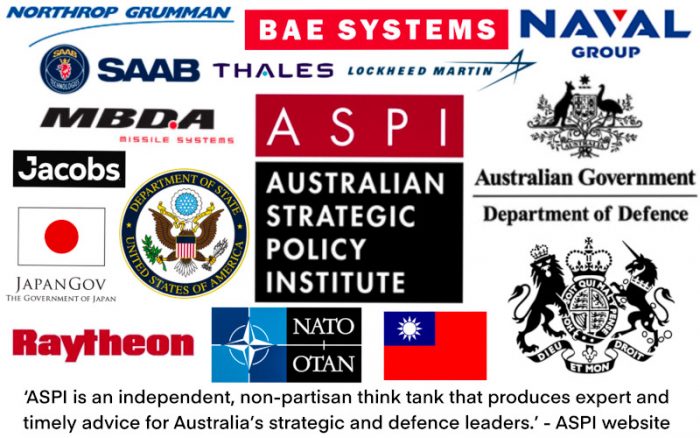
On the day the Prime Minister Scott Morrison announced a $270 billion defence spending plan, the Department of Defence paid the Australian Strategic Policy Institute (ASPI) a $214,500 contract for “management advisory services”. Exactly one year ago today, it was awarded a similar “management advisory services” contract for the considerably larger amount of $614,536. ASPI has pushed hard for boosts to defence spending, in particular an upgrade of Australia’s missile capabilities. The Government says it will spend $800 million on the US-made AGM-158C Long Range Anti Ship Missile, manufactured by Lockheed Martin, which gave ASPI $135,909 in sponsorship funds in 2018-19. Go-to think tank on ChinaThe Australian Strategic Policy Institute is the “go to” think tank for the mainstream media seeking an “independent voice” to make sense of troubled times with China. Its analysts are knowledgeable and articulate, always forthcoming with research pointing to the strategic threat of China. However, it is less forthcoming about the funders of its research, although it is an open secret that foreign governments and multi-billion-dollar weapons makers are generous supporters. What is not widely known is the extent to which taxpayers are propping it up, through dozens of small contracts not listed in its annual reports. Last year, these contracts amounted to more than $2 million and were signed by the chiefs of a small group of government departments which, say ASPI’s critics, have vested interests in promoting China as Australia’s No. 1 strategic threat. On China’s radarTwo weeks ago, ASPI was again thrust into the international limelight after China’s foreign ministry directly named it as the source of claims by Prime Minister Scott Morrison that Australia was the victim of a sustained cyber security attack. Morrison did not name China but, ASPI’s executive director, Peter Jennings did. He told journalists it was a “95%” likelihood that China was behind the alleged attacks. Critics, including former foreign ministers, ambassadors and senior figures within the defence establishment, contend that ASPI is an anti-China lobby that has hoodwinked the media into believing it is independent. Labor Senator Kim Carr, who is pursuing ASPI through a Senate committee, argues it’s a conflicted government-funded body that lacks transparency, particularly in the way it reports who funds its research. It is an Australian government organisation, a Commonwealth company, and they’ve been at the centre of Sinophobia. This is what happened in the Cold War, you set up a front and create a world view that’s unchallengeable. Then you de-legitimize anyone who argues for engagement with China. Ironically, engagement with China remains official government policy”. Disguised defence largesseThe Howard Government set up ASPI in 2001 as an independent think tank that would challenge a supposed culture of stagnated thinking, weighed down by the defence bureaucracy. Its main funding was an annual grant from the Defence Department but over the past decade it has developed more and more revenue streams — and no obligation to reveal exactly who pays it what. Defence remains its biggest benefactor. Before the federal election, the Morrison Government not only increased this funding by more than 13%, it locked in a guaranteed $20 million until 2023. This largesse does not include one-off payments for sponsorship and commissioned reports. In its annual reports, ASPI declares the $4 million annual Defence grant but opaquely refers to this as “core funding”. According to Department of Finance figures, in 2018-19 it received an additional $1,363,002.84 in funding from Defence, which was not publicly declared. According to answers it provided to a Senate Estimates committee in February, ASPI collected $1,158,581.63 (pre-GST) in funding from Defence without clearly declaring the source of those funds. ASPI didn’t explain the discrepancy between its two reported figures. Shrinking support?In its annual report, ASPI splits income into two sources: “Defence funding” and “Sale of goods and rendering of services”. It also produced a gloomy graph [on original] showing how “core” funding had withered away from 100% of its income to a moderate 43%. However, the graph doesn’t take into account its numerous government tenders and contracts that have delivered a financial windfall. In the past five years the value of its government contracts has increased by more than 300%. (second graph on original] Figures from the Department of Finance’s procurement website AusTender show ASPI was awarded $2,133,716.62 in contracts between July 2019 and June 2020. ASPI records all these government payments in its annual reports but muddies the waters by consolidating them with sponsorships and other commercial revenue. ASPI has received 37 government contracts in the past two years. See below [on original] or click here for easier viewing………. Major backersASPI has received funding from the governments of Britain, Japan and Taiwan as well as NATO. Among its corporate supporters are global weapons makers Thales, BAE Systems, Raytheon, SAAB, Northrop Grumman, MDBA Missile Systems and Naval Group. Yet their contribution of over $330,000 last year is dwarfed by that of a handful of government departments and agencies. Disclosures to the Senate revealed that ASPI had at least 56 sources of income in 2018-19 which it categorised as either sponsorships or commissioned income. Critics might accuse ASPI of having a narrow world view, but its views are financially supported by a very broad base of benefactors. Michael West Editor’s Note: This is a special investigation by APAC News, Michael West Media and Pearls & Irritations https://www.michaelwest.com.au/independent-think-tank-aspi-behind-push-for-more-defence-spending-rakes-in-advisory-fees/ |
|
“Not even close:” UN slams Australia and other rich countries for weak climate efforts — RenewEconomy

UN review of emissions targets finds countries “nowhere near” on track to keep global warming to safe levels, and countries like Australia must do much more. The post “Not even close:” UN slams Australia and other rich countries for weak climate efforts appeared first on RenewEconomy.
“Not even close:” UN slams Australia and other rich countries for weak climate efforts — RenewEconomy
March 1 Energy News — geoharvey

Opinion: ¶ “Will Tesla Hit Elon’s 20 Million Vehicles Per Year By 2030 Target?” • One of the bolder targets announced by Tesla CEO Elon Musk last year was to reach a 20 million-vehicle-per-year production capacity before 2030. He projected 30 million EVs sold annually by all companies in six to seven years. Are those […]
March 1 Energy News — geoharvey
AEMO abandons plan to model ‘gas led recovery’, after idea panned by energy market — RenewEconomy

AEMO abandons plan to model the Morrison’s ‘gas led recovery’ in next ISP, after key energy market players question whether if was even plausible. The post AEMO abandons plan to model ‘gas led recovery’, after idea panned by energy market appeared first on RenewEconomy.
AEMO abandons plan to model ‘gas led recovery’, after idea panned by energy market — RenewEconomy
to March 1st – nuclear news Australia
 Like most people, I have not been able to keep up with the pandemic news. Figures on the incidence of Covid-19, and on deaths, seem to fluctuate. Amidst the uncertainties about types of vaccines, new virus strains, and the anti-vaxxer movement, still there is an atmosphere of optimism. Vaccine acceptance is rising in many countries, and health workers and many volunteers are putting in the efforts to administer vaccines , and care for those who are ill.
David Attenborough warns the U.N. Security Council – the world risks ‘collapse of everything’ without strong climate action.
A bit of good news – Pollution in the Mississippi River Has Plummeted Since The 1980s
AUSTRALIA.
Australian scientists warn urgent action needed to save 19 ‘collapsing’ ecosystems.
Australian federal and state governments keeping laws banning nuclear power, despite Murdoch pro nuclear propaganda. Kimba radioactive trash Bill stagnates in the Senate, as Right-wing media extols nuclear power. Legislation banning nuclear power in Australia should be retained. A new motley crew of Australian politicians form “Friends of Nuclear”
Australian government’s nuclear waste plans unacceptable – Dr Margaret Beavis. Australian government obsessed with preventing legal appeals against its nuclear waste dump plan.
National Farmers Federation want govt to support renewable energy (not coal or nuclear).
Murder, corruption, bombings – the company at centre of Australia’s submarine deal.
The remediation of Ranger uranium mine: will it really restore the environment?
INTERNATIONAL
The role of the Churches in promoting the U.N. Nuclear Weapons Ban Treaty. Nuclear-weapons treaty the right way forward.
The media revels in rockets to Mars, ignores the horrible risk of plutonium pollution.
Why is the media fawning over nuclear businessman Bill Gates? Nuclear power-not clean, not renewable – Bill Gates is wrong.
Dr Helen Caldicott on Independent Australia tells The Truth About Nuclear Power.ant.
A new motley crew of Australian politicians form “Friends of Nuclear”

Reporter Rosie Lewis, writing in THE AUSTRALIAN (25/12/21) recorded, with that paper’s usual pro nuclear joy and delight, that 21 Australian politicians have signed up to this group. They named only 9 of these MPs, a motley crew indeed, of minor party members, and 5 Labor Party ones.
It gets confusing, as Labor has a clear policy of prohibiting nuclear technology, ( excluding the Lucas Heights Opal reactor). But then, sabotage of Labor policies is not a new thing for Joel Fitzgibbon. He opposes Labor’s climate policy (which is strange, as nuclear’s big push is about purporting to combat climate change)
However, you can bet that the remaining 12 ‘nuclear friends’ would be Liberals and Nationals.
Meanwhile, the 9 mentioned have an odd assortment of views on energy – some support renewable energy, some oppose. There’s some scepticism on climate change, where you’d expect nuclear being touted as the solution. And Pauline Hanson is on record as opposing the nuclear lobby’s plan for a nuclear waste dump at Kimba, South Australia.
“Dr Gillespie and Senator Gallacher said their priority was on educating other MPs — particularly within Labor — about nuclear energy.” “We can introduce the best scientific minds into our parliamentary friendship group and bring them to Canberra.”
Of course, those “best scientific minds” will come from “Australia’s Nuclear Science and Technology Organisation and other government and industry bodies” which function primarily as nuclear promoters, anyway. I don’t think they’ll be inviting Dr Helen Caldicott, Dr Jim Green, or Dave Sweeney fron the Australian Conservation Foundation.
The end of the NEM as we know it — RenewEconomy

As coal generators exit the grid, Australia is going to have to focus on flexibility in the market, and harnessing distributed resources. The post The end of the NEM as we know it appeared first on RenewEconomy.
The end of the NEM as we know it — RenewEconomy
Small Nuclesar Reactors – not all they’re cracked up to be
Small Nuclear Reactors, There has of late been a lot of promotion of the idea of Small Modular Reactors (SMRs) of a few tens or hundreds of megawatts, which it is claimed will be cheaper than conventional gigawatt scaled plants since they can benefit from economies of mass production in factories. Much has been promised for SMRs, including the delivery of power at £40-60/MWh, but there is still some way to go before any project actually goes ahead and we can see if the promises hold upon practice.
 stage. But it is claimed that one of the more novel design, the Natrium fast reactor system, proposed by Terrapower and backed by Bill Gates, will be on line this decade. Given that this makes use of liquid sodium and molten salt heat storage, that is quite a claim. So is the idea, also being pursued by Terrapower, that reactors can be run with molten salt fluoride as both reactant medium and reaction coolant. It has even been claimed that reactors like this, with suitable fast spectrum neutron fluxes, can burn nuclear waste. That has yet to be proven. But certainly, if they are to use thorium as a fuel, they will need an input of plutonium or some other neutron source, since thorium is not fissile, so in that sense they do recycle something. Though we still have to have uranium reactor, possibly fast breeders, to make the plutonium.
 As can be seen, there are many possible problems ahead for SMRs. Perhaps the central one is safety. Working with high radiation fluxes in small confined spaces is not easy. Even in the case of molten salt systems, which avoid the need for control rods, the super-hot corrosive fluids have to be pumped around for heat and waste extraction. It may not be easy to design compact systems that can do this reliably long-term.
The safety issue interacts with the other key issues for SMRs- location. If they are going to be economically viable, some say that SMRs will have to be run in Combined Heat and Power ‘Cogen’ mode, supplying heat for local used, as well as power for the grid. That implies that they will have to sited in or near large heat loads i.e. in or near urban areas. Will local residents be keen to have mini-nuclear plants near by? That issue is already being discussed in the USA, with some urban resistance emerging.
A key issue in that context is that it has been argued that since they allegedly will be safer, SMRs will not need to have such large evacuation zones as is the norm for standard reactors, most of which are sited in relatively remote area. Indeed, unless that requirement was changed, operation in cities could be impossible- they could not easily be evacuated fast if there was an accident, or perhaps a security threat. On the basis of this view, SMRs will only ever be relevant for remote sites, and of course there are plenty of such locations where local power generation might be welcome, although arguably, renewable sources might be easier, safer and cheaper to use. Indeed, that might be said of all locations.
 The debate over safety, security and location will continue to unfold, with folksy mini-nuke designs emerging for remote rural locations, but concerns also growing over the many unknowns, not least the costs and market potential. There are SMR programmes in the US and UK and elsewhere, but there are big doubts about whether there would be a viable market for this technology.
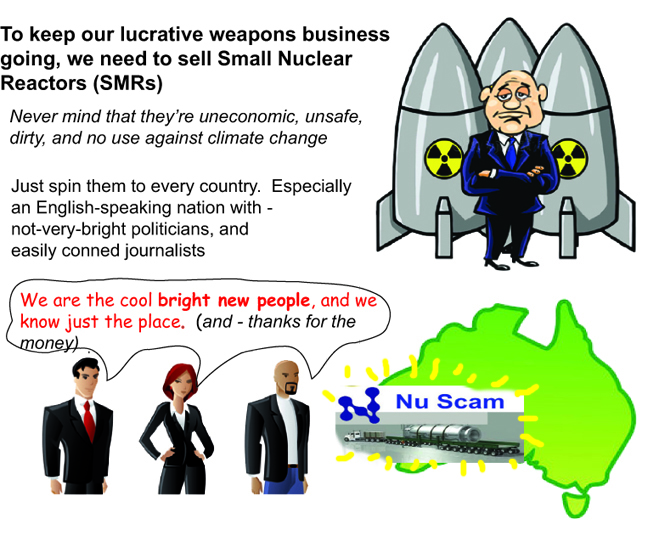
That is despite the fact that there is some dual use/expertise overlap between civil and military nuclear, and, more specifically, that mini reactors are used for submarine propulsion. While that may be one reason why companies like Rolls Royce are pushing for SMRs, on its own military submarine use is a relatively small market.
There is no shortage of promotional enthusiasm for SMRs for a variety of reasons, including, it is claimed, defence-related, and some arguably extravagant claims on comparative investment costs have been made. However, there have also been some strong critiques and gloomy prognoses. At best, they say, SMRs may have a role to play in some remote locations and, as with nuclear generally, perhaps for heat production and hydrogen production, for example for industrial purposes. It has also been claimed that SMRs could produce synthetic aircraft fuel as substitute for kerosene, although ‘at around about twice the price’.
That all seem to be a long shot, with many unknowns, and in terms of energy supply of whatever type, renewables may have the edge in most contexts. However, it is just conceivable that SMRs could be used to back up renewables. Some types of SMR may be able to run more flexibly than can large conventional reactors, so that they could play a role in balancing variable renewables. That is still very uncertain, in operational and cost terms, and there are many other arguably simpler, safer and cheaper options for grid balancing. Though, evidently keen to try their luck, a UK developer has talked of using NuScale units in a hybrid wind-SMR system.
So what’s the bottom line? For the moment, although being pushed in the US and UK and elsewhere, SMRs are some way off, with very mixed prospects. But technology can move fast, and although there will no doubt be local resistance, and they may not pop up near you for a while, we may yet see fission-based SMRs emerge for some remote applications within in a decade or two. Can the same be said for fusion? Some very optimistically are talking about the arrival soon of mini fusion! That seems unlikely, and my guess is that, if fusion SMRs are ever possible, their main use will be off-planet. Same possibly for most fission SMRs! Back on this planet, we’ve got plenty of renewables to get on with, and in that context, arguably, small nuclear, of whatever sort, does not really offer anything different from big nuclear. Just another costly distraction from getting on with renewables
Fukushima disaster: Is TEPCO nuclear plant still a safety risk? — Fukushima 311 Watchdogs

Ten years after the Fukushima nuclear disaster, the Tokyo Electric Power Co. has been criticized for failing to learn safety lessons. A seismograph at the Fukushima Daiichi plant malfunctioned during a recent earthquake Februay 26, 2021 Tokyo Electric Power Company (TEPCO), the operator of the Fukushima Dai-ichi nuclear power plant, is facing renewed criticism that it […]
Fukushima disaster: Is TEPCO nuclear plant still a safety risk? — Fukushima 311 Watchdogs
Radiation criteria sow confusion for evacuees — Fukushima 311 Watchdogs

Workers decontaminate a road in a special reconstruction district in the town of Futaba, Fukushima Prefecture, in October. | FUKUSHIMA MINPO February 26, 2021 Traffic was lighter on the Joban Expressway in the Futaba district in Fukushima Prefecture during the New Year holiday, with people avoiding traveling back to see their relatives due to the […]
Radiation criteria sow confusion for evacuees — Fukushima 311 Watchdogs
Quake shifts 53 water tanks at Fukushima plant — Fukushima 311 Watchdogs

February 26, 2021 The operator of the crippled Fukushima Daiichi nuclear power plant says it has found that 53 tanks storing radioactive wastewater were shifted from their original locations by a powerful earthquake earlier this month. But it says there have been no leaks from the tanks. Tokyo Electric Power Company inspected 1,074 tanks after […]
Quake shifts 53 water tanks at Fukushima plant — Fukushima 311 Watchdogs
Making Waves — Beyond Nuclear International

The original peace boat sets sail again
Making Waves — Beyond Nuclear International
Environmental collapse: It’s time economists put the planet on their balance sheets — RenewEconomy

Planet’s natural systems are on the verge of breakdown, after being ignored by economic theory and policies. That must change. The post Environmental collapse: It’s time economists put the planet on their balance sheets appeared first on RenewEconomy.
Environmental collapse: It’s time economists put the planet on their balance sheets — RenewEconomy
February 28 Energy News — geoharvey

Opinion: ¶ “Environmental Collapse: It’s Time Economists Put The Planet On Their Balance Sheets” • A ‘ground-sparing’ economic report on biodiversity indicates that economic practice has to change because the world is finite. Climate change results from a larger issue, the threat to our life support systems from the plunder and demise of our natural […]
February 28 Energy News — geoharvey
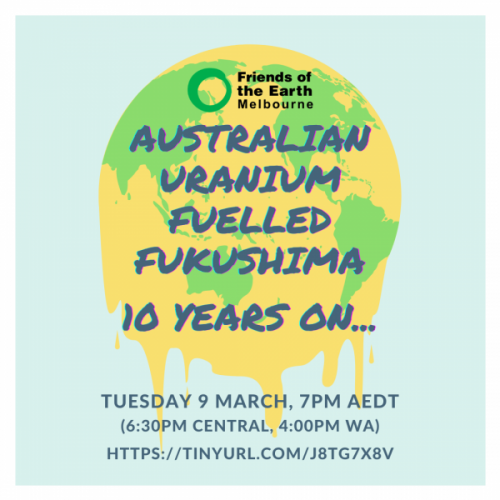
Australian Uranium Fuelled Fukushima Nuclear Reactors – theme for March 21
Please come along to this webinar discussing the Fukushima disaster which is an ongoing disaster that Japan is still pretending to the world is under control.
9 March – WEBINAR.
7 pm Eastern time AAEDT
6.30 pm Central rime South Australia
6 pm. Weatern Australia
Guest Speakers: Ayumi Fukakusa, Climate Change and Energy campaigner,
1 This month.


PETITION – To: Prime Minister Anthony Albanese and the Australian Labor Government
Chernobyl: The Lost Tapes – A good documentary on Chernobyl on SBS available On Demand for the next 3 weeks– https://www.sbs.com.au/ondemand/tv-program/chernobyl-the-lost-tapes/235274195556

19 May – Webinar- Webinar: No Nuclear Weapons in Australia
Start: 2026-05-19 18:00:00 UTC Canberra, Melbourne, Sydney (GMT+10:00)
End: 2026-05-19 19:30:00 UTC Canberra, Melbourne, Sydney (GMT+10:00)
20 May – Webinar – The dangerous world of AUKUS, US, military occupation and suppression of dissent

National Webinar, 20th May, 2026, 6.30pm AEST. Confronting laws restricting/suppressing protest speech and action
Speakers: Former Sen. Rex Patrick, Lawyer Nick Hanna ,Arthur Rorris ,Jorgen Doyle, Sen David Shoebbridge,
Facilitator Kelley Tranter.

of the week – Australians for War Powers Reform (AWPR)
To see nuclear-related stories in greater depth and intensity
 Antinuclear