Solar energy in Australia great potential, poor political support
Australia’s annual solar irradiation stands at approximately 58 million petajoules, enough to provide 10,000 times its entire annual electricity consumption. In order to fully benefit from this resource, however, it needs to do much more than relying on a patchwork of schemes……a national feed-in tariff may be desirable from manufacturers’ perspective, it is currently not a political priority,…..
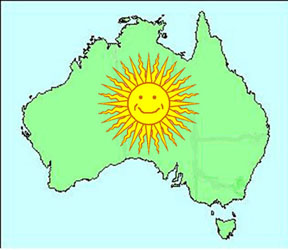
Australia: enthusiastic uptake of solar power leads to cuts in state feed-in tariffs iStockAnalysts, November 10, 2010 Residential solar power installations in New South Wales reached 52MW by mid-2010, prompting the state government to reduce its generous feed-in tariff.
While this is a blow to property owners hoping to invest in renewable energy, it is also a natural part of any feed-in tariff scheme. Still, to maximize its solar resources, Australia must find ways to build on consumer interest in micro-schemes.
In January 2010, the New South Wales government launched one of Australia’s most supportive feed-in tariffs. By October 2010, over 50,000 customers had joined the scheme, adding more than 100MW of renewable energy capacity (with many more applications still waiting to be connected). The state pays A$0.60 per kWh for electricity fed into the grid from micro-power schemes, such as solar photovoltaic cells or mini wind turbines on rooftops. Having reached the threshold in July, the state government was required to complete a statutory review of the scheme, and subsequently chose to cut the rate for new entrants to the scheme to A$0.20 per kWh…….
Almost all of Australia’s states and territories offer comparable feed-in tariff schemes; uptake has been greatest in New South Wales and Queensland. Australia’s annual solar irradiation stands at approximately 58 million petajoules, enough to provide 10,000 times its entire annual electricity consumption. In order to fully benefit from this resource, however, it needs to do much more than relying on a patchwork of schemes.
An earlier proposal to incentivize renewable energy installation through a national feed-in tariff scheme failed to be implemented. Although a national feed-in tariff may be desirable from manufacturers’ perspective, it is currently not a political priority,…..
Australia: enthusiastic uptake of solar power leads to cuts in state feed-in tariffs
1 Comment »
Leave a Reply
1 This month
25 October – Film –Britain’s Nuclear Bomb Scandal: Our Story – part of the Adelaide Film Festival,
Screening and Conversation
A screening of Britain’s Nuclear Bomb Scandal: Our Story (2024) followed by a talk with 2026 Bettison and James Awardee and Tradtional Owner Karina Lester in conversation with Simone Tur.
When: Sun 25 Oct, 12:00pm-Screening, 1:15pm-Talk
Where: The Mercury
Free admission, register below by clicking on BUY TICKETS and select free event tickets, at end of web page:
https://www.adelaidefilmfestival.org/program/2026/britains-nuclear-bomb-scandal-our-story
.

Australians deserve the truth
about
AUKUS – https://aukuspublicinquiry.com/

PETITION – To: Prime Minister Anthony Albanese and the Australian Labor Government

of the week – Australians for War Powers Reform (AWPR)
To see nuclear-related stories in greater depth and intensity


Hi I’m from the Australian Solar Energy Society and am spreading news about the SOLAR 2010 conference occurring in Canberra at the moment. Christina Milne, Australian Greens Deputy Leader has recently stated “I am so frustrated that debate in Australia is always about what we can’t do but let’s talk about what we CAN do and solar is a CAN DO!”
LikeLike