All energy costs rise but small nuclear most reactive
29 July 2025, Jennifer Dudley-Nicholson, Australian Associated Press, https://australian.museum/aap/all-energy-costs-rise-but-small-nuclear-most-reactive-1/
Next-generation nuclear reactors are the most expensive of all energy-producing technologies, a report has found, and would significantly increase electricity prices in Australia.
Establishing a large-scale nuclear power plant for the first time would also require more than double the typical costs, and estimates for wind projects had inflated by four per cent due to unforeseen requirements.
The CSIRO, Australia’s national science agency, released its GenCost report on Tuesday, revealing rising construction and finance costs would push up prices for energy projects of all kinds in the coming years.
The findings come after a heated debate about introducing nuclear power to Australia and after members of the federal coalition questioned the nation’s reliance on renewable energy projects to achieve net zero by 2050.
The final GenCost report for 2024-2025 analysed the cost of several energy-generating technologies, including variations of coal, gas, nuclear, solar and wind projects.
Renewable technology continued to provide the cheapest energy generation, the report’s lead author and CSIRO chief energy economist Paul Graham said.
“We’re still finding that solar PV and wind with firming is the lowest-cost, new build low-emission technology,” he told AAP.
“In second place is gas with (carbon capture storage) … then large-scale nuclear, black coal with CCS, then the small modular reactors.”
Small modular nuclear reactors proved the most expensive technology of the eight options by a large margin, with the report basing its costs on Canada’s Darlington nuclear project, announced in May.
The 1200-megawatt development is estimated to cost $23.2 billion and will be the first commercial small modular reactor built in a Western country.
The new reactors produce one-third the power of typical nuclear reactors and can be built on sites not suitable for larger plants, but have only been built in China and Russia.
“This is a big deal for Canada – it’s their first nuclear build in 30 years,” Mr Graham said.
“It’s not just about meeting electricity demand … they’ve said a few things that indicate they’re trying to build a nuclear SMR industry and export the technology.”
In addition to the cost of different technologies, the report estimated “premiums” for establishing first-of-a-kind energy projects, with the first large-scale nuclear project expected to command 120 per cent more and the first offshore wind development expected to cost an extra 63 per cent.
The cost of wind projects also grew by four per cent as researchers factored in building work camps to accommodate remote employees, and capital financing costs rose by one per cent.
Developing energy projects was also expected to cost between six and 20 per cent more by 2050, the report found, due to the rising price of materials such as cement and wages, as detailed in a report by Oxford Economics Australia.
Findings from the CSIRO report would help inform the design of future energy infrastructure, Australian Energy Market Operator system design executive general manager Merryn York said.
“We’ll use the capital costs for generation and storage from GenCost in the upcoming Draft Integrated System Plan in December,” she said.
Nuclear technology is banned as an energy source in Australia, which has a target of achieving 82 per cent renewable energy in the national grid by 2030 and reaching net zero by 2050.
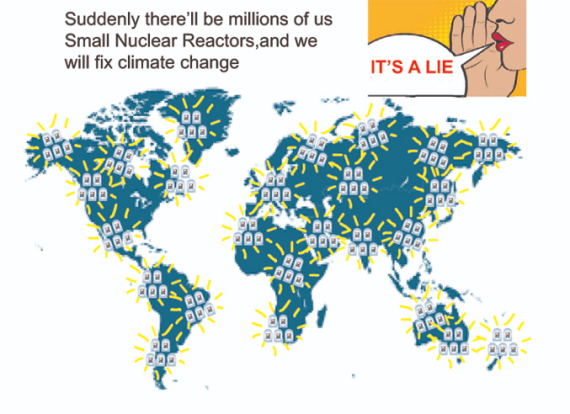
Nuclear needs to build up to 8,000 SMRs just to catch up with wind and solar. By 2035, they might have 5
Giles Parkinson, ReNewEconomy, May 27, 2026
Australia’s almost indistinguishable far right political parties – the Liberals, Nationals and One Nation – are pushing the nuclear barrow once again, not for climate reasons but because of the “anything but wind and solar” ideology demanded by their fossil-fuelled benefactors.
So it came as a timely reminder on Wednesday, when one of the world’s leading green energy analysts, Michael Liebreich, underlined just how useless nuclear energy is for dealing with climate change, and how far the small nuclear reactors championed by many are from competing with surging wind and solar.
Liebreich is the founder of Bloomberg New Energy Finance and his address to the Energy Efficiency Council’s National Conference also touched on the perils of net zero targets (because it puts the focus on what’s really hard rather than what’s readily achievable), and the overwhelming push for electrification for “just about everything.”
But it was the nuclear hype that he was also keen to puncture, if only to underline the sheer scale and dominance of wind and solar, and its rapidly growing share of “useable” energy, as opposed to “primary energy” that ignores the massive inefficiencies of fossil fuels.
SMR are still not being built but they are championed by some of the world’s richest people, the AI and social media “tech bros” who are looking for ample energy sources to power their massive data centre needs (while contracting tens of gigawatts of wind and solar in the meantime).
“They (the tech bros) love nuclear, and they’re going to be very angry when they discover what everybody discovers, which is nuclear is kind of expensive and long and complicated,” Liebreich said.
“But even if they succeed, it’s not going to be a climate solution,” he said. And the reason is that simply to match the output of wind and solar in the 2024 calendar year, the industry would need 1,250 of the 470 MW SMRs that are being developed by Rolls Royce, or up to 8,000 of the much smaller SMRs pushed by the likes of Oklo.
“If they build five by 2035 that will be a big win,” Liebreich said. “And so, as a climate solution, by the time you did build 2000 Westinghouse SMRs, where do you think wind and solar is going to be?
“It’s obviously going to have grown. That green curve is not stopping, it is taking off, and you can see it’s taking off even in the countries that are really trying to build nuclear.”
The nuclear push is usually associated in Australia by calls to abandon net zero targets, with the main argument being – without evidence – that it is trashing the economy.
Net zero has been criticised by others supportive of strong action. Andrew Forrest, aiming for real zero at Fortescue’s giant iron ore mines by 2030, says net zero is an excuse to do not much and use offsets instead of cutting emissions, others say a 2050 target is used by an excuse to do not much anytime soon.
Liebreich’s criticism is that it makes everything sound too hard. “By focusing on zero, immediately your eye is drawn to doing the difficult bits, and the difficult bits are expensive, and we just don’t have to have those discussions right now…………………………………. https://reneweconomy.com.au/nuclear-needs-to-build-up-to-8000-smrs-just-to-catch-up-with-wind-and-solar-now-by-2035-they-might-have-5/
Nuclear brawl erupts over powering Australia’s AI data boom
Ronald Mizen, Financial Review, Aug 25, 2026
A political fight has broken out over using small modular nuclear reactors to meet the soaring electricity demand from data centres, and new research shows that using renewable power could make Australia a regional hub for low-carbon computing power capacity.
On Monday, Coalition frontbencher Jonno Duniam said using SMRs to power data centres should be part of the conversation, and the government should end the moratorium on nuclear power.
Duniam is leading a push within the Coalition to land a largely bipartisan position on artificial intelligence.
Last week, he was appointed deputy chairman of a bipartisan committee on AI and recently travelled to the United States where he held talks with major AI and data centre companies.
“It was clear to me when talking with representatives of major AI and data centre operatives that, if the moratorium was not in place, these companies would be seriously looking to nuclear SMRs to power their operations and not drive up prices,” he told The Australian Financial Review on Tuesday.
The fresh brawl over nuclear power comes ahead of a meeting of the national cabinet on Wednesday during which Prime Minister Anthony Albanese will seek support from premiers and chief ministers for his AI agenda.
The Albanese government wants to force the owners of next-generation, large-scale data centres – those that train and power artificial intelligence agents – to use renewable electricity, and to add more power to the grid than they consume.
This proposal is opposed by Coalition governments in the Northern Territory and Queensland, which want an energy-agnostic policy, including allowing gas.
Grattan Institute energy program director Tony Wood said that despite having as many SMRs today as there are unicorns, Australia needed a plan B to get its electricity emissions to zero.
“It could be [viable],” Wood said of using SMRs. If the technology is viable, it should be part of the energy mix, he said.
Industry Minister Tim Ayres labelled the idea “an ideological fantasy” and said “nobody in the real world with real money” was talking about nuclear power. Energy Minister Chris Bowen said he was opposed based on “cost and delay”, not safety.
“I’m not aware of any proposals to do that in Australia,” Bowen said.
But the AI sector, in Australia and overseas, is keeping a close eye on the development of SMRs, which some believe could power data centres in as little as three to five years.
In late 2024, Google signed a world-first agreement to purchase up to 500 MW of nuclear energy for its data centres from Kairos Power in the US. The first SMR is scheduled to be online in 2030, and the rest are targeted for 2035.
Local industry sources are reluctant to speak publicly on the topic, given how politically charged it is.
A report commissioned by Data Centres Australia from economic consultancy Mandala, being released on Wednesday, shows Australia could become a big exporter of green computing power capacity to the Asia-Pacific region because emissions from hosting this locally are far less than in other countries…………………..https://www.afr.com/politics/federal/nuclear-brawl-erupts-over-powering-australia-s-ai-data-boom-20260825-p60rce
Work begins on Coulport building for Dreadnought submarines a cost of £7.75bn each

15th October, https://www.heraldscotland.com/news/26637101.work-begins-coulport-building-dreadnought-submarines/
Built at a cost of £7.75bn per unit, four Dreadnought submarines will replace the current Vanguard ships
Work has started on a building which will arm the Royal Navy’s new multi-billion-pound nuclear submarines.
Naval Base Commander Clyde and Commodore Andy Bray recently broke ground on a new facility at Royal Naval Armament Depot (RNAD) Coulport to support future classes of Royal Navy submarines.
Building 300 at the Royal Naval Armament Depot will house the Vertical Embarkation System, or VES, a new facility used to load tactical weapons onto future Dreadnought-class deterrent submarines.
The House of Commons approved replacing the current submarines in 2016, despite opposition from anti-nuclear groups and campaigners concerned about the cost.
Built at a cost of £7.75bn per unit, four Dreadnought submarines will replace the current Vanguard ships, which constantly patrol the seas carrying ballistic missiles equipped with thermonuclear warheads.
2026 George Monbiot Nuclear Greenwash Award goes to the UK Green Party for Abandoning Nuclear Opposition

Image: The George Monbiot Nuclear Greenwash 2026 Award to The Green Party for Abandoning Nuclear Opposition. George Monbiot’s famous “I love nuclear” in the wake of the Fukushima disaster deflected an otherwise inevitable crisis of nuclear confidence and was of course key to the push for the building of the first new nuclear plant in the UK in decades at Hinkley C which he now says (after facilitating the damn thing) should be scrapped in favour of, even more dangerous. fast breeder reactors,
Lakes Against Nuclear Dump, Oct 12, 2026, https://lakesagainstnucleardump.com/2026/10/12/2026-george-monbiot-nuclear-greenwash-award-goes-to-the-green-party-for-abandoning-nuclear-opposition/
Just days before the 69th anniversary of the UKs worst nuclear accident to date , the Windscale Fire, the Green Party announced their abandonment of their opposition to nuclear, and with it their reason for being. The Green Party used to call the nuclear industry the “nuclear military industrial complex” for good reason, the “civil” nuclear industry is necessary in order to produce elements for military use, including plutonium, tritium and americium.
Here in Cumbria we won’t notice much difference as the Green Party have spectacularly failed to publicly voice strong opposition or lead any charges against nuclear developments for many years with Green Party members seemingly much more concerned with the horrible nitty gritty of political advancement than protecting the health and wellbeing of the public and our environment from nuclear developments.
Having said that we wait more in hope than expectation to be surprised and delighted by vigorous, strong and principled Cumbrian Green Party opposition to the tsunami of nuclear developments coming our way.
It has not gone unnoticed that despite there being more Green councillors than ever before on Cumberland council, the Council as a whole is like never before, acting as a facilitating arm of the nuclear industry. Cumberland council and its Green Party members are partners in the geological nuclear dump plan and partners in the plan to bring Japanese sodium coolant to Cumbria amongst other things.
Bizarrely the Green Party in Cumbria even had to be persuaded long and hard by Radiation Free Lakeland to oppose the earth quake inducing coal mine near Sellafield with the Green Party’s candidate, in the 2017 Whitehaven hustings Jack Lenox actually saying he was “a big fan of coking coal” this despite its close proximity to Sellafield. The coal mine was finally refused largely on the grounds of induced seismicity.
Professor Chris Busby has this to say: “the Green Party began as an anti-nuclear party in Germany, with Petra Kelly. When I chained myself to the gates of Trawsfynydd Nuclear Power Station in Wales in 1992, Petra Kelly had agreed to come and support our campaign against opening the nuclear site, which was dangerous. The station operators had applied to run the reactors at a high temperature to anneal the cracks in the pressure vessel. This was not long after the experiment at Chernobyl. And the contamination of Wales by Chernobyl (which led to sharp increases in cancer and child leukemia)…..The nuclear police had pistols and we were told they would shoot us. Petra Kelly was assassinated a few months after this. How can I say this? How do I know? Well, of course I don’t know and cannot be sure. But here is something you don’t know about this. The story now widely accepted (look at Wikipedia) is that her man, General Gert Bastiaan killed her.
The police determined that Kelly was shot dead while sleeping by Bastian, who then died of suicide.
Well and Good. But I spoke with Prof Ernest Sternglass about this. He knew both of them, and said it was impossible that Bastiaan would have killed her and himself. They were full of positive energy and life, when he met them in Berlin some 6 weeks before she died. She was very excited. She had received an offer of considerable financial support by German TV to make a series of documentaries with Russian and Belarussian scientists including Dr. Shevchenko, to report on the real health effects of the Chernobyl accident contamination. At the time, the nuclear operators and their tame scientists in the IAEA and the WHO were stating that there were no measurable health effects. It was the same at Fukushima some twenty years later. But back in those days they killed you, rather than using media to destroy your credibility.”
“No economic case:” Global experts say nuclear has role in some countries, but makes no sense in Australia

Giles Parkinson, Oct 12, 2026, https://reneweconomy.com.au/no-economic-case-global-experts-say-nuclear-has-role-in-some-countries-but-makes-no-sense-in-australia/
As Australia’s ultra conservative political parties embark on a headlong race towards nuclear and away from renewables, a major new report by global experts says nuclear has a role in some countries, but makes no sense and will only cause delays and increased costs in Australia.
The new report from the Energy Transitions Commission, a think-tank comprising dozens of energy experts around the world, including those in the nuclear industry, says nuclear capacity could double over the next three decades or so, but it will stay play a relatively minor role in the overall transition away from fossil fuels.
And, they point out in the report – “The Role of Nuclear in the Energy Transition: Complementary but Limited” – it will only make sense in a few countries – a situation the report suggests will not be greatly changed by the hype and interest generated by AI and the push for massive energy-hungry data centres around the world.
For countries like Australia, rich in lower cost renewable resources like wind and solar, the report says nuclear makes no economic sense at all, and trying to build a system around them will simply lead to delays and increased costs.
“In these countries, which include most of Africa, and much of Latin America and Australia, renewables (particularly solar) and batteries will provide the fastest and cheapest option for scaling electricity supply at suitable increments to align with financing availability and system needs,” the report says.
“In these markets, investing in nuclear concentrates scarce capital in a small number of centralised projects, committed roughly a decade before operations, during which the power system could change substantially.
“Developing nuclear would deliver no total system cost benefit, and would require a reliance on foreign nuclear supply chains, which would reduce energy security. Pursuing nuclear programmes in these countries would divert resources from cheaper alternatives, and nuclear shares should remain close to 0%.”
These conclusions, of course, are well understood by the energy industry in Australia, from the Australian Energy Market Operator, the CSIRO, policy makers and regulators, the network operators, the renewables industry and the major utilities who currently burn coal and gas for a living.
But the global fossil fuel and climate denial industry still has its tentacles around the conservative parties in Australia – particularly One Nation and its less popular sidekicks in the Liberals and Nationals – all of whom are determined to slow or even stop the renewable transition in Australia, legalise nuclear and have the government invest countless billions into the tech.
The Energy Transitions Commission highlights the folly of such an approach, and the report would make sobering reading for those politicians, assuming they would be bothered to read it.
Like the World Nuclear Status report released more than a week ago, it punctures a major hole in the nuclear hype, including the assumption that small modular reactors (SMR) will somehow change the game.
- “Small modular reactors remain 1-2 decades away from wide deployment, despite attracting large investment and political attention amid surging AI-driven power demand,” the report notes.
“Early US cost estimates range from ~$US140–$US270 per MWh, well above the large reactor cost range of $US40–$US190 per MWh. Similar reactor designs can cost 4–9 times more to build in the US and Europe than in China and South Korea – financing costs are key factor.”
The report also notes that depending on nuclear power would intensify supply chain risks, rather than easing them. Russia, it notes, controls 40% of global uranium enrichment capacity in 2025, and key nuclear equipment manufacturing is concentrated in just six countries.
“Nuclear supply chain concentration poses the greatest risk, rather than safety and waste management,” the report says.
The report looks at the recent commitment to treble nuclear capacity across the globe by 2050 to around 1,500 gigawatts of capacity. This it says, would require around 500 GW of nuclear extensions (although that itself might be too optimistic), and it struggles to see how 1,000 GW of new capacity could be built.
It says that would require a six-fold increase in contraction compared to recent years. And even if it was delivered, it wouldn’t reduce the need for new wind and solar, which would still have to be built at a rate of 1,500 GW each year, rather than over the next 25 years.
“While this contribution to the energy transition is useful in targeted countries, even this scale of nuclear buildout would be dwarfed by the required scale of investment in renewables to transition to low-carbon energy systems,” the report says.
“An investment of $200 billion per year in new nuclear build is likely to be less than 10% of the $2,200 billion per year needed in renewables, grids and storage.”
The report is at pains to note that nuclear technology may make sense in some countries, those with limited renewable resources and also those with billions already invested in the nuclear industry, including those with nuclear weapons.
More importantly, nuclear’s system value is highest where land is scarce and solar and windresources are weakest
Submission to the AUKUS Public Inquiry – cancel AUKUS, cease to be part of American militarism – Bevan Lee Ramsden

ED. This is a long and clearly argued submission. For reasons of space and time, I am here posting only extracts from it. It can be found in full at https://aukuspublicinquiry.com/
This submission argues that the AUKUS Security Pact should be cancelled and as a
starting point activating the six month cancellation clause in the Naval Propulsion
Agreement.
The AUKUS Security Pact should be cancelled for the following reasons:
- The eight nuclear-powered hunter-killer submarines are neither necessary nor
suitable for Australia’s territorial defence. Twenty air-independent submarines
would be far more effective, be easier to maintain and would cost only fraction
(8%) of the $375 billion. - AUKUS gives the United States porting and maintenance facilities for its nuclear
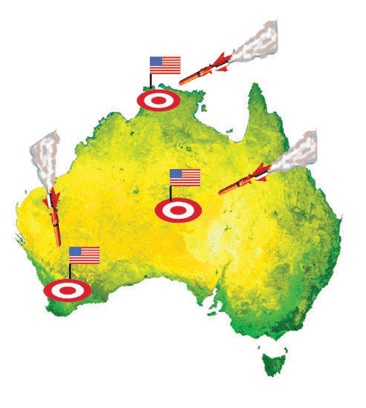
submarines which may be nuclear-armed and will make Australia a missile target
by enemies of the United States in war time. - AUKUS undermines our sovereign ability to make independent decisions about
involvement in US wars and will inevitably draw Australia into future US wars - AUKUS requires Australia to store toxic nuclear waste from the nuclear
submarines with consequential health risks to present and future populations and
exposes local populations to the health risks of a nuclear radiation leak or
accident. - AUKUS Pillar 2 ties Australian defence manufacturing and research into the arms
manufacturing programs of the United States and for their benefit not Australia’s. - AUKUS compromises Australia in undermining its commitment to the Nuclear
Non-Proliferation Treaty and the Treaty of Rarotonga (South Pacific nuclear-free
zone) as well as providing an impediment to Australia signing the TPNW. - The enormous public expenditure anticipated for this narrowly focussed
acquisition of up to eight nuclear subs will severely compromise national efforts to
address other urgent matters of human security including fuel and food security,
housing and medical security and to address the climate crisis.
I will now provide the arguments for cancellation of the AUKUS Security Pact
starting with Pillar 1.
Pillar 1- The acquisition of nuclear-powered attack submarines.
……………………………………………………………………….. The remaining argument used by nuclear submarine proponents is that they are
needed for defence of Australia’s territorial waters. However, Australia’s territorial
waters are in many places too shallow for the large, noisy, nuclear-powered
submarines to operate in safely and without detection, If submarines are needed
for defence of our territorial waters, smaller vessels are available from Japan and
Sweden which would be far more suitable. These vessels have quieter,
air-independent propulsion, cost far less and are free of radiation hazards. Former SA Senator and submariner Rex Patrick has said that Australia could acquire 20
air-independent subs for $30 billion, which is only 8% of the $375 billion for the 8
nuclear-powered vessels.
The arguments for Australia needing nuclear-powered submarines for our defence
clearly do not withstand scrutiny.
So why are successive governments committed to acquiring them?
There appears to be only one answer.
The US views nuclear subs as a vital part of its strategy to contain China, to track
and destroy Chinese naval vessels in the event of war with China. Our subservient
Australian leadership wants us to participate in such a war as we have done in all
the other post-WW2 wars the US has instigated,………………………..
Conclusion one: The eight nuclear-powered hunter-killer submarines are neither
necessary nor suitable for Australia’s territorial defence. Twenty air-independent
submarines would be more effective for territorial defence, be easier to maintain
and would cost only fraction (8%) of the $375 billion.
Conclusion two: The US has made it clear that it will expect Australia’s
nuclear-powered subs to participate in any US-instigated war and be subject to US
orders. To acquire such submarines in order to join a war with the US against
China would not only be extremely foolish but an economic disaster for Australians
and bring an unnecessary war to our soil.
The cost
Cost has to be another reason for questioning the acquisition of these
nuclear-powered submarines. Five of the eight submarines are of a new type, the
SSN series, to be designed by the UK and built largely at the Osborne shipyards in
South Australia. Given that they are yet to be designed and are to be built at a
facility that has no prior experience in building such vessels, the estimated cost of
$375 billion has to be regarded as a massive under-estimate………………………………………………………………..
Under Aukus and the Force Posture Agreement $8 billion of tax-payers fund will be
spent on the development of porting and maintenance facilities at HMAS Stirling,
Garden Island in WA for US and UK nuclear submarines. This development includes
a “controlled industrial facility” which will store the low -level nuclear waste from
these submarines. Greens Senator David Shoebridge has found out that
intermediate-level nuclear waste could also be dumped at this location.
The AUKUS Agreement has thus opened the door to Australia having to store
submarine nuclear waste and the concern is that the high level nuclear waste from
the nuclear reactors that drive the propulsion system of these submarines will also
have to be stored somewhere in Australia when those reactors have passed their
use-by-date.. Such a facility has not been determined yet and the provision of such
a secure facility which will prevent toxic leaks for centuries has proved a problem
for many countries and therefore presents a potential toxic threat to Australians in
the future. It should be noted that these nuclear propulsion reactors use
weapons-grade enriched uranium.
No costing has been done on the design and provisioning of such a facility in
Australia…………………………………………..
The Australian Naval Nuclear Power Safety Bill, 2023 declares Garden Island in WA
and Osborne in SA to be nuclear zones, areas in which the scenarios determined
by ARPANSA, would apply
The residents living near Garden Island and the Osborne Shipyard have not been
ad-vised of the ARPANSA risk analysis and emergency responses in relation to a
nucle-ar radiation leak or accident and so have had no opportunity to ask questions or raise any opposition based on this concern.
It is becoming clear that whether Australia receives or builds its own nuclear
subma-rines, this porting and maintenance facility at Garden Island and also the
proposed similar porting and maintenance at a facility on the east coast of
Australia, will be-come southern ocean ports for the US navy,its nuclear
submarines and perhaps more of its naval fleet pulling Australia even more
securely into US war plans.
In doing so they make Australia a missile target by enemies of the United States in
times of war.
AUKUS introduces nuclear weapons into Australia………………………………………………
The flawed process of signing onto the AUKUS Security Pact
The decision-making process behind AUKUS reeks of authoritarianism and
contempt for the Australian people and parliament. There was no public or
parliamentary discussion as one would expect prior to making such a significant
and costly national decision.
Scott Morrison was the Prime Minister who in 2021 secretly signed us up for AUKUS
together with an unknown number of faceless security advisors. He then sold the
idea to the leaders of the ALP in a two- hour power point presentation with no
documentation, no business case and no costing detail.
The ALP leadership enthusiastically embraced AUKUS and have never questioned
its legitimacy and never held any public discussion or inquiry into AUKUS and the
nuclear submarine acquisition. It has become bipartisan policy of the ALP and
Liberal Coalition with One Nation applauding in the background.
Only the Greens and some Independents have voiced questions and opposition regarding AUKUS.
AUKUS was entered into by a deeply flawed and anti-democratic process and
should be subjected to an immediate review in the form of a Royal Commission or
independent public inquiry.
AUKUS Pillar 2- Integrating Australian research and manufacturing with the US to
increase supply to the US war machine.
………………………………………………………………………………. Under Pillar 2, Australian defence industry will also be increasingly dominated by
the big three US software corporations (which already dominate and surveil all of
us), us-ing massive data centres and military focussed artificial intelligence (AI)
corporations such as Anduril and Palantir.
In practice, Australian defence developments and research will be acquired by the
US military. The Pillar II focus on sharing technologies between partners means in
prac-tice a mostly one-way sharing that is towards the US and building up its war
industry. So they will suck our brains for their benefit.
Under Pillar 2, Australian industry will become increasingly integrated into the US
mili-tary industrial complex – serving the needs of US government and US military rather than Australia.
We do not need Pillar 2. We need a publicly -owned, sovereign defence industry
manufacturing to meet our territorial self-defence needs which is quite a different
role to one designed to meet the needs of the US in its wars of aggression.
Alternatives to AUKUS.………………………….
The United States is a fractured, undemocratic society flouting international law
with impunity. We can have no affinity with this dangerous “ally” as former PM
Malcom Fraser said in his book “dangerous allies”.
The heavy US military footprint on our country will only attract a missile attack by
enemies of the US when they are at war. AUKUS is part of the US military footprint
on Australia…………………………………………………………………….
For a peaceful, independent and more secure future, AUKUS must be cancelled
and the Force Posture Agreement terminated, a consequence of which will be the
regaining of sovereignty and ending the heavy US military footprint on our
continent.
Submission to the AUKUS Public Inquiry – against Australia’s interest to be aligned with aggressor USA – Diane Atkinson

When they attacked Iran, the United States acted as a rogue state. They launched this attack in defiance of rules laid down in the United Nations’ charter, against wars of aggression. This war is already proving to be very much against Australia’s interests
Australia should be seeking to extricate ourselves from the alliance with the US, given the nature and direction of its wars of aggression, rather than tying ourselves more deeply to this alliance through AUKUS.
the danger that wars will be launched from Australian territory by the US, and that Australia will bear the brunt of retaliation against the US.
No 233.
AUKUS represents a very large investment by Australia: $368 billion over 30 years. This is a very
significant portion of our total budget, so we would want to ensure that we get good value, and that
it prepares Australia for the future. However, there is plenty of evidence that this commitment is
taking Australia in the wrong direction. Where we need to be contributing to a more stable and
cooperative world, so that we can solve collective challenges, we will instead be contributing to the
humanitarian and environmental damage that will be wrought by a declining empire, with no
tangible benefit to Australia.
We need to carefully weigh the security threats that are unfolding at this point in history, before we
commit to 30 years of spending. We know that climate change represents a major threat, which is
proving very difficult to confront. Building goodwill and cooperation would contribute to this task,
however the AUKUS alliance does the opposite. Australians have always resisted the nuclear
industry, but this deal forces us to accept the presence of nuclear-powered submarines, and the
waste that will require disposal on our soils. Having nuclear submarines present here is likely to
drive a regional arms race. At a time when resources need to be spent finding solutions to pressing
problems such as climate change, we will instead spend those resources on wasteful weapons of war.
The increased military spending will be perceived as a threat by other powers, and will undermine
the goodwill and global cooperation needed to produce binding agreements to reduce carbon
emissions. Instead, other countries will be obliged to also waste more resources on military
production.
When they attacked Iran, the United States acted as a rogue state. They launched this attack in
defiance of rules laid down in the United Nations’ charter, against wars of aggression. This war is
already proving to be very much against Australia’s interests. It threatens the availability of diesel
fuel and fertilizers, which are so important to Australia’s food security. At this time in history,
Australia should be seeking to extricate ourselves from the alliance with the US, given the nature and
direction of its wars of aggression, rather than tying ourselves more deeply to this alliance through
AUKUS.
Australia’s national security interests are not identical with those of our military ally, the United
States of America. The Global Financial Crisis of 2008 did not impact Australia in the severe way that
it impacted the USA or Europe. One of the reasons that Australia barely registered a recession
during this crisis, is the strength of our trade with China, which accounts for 25% of Australian trade,
based on 2025 figures from DFAT. It could be argued that we are too dependent on trade with China,
but when we think about our national interests, this current reality of China being our strongest
trading partner, needs to be factored in. Australia’s interests are not identical to those of the USA or
Europe, and this is a reflection of both geographical and economic differences. Our proximity with
Asia means that it makes sense for us to trade with Asia, including China. This also makes sense
because we have natural resources that these markets need, while we have lost or failed to develop
our manufacturing base, and our Asian neighbours can supply low-cost manufactured goods. We
made a decision to reduce tariffs and close down some of our industries. These decisions have
consequences for our security.
There is no identifiable threat to Australia’s security that currently emanates from our Asian
neighbours, including China. However, as a result of our free trade policies, we do now face an
economic threat, if our trade is interrupted. This could happen as a result of war, or of trade wars. Neither are in Australia’s interests, given our lack of self-reliance. Australia’s lack of self-reliance in
oil stands in contrast to the position of the United States. The problems in the Strait of Hormuz,
caused by US attacks on Iran, impact Australia more heavily than our military ally.
The United States has different defence priorities to Australia. The US seeks to suppress the rising
powers that have begun to challenge US hegemony. This has become obvious through their attacks
on Iran, which also have a negative impact on both Russia and China, since Iran is at the centre of key
trade corridors, and for that reason both countries have substantial investments in Iran. US leaders
make it very clear that they are hostile to China and Russia, along with a list of nations that are not
willing to accept US domination.
Since the US dollar is the world reserve currency, and this confers huge economic benefits on the US,
challenges such as the BRICS nations trading in their own currencies and using their own payment
systems, are likely to have negative consequences for the position that the US has enjoyed. The
power to shape institutions like the World Bank and trade rules such as the GATT arises from the
overwhelming economic power that the US has held, and this is ultimately backed by their military
power, which has been used to thwart countries that want to reduce the economic and political
dominance of the US over their internal governance. This was manifest in repeated military
interventions in Latin America last century, and in the Middle East more recently.
However, Australia is in a very different position. We are not an empire with hegemony to defend.
We are a smaller power, very reliant on trade, and therefore we have an interest in a stable world
order, and good relations with our Asian neighbours. We have already been adversely affected by
the war on Iran, and this could lead to a direct threat to our national security. One dimension of this
is food security. Diesel and fertilizers are essential inputs to our farming sector, and any resumption
of the war on Iran is likely to cause shortages of both.
The other threat to Australia’s security is the danger that wars will be launched from Australian
territory by the US, and that Australia will bear the brunt of retaliation against the US. We have seen
this happen in the Middle East. Iran retaliated against US military bases in the UAE, Kuwait, Iraq,
Bahrain, Qatar and most recently Jordan, since the US launched their attacks from those bases.
Military agreements such as the Force Posture Agreement and AUKUS prevent Australia from
controlling what the US does on our soil. We may not expect retaliation from Iran because US bases
in Australia in all likelihood provide intelligence for attacks on Iran, but we could well expect
retaliation if the US goes to war with China. Based on US threats, this scenario is currently the most
likely reason that any country might attack Australia.
Australia is currently allied with the very country that is launching wars of aggression. Even the
average person living in the US does not benefit from these wars. They have seen their standard of
living deteriorate over past decades. This deterioration is caused by a shift in the US economy,
whereby it is increasingly dominated by private monopolies, and the public sector increasingly serves
the interests of these rather than the general public interest. This tendency has reduced the
vibrancy of US industry. Even the arms industry, which receives so much public funding, produces
expensive equipment which is proving to be obsolete on the battlefield. Aircraft carriers and
battleships have repeatedly been withdrawn from the area of engagement in the Strait of Hormuz, as
they make easy targets for cheap drones and for missiles. The USA is not demonstrating that it can
use military force to great effect, and yet it relies on such force increasingly, suggesting once again
that it is an empire in decline.
In its attempts to shore up this loss of power, the US is leaning more heavily on its allies like Australia.
We are expected to subsidize the extravagant expenditure on arms that continued world domination
would require, at the expense of our own interests. AUKUS arose out of Australian attempts to
purchase non-nuclear submarines from France. We now find that the Australian prime minister who
undermined that process, and instead committed Australia to purchasing nuclear submarines from
the US and the UK, is now working for the US arms industry. It is obvious that as prime minister, he
was already promoting those interests. Instead of obtaining working submarines in a reasonable
timeframe at a reasonable cost, we now have a program that commits Australia to massive spending,
with no guarantees as to what Australia will get in return. Meanwhile AUKUS spending is driving a
war economy. Education spending by the South Australian government subsidises degrees for the
arms industry, instead of degrees for health care workers and teachers. In this way we are directly
subsidising US owned arms manufacturers, while under-investing in the sectors that ensure our
collective well-being. In the midst of a housing crisis, when many young Australians cannot afford to
buy a home, and many cannot even find let alone afford rent, we neglect to make the necessary
investments in social housing, and instead spend to subsidise the operations of foreign arms
companies. We train our young people to build arms instead of building houses.
The secrecy surrounding AUKUS shows that its proponents have no faith in their ability to convince
Australians that this appalling decision is in our interests. Any reasonable person can see that it is
not.
Submission to AUKUS Public Inquiry – AUKUS a sellout of Australia’s security – Michael Gilligan
232. Michael Gilligan
I was responsible for Defence Department advice on options after retirement of
Oberon class submarines (Head of Force Development and Analysis Division in early 1980s). I am a Board member of Pearls and Irritations (P&I), online policy forum created by John Menadue. Regular contributor to P&I.
Despite its crippling cost, no Minister for Defence has ever explained what the
Virginia class submarine is meant to do. Why has such an obvious ministerial
obligation been evaded? Because it would reveal a sell-out of Australia’s security.
And an extraordinary direct underwriting of US shipbuilding and defence budgets
by Australian taxpayers – of perhaps half a trillion of our dollars. The Virginia class
submarine is not a general-purpose vessel such as our Collins class. It is designed
for supreme acoustic invisibility for a specific purpose – to find, doggedly track
underwater for months and be able to destroy submarines seen as a nuclear threat
to the US mainland. Principally Russian and Chinese SSBN boats. The United States
is stretched beyond its industrial capacity to deal with China’s growing SSBN fleet.
Assisting in that ongoing task is what Australia offered in AUKUS, and so the US
expects Australia’s submarines to do – effectively embedded into US military
command – against China’s burgeoning capacity to annihilate continental America
from under the sea.
LINK – https://johnmenadue.com/post/2026/06/australias-submarine-betrayal/
More broadly, the Minister for Defence has misled Australians habitually on the
value of submarines in defending Australia. His case rests on treating submarines
as essential to Australian sovereignty, while ignoring the powerful array of
capabilities which already protect Australia and its maritime approaches.
Assessments of the submarines’ marginal effectiveness in a whole-of-Defence
context raise serious questions about the value of submarines, even whether they
are warranted at all on cost-effectiveness grounds.
So, the debate on submarines currently consuming Australia’s headlines is
corrupted by two compounding Ministerial lies by omission – the submarines’ job
within AUKUS, and Australia’s range of defence capabilities purposefully created
over decades, which marginalise submarine importance to our security.
Submission to AUKUS Public Inquiry- dubious security value, breaching treaties, radioactive wastes, huge costs – Ian Lowe

227. Ian Lowe
To summarise my relevant experience, my doctoral research at University of York
was funded by the UK Atomic Energy Authority. I studied the basic physics of a
problem affecting the useful life of fuel elements in nuclear reactors. As a member
of the UK Open University’s Energy Research Group, I participated in a
comparative study of the whole-of-life operating costs of nuclear or coal-fired
power stations. I was for twelve years a member of the Radiation Health and
Safety Advisory Council, which advises the nuclear regulator ARPANSA, and I was a
member of the Expert Advisory Committee for the South Australia Nuclear Fuel
Cycle Royal Commission, which reported in 2016.
The critical question is whether owning and operating eight nuclear-powered
submarines would actually enhance our security. I participated in a one-day
seminar run by the Submarine Institute of Australia well before the AUKUS
agreement was negotiated. The submariners were clearly divided about the
question of whether the next generation of submarines should be
nuclear-powered. While they could operate away from base for longer periods and
at greater depth than conventional submarines, their size would prevent them
operating in the comparatively shallow waters around Australia’s northern
coastline, making them less useful for defending our territory. That observation
poses an obvious related question about sovereignty and independence. Would
the AUKUS arrangement move Australia away from being an independent
middle-sized country like Japan or Indonesia, locking us into the US war machine
and increasing the risk of being dragged into great-power conflict with China, our
major trading partner? Some observers fear that AUKUS could actually make
Australia a nuclear target. Given that China is our major trading partner, it seems
bizarre to imagine that we need to protect our ocean-going trade from the Chinese
navy, but that has been proposed as a reason for acquiring nuclear-powered
submarines.
A whole group of questions arise from the specific problems of nuclear-powered
boats. If nuclear technology is transferred from the USA and the UK to Australia to
allow submarines to be built here using weapons-grade uranium, does that
contravene the Nuclear Non-Proliferation Treaty? The proposal has certainly been
seen by some of our South Pacific neighbours as inconsistent with our treaty
obligations. What are the environmental risks of operating nuclear-powered
submarines in Australian waters? Some technologists who are quite enthusiastic
about nuclear power stations are worried about installing reactors in vessels which
an enemy would understandably try to destroy in any serious conflict.
The final issue under this heading is the long-term problem of managing the
radioactive waste when the submarines reach the end of their lives. The AUKUS
agreement makes Australia responsible for waste management. That would be a
huge problem. Our government has made three unsuccessful attempts to
establish a national repository for the comparatively benign low-level radioactive
waste from nuclear medicine and industrial applications. In every case, the
proposals have been successfully opposed by local First Nations groups. Their
memories are critically shaped by their experiences when the Menzies government
allowed the British military to test nuclear weapons on our land. But the problem
of managing the waste from nuclear submarines is orders of magnitude more
difficult than storing low-level waste. The small reactors use highly enriched
uranium, weapons-grade material, which produces a much more intractable set of
waste products than emerges from nuclear power stations. The USA and the UK
have been operating nuclear submarines for more than sixty years, but have still
not worked out how to manage the wastes. The decommissioned boats are just
sitting at docksides while the government scientists ponder the issue.
Assuming we do prove able to solve the problem and develop a system for
managing the waste, it is likely to add another huge sum to the overall costs of the
project. In 2015, a South Australian Royal Commission considered the possibility of
going into business managing the waste from nuclear power stations in Asian
nations that do not have suitably stable geology for long-term secure containment.
I was a member of that inquiry’s expert advisory committee. We sponsored a
serious study of the likely cost of building and operating a secure repository for
high-level radioactive waste from power stations. The consultants came up with an
estimate of $145 billion; adjusting that total to 2026 costs gives a figure of about
$190 billion. So accepting responsibility for managing the wastes will mean a
further eye-watering cost burden on future generations. In fact, that figure is likely
to be a conservative estimate, because the consultants were asked to calculate
the cost of managing waste from nuclear power stations. Not only is the mix of
waste products from a nuclear submarine nastier, it also contains enough
weapons-grade uranium to make at least 20 bombs. So the waste management
facility will require military security to ensure the fissile material is not misused.
Submission to AUKUS Public Inquiry – dissolve AUKUS, stop being a cog in USA’s military industrial complex – Heidi Glaser.
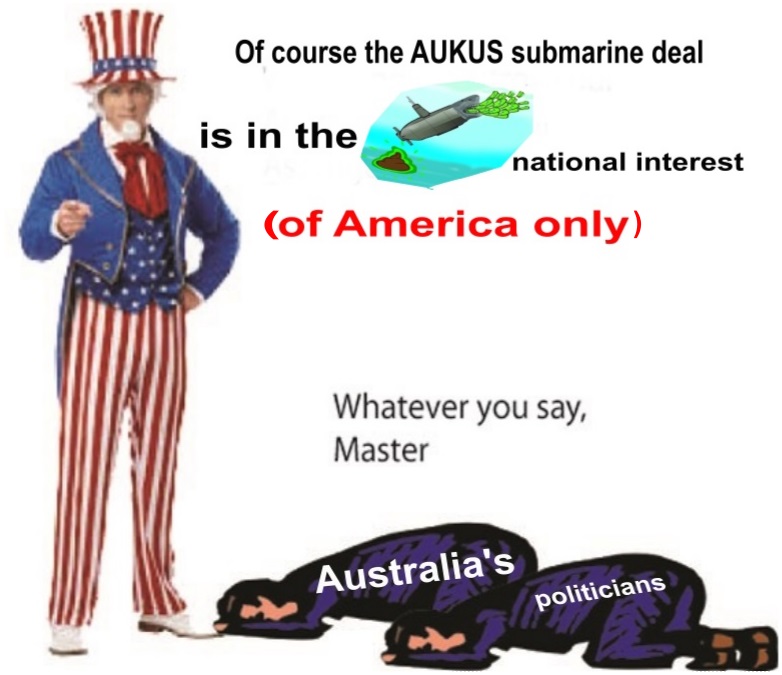
226. Heidi Glaser
AUKUS must be dissolved. It is beyond comprehension, the level of incompetence
and ignorance our government is capable of to think Australian’s would support
and agree to these conditions. It could not be more insulting to our intelligence.
We are a peaceful people. We have no interest in wars. We do not want to be
aligned with the US and participate in their forever wars. We have become a cog in
their military industrial complex. Why are we supporting a country we know are
involved in illegal wars who are committing war crimes with complete impunity?
Why would we sacrifice our country for them? The US are not our ally. We have
become a vasal state against our will. No wonder they mockingly refer to us as a
lap dog.
We are enabling them to continue their slaughtering of innocent civilians
around the world. We want no association with them, their bullying, coercion and
disruption globally needs to end now. We are paying them to become a military
target on their behalf, we are less safe because of AUKUS.
We have no interest in
conflict with China. They have no reason to attack us and have never threatened
our country. We rely on them for our economic success. We should be doing more
to partner with them and create a coalition in the global south to make Australasia
the safest and economically sound region in the world.
We have great relationships with our neighbours and AUKUS will destroy that. That is the
incredible insanity of this agreement. It is ensuring our future failure not
prosperity. If we spent this much time and money on peace in the world, and not
on planning for future wars, humanity would be thriving. Fearmongering from the
US must be stopped, not supported.
We can never allow nuclear dumping on this
land. These submarines shouldn’t even be made. Why are they even allowed to
build anything that produces a radioactive poisonous waste? They have no idea of
the long term damage to the planet and it’s unbelievable to hear they have never
had an established protocol around safe storage of the nuclear waste produced.
That is sickening to me. Stop making things that are killing us and the earth. We
need to protect this land. The first nations people are the oldest continuous
civilisation on the planet, the ancient history of their people and of their land is
sacred and it should be honoured and protected at all costs. We can not let them
down, we owe them to fight for this beautiful land.
We reject AUKUS, we don’t
want wars, we don’t want a world where we even need weapons. This can not be
allowed to proceed. No intelligent Australian supports this. It’s time Australia took
back it’s sovereignty. Imperialist America’s must be stopped and this is our chance
to cut all ties with them.
Submission to AUKUS Public Inquiry – concern about AUKUS Command unit within the Federal Police -Suzanne Pinchen
218 Suzanne Pinchen

the function of this unit will be to protect AUKUS related activities and facilities, including public order responsibilities.
this unit will be supplied with
firearms, and, what are referred to as, “crowd suppression munitions” including rubber bullets, tear gas and capsicum spray.
Question for Inquiry:
I am a grandmother of two identical twin boys aged 3 1⁄2, for whom AUKUS
will have real consequence. I am also retired after working in
Broadmeadows as a Social Worker working with women and their families
for 40 years. I am now a chorister – part of a choir which became the
unofficial choir for the Yes to the Voice to the Parliament Referendum in
Melbourne and a member of both the Australian Living Peace Museum
and Labor Against War.
The issue I would like to address is one I have already raised in person at
an electorate meeting with my local MP, Peter Khalil, Assistant Minister for
Defence. At this meeting Mr. Khalil advised that he was unable to answer
my question but requested that I email him the question and committed
himself to a quick response, which I have not received.
It is an issue that goes to the impact of AUKUS on internal relations
between agencies in Australia and its consequence for public expression
of concern raised by Australia’s binding relationship with the US. Now,
having not received an answer or acknowledgment of the email, I now
raise the issue with the Public Inquiry Commissioners in the hope that you
may be able to examine the issue.
You may be aware that there have been reports in the ABC, the Australian
and the Guardian gathered through FOI requests regarding the
establishment of an AUKUS Command as a unit within the Federal Police in
conjunction with the Department for Defence. These reports indicate that
the function of this unit will be to protect AUKUS related activities and
facilities, including public order responsibilities.
In addition, it has also been to reported that this unit will be supplied with
firearms, and, what are referred to as, “crowd suppression munitions”
including rubber bullets, tear gas and capsicum spray.
In particular, could the Inquiry please examine the impact of the
establishment of an AUKUS Command may have on the legitimate
expression of community dissent in Australia; both in areas surrounding
defence installations and other general venues.
Submission to AUKUS Public Inquiry – Radiation protection for workers and members of the public under AUKUS – Dr Tony Webb
No. 204 -Summary
Summary of key issues covered in this submission
The key issues I wish to raise for consideration as part of this Inquiry into the AUKUS
submarine program are:
That there is a potential risk to health of workers and the public from routine as well
as unpanned/accidental exposures to ionising radiation from many aspects of this
AUKUS program including: submarine construction, operation, maintenance,
decommissioning, and long-term management of radioactive waste materials.
It has long been an established principle for radiation protection that there is no
threshold or safe level of exposure – that even small doses may result in stochastic
health effects where probability of effect rises with the level of exposure rather than
disease outcomes being determined by dose. As a result, it is expected that all
exposures need to be justified against some expected social benefit, be kept as low
as reasonably achievable (ALARA) and be kept below strict annual worker and public
exposure limits.
These established principles are currently being challenged in the USA as a result of a
2025 Presidential directive that instructs the US Nuclear Regulatory Commission to
abandon the no threshold and ALARA principles and revise occupational and
exposure limits to reflect deterministic rather than stochastic health effects – changes
that, if implemented would significantly increase permissible exposures.
It is unclear how such changes might be applied to nuclear submarine operations
under AUKUS particularly where US or Australian-US co-owned/operated boats use
Australian facilities. Pressure from the US to operate within US standards can be
anticipated. It should be noted that Australia has already established a Naval
Nuclear Protection Standards Regulator (ANNPSR) – separate from the current
Radiation Protection and Nuclear Safety Agency (ARPANSA) – that will regulate all
aspects of safety for the AUKUS program.
The changes to US standards – already weaker than those applied under international
recommendations by most other countries, come at a time when scientific evidence
from large scale epidemiological health studies on workers employed in, and
communities living close to, nuclear facilities indicates that the estimates used in
setting current standards underestimate the risks to health and need to be
significantly tightened.
Details and evidence relating to these issues are outlined below. I will be happy to provide
further information and be questioned on matters arising if this would assist the Inquiry.
Impending changes to radiation protection standards
Changes for worse or better protection for workers and the public is on the international and
national political agenda in a number of countries. Trade Union, environment and public
health groups around the world are concerned that the USA is considering proposals that
would weaken radiation protection standards at a time when the scientific evidence
suggests these need to be significantly tightened. These need to be resisted with pressure
to provide better not worse protection for workers and the public.
In May 2025 US President Donald Trump issued a Directive (EO 14300) i
requiring the US Nuclear Regulatory Commission (NRC) to review nuclear safety regulations with particular
reference to radiation protection of workers and the public. The Directive instructs the NRC
to abandon fundamental principles that have formed the basis for radiation protection for
much of the past century. These include: the internationally accepted position that there is
no threshold or safe level of exposure to ionising radiation; that, as a consequence, all
exposures should be kept as low as reasonably achievable (ALARA); and that exposures to
workers and the public be kept below strict annual limits in line with the best evidence of
radiation-induced health risks.
Evidence for increased health risk from radiation exposure
The evidence used to set current standards is drawn mainly from the studies of cancer rates
among the Japanese A-bomb survivors who were exposed to relatively high doses over short
time periods. Since then, studies of workers in nuclear power facilities exposed to lower
doses over long time periods show higher rates of cancer than predicted by the Japanese
studies. Rather than indicating any threshold these studies suggest that at low doses the
cancer rates are proportionately higher than expected from the Linear No-Threshold (LNT)
model used to set current standards.ii Worker studies also show elevated rates of cardio-
vascular diseases, and increased rates of dementiai. In addition, studies on populations around nuclear power plants are now showing higher cancer rates affecting the population
generallyand particularly childrenvi and the elderly with level of health damage correlated
with how close they lived to these facilities……………………
US pressure on global standards
If they go through there will also likely be pressure on international and national standards
agencies to align with changes in the USA. There is already some push-back. In June 2025
the heads of European standards agencies issued a statement supporting the LNT and
ALARA principles and insisting that exposure standards be set on the basis of the scientific
evidence without undue influence. ix In May 2026 the World Health Organisation urged
national and international bodies to continue collaboration to “harmonise standards, share
data and strengthen coordination on radiation and health.”
The AUKUS connection
In Australia there are a number of joint ventures in uranium and radioactive rare earths and
mineral sands mining and the government has already established a separate Naval Nuclear
Power Safety Regulator (ANNPSR) to oversee all aspects of construction, operation,
maintenance, decommissioning and nuclear waste management under the Australia-UK-US
(AUKUS) nuclear submarine program. While these nuclear submarine standards are
expected to be consistent with those of the current Australian Radiation and Nuclear Safety
Agency (ARPANSA) it is unclear whether US or Australian standards will apply to US military
or joint US Australian assets operating from Australian facilities. Pressure for change is
inevitable. Hopefully the outcome of politically independent science-based pressure will be
not merely opposition to changes prompted by the US President’s directive but for
significantly better standards to protect health.
What the AUKUS investigation might recommend
First: that Australian radiation protection should continue to be based on the established
principles that: there is no safe level of exposure to ionising radiation; that all exposures in
the workplace, and in community from whatever source need to be justified against some
recognizable benefit and where justified be kept as low as reasonably achievable and in any
case below strict exposure limits that are set on the basis of the best available evidence for
the level of risk of health damage.
Second: that all radiation protection safety standards operated under the AUKUS program
and regulated by the ANNPSR be consistent with those developed by ARPSANSA for
occupational and public exposures generally and that these apply to construction,
maintenance, decommissioning and waste management for all nuclear-powered submarines
whether these are owned by Australia or another country – Australian standards rather than
those of another country should apply in Australia.
Third: that ARPANSA be asked to provide a clear and unequivocal statement that Radiation
Protection standards in Australia will not be changed in line with the US Presidential
Directive
Fourth: that ARPANSA be asked to undertake a systematic review of the evidence suggesting
that the current occupational and public exposure limits need to be revised – and tightened
so as to lower permissible exposure limits.
References and Further Reading………………………….
International law isn’t dead. It’s being tested. Australia can prove it matters
by Emily Crawford | Oct 5, 2026, https://michaelwest.com.au/international-law-isnt-dead-its-being-tested-australia-can-prove-it-matters/
The silence in Canberra over attacks on the ICC, the US attack on Venezuela and the war on Iran rings loudly. Australia has a unique chance to uphold it, writes Emily Crawford.
When a powerful state breaks the rules, the temptation is to declare international law dead.
Over the past 20 months, there has been plenty of evidence to feed that mood. The Trump administration alone has withdrawn from the WHO, the Paris Agreement, the UN Human Rights Council and UNESCO.
It has sanctioned the judges and prosecutors of the International Criminal Court. It has threatened to seize Greenland and take back the Panama Canal. It has struck Venezuela and seized its president, with no Security Council authorisation and no credible claim of self-defence.
UN Special Rapporteur Ben Saul has found that the US campaign of boat strikes, which has killed at least 223 people, amounts to “serial extrajudicial killings”. More than 100 international law experts have warned that strikes on civilian sites in Iran may constitute war crimes.
In addition, we are seeing widespread violations of the law in Myanmar, Sudan, and Gaza, among other sites of atrocities.
The cynics
Cynics say this proves international law is a fiction that binds only the weak. Its an appealing conclusion – after all, the UN Charter was founded on the promise of outlawing war.
But the UN is not the totality of the international legal system. And legal system that has its rules broken is no less a legal system for the breach. After all, we do not unilaterally declare that laws against theft are meaningless because theft occurs.
A prohibition on the use of force, on attacking civilians, on forcibly transferring populations, exists precisely because states are tempted to do these things.
“What matters is how the world responds.”
When a violation is named as a violation, documented by UN investigators, condemned by legal scholars and recorded for future accountability, the law is doing its work. Even the powerful tend to reach for legal language to justify what they do, because they know the rules carry weight.
Nobody feels the need to argue that a rule doesn’t apply to them unless the rule matters.
The rules also matter most to those with the least power. Australia is the textbook example. As a middle power, we cannot secure our interests by force alone. We depend on freedom of navigation, on binding trade rules, on arms control agreements that restrain nuclear weapons, and on the expectation that borders cannot be redrawn by whoever is strongest.
Successive Australian governments have understood this, and Australia has long been a builder and beneficiary of the multilateral system.
Wrong way Australia
That is what makes the recent silence so striking. Canberra did not respond to the attacks on the ICC or the strikes in the Caribbean, and it backed the new war on Iran. If international law is the foundation of Australian security, treating its erosion as somebody else’s problem is a strange way to defend it.
Yet there is a real opening. Since announcing its bid for a seat on the UN Security Council, the government has been talking about international law constantly. The Prime Minister Anthony Albanese has said the international rule of law
“isn’t something that is regarded as, if you like, optional”.
The Foreign Minister Penny Wong says Australia wants “a safer world … governed by rules, not power and force alone”, and has promised a Council term focused on conflict prevention, the protection of civilians and “defending the rules that protect us all”.
Australia’s ambassador to the UN has set out why rules and norms matter to Australia’s prosperity and security, from trade to nuclear non-proliferation to the aviation and satellite systems that most of us rely on without thinking.
These are good words, and for anyone who cares about international law, hearing them from those in power is welcome.
But words in a campaign are cheap.
A Security Council bid is a promise to the world that Australia will defend the rules, and the test is whether that promise is matched at home.
Red Lines
That is where the Red Lines Package comes in. It was recently introduced into Parliament, and it is a chance to turn the government’s rhetoric into something concrete.
Professor Emily Crawford is one of the panelists to be discussing international law with the International Criminal Court’s Judge Hilary Charlesworth on 13 October at the NSW Teachers Federation Conference Centre in Surry Hills.
Yet Labor and the Coalition combined to prevent it from receiving scrutiny through a Senate inquiry. It is hard to reconcile a campaign that puts the rule of law in every speech with a refusal to let Parliament examine a proposal built on that principle.
If the commitment is genuine, an inquiry should be welcome, since the statements already made would be the strongest possible case for it.
The lesson is not that international law has failed. Law has always depended on people choosing to uphold it, insisting on it, and paying a price for doing so. It survives every time a state, a court, an expert or a citizen refuses to accept that might makes right.
The Security Council bid gives Australians a rare lever. We can take the government at its word and ask it to act on what it has said.
An Australian comment on the The Evacuation of US Bombers from RAF Fairford.
New England Cocky says:
, https://theaimn.net/flying-scared-the-evacuation-of-us-bombers-from-raf-fairford/
It is time for Australia to unravel the too deep embedding of Australian sovereignty into American imperialist dreams of natural resources theft and political intrigue.
The correct future for Australia is as an independent, non-aligned middle power, trading with Asia where we belong and ceasing to dream that Europe is the centre of the Universe. it is NOT, and neither is the USA (Undemocratic Sewer of Apartheid).
The US Supreme Commander is unfit for purpose, a bone spurs refugee from conscription now more important than any returned US military person who has served their country with distinction rather than cowardice.
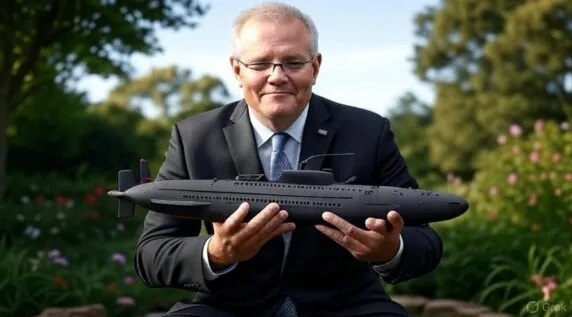
It is time to cancel Scummo’s USUKA dirty deal for self-serving post-politics career working for a foreign power, because neither the USA nor the UK have the ability to meet the original contract conditions.
Hence, Australia is paying for US security plus an allegedly non-refundable tribute payment of about $2 BILLION for now already redundant boats, in an age when drone technology is cheaper and equally effective at killing people.
1 This month
.

Australians deserve the truth
about
AUKUS – https://aukuspublicinquiry.com/

PETITION – To: Prime Minister Anthony Albanese and the Australian Labor Government

of the week – Australians for War Powers Reform (AWPR)
To see nuclear-related stories in greater depth and intensity

