Whyalla and Port Augusta could be a renewables powerhouse, says local mayor,ABC North and West By Tom Rohde , 4 Jan 18
SA’s clean-energy projects
A hybrid power station is being built at Coober Pedy. The hope is that the outback community can be powered solely by solar, wind and diesel energy
Investors have funded a $300m solar battery-power plant at Roxby Downs
A wind, solar and battery farm is planned at Crystal Brook in the state’s mid north
A 100 megawatt solar powered facility is being built at Tailem Bend
US-based company Solar Reserve is seeking federal support for a $650 million solar-thermal project in Port Augusta
Zen Energy wants to build a solar power plant in the Upper Spencer Gulf
The mayor of a South Australian regional port city built on the steel industry and iron ore mining says it could pair with a neighbouring centre to become the nation’s hub for renewable energy.
Whyalla Mayor Lyn Breuer said she hoped her city could team up with Port Augusta 80 kilometres away to make the plan a reality.
Regional South Australian cities have seen several energy projects announced over the past year, with construction on a new solar thermal power station in Port Augusta to start early this year.
In October last year, Whyalla steelworks owner Sanjeev Gupta announced that he had approved a plan worth up to $700 million for solar, battery storage and pumped hydro, with 200 megawatts of solar photovoltaics at Whyalla……..
Port Augusta’s mayor Sam Johnson said he believed the region was already becoming a hub for renewable energy.
“Port Augusta will, and I believe actually is becoming the renewable capital of Australia and there’s no doubt that Whyalla is a direct link into that.
‘Aboriginal people across this country are calling for a Treaty with Aboriginal and Torres Strait Islander people
that recognises Aboriginal sovereignty as the First Peoples was never ceded,
address the stark disparity in economic social conditions of Aboriginal communities poverty
and the structural racism that continues to repress Aboriginal people.
‘The Declaration on the Rights of Indigenous Peoples,
now endorsed by the Australian Government, asserts in Article 3:
Indigenous peoples’ rights to self-determination.
‘Yet Australia remains the only commonwealth colonised country
without a Treaty with its Indigenous peoples.
‘Calls for a Treaty were repeatedly raised by Aboriginal communities
during the recent Constitutional Recognition consultations
as a practical means to recognize Aboriginal and Torres Strait Islanders
as the First Nation Peoples and to implement the structural changes
required to establish self-determination.
‘A Treaty builds on the Statement from the Heart’s call for a ‘Makarrata’,
a Yolgnu word for coming together after a conflict, to move forward together.
It also builds on several State based Treaties currently being developed.
‘A Treaty sets a process to legitimately move forward in partnership
between Aboriginal people and the Australian State.’
Adani $1b loan bid was likely to fail key criteria for NAIF approval, ABC News, By Josh Robertson, 5 Jan 18, Adani’s bid for a $1 billion taxpayer-funded loan may have been doomed even before it was scuppered by Queensland’s Palaszczuk Government, the Productivity Commission has said.
Key points:
Qld Govt vetoed critical $1 billion loan for Adani mine
Productivity Commission says mine may have failed loan criteria anyway
Qld Govt could also veto rail company loan bid
The miner’s proposed Galilee Basin rail line faced rejection by the Northern Australian Infrastructure Facility (NAIF) because it may have failed key hurdles, the commission’s latest bulletin suggested.
However, the commission is yet to analyse a rival NAIF loan bid by rail operator Aurizon, which the State Government will also consider blocking in line with an election promise relating to Adani.
It comes as environmental activists plan to target Aurizon over its rail proposal, which would set up an export route for Adani.
State Labor told lobby group GetUp! during the election campaign in November it would veto “any NAIF loan” that enabled Adani’s coal project.
The Productivity Commission’s December newsletter noted that projects seeking low-interest loans from NAIF must “not otherwise be able attract finance, but would be commercially viable once constructed”.
There must also be “a public benefit from the infrastructure [to justify the cost to the taxpayer of the short-term assistance provided]”.
“Many of the projects suggested in the media as candidates for NAIF funding — such as the rail line to the Galilee Basin and various large irrigation dams — may fail at least one of these criteria,” it said.
This raised the risk of taxpayers throwing good money after bad, the commission suggested.
“If the return on the investment does not cover the operational costs of the infrastructure and the costs of servicing the loan at market rates over the life of the asset, the small initial level of assistance provided by a concessional loan may simply become another case of inefficient resource allocation,” it said……http://www.abc.net.au/news/2018-01-05/adani-loan-bid-likely-to-fail-before-palaszczuk-intervention/9305040
Pacific rift: When nuclear tests made France a dirty word, SMH, Damien Murphy, 1 Jan 18 “…….the 1985 sinking of the Greenpeace vessel Rainbow Warrior by French operatives, union outrage, peacenik panic and maintenance of uranium exports shaped Australia’s response to Paris’ decision to start letting off bombs as far away as possible from La Belle France.
In a June 5 report to cabinet about possible resumption of French tests, the minister for foreign affairs, Gareth Evans and the minister for Pacific Island affairs, Gordon Bilney, said memories of the Rainbow Warrior were strong and New Zealand could be expected to postpone official visits and suspend military-related co-operation with France.
The ministers were concerned about Australia looking as hard-nosed as New Zealand.
“New Zealand will obviously be hoping that Australia’s response is similar to theirs,” the ministers said. “Wellington’s response may have an impact in Australia if it is significantly stronger than ours.”
The ministers advised treading softly so as not to make nuclear testing dominant in the bilateral relationship and stop the French from taking retaliation.
“Three specific areas of current Australian interest could be targeted by the French: Australia’s (United Nation’s) Security Council bid, market access for special Australian products such as kangaroo meat, and Australia’s candidature for the position of secretary-general of the South Pacific Commission.”
On June 13, president Jacques Chirac announced the resumption of nuclear tests in the South Pacific.
The Keating government hardened up its act.
On June 22 cabinet decided to recall Australia’s ambassador and Australian Defence Force staff from Paris, suspend Australian ship and aircraft visits to French territories and ban French ship visits and “not progress” collaboration on military logistics and equipment or exchange classified information.
Cabinet maintained the policy of not negotiating any new uranium contracts with France while it was conducting nuclear tests in the South Pacific.
“These measures are in line with the government’s consistent policy on this issue, which has been to respond in a measured, graduated way, leaving open every avenue for France to respond to South Pacific concerns,” an attachment to a cabinet minute noted.
Microgrids are in their early stages in Australia, but the country is swiftly taking a world-leading position, making the nation a renewable innovation hub.
Australian towns going off the grid http://www.theage.com.au/business/the-economy/australian-towns-going-off-the-grid-20171219-p4yxvv.html, Cole Latimer, 3 Jan 17, Australia is facing an energy crisis. As prices rose to new highs last year and the ever-constant threat of blackouts hung over the east coast, many Australians looked for energy alternatives. Some turned to solar panels and battery storage technology to solve their bill woes, gain greater control of their own power and make a real change in terms of their impact on the climate.
While they are taking steps at the individual level, others are looking to take full advantage of the push for more renewable energy and shift away from centralised power systems on a larger scale.
This is seeing the rise of microgrids, a unique solution to a very Australian problem.
The vast distance covered by Australian energy distribution networks presents a serious problem: How do you get energy generated from point A to a user at point B, and how much will it cost?
Microgrids circumvent this issue by creating power and keeping it local, and at the same time lowering costs by cutting much of the associated distribution costs. Microgrids are autonomous energy distribution systems that can generate power from its users and operate off the main grid, or connect to existing grids, and support different generation assets and load demand.
This market is forecast to increase to more than $20 billion annually, with around half of all Australian homes expected to have rooftop solar panels installed, by 2024. Continue reading →
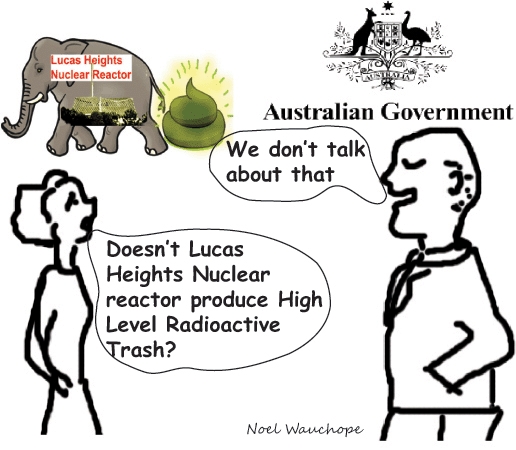
Spent nuclear fuel storage at Sydney’s Lucas Heights was destined to be full within three years, cabinet was told in a December 1995 minute.
The cabinet agreed the Australian Nuclear Science and Technology Organisation should cost proposals to have Britain reprocess their spent fuel in Scotland, return all American spent fuel to the United States and not accumulate spent fuel beyond the capacity of existing storage.
Cabinet wanted the information for consideration in the 1996-97 budget.
The minister for primary industries and energy, Bob Collins, and the minister for industry, technology and commerce, Peter Cook, told cabinet that reducing spent research reactor fuel holdings would be welcomed by the community at Lucas Heights although any operations involving radioactive materials were likely to be opposed by groups that object to nuclear activities.
Australian Defence Force on heightened alert during Russian military exercise in Indonesia ABC News Defence reporter Andrew Greene, 30 Dec 17, Defence personnel in Darwin were operating at “increased readiness” earlier this month as Russian strategic bombers conducted navigation exercises close to Australia, flying out of an Indonesian military base.
Key points:
RAAF Base Darwin placed on a “short period” of heightened alert
Russian Ministry of Defence claims it “carried out air alert mission over neutral waters of south Pacific Ocean”
Defence Department would have been concerned about Russian intelligence collection, defence expert says
The ABC can reveal RAAF Base Darwin was placed on a “short period” of heightened alert, while over 100 Russian personnel and several aircraft were stationed at the Biak Airbase in Indonesia’s eastern Papua province.
During the five-day stopover two nuclear-capable Tu-95 bombers flew their first ever patrol mission over the South Pacific, prompting concerns they may have been collecting valuable intelligence.
French nuclear test tensions threatened Olympic Dam expansion plans, declassified Cabinet documents reveal, Peter Jean, The Advertiser, January 1, 2018
THE FRENCH NUCLEAR TESTING
KANGAROO meat and other exports to Europe could be jeopardised if Australia took a hard line against French nuclear testing in the South Pacific, the Keating cabinet feared in 1995.
A ban on uranium exports to France could also have put at risk a potential $1 billion expansion of South Australia’s Olympic Dam.
The resumption of underground nuclear testing in French Polynesia sparked boycotts of French businesses in Australia and plunged the Labor government into a diplomatic and political crisis.
Mr Keating recalled Australia’s Ambassador from Paris and suspended some defence co-operation with France, including ship visits and training arrangements.
In a May cabinet submission ahead of the nuclear tests, Foreign Affairs Minister Gareth Evans and Pacific Island Affairs Minister Gordon Bilney warned that Australia’s interests could be damaged if the Government overreacted.
“Australia’s response should also be shaped so as to limit French retaliation in those sectors of the relationship we wish to see preserved,’’ the submission said.
“Three specific areas of current Au1stralian interest could be targeted by the French: Australia’s Security Council bid, market access for special Australian products such as kangaroo meat, and Australia’s candidature for the position of Secretary-General of the (South Pacific Commission).’’
There were widespread calls for Australia to suspend uranium exports to France but this would have led to the Government having to pay compensation to mining companies with existing contracts.
Australia had already imposed a ban on new uranium export contracts with French companies until France agreed to a comprehensive nuclear test ban treaty.
The papers note the Australian government was under increasing pressure from Europe and Pacific island nations to take tougher steps to reduce carbon dioxide emissions.
The truth was that the “no regrets” policy made Australia’s efforts to cut emissions ineffectual, as officials acknowledged in the cabinet papers.
Among the policy responses considered was a carbon or energy tax
Cabinet debated how to cling on to government’s ‘no regrets’ policy while maintaining Australia’s influence at international bargaining table, Guardian, Anne Davies, Australia’s response to climate change and the challenge of meeting its international obligations proved as difficult for the Keating government in 1994 and 1995 as it would for future governments.
Cabinet papers released by the Australian National Archives on Monday show that much of the debate in the Keating cabinet was about how to cling on to the government’s “no regrets” policy while maintaining Australia’s influence at the international bargaining table.
The “no regrets” policy meant Australia would consider only measures that involved cutting emissions without any adverse impact on the economy or trade competitiveness. That ruled out most measures to tax fossil fuels, which would increase the cost of electricity.
It meant Australia relied mainly on creating carbon sinks by limiting land-clearing and planting trees.
Australia had signed on to targets at an international conference in Toronto in 1990 on the basis that the convention would recognise Australia’s high dependence on fossil fuels.
But by September 1994 ministers were told Australia was falling woefully behind the implied target set in the Framework Convention on Climate Change and the interim planning target it had set itself.
A note to reflect on 2017 which has seen the Australian nuclear free community restrict uranium exports, derail plans for a global high level radioactive waste dump and help advance an international initiative to abolish nuclear weapons and receive the Nobel Peace Prize.
Not too shabby!
The end of the calendar year provides a pause to welcome the entrance of new life and to mark and mourn the passing of old.
It is also a time to reflect on our collective efforts and achievements – the below observations are by no means comprehensive but my sense of gratitude, solidarity and respect is.
With all best wish for a refreshing and recharging break.
I look forward to seeing and working with you in season 18,
Uranium:
A big year of activity that has seen the industry further contested and constrained.
In March the WA state election saw the defeat of the aggressively pro-nuclear Barnett government. WA Labor were elected with a strong no uranium policy but have disappointingly failed to clearly implement this and are allowing four projects to continue to be advanced. All projects remain the focus of community concern and active opposition. The WA Conservation Council and Traditional Owners have taken Supreme Court action to oppose the approval of Cameco’s Yeelirrie project with a decision expected in the first quarter of 2018 and pressure is growing on Vimy Resources, the most enthusiastic uranium hopeful. There are no commercial uranium operations in the West and any wannabe miners face a very tough road.
In November Queensland Labor were returned to government with a strong anti-uranium position and the door remains tightly shut on the uranium sector in the sunshine state.
In the NT further assessment is under way about rehabilitation and clean up options for the contaminated Rum Jungle site and issues around the closure and rehabilitation of the heavily impacted Ranger mine site on Mirarr land in Kakadu moved to centre stage. The era of uranium mining in Kakadu is over: Jabiluka is stopped and stalled, Koongarra is finally and formally part of Kakadu National Park and Ranger has stopped mining and is in the final days of mineral processing. The challenge now is a massive one – to help ensure that the NT and federal governments and Rio Tinto have the commitment, competence and capacity to clean up, exit and transition in the most credible and effective way.
South Australia remains the nations sole uranium mining state but even the pro-nuclear Royal Commission found that there was no justification for increased mining. The global uranium market remains over-supplied and the commodity price remains deeply depressed. Our planets energy future is renewable, not radioactive and Australia is ripping and shipping less uranium oxide each year. In contrast to the continuing column inches and Mineral Council of Australia drumbeats – the market and the community both continue to have little confidence in, or time for, the uranium sector.
International radioactive waste:
One of the best news stories of 2018 was the declaration in June that the plan to ship, store and ultimately bury one-third of the world’s high level radioactive waste into South Australia was dead’.
This result is a massive tribute to the sustained efforts, action and advocacy of so many – especially SA Aboriginal communities and representatives who spearheaded the community resistance. The result is also a real validation of the potency of people power over poisoned power. There was deep and well-resourced political, corporate, media and institutional support for the dump plan and this was stopped by the little people stepping up and doing big things. This result has significant international implications as the absence of an Australian based ‘disposal pathway’ makes it harder for aging reactors overseas to gain license extensions.
This is the second time in as many decades that the Australian community has successfully opposed plans to open a global high level radioactive waste dump with Pangea Resources seeking to advance a plan in WA in the late 1990’s. Some of the same players then were also behind the recent SA push and, like liberty, the price of keeping Australia free from being a global dumping ground is eternal vigilance.
National radioactive waste:
The federal government continues to lurch along an increasingly dry gully in its search to find a site to develop a national radioactive waste dump and store. Three sites in South Australia – one in the Flinders Ranges and two near Kimba on the Eyre Peninsula – remain the focus. All sites are strongly contested by large numbers of locals and in the Flinders Adnyamathanha Traditional Owners are continuing to lead the campaign. There has been lots of activity with publications, films, songs, exhibitions, rallies, actions, speaking tours, gatherings, public meetings, media events, Canberra trips and much more.
The government faces a set of sustained and significant procedural and community roadblocks in advancing this plan. It has had its eyes off the ball and been playing musical chairs over Ministerial responsibility – the song has now stopped with Matt Canavan in the hot seat. A growing range of groups are advocating a revised approach to responsible waste management based on extended interim storage at the two federal sites where 95% of the waste is currently stored and a detailed examination of the full range of future management options, not simply a search for a remote postcode. Hardly rocket science and set to be an area of key movement focus in 2018.
Nuclear weapons abolition:
Viva ICAN!
Against a backdrop of increasing global nuclear tensions an Australian born initiative has provided hope and a pathway to peace. The International Campaign to Abolish Nuclear Weapons was formed in Melbourne a decade ago and ICAN was behind the UN’s adoption of a treaty to prohibit nuclear weapons earlier this year. The treaty seeks to make nuclear weapons illegal and to challenge and change the ways these weapons are viewed and valued. It is our shared planets best chance to get rid of our worst weapons. In October ICAN was awarded the 2017 Nobel Peace Prize in recognition of its efforts. Surreal, timely and important. In 2018 work will continue to grow the treaty, including pressuring Australia to sign and ratify.
Along with ICAN’s Nobel there was other external recognition and acknowledgement of the efforts of Australian nuclear free work in 2017 including WA’s Judy Blyth’s commendation in ACF’s Rawlinson Award, respected and beloved Yankunytjatajara elder and prominent anti-nuclear and land rights campaigner Yami Lester was posthumously awarded a SA Environment Award lifetime achievement and the makers of the remarkable Collisions virtual reality film telling a key part of the Martu story won an Emmy Award. And more….congratulations to all.
Of course most of our work is not seeking and does not receive awards. It is done to move Australia away from fuelling and facilitating a trade that disrespects and endangers community and country today and far into the future. It is profound and pivotal – and it is making a real and demonstrable difference and I am proud to work and travel alongside you in this continuing journey.
The Numbers Don’t Stack Up: W&J’s Rights on the Chopping Block for Adani’s ‘Non Viable’ Project, New Matilda By John Quigginon In the fourth in a five part series on the proposed Adani Carmichael coal mine, John Quiggin looks at the numbers for the project, and like virtually all other parts of the planned project, they don’t survive closer examination. John Quiggin explains.
In what was lauded as a landmark moment for the Adani Group, in June 2017, its chairman Gautam Adani announced his board had given final investment approval for the $5.3 billion first stage of its Carmichael mine project in the Galilee Basin, as well as approval for the associated rail line project, to be constructed from the Basin to the Abbot Point coal terminal.
At the same time, however, Adani asserted its project’s future would remain contingent on finance. Given the projects’ outstanding financial issues, exposed in detail here, alongside Adani’s sustained failure to reach agreement with Traditional Owners, which undercuts the legal basis and legitimacy for this mine to proceed on W&J Country, its future remains uncertain.
Seven years since Adani Mining Pty Ltd. – Adani’s Australian arm – moved into Australia when it secured coal tenements, it has neither financial nor legal close for its proposed Carmichael mine.
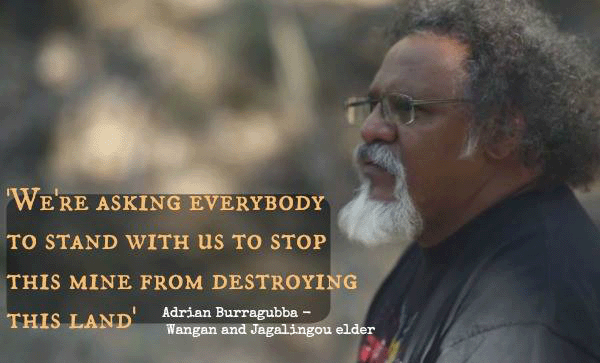
These are the shaky grounds on which W&J are expected to forego their rights, assume the destruction of their country, and be grateful for a tiny sliver of the pie.
Yet the rhetoric of 10,000 jobs and great social advancement that would flow from the supposed benefits of the project to Traditional Owners along its corridor, and especially the W&J on whose country the mega mine will operate, is a far cry from that which Adani has actually put on the table.
A preliminary analysis commissioned by the W&J Traditional Owners and presented to the claim group meeting on 2 December shows what a miserable proposition Adani’s proposed deal is for Traditional Owners.
Adani is offering Traditional Owners just 0.2 percent of its total revenue; far below industry benchmarks that indigenous groups should get 0.35 – 0.75 percent.
To put this in perspective, even if Adani doubled what was on offer, it would still only be equivalent to some of the lowest Indigenous Land Use Agreement (ILUA) deals in Australia.
The deal on offer is also out of balance in terms of the kinds of economic opportunities it will afford Indigenous communities; with primary focus on highly speculative job opportunities. Seventy-five per cent of Adani’s benefits package is wrapped up in jobs; and yet if the jobs don’t come, the purported benefits will simply not be realised.
While the economics of the mine represent a very poor deal for Traditional Owners, they are at the same time expected to cop the brunt of the costs – including destruction of country – for the mines go ahead………
Even with financial breaks from government, the evidence – drawing from the Institute for Energy Economics and Financial Analysis (IEEFA) and other recent figures – demonstrates the Adani mine-rail project is highly unlikely to be economically viable. On this basis, any public money lent to the project, whether through the NAIF, or through a deferral of royalties, is unlikely to be recovered……
Adani has proposed a package to support Traditional Owners – a kind of quasi compensation for destruction of Country – including a $250 million Indigenous Participation Plan for the Traditional Owner groups along it’s project corridor, and the wider Aboriginal community of Central Queensland.
The details of this, however, have been described by W&J as a parlous deal. Demonstrating this, W&J draw attention to the very limited job creation. And on the basis of figures provided by Adani, Traditional Owners employed by the mine would be paid just $35,000.00 per year, a figure that barely meets Australia’s minimum wage.
This plan on offer is no exchange for the losses of land and waters, cultural and self-determination that W&J would incur; which is why they remain resolute in their opposition to the proposed mine. They alone are expected to give up their ancient legacy and birth rights so that others can benefit.
W&J has every right to object to the mine and refuse consent………..
The Numbers Don’t Stack Up: W&J’s Rights on the Chopping Block for Adani’s ‘Non Viable’ Project, New Matilda, By John Quigginon Adani Changes its Plans
In the context of shifting policy settings and coal markets, Adani has changed its plans. The original Adani proposal involved production of 60 million tonnes of coal from W&J Country in the Galilee Basin, and with an expected life of 90 years.
This was at first downgraded to 40 million tonnes of coal by 2022, with an expected life of 60 years, and then further reduced to 25 million tonnes of coal.
This revised so-called ‘Stage 1’ project would defer expansion of the Abbot Point terminal, alongside establishment of an initial, smaller mine.
Given the very unlikely possibility that coal will actually be in demand for electricity generation beyond 2050, the difference in duration is immaterial. However, these reductions in scale do have important implications for the viability of the rail line.
Capital investment for the life of the original mine project was expected to total US $21.5 billion. This total figure continues to be regularly cited, despite the significant downsizing that has since occurred.
Adani has, to date, invested approximately US $3.5 billion in this project, of which approximately US $2.1 billion financed the purchase of the Abbot Point T1 coal terminal. The remainder was associated with the acquisition of the Carmichael mine site.
A large portion of Adani’s total investment is what economists like to call ‘sunk’: that is, it is investment that would be written off if the Carmichael mine project failed to proceed. The only terms in which Adani could recoup these funds was if it could find a buyer for its assets. Adani’s unwillingness to write off such a large investment is likely one reason it has persisted with the project.
But the Numbers Don’t Stack Up
With its new scaled down project proposal, alongside global coal price fluctuations and the very real market access challenges in India, and elsewhere, just how do Adani’s numbers stack up?
Let’s start with estimates on the sale price for Carmichael coal.
As of October 2017, the price of Australian thermal coal was approximately $US97/tonne. Futures markets predict a decline in this price over coming years. Reflecting this trend, the futures price for delivery in February 2020, a possible start date for shipments from the project, is $US81/tonne.
However, Tim Buckley of IEEFA has estimated that the lower quality of the Carmichael mine’s coal output will result in a 30 per cent discount in revenue per tonne.
On this basis, the price of coal from the Carmichael mine – assuming exports begin in 2020 – will deliver just $A74 tonne.
But what will it cost to produce?
In its original analysis, Adani – based on advice from McCullough Robertson in January 2015 – estimated costs of US $38.70/tonne, although other analyses suggest the cost may be higher. Significantly, this figure does not include the costs of rail transport and ship loading. And of course, such figures fail to capture the environmental costs of Adani’s proposed mega mine nor do they measure the irreplaceable loss of Country for Traditional Owners if this mine were to proceed.
Putting these ‘externalities’ aside, this suggests a cost of A $50/tonne in 2015, or $A55, updating for inflation at an annual rate of 2 per cent.
Based on these figures, the price for Carmichael coal – net of all operational costs – would be approximately $10/tonne. If royalties were paid at the standard rate, the net return would be just $3/tonne. That’s a very small return for the destruction of Country and walk over of Traditional Owners rights………..
If It’s Not Viable, Why Would the Project Proceed?
The analysis above shows that, even under highly favourable assumptions, the Adani Carmichael project will be unable to generate sufficient returns to cover interest at commercial rates, or to repay capital to lenders and investors.
This analysis therefore raises the question; why does Adani Enterprises choose to proceed with such a project?
Three possible answers present themselves.
The first is that Adani does not in fact intend to proceed with the project in the near future. Rather, the project is being kept alive with relatively modest expenditure to avoid writing off the large amounts already invested, and to maintain an option in the hope that ‘something will turn up’, such as an unexpected and sustained increase in the price Adani can realize for coal.
A second hypothesis is that the complexity of the Adani corporate structure is such that Adani could construct the proposed rail line almost entirely with public funds provided on concessional terms, then hope that other coal mines in the Basin would render it profitable.
The apparent transfer of ownership of the rail project to an Adani-controlled company in the Cayman Islands supports this idea.
A third possibility, is that by making continuous new demands on governments for concessions of various kinds, Adani will eventually be able to blame government policy for the project’s failure, and on this basis extract compensation. If this is the strategy, it has so far been foiled by the abject compliance of governments at all levels.
The Adani mine-rail-port project is not commercially viable, even under the most optimistic assumptions. That Adani has failed to achieve final close reflects the dubious economics on which this project is based
While much remains obscure, it is clear that any public funds advanced to the project – a project that does not have the consent of the Traditional Owners – will be at high risk of loss.
There is no future for exploitative developmentalism. The economy of the future will depend on sustainable management of resources, a task in which Indigenous communities must play a central role.
This follows the general (though not universal) recognition of the principle, following the Mabo decision, that Indigenous people have the right to play a role in determining the appropriate use of their land.
But this is not simply a nice ideal that will come about through sensible public policy development. This is a brutal contest for land and resources that started with colonisation.
By Tammy Solonec, Amnesty International Australia’s Indigenous Rights Manager, 21 December 2017www..amnesty.org.au
‘Over the past couple of years, Amnesty has supported #ChangetheDate by giving people a platform
to speak on why they choose not to celebrate on 26 January.
‘Now we are taking a step further, and asking you stand with us in solidarity with Aboriginal and Torres Strait Islander peoples across this country.’
‘Australia Day should be for all Australians, but for Aboriginal and Torres Strait Islander people
who mark the day as one of invasion, survival and mourning, 26 January is not a day for celebrations. ‘We need to move to a date that is inclusive of all Australians.
‘Although Australia Day has only been officially nationally celebrated since 1984,
protesting on 26 January is not new for Aboriginal people.
‘Protests about the celebration of Australia Day on 26 January date all the way back to the 1800s.
‘In 2018, Amnesty will be calling on our leaders to acknowledge this plight
and start a consultation process to change the date of Australia Day
so it can be celebrated by all Australians.
‘Over recent years, momentum to change the date has grown.
‘Some local councils in Western Australia, Tasmania and Victoria have amended their celebrations,
and there has been extensive debate in the media..
Brett Burnard StokesFight To Stop Nuclear Waste Dump In Flinders Ranges SA, 27 Dec 17
I am working on a challenge for ANSTO/ARPANSA and Chief Scientist Finkel.
Finkel says nuclear reactors are “zero emissions” … ANSTO admits to “controlled emissions” which include Iodine131 and other radioactive poisons.
ANSTO/ARPANSA employee Solomon has published assurances of safety in the event of a Lucas Heights “accident”, with no consideration of health effects other than cancer.
Australian women experience 100,000 miscarriages per year – most of these are unexplained and some could be the result of Iodine131 poisoning.
ANSTO/ARPANSA rely on the unproven hypothesis that there is no impact on any of the pregnant women who are unknowingly exposed to the “controlled emissions” from Lucas Heights.
The unproven hypothesis is supported by dodgy data from a dodgy 70 year old military operation in occupied Japan at the start of the Cold War, and a set of techniques to average and minimise predicted impacts … plus an avoidance of real world data.
Real science would not avoid the question, real science would seek a way to measure real things and test the hypothesis.
I am proposing a small budget rapid research exercise to look at
(a) dates and locations of miscarriages in Australia
(b) dates and wind conditions for Lucas Heights emissions.
Can anyone help me improve or progress this new idea?
POTENTIALLY dangerous radioactive gases have been secretly pumped into the atmosphere from Lucas Heights and have spread hundreds of kilometres from the nuclear reactor – but the public have never been told.
The release of the highly volatile radioxenon over several months last year was so concentrated that the plumes were detected in Melbourne up to two days later. Other plumes were dragged out to sea by winds before drifting back over Sydney.
The Sunday Telegraph understands the Australian Nuclear Science and Technology Organisation (ANSTO) decided against releasing a public statement at the time to avoid causing alarm.
Scientists at a nuclear testing station in Melbourne traced the source of the radioactive gases to Sydney after the The Comprehensive Test Ban Treaty Organisation International Monitoring System site in Melbourne contacted Lucas Heights after detecting the radioxenon isotope Xe-133.
They were told that 36 hours earlier the first “hot commissioning trials” at ANSTO’s Lucas Heights radioisotope facility for Molybdenum-99 had taken place.
Molybdenum-99 is produced by the fission technique – the intense neutron-bombardment of a highly purified uranium-235 – and is used in nuclear medicine.
While the nuclear reactor – and the government body that oversees it – insists the release of the radioxenon by-product were no threat to public safety, no one, including neighbours of the suburban Sydney plant, were informed.
“Xenon gases are highly volatile and, being inert, they are not susceptible to wet or dry atmospheric removal mechanisms,” a scientific report obtained by The Sunday Telegraph says.
“Consequently, once released to the atmosphere they are simply transported down-wind while radioactively decaying away.”












 Antinuclear