Senator Claire Moore refutes arguments of Australia’s pro nuclear lobby
The far Right in Australia have turned their attention, for the moment, away from efforts to sabotage the Equal Marriage Bill, and on to efforts to sabotage Australia’s laws against the nuclear industry .
In the Australian Senate, Cory Bernardi (Australian Conservatives) introduced the Nuclear Fuel Cycle (Facilitation) Bill 2017 and 3 right-wing senators backed it:
– Ian MacDonald (Liberal)
– David Leyonhjelm (Liberal Democrats)
– Eric Abetz (Liberal)
We surely miss Greens Senator Scott Ludlam. However, Senator Claire Moore (Labor) rose nobly to the defence of Commonwealth bans on nuclear power and on nuclear fuel processing, reprocessing and enrichment. These bans are found in the Environment Protection and Biodiversity Conservation Act, and the Australian Radiation Protection and Nuclear Safety Act.
 SPEAKER: Moore, Sen Claire (ALP) 30 Nov 17
“…..Over the years, issues around nuclear energy have come before this place and they have been part of the wider community discussion. Through that process, a number of investigations have taken place, and, as our shadow minister, Mark Butler, has said, the simple fact is that nuclear power in Australia simply doesn’t add up. The arguments do not add up now and they didn’t add up in the past. Sometime in the future they may, but at this time they just don’t add up. The Australian Nuclear Science and Technology Organisation, which is well skilled and well knowledgeable in this space, noted: ‘It’s difficult to envisage traditional nuclear power plants being established on the NEM given the current grid structure.’…..
Another major issue, if a decision were made to build a nuclear energy facility at a particular point, would be how long would it take for it to be operating on the ground, providing the kind of energy that we, as a nation, require? The CSIRO calculations say that it’s a 10- to 15-year interval from the commencement to the start-up of a reactor. I know that Senator Bernardi gave other figures. I understand that it would be part of a discussion in this area, but the data that we have before us on the current knowledge that’s out there from the CSIRO says that the time frame from commencement to completion and to operation is a 10- to 15-year process, and that, of course, is a very long-term plan, if we’re looking at a transition to another form of energy.
There is also the issue of reactor locations. When we talk about nuclear reactors and nuclear waste facilities, a massive community discussion occurs when proposals are put up for these types of facilities. ….. Our personal experience in Australia has been that when these things are brought out into the open—when finally, after discussions that often take place in secret, I’ll say, and when finally decisions are made public as to where a nuclear reactor or a nuclear waste facility could be located—there does seem to be a reaction from the community that is not positive…..
…water use. CSIRO has done a lot of work generally on the issue of water use in our community. They’ve used that knowledge in the discussion on what would be necessary for nuclear plants or nuclear operations. The indications that they have—and this is available on their website—is that nuclear plants use more cooling water than coal and gas plants. In terms of the sensitivities in our community and also the necessities of our climate and our access to water in Australia, that is a really important issue. Where would you be able to ensure that there were appropriate water sources, that would be safe and that would provide the support that would be necessary for the implementation of nuclear energy?
Even if you were to overcome the community, legal and political barriers to nuclear energy, it’s clear that due to the skills and other technical barriers it would take very many years, over a decade—and that’s the optimistic option—for Australia to be ready to begin construction of a nuclear power plant. That also does not take into account, as I said, the real need existing in our nation, and I am very much aware of strong community opposition to nuclear power…
As I was saying, that remains a major issue within the community in terms of any acceptance of a change to the current position that we have in the country around nuclear power. Senator Macdonald did allude to the ‘issue’ or ‘incident’—I should have written it down—of Fukushima. His dismissal of the significant issues around what happened at Fukushima was, I think, indicative of the lack of genuine understanding of the concerns in the community around this issue. Certainly over a long period of time one of the clear issues that has been raised within the community about anything around the further development of nuclear energy in our country has been a concern around a guarantee for safety and that there not be the kind of environmental, social and serious damage that occurred as a result of a series of nuclear incidents over many years. The most recent of those was in Fukushima, but the Chernobyl situation, of which we’ve just passed a significant anniversary, caused immense damage all across northern Europe and into the Arctic. In parts of Europe and the UK—I know that the UK are probably not referring to themselves as part of Europe any longer—there is still monitoring being done of ongoing issues around environmental damage in that area as a result of an incident that happened well over 20 years ago.
We’ve had Chernobyl identified and national and international reviews of what occurred at Three Mile Island and the significant safety issues that occurred. When something goes wrong in a nuclear energy facility, the resultant impact is much more serious than we see when things go wrong with other forms of power in the power industry. Certainly no-one can ever offer a guarantee. …. http://parlinfo.aph.gov.au/parlInfo/search/display/display.w3p;query=Id%3A%22chamber%2Fhansards%2F676f35b6-5c99-4c03-b7ba-036ffe24360c%2F0023%22
Iodine 131 – a treatment for thyroid disease, but still a radiation risk
Paul Langley Nuclear Fuel Cycle Watch South Australia, 1 Dec 17
Today in this forum, the implication has been made that I131 as a treatment for thyroid disease is a benefit and that therefore, it is implied that the benefit of I131 as a nuclear medicine is harmless to the general public who are not in need of treatment dose I131.
It is easy to point out that low dose I131 is acknowledged as a public risk factor and is a known carcinogen. The cost/benefit equation used in medicine to determine treatments does not apply to members of the community. In fact, in the case of treatment dose radiation therapy patients, the general rule is to minimise addition exposures outside of the medical setting. It is also easy to point that world wide governments approve the medical use of nuclear medicines (radio isotopes) according to strict ethical and medical need guidelines.
What is good for someone seeking to lengthen their survival time in the context of disease is not good for someone who has no illness. Radiation is a double edged sword. In the context of the five year survival time for cancers, radiation treatments work. Longer term limits to treatments include recurring cancers and heart disease. The research clearly shows this.
The hope that I131 may be considered to be innocuous is a false one. Here is a list of US FDA approval nuclear medicines. It is forbidden under US law, Australian law etc to administer these substances to any person for any reason apart from medical need and with patient consent:
Adani coal mine project headed to be a big issue at next Federal election?
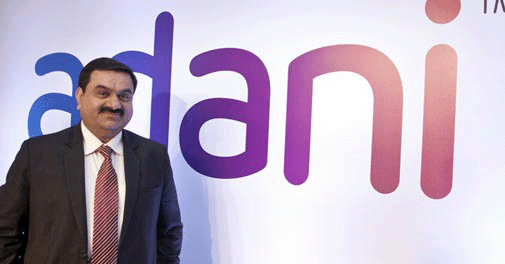 The future of the Adani mine, Overwhelming public opposition to the Adani coalmine in northern Queensland tipped the scales in state election campaigning. But now that’s over, what influence does it have at a federal level and on the mine’s future? The Saturday Paper, By Alex McKinnon. 2 Dec 17,
“……Palaszczuk’s explanation for abandoning her long-time support of the loan was to avoid a potential conflict of interest, arising from her partner’s work on Adani’s Northern Australia Infrastructure Facility (NAIF) loan application as a consultant for PwC. But state treasurer Curtis Pitt admitted during the campaign that the real reason for Palaszczuk’s about-face was the overwhelming public opposition to taxpayers’ money being used to fund a private mine.
Queensland’s Labor government supports the Adani mine going ahead, to provide jobs in struggling regional areas. But GetUp! environmental justice co-director and Stop Adani campaigner Sam Regester points to the huge swings to the Greens in a swath of inner-Brisbane electorates as proof Labor recognised anti-Adani sentiment was hurting them enough to force a response. Counting still under way in Maiwar could lead to the Greens winning their first seat at a general election, and candidate Amy MacMahon came close to knocking over Labor deputy premier Jackie Trad in South Brisbane.
ON THE ISSUE OF THE NAIF LOAN, AT LEAST, PUBLIC OPINION IS EMPHATIC ENOUGH TO PRESSURE PALASZCZUK INTO KEEPING HER WORD.
“The Greens’ strong position on Adani was directly responsible for their strong showing in the inner city,” Regester says. “Labor tried to have it both ways for three years, and they offset some of the damage by deciding to veto the NAIF loan, but voters rewarded the party that had a consistent stance.”
Given Labor will most likely form a majority government, that balancing act appears to have worked for now. What comes next – for the mine, those opposing it, and the government that could make or break it – is less clear. As counting continues and the Palaszczuk government prepares to go back to work with whatever parliament the voters have given it, anti-Adani campaigners are planning their next moves.
The Stop Adani Alliance, the umbrella organisation of environmentalists, climate scientists, traditional owners and civil society groups that formed to campaign against the mine in March, largely regards the election result as a win. Nicholls’ Liberal National Party, which has backed the mine to the hilt, remains in opposition. One Nation’s promised windfall of seats failed to materialise………
Palaszczuk’s Labor government will likely hold 47 or 48 seats in Queensland’s 93-member, single-house parliament. Once it nominates a speaker, the government will have the barest of majorities, provided every Labor MP stays in line. Given the record of Palaszczuk’s previous government, which lost Pyne and former Cook MP Billy Gordon to the crossbench, that may be too much to hope for. If Labor is forced to negotiate with the KAP’s three parliamentarians, One Nation’s Stephen Andrew, or Noosa independent Sandy Bolton, it may find the competing interests over the Adani mine can’t be finessed away.
On the issue of the NAIF loan, at least, public opinion is emphatic enough to pressure Palaszczuk into keeping her word. ReachTel polling conducted for the Stop Adani Alliance during the campaign found 70 per cent of Queenslanders oppose directing public funding towards the Carmichael project, with voters across political lines expressing strong support for the government using its veto power.
Queenslanders are more evenly split on the larger question of the mine itself, but losing the NAIF loan will compound Adani’s difficulties in securing the $3.3 billion it needs to fund the first stage of the project, and could sink the mine altogether. While Adani has made noises about seeking financing from Chinese banks, such a move would likely require construction materials and infrastructure contracts to be sourced from Chinese firms, further souring the project in the public eye and undermining the argument that the mine will bring local jobs.
So much attention has been devoted to Palaszczuk’s manoeuvring, it’s easy to forget how much of Adani’s ultimate fate lies in Canberra. The federal opposition leader, Bill Shorten, stayed far away from Queensland during the campaign, not least to avoid awkward questions about where he stands. Shorten tied himself in knots trying to articulate his various positions on the mine earlier this year, sometimes changing his mind mid-sentence……..
With the state election over, Shorten and federal Labor no longer have the luxury of dithering. Regester says the anti-Adani movement’s top post-election priority, “besides ensuring the veto goes through” and “working to ensure Adani can’t secure funding from anywhere else”, will be recentring the campaign on the national stage.
“Unless a major party moves on Adani, we’ll be making it an issue at the next federal election,” Regester says, highlighting “marginal seats in Sydney, Melbourne and Brisbane” where support for Adani could prove costly. Labor’s Terri Butler and the Liberals’ Trevor Evans will be looking nervously at the huge upswing in the Greens’ vote across territory their inner-Brisbane seats cover, while the Stop Adani movement’s large Melbourne presence could see the thumping Greens victory in the Victorian Northcote byelection repeated in Batman, Wills, Higgins and Melbourne Ports…….. https://www.thesaturdaypaper.com.au/news/politics/2017/12/02/the-future-the-adani-mine/15121332005585
Fraud allegations against Adani – review surely means new scrutiny of its coal megamine plan
 Adani mining giant likely to face fresh scrutiny over financial fraud allegations https://www.theguardian.com/business/2017/dec/01/adani-mining-giant-likely-to-face-fresh-scrutiny-over-financial-allegations
India’s finance secretary has called for decision clearing company of allegations of siphoning huge sums into tax havens to be reviewed, Guardian, Michael Safi in Delhi, 1 Dec 17, The Adani Group is likely to again have to answer allegations it siphoned more than US$600m (£445m) into overseas tax havens after senior Indian finance authorities recommended an appeal of a judgment clearing the mining giant.
The Indian finance secretary has confirmed to local media the August decision clearing the Adani Group had been reviewed by senior officials in November who ordered an appeal to be lodged by 14 December.
In August the Guardian revealed details of a massive fraud investigation into the company, which is preparing to build one of the world’s largest coal mines in Australia.
According to two sets of Indian customs intelligence documents from 2014, the Adani Group was accused of inflating the cost of electricity equipment for power projects in Maharashtra and Rajasthan states using fraudulent invoices. Authorities valued the alleged scams at nearly $852m.
The company or entities linked to it are currently being scrutinised for their suitability for a $681m concessional loan from the Australian government to build a railway line linking the proposed coal mine to a Queensland port. However it is reportedly close to securing loans from a Chinese state-owned company that would make the Australian loan unnecessary.
The Adani Group has denied any wrongdoing and was cleared on one set of allegations in August and a second set in October.
But the Indian finance secretary, Hasmukh Adhia, has confirmed the August judgment – referring to fraud allegations worth around $600m – has been recommended for appeal by senior customs officials.
“As per the procedure for review of orders of the Adjudication Authority, a committee comprising of two chief Commissioners of Customs has reviewed this order of Adjudicating Authority and directed the Commissioner of Customs vide their order dated November 15, 2017 to file an appeal in the tribunal,” Adhia said
Customs officials have until 14 December to lodge the appeal, which will be heard by the Customs, Excise and Service Tax Appellate Tribunal. Any subsequent appeals would be heard by the Indian supreme court.
Six Adani subsidiaries are among 40 companies being investigated by Indian authorities over a separate alleged fraud involving the over-invoicing of coal imports from Indonesia.
The general modus operandi of the alleged scams is that the energy companies used fake middlemen to inflate the price of equipment or coal they sourced from overseas.
The extra money allegedly paid by the businesses was allegedly channeled into offshore bank accounts out of the reach of Indian regulators or tax authorities.
The Indian Express reported on Thursday that the outcome of the allegations against the Adani Group could impact a $125m compensation package the company has been promised from electricity distribution companies in Haryana state over its “financial difficulties” in the area.
Indian opposition groups have called for a supreme court inquiry into the company over the fraud allegations which, if proved, could have pushed up power prices for local consumers.
A public-interest lawsuit has also been filed in the supreme court calling for an investigation into alleged over-invoicing by the Adani Group and other energy companies.
The Adani Group has been contacted for comment.
Immense glacier in Antarctica is melting – NOW!
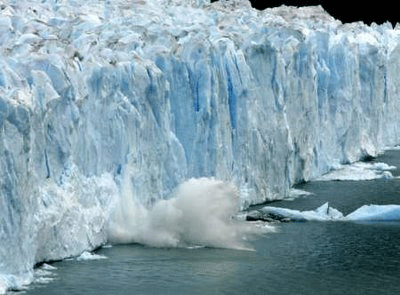
“The majority of the heat that has gone into the global climate system has gone into the ocean, about 90 percent over the last few decades of measurements,” he said. “The hypothesis is ocean temperatures around Antarctica will keep warming and drive the melting of the glaciers. If the glaciers flow faster, sea levels will rise, and that has profound implications for global civilisation.”……..“Climate change is a reality. There’s the whole debate around how we deal with it, and the work we do in Antarctica is influencing our ability to look forward and genuinely understand how much things are going to change,” Australian Antarctic Division director, Dr Nick Gales told HuffPost Australia from Hobart, the base of operations for the AAD.
“It is alarming. There is huge change going on there.
UNFROZEN IN TIME, Huffington Post, Video and Pictures: Tom Compagnoni | Words: Josh Butler, 1 December 17 There’s a glacier in Antarctica so immense that, if it melted, would raise sea levels globally by 3.5 metres.
It’s melting. Right now.
“The facts around climate change are undeniable. It’s happening,” Australian glaciologist Ben Galton-Fenzi told The Huffington Post Australia. “The research we do now isn’t about trying to convince ourselves it’s real, because it’s irrefutable. What we’re trying to do is understand what the response time of the system is going to be into the future, so we can adapt to it.”
The Totten glacier is the biggest in east Antarctica. The glacier itself is around 120 kilometres long, 30 kilometres wide and drains some 538,000 square kilometres of the continent. That’s an area bigger than California. The ice is kilometres thick, but it’s melting at 70 metres a year in some spots. A study released in December reported warmer water was melting the Totten ice from below. Continue reading
Banks warned of ‘regulatory action’ as climate change bites global economy
Australian Prudential Regulation Authority says it is quizzing companies about their actions to assess climate risks, Guardian, Michael Slezak, 1 Dec 17, Australia’s financial regulator has stepped-up its warning to banks, lenders and insurers, saying climate change is already impacting the global economy, and flagged the possibility of “regulatory action”.
Geoff Summerhayes from the Australian Prudential Regulation Authority (Apra) revealed it had begun quizzing companies about their actions to assess climate risks, noting it would be demanding more in the future.
Apra also revealed it has established an internal working group to assess the financial risk from climate change and was coordinating an interagency initiative with the corporate watchdog Asic, the Reserve Bank of Australia (RBA) and federal Treasury to examine what risks climate change was posing to Australia’s economy…….https://www.theguardian.com/australia-news/2017/nov/29/banks-warned-of-regulatory-action-as-climate-change-bites-global-economy
2 December REneweconomy News
 RenewEconomy
-
ASX top 20 companies for climate change reporting in 2017We’ve looked at the top 20 companies listed on the ASX to see what they actually said about climate change in their latest annual report.
-
Developing nations are driving record growth in solar powerEmerging markets now account for the majority of growth in solar power, according to new data from Bloomberg New Energy Finance .
-
How to find a site for a solar farm in less than 10 minutesWant to know where to connect a local solar farm to the grid? Now you can, in 10 minutes or less.
Yami Lester’s daughters continue his fight against the nuclear industry
Yami’s daughters take up anti-nuclear fight https://nit.com.au/yamis-daughters-take-anti-nuclear-fight/ – Wendy Caccetta –reporter@nit.com.auSisters Karina and Rose Lester know all too well the tragedy nuclear weapons can bring.
Their late father Yami Lester, a Yankunytjatjara man of northern South Australia, lost his sight after  being exposed as a boy to nuclear testing by the British Government at Maralinga in remote SA.
He went on to become a prominent anti-nuclear campaigner.
Now his daughters have taken up the battle, collecting and sharing stories that have helped the International Campaign to Abolish Nuclear Weapons (ICAN) win a Nobel Peace Prize.
The prestigious prize will be presented in Oslo on December 10, with an event at Melbourne Town Hall to be held the same day.
 Karina Lester, who lives in Adelaide, said when she was growing up her father did not talk much at home about what had happened to him as a boy when the nuclear testing took place.
But in public Mr Lester, who passed away in July at the age of 75, felt it was important to share with the world the events that shook the Wallatina community in the ’50s.
“There’s a role a parent plays in protecting your children from really knowing some of the sad, sad stories that did take place across our community,” Ms Lester said.
“He spoke a bit about where the camp was, he remembers that day, he remembers the ground shaking and this black mist rolling and the fear in the community.
“There was a huge loss for us as an Aboriginal community and we were so badly done by when the British came in and tested in our backyard that we still suffer to this day.”
Ms Lester said conditions in the community deteriorated over a week after the testing.“When the fallout happened, that evening, people were violently ill,” she said. “There was a lot of vomiting going around in the camp. People became sick. Their eyes started getting sore and tender.
“By day two, people were really starting to suffer. By week two, people’s eyes were either burnt out or people had bad burns on their bodies. “There were lots of rashes appearing and there was a trail of black-like soot that fell over the whole of the community.
“The oranges had shrivelled up and by that week were non-edible.”
Ms Lester said the story was a painful one, but needed to be heard. She said it was important to take a stand against anything nuclear from weapons to waste storage facilities. The Lester sisters gave NIT permission to reproduce the photo of their late father.
Report finds that Aboriginal landowners would get little benefit from Adani’s coal mine expansion
Adani’s compensation for traditional owners ‘well below’ industry standard, report finds, ABC News 1 Dec 17, By Josh Robertson A hotly contested deal between Adani and traditional owners of its proposed Carmichael mine site in Queensland’s Galilee Basin would deliver compensation “well below” what most big miners pay, according to a new analysis.
The Wangan and Jagalingou (W&J) people would only get 0.2 per cent of Adani’s earnings from the mine, less than half the industry average, respected mining industry outfit Economics Consulting Services has found.
Its report, obtained by the ABC, was commissioned by six W&J representatives whose looming court challenge to the deal stands as the final legal hurdle to Adani’s contentious mega-mine.
It found the W&J people would earn up to $145 million over 30 years, out of the project’s estimated $77.4 billion in gross revenue, a share which was “well below industry benchmark standards”.
The benchmarks for such deals usually ranged from 0.75 per cent to 0.35 per cent.
Only 11 per cent of the deal would come to the W&J people in cash, up to $17.4 million over 30 years, or about $2,300 a year per adult member of the clan.
Report author Murray Meaton, who was awarded an Order of Australia in 2014 for services to the mining industry, found the benefits to the W&J people would be “dramatically lower” if job promises for locals fell short as they did “in most jurisdictions and agreements”.
Traditional owners divided
To gain finance for the $21 billion project, Adani needs an Indigenous Land Use Agreement (ILUA) with the W&J people, or it must call on the Queensland Government to forcibly extinguish any native title claim over the mine site in the Galilee Basin.
After almost six years of vexed negotiations with Adani, the W&J representative group is evenly split over the deal.
The Indigenous group twice rejected Adani in 2012 and 2014 before seven of 12 W&J representatives swung their support behind the miner last year.
But Adani lost majority support in June when one representative changed heart, sending the group into deadlock after the ILUA was allegedly authorised in a meeting funded by Adani……… http://www.abc.net.au/news/2017-12-01/adani-compensation-well-below-industry-standard-report-finds/9212058
Chinese Government denies receiving application to fund Adani’s Carmichael coal mine
 Adani: Chinese Government denies receiving application to fund Carmichael mine, ABC News, 30 Nov 17, By Stephen Long, As Adani angles for Chinese money for its giant coal mine in North Queensland, China’s Australian embassy has made clear that any backing from Chinese state enterprises would need central government approval.
Senior embassy officials have also told opponents of the mining venture that no applications for funding have been made, despite Adani insiders claiming recently that finance from China had been secured.
Over the past month, businessman and environmentalist Geoff Cousins and prominent investment banker Mark Burrows, AO, have held talks with Chinese embassy officials in Canberra to lobby against Adani’s Australian project, amid reports Adani was close to finalising a deal for Chinese backing.
“Myself and Mark Burrows went to see senior officials from the Chinese embassy; we explained that China might think that Australians supported the Adani mine and we gave them a lot of evidence that that was not the case,” Mr Cousins told the ABC.
“The Chinese embassy was very forthright in saying that investment from a Chinese corporation would require the approval of the central government and that also no such proposal had been put.”……….
Chinese funding for the project is becoming more critical as prospects for a subsidised loan of up to $1 billion from the Northern Australia Infrastructure Facility for the mine railway fade.
The Labor Party, which looks likely to form a government in Queensland, has pledged to effectively veto the loan.
Pauline Hanson’s One Nation Party, which has secured at least one seat in the state parliament, is also opposed to the loan.
Banks across the globe have refused to fund the Carmichael coal mine because of doubts about its financial viability and its potential to worsen global warming. http://www.abc.net.au/news/2017-11-30/adani-china-government-would-have-to-sign-off-on-loans-for-mine/9209188
Hot weather in South Australia: Tesla battery turned on a day ahead of schedule
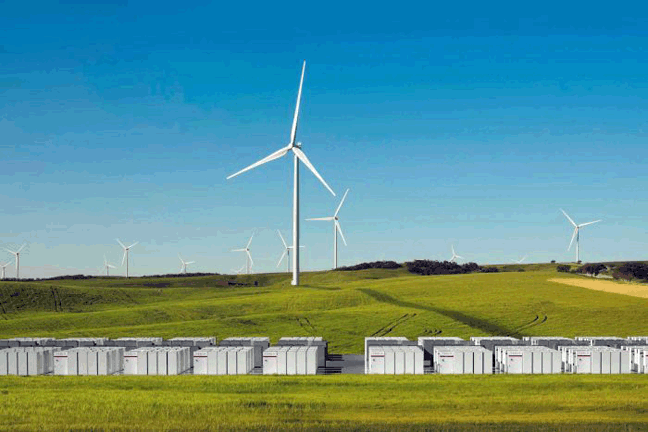 South Australia’s Tesla battery called on a day ahead of schedule as hot weather takes hold, ABC News 30 Nov 17 By politics reporter Nick Harmsen, South Australia’s giant Tesla battery has begun dispatching stored wind power into the electricity grid a day ahead of its scheduled switch-on.
Premier Jay Weatherill will visit the battery site — alongside the Hornsdale windfarm near Jamestown in the state’s mid north — on Friday, to mark its official opening on the first day of summer.
But with temperatures across South Australia and Victoria hitting the mid 30s, and output from the state’s wind farms low, the battery was called upon early to help meet Thursday afternoon’s peak demand.
The battery dispatched a maximum of 59 megawatts of power. The 100MW/129MWh battery is capable of powering about 30,000 homes for a little over an hour.
The manufacturer, Tesla says the lithium-ion device — made up of PowerWall 2 batteries — is both the “largest” by storage and “most powerful” of its type in the world……..http://www.abc.net.au/news/2017-11-30/sa-tesla-battery-begins-producing-power-a-day-ahead-of-schedule/9212794
1 December REneweconomy News
-
 It’s 30 years since scientists first warned of climate threat to AustraliaIn November 30, 1987 Australian scientists officially sounded the climate alarm. No one can say we haven’t been warned.
 -
Wind power prices have plummeted again in GermanyThe predicted price of onshore wind in Germany is now half the EU’s projections for 2030, following an auction in Germany this week.
-
Tesla big battery shows off its flexibility in final testingTesla battery goes through final testing with a rapid series of charging and discharging – never seen before on Australia’s ageing dumb grid.
-
Finkel’s frustration: Everyone else has a strategy, but not AustraliaFinkel vents his frustrations in final energy speech of the year, dumping on six biggest myths about electricity market, and delivering brick-bats to both policy makers and regulators.
-
Aera Energy and GlassPoint to build California’s largest solar energy projectAera Energy to install first-of-its-kind solar project to reduce oilfield emissions.
-
Vestas, CWP get serious about plan to export Pilbara solar and wind to AsiaSceptics might call it crazy to run a clean power ‘extension cord’ all the way to Indonesia, but the ELEXI plan to export Pilbara generated renewable energy to Asia has a serious team behind it.
South Australian law: government now prohibited from spending money to promote nuclear waste importing
 29 Nov 17, Today the Lower House of the SA Parliament passed my Greens Private Members Bill to remove the clause in the Nuclear Waste Storage Facility (Prohibition) Act 2000 that allowed the Government to spend public money on spruiking the benefits of an international high-level nuclear waste dump in SA.
That means that this will now become South Australian law as it has passed both Houses of the SA Parliament.
The Government will no longer be able to spend public money on pursuing an international nuclear waste dump.
With the focus now on fighting the Turnbull Federal Government’s plans for an intermediate-level nuclear waste dump in Kimba or the Flinders Ranges, it’s important to show your opposition to these plans. Come along to the “Don’t Dump on SA Rally” at 11am this Saturday, 2 December 2017 on the steps of Parliament House.
I will be speaking at the rally, outlining the Greens position on this important issue.
The Greens stand with the people of South Australia who choose a nuclear-free future for our State.
News Corpse writers and politicians mindlessly parrot spin about Small Modular (Nuclear) Reactors (SMRs.
 Steve Dale Nuclear Fuel Cycle Watch South Australia
How big is a SMR (Small Modular Reactor)? If you read the comments in the recent Australian article entitled “Want a nuclear reactor in your backyard? Step this way” – many people really think these things can fit in your back yard.
The news article is based on SMR Nuclear Technology Pty Ltd submission to the Australian Energy Security Board (Nov 2017) ( http://www.smrnuclear.com.au/…/SMRNT-ESB-Submission-Nov-201… ). The submission mentions the NuScale SMR module – which is actually 3 metres in diameter and 20 metres high! – and you need 12 or more of them together to create a plant, each weighing 700 tons.
I wonder how many politicians that parrot the words “Small Modular Reactor” actually know how big they are? The following document (“Small Isn’t Always Beautiful – Safety, Security and Cost Concerns about Small Modular Reactors”) is still very relevant http://www.ucsusa.org/…/nuc…/small-isnt-always-beautiful.pdf
1 This month
25 October – Film –Britain’s Nuclear Bomb Scandal: Our Story – part of the Adelaide Film Festival,
Screening and Conversation
A screening of Britain’s Nuclear Bomb Scandal: Our Story (2024) followed by a talk with 2026 Bettison and James Awardee and Tradtional Owner Karina Lester in conversation with Simone Tur.
When: Sun 25 Oct, 12:00pm-Screening, 1:15pm-Talk
Where: The Mercury
Free admission, register below by clicking on BUY TICKETS and select free event tickets, at end of web page:
https://www.adelaidefilmfestival.org/program/2026/britains-nuclear-bomb-scandal-our-story
.

Australians deserve the truth
about
AUKUS – https://aukuspublicinquiry.com/

PETITION – To: Prime Minister Anthony Albanese and the Australian Labor Government

of the week – Australians for War Powers Reform (AWPR)
To see nuclear-related stories in greater depth and intensity

