Submissions to #NuclearCommissionSAust show up 10 things wrong with its case
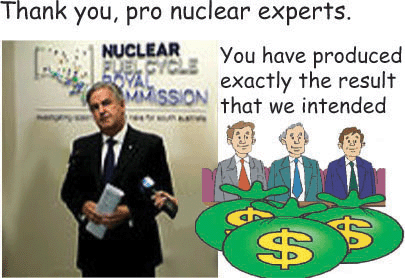 10 holes in the Royal Commission’s pro nuclear dump case, Independent Australia Noel Wauchope 9 May 2016, IT WOULD BE no surprise that South Australia’s questionable Nuclear Fuel Cycle Royal Commission (NFCRC) is recommending that Australia become the world’s nuclear waste import hub.
That has been the intended outcome from the beginning, when the Commission was set up, over a year ago.
The questionable integrity of the NFCRC was discussed in a submission by Yurij Poetzl over a year ago. Poetzl pointed out Royal Commissioner Kevin Scarce‘s conflict of interest, as a shareholder in Rio Tinto, and as a member of the Committee for Economic Development In Australia (CEDA).
CEDA’s Policy Perspectives of November 2011 clearly supports and promotes the growth of South Australia’s nuclear industry. The Royal Commissioner selected predominantly pro-nuclear experts for the Commission’s Expert Advisory Committee. The Expert Advisory Committee had no involvement from health or medical professionals. Poetzl went on to list 22 significant questions that were not addressed in the Royal Commission’s Terms of Reference.
Speaking in November 2014 at Flinders University, Scarce acknowledged being
“an advocate for a nuclear industry.”
This doubt is raised again, in the latest batch of submissions, which were published on the Royal Commission’s website on 2 May. In a submission that is neutral, not anti-nuclear, Gary Rowbottom notes that:
Mr. Scarce, in his delivery of the tentative findings, a mere day after the release of these findings, seemed to be critical of any comments made in opposition to deepening Australia’s involvement in the nuclear fuel cycle, often citing lack of evidence for viewpoints expressed.
there is a fair bit of evidence that the commission members themselves are in the majority, clearly quite pro nuclear. I am not happy at the lack of subjectivity that may have brought to the findings, particularly on the waste issue. Whilst Mr. Scarce did say that they did look at the negative sides of all the Issue papers, there is not much evidence of that in the Tentative Findings.
Kevin Scarce, would, I am sure, dismiss such criticisms as just “opinion” or “emotional”, “not fact-based” or “formed upon fear”.
The Royal Commission’s problem is that criticisms of its findings are fact-based.
The latest batch of submissions brings up many unanswered questions
1. Aboriginal rights……. ~ Anggumathanha Camp Law Mob, ……
2. Economics…….The Royal Commission’s Tentative Finding, that substantial economic benefits could be obtained at low risk from the storage and disposal of used nuclear fuel in South Australia, is not soundly based……. ~ Dr Mark Diesendorf,
…..The proposal is that we should accept waste before the repository has been completely built and tested. This proposal is so reckless, as to be negligent. We would face the very real risk of being left with high-level nuclear waste, and no technology to properly handle it. ~ Dr Andrew Allison
…..If this is such a great deal, how come no other country has grabbed it before now? ~ South Australian Greens…….
In the event of a disaster the Government (and therefore, the taxpayer) will be required to sort out the mess. ~ Graham Glover.3. Safety……We are asked in the Tentative Report to take these recommendations “on faith” given that the proposed high-level waste dump is not operational anywhere on earth — and, further, that the dump proposed for our state is twenty times larger than that planned (not actual) for Finland. ~ Mothers for a Sustainable South Australia
4. Transport dangers…… I do not accept that road transport from port to repository site will be perfectly safe, even on a dedicated purpose built road. ~ Paul Langley……..We are concerned at the obvious dangers of transporting overseas high level radioactive wastes into our state and country. ~ Catholic Religious South Australia
5. Climate change…..
Has the NFCRC incorporated the potential impacts of climate change on the ecology and geology the State? ….~ Trisha Drioli……. There is no analysis of the potential impacts on the environment into the future…….~ Mark Parnell
6. Health …. Factual evidence is given in this submission by Dan Monceaux
7. The legality of the Commission under question ……THE WASTE REPOSITORY PROPOSAL VIOLATES EXISTING AGREEMENTS AND AUSTRALIAN LAWS ~ Dr Andrew Allison
8. Lack of transparency…….there is no transparency. Local get-togethers do not equal public engagement. These are serious matters which are of national concern. ~ Anne McGovern
9. Impact on other industries ……The Nuclear Fuel Cycle Royal Commission Tentative Findings Report contains many generously overstated ambitions, almost no analysis of the environmental, tourism or agricultural consequences with its focus on narrowly supported economic benefits…. ~ Holly-Kate Whittenbury …….
SAWIA notes that its members have genuine concerns about the potential risks to the reputation of the South Australian wine industry in the event of a nuclear accident occurring on South Australian soil…..~ South Australian Wine Industry Association Incorporated
10. Deceptive spin about medical wastes… Even if the waste depot did only receive low level, medical waste, the facility would not be economically viable; medical waste, as described by physician Louise Emmett, only needs to be stored for such a short time that it would hardly make it to the waste facility for dumping, before it breaks down;‘In the vast majority of nuclear medicine practices the storage issue is not particularly current in terms of what we keep. It’s waste products have a short half life, up to eight days half life, so it would be difficult to take that long distances for storage.’ (Baillie, R. 2012.)
‘It is at best misleading and at worst a lie to claim that a large-scale nuclear waste repository such as what is being proposed would be solely justified to handle the minuscule amounts of nuclear medicine waste generated in Australia.’ (Parnell, M.2015.) ~ Holly-Kate Whittenbury https://independentaustralia.net/politics/politics-display/10-holes-in-the-royal-commissions-pro-nuclear-dump-case,8966
Today – Nuclear fuel cycle royal commission final report to be made public
 Nuclear fuel cycle royal commission: Final report expected to reiterate support for dump, ABC News 9 May 16 By Daniel Keane The final report arising from South Australia’s nuclear fuel cycle royal commission is almost certain to leave crucial questions about possible future dump sites unanswered, an anti-nuclear spokesman says.
Key points:
- Final report to be made public after commissioner Kevin Scarce briefs Government
- Report expected to reiterate support for waste dump
- Bipartisanship by major parties could benefit Greens, political expert says
The report was handed down to the State Government on Friday, but its contents will not be made public until later today, after royal commissioner Kevin Scarce briefs State Cabinet.
Tentative findings released in February recommended the creation of a high-level waste nuclear dump that would store 138,000 tonnes of spent fuel from around the world, as well as a separate “above-ground interim storage facility”.
Friends of the Earth’s national nuclear campaigner Dr Jim Green said South Australia could end up with “the biggest waste stockpile in existence”, but said it was the interim storage site that could prove the greater security concern.
“The plan is to import the waste and store it above ground – perhaps on the Eyre Peninsula, perhaps somewhere further north – for some decades before they even begin to consider the option of ultimate disposal of this waste,” he said.
“The reason they’re configuring it that way is because it will cost so many tens of billions of dollars to build a nuclear waste dump that they simply won’t have those funds until they’ve imported vast amounts of waste in the first place.”……..
He said the interim report had ignored accidents, such as the closure of a New Mexico waste repository because of a chemical explosion in 2014.
“There was also no mention in the tentative findings report of the royal commission about a fire at a nuclear waste dump in Nevada in the US last year,” he said.
“There’s no mention of a nuclear waste dump in Germany where they’re in the process of exhuming 126,000 barrels of nuclear waste because of water infiltration and corrosion.”…….http://www.abc.net.au/news/2016-05-09/nuclear-fuel-cycle-royal-commission-final-report-to-be-revealed/7394400
South Australian local community rejects nuclear dump proposal
Hawker locals reject nuclear dump proposed for Wallerberdina station at packed public meeting, ABC News AM By Natalie Whiting, staff, 7 May 16 Angry locals from a small South Australian community earmarked to host the nation’s first nuclear waste dump fear the project is a foregone conclusion, despite Federal Government assurances to the contrary.
Key points:
- Hawker locals fear Wallerberdina station nuclear dump proposal is “set in concrete”
- Landholders and traditional owners express anger at public meeting
- Local MP says many support the dump proposal
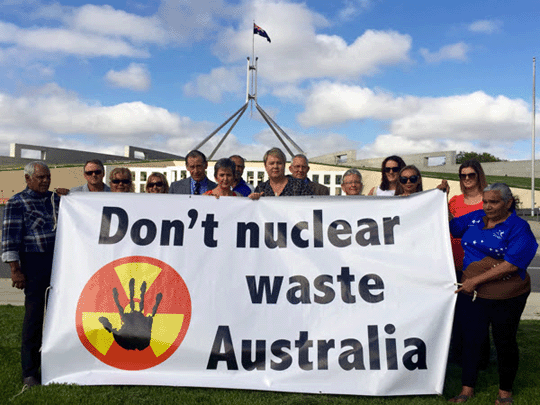 A fiery public meeting held in Hawker in the Flinders Ranges last night was the first chance for locals to express their concerns since nearby Wallerberdina station was announced as the Government’s preferred site.
The town has a population of about 300, and more than a third of that number packed into the local community hall.
Government representatives faced a barrage of questions from people opposing the dump, including traditional owners who fear important cultural sites will be put at risk, as well as other landholders. “I think we’re getting the wool pulled over our eyes, big time,” neighbouring property owner John Gill said. “I reckon it’s set in concrete now, and I could almost 90 per cent guarantee it’s going to go there.”
Local mayor Peter Slattery opened the meeting by telling those gathered it was “not a soapbox forum”, but emotions soon spilled over, with angry interjections from the floor.
“It’s a last link in the area where the footsteps of our ancestors were,” Adnyamathanha elder Tony Clarke said. “They walked this land, they lived in this land, they hunted in this land and they died in this land.”Adnyamathanha elder Enice Marsh held a sign protesting against nuclear waste as she addressed those gathered.
“The dreamtime that runs through [the area] is very strong. It’s alive and well,” she said. “That story belongs to my people and me.”
Strong local support for nuclear dump, MP says
The Wallerberdina cattle station near Barndioota is co-owned by former Liberal Party president Grant  Chapman and was last week singled out from a shortlist of six potential waste storage sites across the country.
“There is a lot of support in this community for this facility, which is why it’s gone through to the next round,” local federal Liberal MP Rowan Ramsey said……..
The department will set up an office in Hawker and is recruiting locals for a community committee, and also plans to conduct an independent Aboriginal heritage survey.
The community will receive $2 million from the Federal Government as compensation, regardless of whether the facility is built……http://www.abc.net.au/news/2016-05-07/locals-reject-wallerberdina-nuclear-dump-at-hawker-meeting/7393082
Climate Change Authority report recommending ‘a mandatory carbon price’ held back until after election
 May 6, 2016. A report that recommends putting a price on emissions from the electricity sector has been held back by the Climate Change Authority until after the election, prompting calls from Labor and the Greens that it be made public to inform debate.
The independent authority, whose board is now dominated by appointments made last October by Environment Minister Greg Hunt, was to have released its policy options paper for the power industry by the end of April. http://www.theage.com.au/federal-politics/federal-election-2016/climate-change-authority-report-recommending-a-mandatory-carbon-price-held-back-until-after-election-20160506-gonw88.html
Nuclear Commission Special this week – some other news, too
Nuclear dump investigation by Committee For Adelaide backs SA waste storage plan, ABC News, 6 May 16 By Nathan Stitt and Simon Royal An Adelaide team has returned from an overseas investigation of a nuclear fuel dump having concluded South Australia has an extraordinary opportunity to follow the same path.
“I don’t think there’s any doubt that the science is safe (!!) ,” delegation leader Matt Clemow said. The former journalist and political adviser now heads up the Committee For Adelaide, a group of community and business leaders which promotes investment in Adelaide.

They visited Finland to investigate the handling of nuclear waste, visiting facilities which deal with low and medium-level waste. “The high-level [facility] is yet to be built (!!) alongside the site. We went into the facility 448 metres underground and were standing where the waste would be delivered into,” Mr Clemow said.
“It was a warehouse-type facility, largely computer-operated.” Mr Clemow said safety standards were high. “You essentially have a fuel rod which is put in a canister, which is then embedded into a type of clay which is scientifically proven to last hundreds of thousands of years (!!) ,” he said.
Mr Clemow said it remained vital the wider community became as convinced of the benefits as the delegation had been…….http://www.abc.net.au/news/2016-05-06/nuclear-dump-investigation-committee-for-adelaide/7391554
Woman arrested in SA nuclear protest , 9 News 6 May 16 An anti-nuclear protester has been detained by security as South Australia’s nuclear royal commission handed over its final report.
The 65-year-old woman attempted to walk through the gates of Adelaide’s Government House shortly before Royal Commissioner Kevin Scarce delivered his final report to Governor Hieu Van Le on Friday.Police said the woman had been reported for trespass and would be summonsed to face court at a later date….. The ceremonial handover marked the end of SA’s nuclear fuel cycle royal commission…….. http://www.9news.com.au/national/2016/05/06/03/46/sa-nuclear-royal-commission-report-due#BAvriHKbizdAMBy3.99
Locals at nominated nuclear dump site share concerns in fiery public meeting, ABC Radio AM Natalie Whiting reported this story on Saturday, May 7, 2016 ELIZABETH JACKSON: It’s been a week now since the Federal Government named a South Australian cattle station as the preferred site for its nuclear waste dump. Last night, the first public meeting since the announcement was held in the nearby town of Hawker – and it was at times a fiery event.
Government representatives faced a barrage of questions from people opposing the proposal, including several traditional owners who say important cultural sites will be put at risk.
It’s the start of an extended consultation period, but some locals are concerned that the waste facility is already a done deal, despite Government assurances to the contrary. Our reporter, Natalie Whiting, attended the meeting and filed this report from Hawker:……http://www.abc.net.au/am/content/2016/s4457862.htm
Senator Scott Ludlam – jobs, economics, national aspects of Nuclear Royal Commission’s findings
 SENATOR SCOTT LUDLAM AUSTRALIAN GREENS SENATOR FOR WESTERN AUSTRALIA – Response to the Tentative Findings of the South Australian Nuclear Fuel Cycle Royal Commission
“………I would like to point to some research conducted by the Climate Institute that was done in collaboration with Ernst and Young and identifies that there is potential in South Australia to produce enough renewable energy to power 3,000,000 homes, remove pollution equivalent to 450,000 cars, and create close to 5,000 new jobs.
The report suggests that if a renewable energy industry were pursued there could be the creation of 5,178 new jobs including 1,300 permanent ongoing jobs, 2,688 jobs during construction and over 1,189 jobs in manufacturing.
It was very encouraging in December 2015 to see the South Australian Government release the “Low Carbon Investment Plan for South Australia” which looked at a $10 billion investment in low carbon energy – with the hope that by 2025 renewable energy would power 50% of South Australia and 100% by 2050ii . It seems that South Australia is making leaps and bounds, even without this significant investment. It was also encouraging to hear Premier Jay Weatherill’s commitment to renewable energy at the Paris climate summit. Being at the cutting edge of renewable energy technology suits South Australia. I welcome the commitment, enthusiasm and the exciting opportunities this presents to the state……..
While we welcome the preliminary finding that there are no prospects for nuclear power it is disturbing the preliminary findings ignore many serious and ongoing issues with the industry. While the economics are a clear barrier to nuclear power there are a range of safety issues that should be considered as well as suite of safeguards and proliferation considerations that do not appear to have been addressed by the NFCRC……..The world’s only deep geological repository that contains waste is the Waste Isolation Pilot Plant in New Mexico, USA. The Onkalo facility in Finland has been in the pipeline since 1983, and the total expected costs for the waste disposal is upward ofAUD $4.4 billion. The Sure facility in France is still under construction but earlier this year there was a collapse in the tunnel killing one worker and injuring and trapping another.
The WIPP facility, designed to contain radioactive waste for 10,000 years had a major radiological incident due to a chemical explosion within the first decade. 21 individuals received low level internal contamination; and there was a measurable leak of waste from the site discharged directly into the environment. The trial facility cost $19 billion to establish and will cost another half a billion to clean up after the 2014 radiation leak. The facility is still closed as the clean-up continues two years later.The preliminary findings of the NFCRC make no mention of the issues at WIPP or other facilities. This lack of consideration of real examples of waste management failures is a clear diversion from the fact based premise of the Royal Commission.Consideration of deep borehole waste storage also relies on optimism rather than evidence. There is no operating or trial deep borehole waste storage globally. There is one proposed trial in the US that will not be using radioactive waste.
The economic scenario put forward by Senator Sean Edwards to take International waste has been heavily criticised. Some of the issues with the Senator Edwards proposal identified by leading Australian economists include:• There is no plan for the management o fthe 56,000 tonnes of waste out of the 60,000 tonnes of waste proposed to be imported.
• There is no plausible case for the suggestion that another country would pay Australia US $lmillion per tonne to dispose of waste
- The proposal to convert nuclear waste into fuel for PRISM reactors is not warranted given that PRISM reactors don’t exist, and trials of PRISM reactors have been abandoned due to unacceptable risks
Over the last 30 years Australia has failed to come up with an acceptable solution for managing our own nuclear waste. The proposal to store international radioactive waste relies on Australia doing what other countries have failed to do since the inception of the industrial nuclear industry.
This issue is not just an issue for South Australia but has relevance for all Australians and for people globally. http://nuclearrc.sa.gov.au/app/uploads/2016/04/Ludlam-Scott.pdf
Adelaide University questions the Nuclear Royal Commission’s attitude to Aborigines
 Comments on the Nuclear Fuel Cycle Royal Commission Tentative Findings of 15 February 2016 – University of Adelaide , Consent and the Siting of a Nuclear Waste Storage Facility By Mr John Podgorelec*, Dr Alex Wawryk and Dr Peter Burdon†
“……Given many Indigenous communites have already expressed opposition to a storage facility, potential conflict lies ahead. While the finding that free, prior and informed consent must be obtained is welcome, the question remains as to whether this will be followed by the existing, or future, governments. Although intended to guide government, the Tentative Findings arguably provide no strong assurance to communities. For example, they fall well short of making a finding that specific legislation be passed, or the Native Title Act be amended, to provide a right of veto over nuclear activities, including the storage of toxic wastes. ….
Michael Wallis-Smith examines indigenous, ethical, economic aspects of the Nuclear Royal Commission’s findings
SUBMISSION TO THE NUCLEAR FUEL CYCLE ROYAL COMMISSION TENTATIVE FINDINGS, Michael Wallis Smith A sad little Submission to the Nuclear Royal Commission – from Terrestrial Energy
Response to the Tentative Findings of the South Australian Nuclear Fuel Cycle Royal Commission – Terrestrial Energy
(Terrestrial Energy is a company marketing the not yet existent Generation IV nuclear reactors, such as , the Integral Molten Salt Reactor (IMSR))
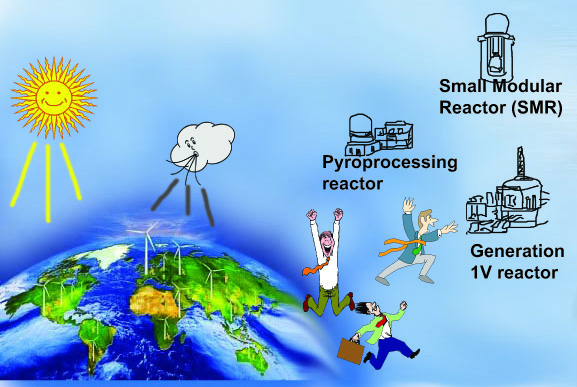
“……There is little in the Tentative Findings to reflect the exciting commercial and manufacturing opportunities available in advanced nuclear technologies. South Australia might be well-positioned to proactively engage with this sector yet it appears to have been overlooked.
Terrestrial Energy strongly disagrees with the statement that innovative, non-lWR designs will not be
available for the foreseeable future…….http://nuclearrc.sa.gov.au/app/uploads/2016/04/Terrestrial-Energy.pdf
Humphrey Hunt calls for a federal referendum on The Royal Commission’s nuclear waste import plan
Humphrey Hunt’s Hand- written submission – recommends that there should be a federal referendum on the question of importing nuclear wastes, and he warns of the dangers to prsent and future generations http://nuclearrc.sa.gov.au/app/uploads/2016/05/Hunt-Humphrey.pdf

Nuclear Royal Commission: it is a National, not a State matter – Robin Foley
Nuclear Fuel Cycle Royal Commission Response – Robin Foley
Nuclear Royal Commission downplays the safety and environmental risks of importing nuclear wastes – Gil Anaf
 Gil M Anaf Response To: Nuclear Fuel Cycle Royal Commission 18 May 2016
Royal Commission seems unaware of the toll of nuclear industries on scarce water supplies
 Deidre Allen – response to Nuclear Fuel Cycle Tentative Findings
“………Nuclear energy requires extreme amounts of water in every stage of development.
Given that SA is the driest state in the driest continent we can not use this essential resource wastefully. http://www.answers.comlQlIs_South_Australia_the_driescstate_in_Australia.…..
- 56. 95. 141.
The idea of planning changes to current regulations in advance of public acceptance for any part of the nuclear industry is premature,
Surely parliament must first deliberate and decide whether to accept the nuclear industry, before changes are made to legislative requirements; that would allow the industry to proceed with any new developments….
74
There is no substantiated evidence that ‘Finland or Sweden have successfully developed long term domestic solutions’, neither project has begun.
There is no opportunity to say that their models are proven safe for a ten or even a fifty year period; let alone for the extended time of 250,000 or several hundred thousands of years, that is required…..
I’d like to submit that you have neglected to consider the impact of climate change. Sea water levels are predicted to rise. Land that for millions of years has been dry could again become submerged. http://www.theguardian.com/environment/2015/jul/10/scientists-predict-huge-sea-Ievel-rise-even-if-we-limit-climate-ehange
Without having to factor in climate change, an article in the Sunday Mail on Feb 21 quoted a Flinders University groundwater scientist, Professor Craig Simmons who has said “we need to think much longer term, 10,000 plus years, which is actually on geological time scales… Sea levels go up,
not one metre but hundreds of metres on these time scales, it’s totally different.”….
146a
With a 20- 30 year period of construction the likelihood of future politicians reversing any decision must not be prevented.
If a better safer option for disposing of nuclear waste was known to exist and to be achievable then it must be allowed to be adopted.
150 If the nuclear waste repository was breached and irradiated vast areas of land and water, all royalties earned by the SA Government would be lost in trying to repair the disaster. Indeed the cost to both the SA and Federal Governments would be inexhaustible……http://nuclearrc.sa.gov.au/app/uploads/2016/04/Allen-Deidree.pdf
Biased Nuclear Fuel Chain Royal Commission – will it sink like a rock?
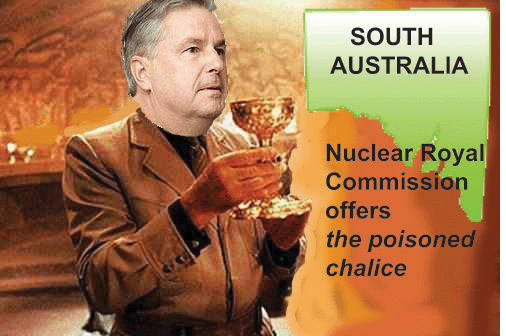 To make Australia the toilet for the world’s radioactive trash – this is an extraordinary aim!
To pretend that it’ s just a little local issue – to (supposedly) bring jobs to south Australia – is ludicrous!
By the way – those dirty and dangerous jobs wouldn’t come for decades. Meanwhile South Australia would miss out on its opportunities to be a hub of jobs in renewable energy and clean agriculture, fisheries wine-making, tourism. If South Australia were to become that global radioactive trash toilet – goodbye to its clean green image!
Of course it’s a National issue – however much our bought politicians of both Liberal and Labor pretend that it doesn’t matter – not an election issue – keep it hush hush till December.
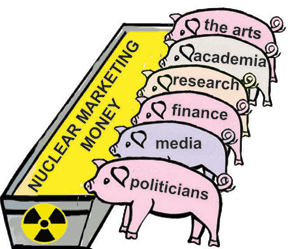
Look out for all the pro nuclear tripe from those drinking at the corporate trough.
Holly-Kate Whittenbury finds the Nuclear Royal Commission UNETHICAL
What is also extremely unethical is how the Commission has twisted the words of experts in favour of the dump; an example of this would be its claims, in tentative finding 78, p. 16, that the proposed areas are seismically suitable.
Submission response to ‘Tentative Findings’ – Holly-Kate Whittenbury
“……The Nuclear Fuel Cycle Royal Commission Tentative Findings Report contains many generously overstated ambitions, almost no analysis of the environmental, tourism or agricultural consequences with its focus on narrowly supported economic benefits. The media has claimed that there is ‘scientific consensus’ on supporting a waste facility for South Australia, despite there being many scientific professionals disagreeing with it.
Advocates for the facility have stated that as a state which supposedly ‘benefits’ from uranium mining in its far north, shipping the extracted products out to other countries, that we have a responsibility to deal with the waste created from such products. I disagree; it is questionable whether South Australia actually has benefited from mining as much as we are led to believe, with 83% of all mining profits going to overseas companies according to the Australian Institute’s paper #7, ‘Mining the Truth’ (Richardson, D. Denniss, R. 2011, p. 17).
This is a topic that we recently explored at University during our Environment: A Human Perspective course; it is what is known as ‘Privatizing profits, socializing losses’. Continue reading
1 This month
17 October, Free Public Talk on Nuclear Issues in South Australia
David Noonan will speak on public interest concerns over the new Roxby Downs Indenture Act 2026 on BHP copper-uranium mining and ore processing in SA, and on how AUKUS may face SA with a High-Level nuclear waste agenda.
Dr Jim Green will discuss international developments in the field of nuclear power including ‘small modular reactors’ and Generation 4 ‘advanced’ nuclear reactor concepts.


Help Aunty Sue Protect Her Land and Sacred Sites From Destructive Rocket Testing.
.

Australians deserve the truth
about
AUKUS – https://aukuspublicinquiry.com/

PETITION – To: Prime Minister Anthony Albanese and the Australian Labor Government

of the week – Australians for War Powers Reform (AWPR)
To see nuclear-related stories in greater depth and intensity

