Ambivalence in Port Adelaide Enfield Council about trucking radioactive trash
 Trucking nuclear material could clog LeFevre roads, Port Adelaide Enfield Council says, Kurtis Eichler, Portside Messenger August 19, 2015 TRUCKING nuclear material through the Lefevre Peninsula would add “significant” pressure to already clogged transport routes, Port Adelaide Enfield Council says.
Councillors voted last week to send a four-page submission to the State Government to be considered by its Royal Commission into nuclear energy.
Issues raised in the submission included transporting uranium from northern mining areas through Outer Harbor…….In February, contentious climate commentator Professor Ian Plimer pushed for a nuclear reactor in Port Adelaide, saying it would create jobs and make electricity cheaper.
The idea was rejected by Mr Johanson and Port Adelaide MP Susan Close. http://www.adelaidenow.com.au/messenger/west-beaches/trucking-nuclear-material-could-clog-lefevre-roads-port-adelaide-enfield-council-says/story-fni9llx9-1227489550161
A top Submission on Nuclear Waste Importing for South Australia
The Commission’s whole aim is to further the drive to make South Australia the World’s nuclear toilet. So, the Submissions on this topic of importing nuclear wastes are especially important.
NGOPPON TOGETHER INC sent in a top Submissions on all 4 Issues papers
Excerpts from NGOPPON TOGETHER INC – Submission on Issues Paper 4 – Management, Storage and Disposal of Wastes.
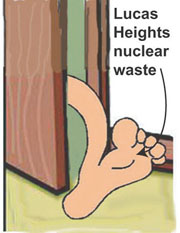 “…..Ngoppon Together’s answer [to Australia’s Lucas Heights wastes] – leave it where it is, where the expertise is, in Lucas Heights where it won’t be out of sight, out of mind; so that we avoid the hope of the pro-nuclear lobby and the consequent burgeoning of high and intermediate level waste in having finally established a repository, nuclear power will be far more possible (and the pressure to establish a nuclear power reactor thus increase.)
Measured by radioactivity, spent nuclear fuel reprocessing waste from Lucas Heights reactors accounts for over 90% of the waste the Government wants to dump … Although the volume of this waste is relatively small – some tens of cubic metres – it is by far the most radioactive material “ANSTO is capable of handling and storing wastes for long periods of time. There is no difficulty with that.” Dr Ron Cameron, ANSTO.(Lucas Heights (quoted in ‘Nuclear Freeways ‘)…….
 and waters, its people, its children? In such a vast country to discount the potential high level dangers of transport? Do we have no responsibility towards the future generations of South Australian and indeed Australian children?
 Ngoppon Together strongly refutes the muddled, quite fallacious so-called ‘ethics’ argument – We export and so are ethically bound to receive waste. This argument fails, as the people do not choose to export uranium but Governments and companies do. Aboriginal people oppose digging up uranium on their land in the first place and then to compound the burden, in the past at least are faced with the waste being imposed on them and their lands, waste that is up to one million times more reactive after enrichment. Our members point out the obvious realityif any government imports uranium then they import the responsibility for dealing with the implications of the purchase. Fewer than 1 in 6 South Australians are inclined towards reactors or waste dumps in S.A. We remind the Commission of their duties – to inform clearly and fully the SA Community of the facts and implications , rather than to persuade and cajole………
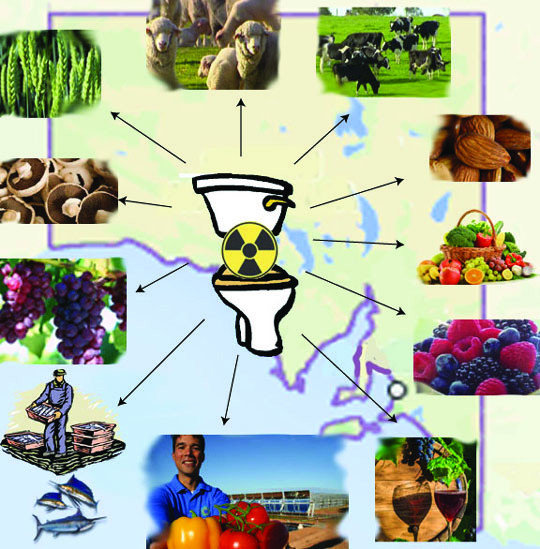
Radioactive trash storage would ruin South Australia’s vital fishing, agricultural and tourist industries
Claire Catt’s fine Submission to #NuclearCommissionSAust
 CLAIRE CATT: SUBMISSION TO THE NUCLEAR FUEL CYCLE ROYAL COMMISSION
To the Commissioners, This submission pertains to Issue Paper No 4 Management, Storage and Disposal ofNuclear and Radioactive Waste
The following views and comments are sole my own as a citizen of the State of South Australia. My interest in nuclear issues is longstanding and my concerns are shared by many of my family and friends, here in Australia and overseas.
Issue Paper Question No. 4./ Clean and sufficient water resources are becoming a serious and difficult issue for countries all over the world. Australia is a very dry continent with limited and dwindling water resources. South Australia is its driest state. The nuclear industry requires huge and ongoing water resources which Australia cannot spare, let alone South Australia.
Issue Paper Question No. 4.6 Maintaining security at nuclear installations, both reactors and storage facilities, is becoming increasingly difficult due to geo-political developments. Security and defence issues are causing major concerns in the US and Europe. This heightened threat is relatively new and rising. Costs associated with maintaining security may become prohibitive, especially for a small community like South Australia. Provision of security by profit driven corporations poses its own inherent risks.
Issue Paper Question No. 4.8 Despite many years of research and experimentation, disposal/storage methods remain unsatisfactory, expensive and in terms of safety largely speculative, certainly in the (very) long term.
Issue Paper No. 4.10 It is important for each nation to responsibly address the problems caused by their own nuclear industries. The transportation and shipping of these dangerous material around the world exposes people and environments to unacceptable risks which are greatly reduced when local solutions are in place. Auslralia also needs 10 dispose of its own relatively small amount of medical nuclear waste as safely as possible in the most suitable location, away from large population centres. For this purpose we do require a small storage facility. The solution of this problem wilhin Australia is inthe interest of all Austral ans.
In conclusion I would like to voice my long held view that Australia has been very lucky and wise to avoid the significant problems posed by the nuclear industry all over the world. It would be an extraordinary decision to embark au this high risk venture at a time when much of the population here and overseas is focussing on clean renewable energy solutions which will benefit all including future generations.
#NuclearCommissionSAust: an overview of submissions published about Radioactive Trash
 So far the South Australian Nuclear Fuel Chain Royal Commission has published 44 Submissions about Issues Paper 4 – Management, Storage and Disposal of Waste
Surprise surprise! They haven’t published Dr Helen Caldicott’s submission. They haven’t published mine, (written under my full name Noel Christina Wauchope)
Well, as the import of radioactive trash is the main purpose of this shonky Royal Commission, we can expect that they will give priority to the pro nuclear ones.
The tally for the published submissions? – 29 in favour of South Australia importing radioactive trash, 15 against.
Of the 29 in favour- well – they ALL have a vested or very obvious commercial or career interest in the radioactive-trash-import project.
- 9 are actually companies or nuclear associations.
- 2 are government agencies, – ANSTO and the Commonwealth Government.
- 14 Individuals – all with either direct connection to a nuclear /uranium company, or with a political/career motive
- Australian Workers Union – a sad standout? I guess they have bought the nuclear lobby mantra of “jobs jobs jobs”
Nuclear is the wrong direction for SA: Environment groups enter submission to Royal Commission.
Three leading environmental organisations – Conservation SA, the Australian Conservation Foundation and Friends of the Earth, Australia – have submitted a detailed joint submission to the Nuclear Fuel Cycle Royal Commission which forensically details an extensive series of nuclear myths and false assumptions.
“South Australia’s future lies in renewable energy, not nuclear. It’s cheaper, safer and quicker to roll out,” said Conservation SA Chief Executive Craig Wilkins.
“This week’s axing of hundreds of jobs from Olympic Dam should raise huge questions about growth potential in the nuclear industry.
“With renewables, we can be in charge of our own destiny, not dependent on decisions made in corporate boardrooms on the other side of the world,” he said.
“Much of the nuclear promotion in SA is premised on the idea of a global nuclear ‘renaissance’, said lead submission author Dr Jim Green. “In fact, the nuclear renaissance is stone cold dead.
“There are fewer reactors now than there were a decade ago. Nuclear fuel cycle markets for enrichment, conversion and fuel fabrication are oversupplied. And as the continuing job losses at Olympic Dam demonstrate, the uranium market is extremely weak and will remain so for years,” he said.
As well as highlighting the contested and constrained status of the current nuclear sector the 248 page report makes a compelling case that the industry’s future will be no brighter.
“So-called Generation 3 reactors projects such as the French EPR and Westinghouse AP1000 are in trouble, with multi-year delays and multi-billion dollar cost blowouts,” said Dr Green. “So-called Generation 4 reactors are decades away and, as a recent report by the French government concludes, safety claims made by Generation 4 advocates do not stand up to scrutiny.”
Many environment, public health and Aboriginal groups have expressed concern that the Royal Commission is being used by the nuclear industry as a Trojan Horse in an attempt to open national and international radioactive waste dumps in SA.
“Australia has yet to find a lasting, responsible solution to domestic radioactive waste so it beggars belief that some are promoting Australia as the solution to the world’s nuclear waste problems.
“Proponents of a deep underground nuclear waste dump in Australia have been coy about the fact that the world’s only deep underground nuclear dump – in the US state of New Mexico – has been shut down following a February 2014 explosion,” Dr Green concluded.
Attachment 1: Two page submission briefing.
Attachment 2: Joint submission to the Nuclear Fuel Cycle Royal Commission by Conservation SA, Australian Conservation Foundation, and Friend¬¬s of the Earth, Australia.
#NuclearCommissionSAust plan rejected by the Australia Institute
Australia Institute rejects nuclear option for South Australia, International Business Times, By Vittorio Hernandez @ibtimesau on August 13 2015 The global debate on the safety of nuclear power continues, with South Australia joining the debate.
A plan by the state to set up either a nuclear waste dump or a nuclear power station was rejected by the Australia Institute due to major flaw in economic and technical assumptions for a domestic nuclear power industry. Richard Denniss, chief economist of the institute, points to lack of commercial scale of the technology being proposed as the most extreme assumption……..
Even nuclear power is not an option for the state, Denniss said, adding “Even if you totally dismiss issues like security, proliferation, safety, insurance and public opposition, nuclear energy is Australia is a very expensive and very slow option to implement.”
In its submission to the SA Nuclear Fuel Cycle Royal Commission, the the institute said that if there was a way for other countries to profit from nuclear waste, it would have done so. It said the proposal would only “create a high level waste problem for ourselves in the hopes that we would be able to not merely solve it, but profit from it.”
The submission also cited experience of other countries that use nuclear power, such as France, which sources 80 percent of its electricity for nuclear plants. However, the 2014 net loss reported by Areva, the state-controlled nuclear power company, of 4.9 billion euro was even bigger than Areva’s stock market value of 3.7 billion euro.
The institute instead pushed for renewables such as solar and wind power, although Australian Prime Minister Tony Abbott is also cold to the idea of wind power, particularly windmills which he considers ugly……. http://www.ibtimes.com.au/australia-institute-rejects-nuclear-option-south-australia-1460187
Nuclear power will be redundant, as renewables develop fast -Conservation Council of SA
SA told prioritise renewables, not nuclear 9 News, AAP , 13 Aug 15, Renewable energy should be prioritised over nuclear power, the Conservation Council of SA says.
Detailing its submission to South Australia’s royal commission into the nuclear fuel cycle, the council says the state’s future lies in renewable energy.
“It’s cheaper, safer and quicker to roll out,” the council’s chief executive Craig Wilkins said on Thursday.
“In the time it would take to develop an Australian nuclear power industry, it will be made utterly redundant by renewables.”…..http://www.9news.com.au/national/2015/08/13/10/09/renewable-energy-makes-nuclear-redundant
#NuclearCommissionSAust might crash and burn, judging by these submissions
CONSTRUCTION FORESTRY MINING ENERGY UNION excerpt…
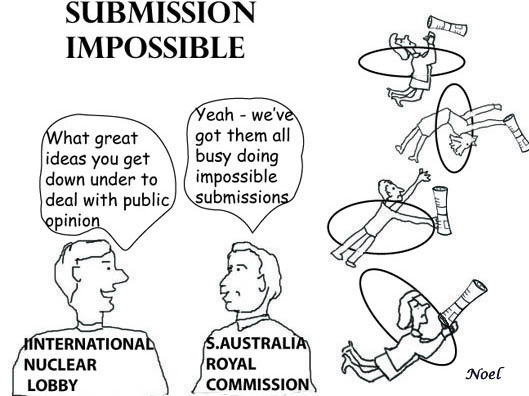
bureaucratic, indicates that the views that they consider relevant are extremely limited. For example Aboriginal representatives, who have stated that the difficulty in translating the papers alone is going to prevent many of their communities from participating in this process at all.
 URANIUM FREE NSW ISSUES PAPER ONE: EXPLORATION, EXTRACTION AND MILLING The first 6 questions seemed to be aimed at industry to easily to enable their argument for expansion. They are akin to the Royal Commission/Government asking “how can we facilitate the expansion of the industry?” UFNSW is opposed to the expansion or the nuclear industry in SA or anywhere, hence has not answered these questions………
- Only deals with economic viability, but even then ignore issues of reparations, compensation, or insurance costs in the event of exposure, spills, accidents, or even routine emissions.
- The paper quotes the International Energy Agency (IEA) as saying that the expansion of the nuclear industry “depends on listening to, and addressing public concerns, about the technology.”
- Doesn’t address fundamental question of should uranium be mined at all. The entire process is underpinned by an assumption that uranium mining is good and looks at the supposed best ways to go about it.
- Nothing regarding keeping profits in Australia
- Environmental impacts are minimised to native vegetation, water is not separate. Scope very narrow • Minimisation of environmental impacts is not a good enough aim given time of radioactivity, it is unmanageable and difficult or impossible to remediate or rehabilitate sufficiently • This Issues Paper does not provide information regarding direct or indirect Government funding of the nuclear industry, in the past, present or potential future.
- No mention made of the social or environmental costs of Radium Hill, Roxby Downs, Honeymoon, Beverley and Four Mile. Traded price of uranium is provided in a graph, but not costs
- Paper states that international demand for uranium is primarily driven by its use in electricity generation, however it is undoubtedly influenced by the supply and demand for uranium to be used in weapons. Market is influenced by uranium from dismantled nuclear weapons is released onto the uranium market, which is presumably harder to predict
- The issues papers seem to ignore the impacts of radiation on health • No mention of ionising radiation
- The issues papers questions ask about economic and some environmental impact, but completely ignore any cultural or social impacts • No mention on the length of time materials are radioactive and need to be managed for
- Seems to treat uranium like coal or iron, materials that have far lesser risks The questions seem to be written in such a way as to set up opposition to nuclear expansion as emotional and hence discredit it.
Submission to #NuclearCommissionSAust addressing questions of WATER
 ANNIE MCGOVERN Excerpt …
this writer has witnessed a declaration by on station owner to the North declare that their borefloqw had been significantly depleted by Roxby’s misuse and phenomienal extraction rate of Great Artesian Basin (G.A.B.) water. The people of the Marree region where this extraction occurrs, have been actively engaged in objecting to the Borefield activities for the past 32 years.
1.10 Any further developments to mine and mill Uranium would further compromise both the environment and the people of S.A. Roxby is already depleting the G.A.B. to the detriment of all in the vicinity, plus those dependant on its waters in both Queensland (Qld.) and New South Wales (N.S.W.). The draw-down effects of the 42 million litres/day licence has depleted the basin to its furthest extremities with little thought given as to why places like Longreach (Qld.) are in almost permanent drought despite rainfalls recorded in recent years that should have been able to sustain some productivity. This is the single largest body of water in S.A. and is no longer sustainable…..where is there water for any expansion?
1.11 The flow of water beneath the mine at Roxby Downs is part of an underground river system which flows to the top of Lake Torrens and empties into the underground sytem of Lake Torrens….to where does this highly contamminated water ultimately flow? The answer is unknown. Mining activities at every level contamminate the surrounds. Underground blasting, mining and fracturing destabilises fault zones that are prominently featured in this landscape. 10% of S.A.’s available electricity is designated for the production of the industry. Where is the room for more?,
Some top submissions to #NuclearCommissionSAust on Issues Paper 1
PAUL HARRIS – EXCELLENT OVERALL submission covering all 4 Issues Papers and ULRIKE HECK Also very good overall
GLADSTONE UNITING CHURCH SA Response to Issues Paper One…Exploration, Extraction & Milling ” Excerpt..….
- As responsible Australians we request an explanation as to why our government did not advertise more widely about the Nuclear Royal Commission as many people were unaware of this very serious issue.
- The safety of uranium exploration hasn’t been proven to be 100% safe in the world.
- Will SA Emergency Services be supported adequately by our government for the events of accidents, spillages or radioactive fall out similar to Marralinga?
- How would the finished product be transported?
- Major concerns are…underground water/soil contamination which will effect farmers etc & our environment…therefore touching every person’s life & for every generation to come in our area.
- Huge concerns also for our native wild life as well as farm animals. This can also contaminate the animals making them unsafe for human consumption.
Submissions to #NuclearCommissionSAust by Medical Association for Prevention of War & Public Health Association of Australia
MAPW & PHAA make joint submission to the SA Nuclear Fuel Cycle Royal Commission http://www.mapw.org.au/news/mapw-phaa-make-joint-submission-sa-nuclear-fuel-cycle-royal-commission05/08/2015
MAPW in partnership with the Public Health Association of Australia have lodged a joint submission addressing the terms of reference of the South Australia Nuclear Fuel Cycle Royal Commission.
MAPW would like to thank everyone who contributed to the submission and would welcome the opportunity to provide evidence in person to the commission if required.
For further information please contact Phyllis Campbell-McRae on 03 9023 1958
Click here to read the executive summary
Click here to read the full submission
If you would like any further information about the submission please contact Phyllis Campbell-McRae 03 9023 7958
http://www.mapw.org.au/news/mapw-phaa-make-joint-submission-sa-nuclear-fuel-cycle-royal-commission
(This must-read 77-page submission and the 3-page Executive Summary can be downloaded here or via links on the MAPW Resources webpage at: http://www.mapw.org.au/resources)
Dr Helen Caldicott’s Submission on all 4 Nuclear Royal Commission Issues Papers
 Submission to the Nuclear Fuel Cycle Royal Commission, by Helen Caldicott on July 24, 2015 I begin my submission to the Nuclear Fuel Cycle Royal Commission by posting an article which I wrote for the Australian Medical Student Journal, which outlines in some detail the medical implications of the whole nuclear fuel chain.
The impact of the nuclear crisis on global health
Due to my personal concerns regarding the ignorance of the world’s media and politicians about radiation biology after the dreadful accident at Fukushima in Japan, I organized a 2 day symposium at the NY Academy of Medicine on March 11 and 12, 2013 … [ to read the full text of this article, click on this link: http://www.helencaldicott.com/the-impact-of-the-nuclear-crisis-on-global-health/. The link will open in a new tab or window. Close it to return to this page ]
Now to answer some of the questions posed by the Royal Commission Continue reading
Answer Points to Nuclear Royal Commission on Importing Nuclear Waste
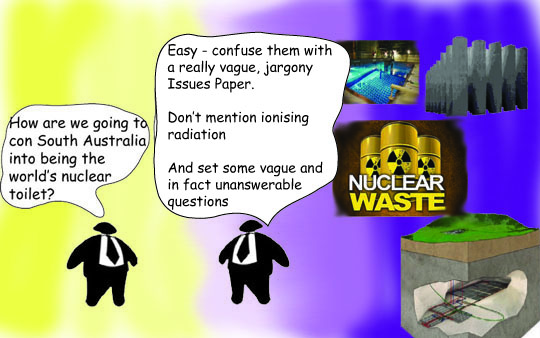
Friends of the Earth Adelaide: Submission on TOR of ROYAL COMMISSION INTO THE NUCLEAR FUEL CYCLE
SUBMISSION ON THE TERMS OF REFERENCE FOR THE ROYAL COMMISSION INTO THE NUCLEAR FUEL CYCLE
To the Attorney-General Department submissions@agd.sa.gov.au
Friends of the Earth Adelaide urge you to consider the following Terms of Reference to be included for the Royal Commission into nuclear energy.
The Royal Commission will be undermined if it does not include the following Terms of Reference:
1. Balanced and fair representation in the Royal Commission
(a) provision must be made for qualified anti-nuclear people on the royal commission, so all evidence is public; including
(b) funding for anti-nuclear people to make their case (since the industry will be spending lots of money presenting their side).
2. Environmental impacts of uranium mining in South Australia The terms of reference should explicitly look at:
(a) long term worker health and safety (why are no lifelong records of exposure kept);
(b) Roxby’s record of tailings dam collapses/breaches;
(c) damage to underground aquifers and the loss of biodiversity;
(d) net economic subsidy of mining and exploration, as opposed to actual income for the state (rather than big mining companies).
3. Enrichment The Terms of Reference should include any requests from industry for subsidies industry to build and operate any enrichment facilities, as well as power and water requirements, worker health, transport safety and security, and waste management.
4. Nuclear waste The Royal Commission must look widely at nuclear waste management in South Australia, including uranium tailings. The Commission should examine proposals to host international nuclear waste and status of the waste industry globally.
5. Nuclear waste dump
(a) the commission should examine the full cost of maintaining and guarding a waste-dump for 30, 50, 100, 1000 years or more, factoring in real world cost experience of testing potential waste dump sites; (b) South Australia’s legacy contaminated nuclear sites include Maralinga, the Port Pirie Uranium Treatment Complex, and Radium Hill. There are unresolved concerns over the status of these sites in relation to public health and environmental impacts, and the Royal Commission provides an opportunity to finally resolve these issues.
6. Nuclear Power The economic analysis should:
(a) compare cost of nuclear energy to renewable energy, in terms of real world, not theoretical estimates; (b) proper analysis of cost of building a power plant, including the cost of water, electricity etc, versus the returns to the state and taxpayers (not the big companies);
(c) potential cost of an accident during transport or storage, and cost of cleanup;
(d) the record of the global nuclear industry’s optimistic predictions and its failure to live up to those predictions (in relation to issues such us global demand, global capacity, construction costs, facility start-up dates, technological difficulty, and safety);
(e) the reasons for the nuclear industry’s failure to live up to its predictions and the likelihood that that pattern will be repeated in Australia.
7. Climate Change solutions and Renewable Energy The Terms of Reference should include
(a) an analysis of alternative energy sources to address the challenge of climate change, including the potential for growth in renewables and other low carbon technologies; (
b) compare nuclear reprocessing/power generation ( including insurance!) to solar thermal plants; to large solar PV arrays; to building windfarms; to adding storage to the grid;
(c) consider probability of major floods/droughts from climate change displacing assumptions of dry, geological stability, and
(d) the developmental status and economic viability of proposed technologies (in light of past failures to accurately estimate costs and delivery times).
8. Negative impact on other export industries The terms of reference should include a thorough analysis of the opportunity costs of a further embrace of the nuclear cycle, including the impact on our clean and green food and wine reputation, and the tourism and international student markets, particularly if South Australia were to host an international repository for high-level nuclear waste
9. Insurance, financial risk, public liabilities and subsidies; The terms of reference should include:
(a) A comprehensive examination of the potential liability of the SA Government in the case of an incident or accident;
(b) tax-payer subsidies required to support each proposed role in nuclear energy (in light of past failures to accurately estimate costs and delivery times);
(c) risks of transport of radioactive materials, both within Australia and on the high seas.
10. Proliferation of nuclear weapons The terms of reference should address the nuclear proliferation and global and regional security implications of Australian involvement in nuclear fuel cycle activities. Progress in halting proliferation, spread of nuclear technology, terrorist attacks etc should be reviewed.
11. International Geopolitical response The terms of reference should also include likely foreign government reactions to each proposed role in the nuclear energy cycle.
12. Public participation Friends of the Earth Adelaide call upon the royal commission to canvass public attitude to each proposed role in nuclear energy, nationally, regionally, and locally and to ensure an appropriate public participation process is undertaken before any decisions are finalised.
1 This month

of the week – Australians for War Powers Reform (AWPR)
To see nuclear-related stories in greater depth and intensity
 Antinuclear