Earthquake near Port Pirie
Earthquake Details Issued by © Commonwealth of Australia (Geoscience Australia) 2016
Date and Time UTC: 13 August 2016 @ 19:49:39
Location NE of Port Pirie, SA. Magnitude ML: 2.0
Coordinates: -32.811, 138.228 Depth: 1 km
Potentially Tsunamigenic No http://www.ga.gov.au/earthquakes/getQuakeDetails.do?quakeId=3856247
The “heroic” assumptions of the Nuclear Fuel Chain Royal Commission
 Submission to Joint Committee on Nuclear Royal Commission South Australian Parliament, – Mothers for a Sustainable South Australia, August 2016 http://www.parliament.sa.gov.au/Committees/Pages/Committees.aspx?CTId=2&CId=333
The assumptions underpinning the century-long cost-benefit calculation that this proposal relies upon, are heroic.
Price: There is no market for disposing of HLNW, so the proposed ‘price’ is a guess. It is ‘an illustrative benchmark’ (p 293) – but is critical to the $51 billion profit figure. Experts cannot predict the price of gas, coal or iron ore one year ahead – despite well developed markets for all three. How can a century-long price for something that is not yet traded be sensibly predicted? The price used by the RC is much higher than that suggested by Finnish experience. It is nothing more than a guess.
Cost: There is no existing deep geological storage anywhere in the world, so no experience with what it actually costs. The cost estimate – from transport through to maintenance of the site for 100,000 years – is also simply a guess. The Finns who must dispose of about 6,000 tonnes of their own high level nuclear waste have recently granted construction approval for a deep geological dump at Onkalu – after 40 years lead up. This is the first of its kind in the world – expected to be operational in the 2020s. But until it is built, there is no reliable cost experience for the experimental technology. Further, Onkalu is much smaller than that proposed for SA. What are the costs of something 23 times larger likely to be? Who knows? There are no reliable estimates of what it will cost to transport 138,000 tonnes of HLNW or intermediate waste from, say, Korea to Port Augusta – and then to store it and re-transport it to the far north of the state. Such international transport has not been done before.
A single quote from a nuclear industry insider: As we have pointed out, all these rely on a single consultant report by Jacobs & MCM. Jacobs are industry insiders. They have been in the nuclear industry for 50 years – on projects from construction through to clean up. They have a business interest in the nuclear industries expansion. Jacobs’ website prides itself on ‘ongoing business relationships’ with nuclear industry clients, promising ‘to serve as their advocates and support them in their global aspirations’. They are hired consultants who pride themselves on acting in the interests of their hirers – not for an objective critical viewpoint on behalf of the larger community
The nuclear industry consistently overestimates returns and underestimate risk. For example, academic analysis of the cost of building 180 nuclear reactors up until 2014 (for which cost data is known) found that on average they cost double their original estimates – and most took years longer than expected to build, increasing the costs of finance very significantly (Sovacook, Gilbery and 4 Nugent, 2014). The costs of the US Yucca Mountain deep disposal project also blew out very significantly (prior to it being mothballed). The RC offers ‘sensitivity analysis’ on price, costs and quantity but keeps its analysis within parameters that mean it remains profitable on paper. There are many other plausible assumptions about price, cost and amount of waste received, accidents, and changes in legal, contractual, market or community circumstances that make it not only unprofitable, but potentially extremely costly to Governments – who would own and control the project – and who would have to pick up the tab. The financial risks of the project throw the losses of SA’s state bank debacle into the shade.
What happens if the amount of high level nuclear waste does not eventuate? The economics of the project rely on a minimum quantity of high and medium level nuclear waste. What happens if it does not arrive – for any number of reasons? What if China or the US – or companies from anywhere in the world – enter the market for waste disposal? Both countries – and others – plan to build dumps for their own waste. If this is so profitable, why would they not enter the market to take waste, easily undercutting SA’s price and reducing the quantity in the SA facility – which must achieve a very large share of the international market to be viable, let alone profitable? The nuclear industry consistently overestimates returns and underestimate risk. For example, academic analysis of the cost of building 180 nuclear reactors up until 2014 (for which cost data is known) found that on average they cost double their original estimates – and most took years longer than expected to build, increasing the costs of finance very significantly (Sovacook, Gilbery and 4 Nugent, 2014). The costs of the US Yucca Mountain deep disposal project also blew out very significantly (prior to it being mothballed).
The RC offers ‘sensitivity analysis’ on price, costs and quantity but keeps its analysis within parameters that mean it remains profitable on paper. There are many other plausible assumptions about price, cost and amount of waste received, accidents, and changes in legal, contractual, market or community circumstances that make it not only unprofitable, but potentially extremely costly to Governments – who would own and control the project – and who would have to pick up the tab.
The financial risks of the project throw the losses of SA’s state bank debacle into the shade. What happens if the amount of high level nuclear waste does not eventuate? The economics of the project rely on a minimum quantity of high and medium level nuclear waste. What happens if it does not arrive – for any number of reasons? What if China or the US – or companies from anywhere in the world – enter the market for waste disposal? Both countries – and others – plan to build dumps for their own waste. If this is so profitable, why would they not enter the market to take waste, easily undercutting SA’s price and reducing the quantity in the SA facility – which must achieve a very large share of the international market to be viable, let alone profitable?
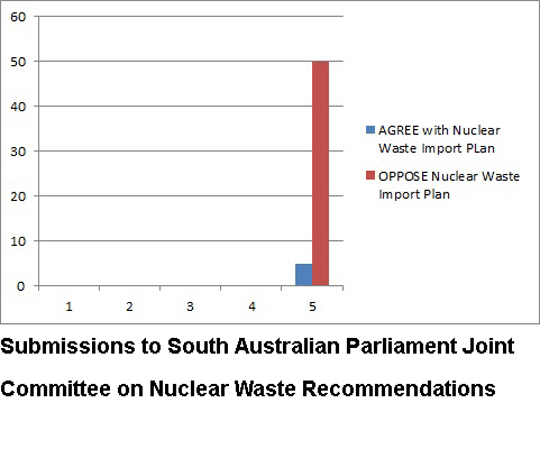
Submissions to South Australia Parliament are overwhelmingly opposed to nuclear waste importing
South Australian Parliament’s Joint Committee on Findings of the Nuclear Fuel Cycle Royal Commission.
This Parliamentary Inquiry is still going on. Transcripts of hearings and submissions can be read at
http://www.parliament.sa.gov.au/Committees/Pages/Committees.aspx?CTId=2&CId=333.
The opinions of those submitting to this Committee are overwhelmingly opposed to the nuclear waste import plan.
However,the Committee itself is hardly neutral:
- Hon Tom Kenyon MP Labor’s “ true believer in SA’s nuclear potential”
- Mrs Annabel Digance MP – Labor party. well, we all know how Labor MPs toe the party line, no matter what the evidence.
- Hon Dennis Hood MLC, of Family First a party that is more interested in matters of personal sexuality, than in wider causes. However, Mr Hood has made his own views clear, in saying ” The stars are aligning for our nuclear future“
- Mr Dan van Holst Pellekaan MP Liberal Local Member for Stuart Dan van Holst. Pellekaan said “all options for the future of the town must be explored and if it can be proven to be done safely, then there would be significant benefits for the community“.
- The Greens’ Mark Parnell will be putting a strong case for opposing the nuclear waste import plan.
Nuclear waste forum in Port Pirie got a negative response from indigenous community
 Speakers in Pirie raise doubts about nuclear dump http://www.portpirierecorder.com.au/story/4087477/negative-vibes-at-nuclear-forum/ Greg Mayfield 10 Aug 2016, Speakers at an indigenous forum in Port Pirie questioned the merits of proposals for a nuclear waste dump in South Australia.
The forum was hosted by Jason Downs, of the Consultation and Response Agency set up after the Nuclear Fuel Cycle Royal Commission. It was aimed at gathering informal views from the Aboriginal community on the findings of the commission.
Gregory Waldon, of Wirrabara, said radioactive contamination on the leg of a fly could be a “problem dose” amid the scenario of handling nuclear waste. He said the issue of “risk” should be reserved for the casino. Only about $230 for each resident of South Australia would flow, he said, from development instead of an original estimate of $3300, once the Commonwealth became involved.
“It is not our waste. We should not be taking any risk,” he said.
Enice Marsh, 73, of Gladstone, is an Adnyamathanha indigenous woman who was once a coal-miner at Leigh Creek. Mrs Marsh said she was on Adnyamathanha land and was the only person from this group here at the gathering. “There are lots of Adnyamathanha people living here in Port Pirie and the area,” she said.
“I really got very little notice about this gathering. It is my duty to come here to represent my country.
“We have two uranium mines on our land – Beverley and Honeymoon. “It doesn’t matter whether it is low, intermediate or high-level waste, we are saying ‘no’ from day one.”
Neville Reid, who works in Port Pirie, said that if he were not logged into the “no nuclear” website, he would not have known about the event. He queried why there were only 10 country people on the Citizens’ Jury looking at the nuclear issue when the dump was “going to be in a country area”.
He warned that steel and concrete doors on repositories would “rot away”, leading to “another site then another site” being used during the long radioactive life of the waste.
Leader for engagement with the agency Mr Downs said a private research company had been engaged to report to the next Citizens’ Jury in October followed by a report to Premier Jay Weathefill who would “make decisions” in November based on feedback.
Native title claims over Lake Torrens area not extinguished, but were dismissed by Federal Court
SA native title claims dismissed, Valerina Changarathil, The Advertiser August 10, 2016
 THE Federal Court yesterday dismissed three overlapping native title claims near key exploration projects in the state’s mid-north, but the issue is far from resolved with some groups assessing their appeal options.
The claims by the Kokatha, Adnyamanthanha and Barngarla people were over the lands and waters of Lake Torrens — Australia’s second largest salt lake — which is in proximity to OZ Minerals’ proposed Carrapateena copper-gold project, Argonaut Resources’ and Aeris Resources’ jointly proposed Torrens iron-oxide, copper-gold project and BHP Billiton’s Olympic Dam operations.
A native title application is a claim for legal recognition that a group hold rights and interests in an area of land and/or water according to their traditional laws and customs.
Justice J Mansfield yesterday said he was not “persuaded that a determination of native title in favour of any of the three applicants should be made in respect of any part of the claim area”.
“While the archaeological evidence in this matter supports Aboriginal activity and use on and around the western shore of Lake Torrens of considerable antiquity, I have not found the archaeological evidence in this matter persuasive of a particular conclusion directed in favour of one or other of the three applicants,” he said.
He was not satisfied the Kokatha people occupied or possessed the claim area according to their traditional laws and customs at sovereignty and while the ethno-historical records provided some support for the Adnyamathanha (Kuyani) and Barngarla peoples’ connections to part of the claim area, it was difficult to date it back to the time of sovereignty or establish a continual connection to the present time.
SA Native Title Services, a solicitor for the Kokatha people, said that while applications were dismissed, there was no finding that native title rights and interests did not exist or were extinguished……..http://www.adelaidenow.com.au/business/sa-native-title-claims-dismissed/news-story/1b488e017dbd68c515907666b8f61f53
South Australia: Electricity market’s unstoppable move away from coal-fired “base-load generation”
 South Australia signalling the death of base-load generation, REneweconomy,By Giles Parkinson on 8 August 2016 Tuesday marks the three-month anniversary of the closure of the last coal-fired “base-load generator” in the South Australia electricity market, and despite the best efforts of many in the Coalition and the Murdoch media, there is nothing to suggest that other states will not follow suit, in time.
The fossil fuel industry predicted – and possibly hoped for – “armageddon” from the closure of the last coal plant. But all it got was a big jump in wholesale electricity prices, caused not by renewable energy, as federal and local energy ministers have made clear, but by the soaring cost of gas and constraints on the interconnecter.
If anything, the events of the last few weeks have reinforced the point that the electricity market is in the early stages of an unstoppable transition. Coal-fired plants will soon be a thing of the past, and the role of gas-fired generators may all diminish as battery storage and other renewables take more central roles.
The announcement by AGL on Friday of its plans – supported by the South Australian government and the Australian Renewable Energy Agency – for an array of 1,000 batteries in homes and businesses to create a “virtual power plant” to address demand peaks and grid stability, is a foretaste of what is to come.
Indeed, South Australia’s experiment – as premier Jay Weatherill has described it – in pursuing the world’ highest level of wind and solar generation is rapidly evolving into a whole bunch of world-leading projects.
These include AGL’s (described the world’s biggest virtual power plant), South Australia Power Networks’ commitment to a second “world leading” battery storage project that will likely reduce the need for grid investment, and various proposals for large-scale solar with storage (from SolarReserve,Lyon Infrastructure and others) and the creation of suburban and remote town micro-grids that will reduce the need for centralised power and distribution.
The withdrawal of base-load coal generation from the South Australian grid has sparked predictions of economic collapse and soaring prices, but these have simply replicated what used to happen when the state relied entirely on gas for the balance on power, even before the arrival of wind and solar. Continue reading
Whyalla is a worry – residents not awake up to the nuclear waste economic and environmental dangers?
 What’s happening in Whyalla? These articles come From February. I hope that Council and the newspaper editor have done their homework on nuclear waste, since then
Acting Whyalla mayor Tom Antonio has said that he is “positive” about nuclear energy’s future in South Australia ahead of his visit to the Lucas Heights nuclear reactor in Sydney next week.
South Australian Govt’s “Simplify Day” – aimed at removing nuclear restriction laws?
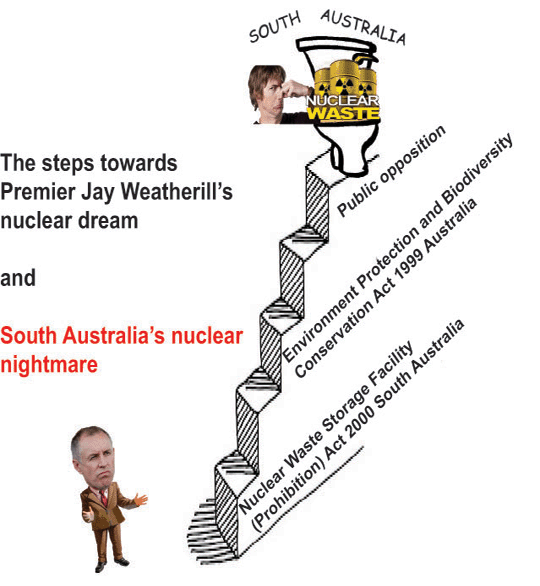
The Premier has announced that the first ‘Simplify Day’ will be held on 15 November, 2016 to repeal out-dated and redundant legislation that impacts on the Government’s ability to deliver on its 10 Economic Priorities.
In the lead-up to Simplify Day a consultation process is being held to seek the views of businesses and the community on how red tape can be removed for businesses, including any legislation that may be outdated or unnecessary.
Should you wish to know more about this initiative or make a submission visit the YourSAY website at www.yoursay.sa.gov.au.
The consultation period is open until 13 August, 2016.”
What’s the Australian govt doing – buying pro nuclear opinion in the Flinders Ranges?
Hookina Newsflash 4th August 2016
Cindy K. Hoskin Fight To Stop Nuclear Waste In The Flinders Ranges  https://www.facebook.com/groups/941313402573199/ August 2 Here is the latest from port pirie. Tonight there is a paid invited meeting for nuclear in port pirie. A business man was rang on his moble and offered payment to attend, they asked his age which is 48, their reply was that they had enough over the 45 age limit and were seeking people under that age. Has any one else heard this? I have the number that this call came from if any one is interested.
World’s largest ‘virtual power plant’- 1000 battery systems for solar energy in Adelaide
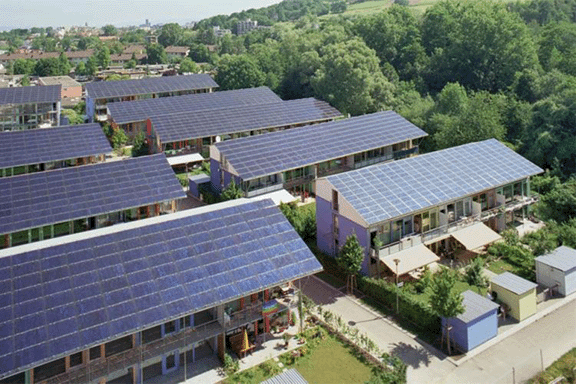 Adelaide charges ahead with world’s largest ‘virtual power plant’ AGL project to roll out 1,000 battery systems to homes and businesses will operate like a 5MW plant, and optimise energy produced from solar panels, Guardian, Michael Slezak, 5 Aug 16, Adelaide will be home to the world’s largest “virtual power plant” – AGL is rolling out 1,000 battery systems to homes and businesses, with backing from the Australian Renewable Energy Agency (Arena).
AGL and Arena say the project will improve network security and dampen a volatile wholesale electricity price in South Australia. However, an energy expert says that at the current size, the system will have a minimal impact on network security or wholesale prices, but might pose a challenge to the revenues of companies that own the poles and wires.
Offered to homes and businesses with solar systems, the $20m AGL project, backed with $5m from Arena, will operate like a 5MW peaking power plant, providing power to homes and businesses during periods at optimal times.
The chief executive of AGL, Andy Vesey, told Guardian Australia: “The beauty of the project is it’s being done over 1,000 batteries, and that’s how we deliver an aggregate benefit to the grid itself.
“But for the consumer, it will have the value of the battery. And it’s being priced at a way that a good investment decision could be made. We’re viewing that the average savings for someone who has rooftop solar right now would be $500 a year. It’s really a way of optimising the energy produced out of their solar panel.”
The system will cost $3,500, and AGL estimates it will take about seven years for solar customers to recover the costs.
Arena’s chief executive, Ivor Frischknecht, said the project would boost grid stability, reduce power price volatility and support the expansion of renewable energy……..
As a demonstration of something that could be bigger, McConnell said one of the biggest impacts of the business model could be on how the networks recover the costs of the poles and wires.
About half the cost of a home energy bill is linked to the network’s cost recovery of its poles and wires. McConnell said that meant a lot of the money being saved by consumers was actually done by avoiding paying the network costs. And that’s what AGL is relying on for its business model.
But this “virtual power plant” isn’t moving people off the grid. Instead, it’s relying on the grid, while avoiding the charges the distributors use to pay for the grid…….https://www.theguardian.com/environment/2016/aug/05/adelaide-charges-ahead-with-worlds-largest-virtual-power-plant
Festering doubts on impartiality of Nuclear Royal Commissioner Kevin Scarce
Kevin Scarce, head of SA’s Nuclear Fuel Cycle RC, also has a conflict of interest, 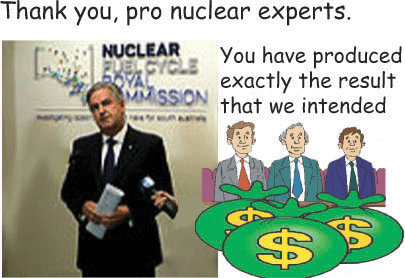 Independent Australia, 4 August 2016, Given the public outcry over Brian Martin’s conflict of interest as head of the Royal Commission into Juvenile Justice in the NT, Noel Wauchope asks why Kevin Scarce’s suitability as head of SA’s Nuclear Fuel Cycle RC wasn’t questioned……..
Brian Martin did not think that he had a conflict of interest in relation to his previous role as a Northern Territory judge. He did not doubt his “capacity to be both independent and competent in the role of the commissioner”. However, he recognised that a community perception of his having a conflict of interest would compromise the Royal Commission and its results.
As Mark Kenny wrote in The Age on 2 August 2016:
‘Indeed, Martin acknowledged this [public confidence] was the crucial factor — irrespective of the facts. He observed if any public doubts about the impartiality or commitment to the unvarnished truth were allowed to “fester” during the commission’s long months, its outcomes would be compromised.’
Why no outcry about the conflict of interest in appointing Kevin Scarce as head of SA’s Nuclear Fuel Cycle RC?
Apparently, while it’s not OK to have a conflict of interest in a National Royal Commissioner, this has not yet been a problem for a State one…….
Unlike the situation with Brian Martin, this is not a case of a perception of conflict of interest by some special sections of the community. It looks more like a choice of a royal commissioner that is unusual and inappropriate and involving a much more obvious conflict of interest.
The general practice in royal commissions is to appoint a serving or retired judge, due to the quasi-legal nature of the process…….Kevin Scarce with no legal background, was a most unusual choice as royal commissioner for South Australia’s Nuclear Fuel Cycle Royal Commission. Furthermore, his military career and close involvement with defence agencies, raises questions about his impartiality…….
There is a strong defence lobby pushing for Australia to acquire nuclear powered submarines. Kevin Scarce was previously the head of Maritime Systems at the Defence Materiel Organisation.
Kevin Scarce is a shareholder in Rio Tinto Group, the owner and operator of Ranger and Rossing uranium mines in Australia and Namibia
Prior to his appointment as Royal Commissioner, Kevin Scarce advocated a nuclear industry for South Australia. Speaking in November 2014 at a Flinders University guest lecture, Scarce acknowledged being “an advocate for a nuclear industry”. ……
2014 Investigator Lecture – Rear Admiral the Honourable Kevin Scarce AC CSC RAN Rtd
Will the outcome of the SA nuclear RC be compromised, given the criticisms so far?…..
The selection of pro nuclear advisers and speakers continued through the Royal Commission’s year-long proceedings and subsequent Citizens’ Jury sessions, as Independent Australia has shown in recent articles. ..
Numerous well researched criticisms sent to this Royal Commission seem to have been ignored. Kevin Scarce has dismissed opposition as based on emotion or opinion, rather than on facts,saying: “The debate has been formed upon fear…”
in South Australia, the outcome of its Nuclear Royal Commission may well be compromised, as public confidence in Kevin Scarce might fester amongst Australians in general, and even amongst South Australians, despite that State’s government now bombarding them with pro nuclear propaganda. https://independentaustralia.net/environment/environment-display/kevin-scarce-head-of-sas-nuclear-fuel-cycle-rc-also-has-a-conflict-of-interest,9310
Quite secretively organised, the plan for a federal nuclear waste dump at Hawker, Flinders Ranges, South Australia
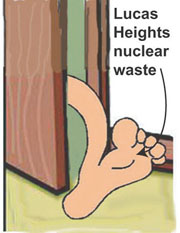 https://www.facebook.com/groups/941313402573199/ This secrecy is outrageous. It would not happen in America. The whole bs about “medical wastes” is one big cover-up for the transport of a tiny amount of intermediate to high level nuclear wastes returning from France. The plan is to continue to take in such returning nuclear wastes, so that Lucas Hieights’ reactor can continue to produce them. After that, how convenient for the global nuclear lobby, if South Australia is already taking in ‘Australian’ high level wastes. What a lovely precedent for the global nuclear waste import plan.
Australia’s Secret Shipment of Radioactive Nuclear Waste Arrives !
This will be the tick the box and no-one is concerned b.s.
Gavin Smith Joy Engelman It is a national project and we should all be given a fair go . It is not in the Council Region but Outback Lands . My blood is near boiling point about this.
Goodbye and good riddance to nuclear stooge Senator Sean Edwards
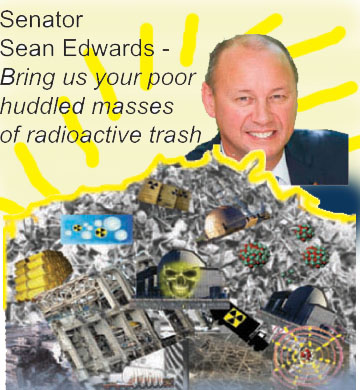 Outgoing senator Edwards lost his seat after winning the fifth spot on the Liberal ticket.
“I’ve lobbied heavily for South Australia’s expanded involvement in the nuclear fuel cycle, producing a substantial submission to the SA Nuclear Fuel Cycle Royal Commission in the process, and it now appears the state will do just that. This will deliver hundreds of billions of dollars in sovereign wealth to South Australia.”– http://www.adelaidenow.com.au/news/south-australia/bob-day-wins-12th-senate-spot-for-south-australia-labor-and-liberal-senators-out/news-story/ab561f14c51aebce726b9852fb7b52b6
Manufacturing social licence – South Australia’s Nuclear Fuel Chain Royal Commission
 The concerns that this approach is focussed more on manufacturing social license or acceptance of the dump plan, rather than forensically and objectively analysing the full range of risks and opportunities, have increased following news that a key adviser to the nuclear Royal Commission was an industry “true believer” linked to a failed attempt to open a global radioactive waste dump in Australia in the 1990s.
In the late 1990s, public outrage forced Pangea to abandon its dumping plan. Today, a pro-nuclear Royal Commission is using public funds to facilitate Pangea’s inheritors to rewrite the proposal.
Big bucks, radioactive waste and a biased SA Royal Commission https://independentaustralia.net/environment/environment-display/big-bucks-radioactive-waste-and-a-biased-sa-royal-commission,9304 1 August 2016 Following SA’s nuclear fuel cycle Royal Commission, a publicly-funded PR campaign is attempting to make the largest ever radioactive waste dump in the world, a tepid topic, writes Dave Sweeney.
A STATE-BASED Royal Commission unleashed a plan with massive national implications when it recommended, in May, that South Australia should move to import, store and bury around a third of the globe’s high level radioactive waste ‘as soon as possible’.
The Royal Commission, initiated by PremierJay Weatherill in 2015 and presided over by former governor and self-proclaimed state salesman Kevin Scarce, has unsurprisingly generated column inches, congratulations and critics.
With its pro-nuclear terms of reference and advisory panel, and its often oblique process, the exercise has been a case study in issue management. Radioactive waste may be hot but a well-funded series of rolling roadshows, a citizens’ jury, and a social media initiative are all part of a state campaign working to make the topic tepid and the “conversation” constrained. Continue reading
Credibility of South Australia’s Nuclear Royal Commission in tatters?
Today’s Age discusses the planned Australian Royal Commission into Juvenile Justice in the Northern Territory. The appointed Commissioner, Brian Martin, has resigned because he recognised a perception of bias by the community, however well qualified he might be for the position.
The South Australian Royal Commissioner, Kevin Scarce, was not only not qualified, with no legal background, but IS clearly perceived as biased.
Kevin Scarce has a conflict of interest, as a shareholder in Rio Tinto, and as a member of CEDA (the Committee for Economic Development In Australia). CEDA’s Policy Perspectives of Nov 2011 clearly supports and promotes the growth of South Australia’s nuclear industry. The Royal Commissioner selected predominantly pro-nuclear experts for the Commission’s Advisory Committee.
Speaking in November 2014 at a Flinders University guest lecture, Scarce acknowledged being an “an advocate for a nuclear industry”.
Mark Kenny, writing in The Age today says:
Indeed, Martin acknowledged this [public confidence] was the crucial factor – irrespective of the facts. He observed if any public doubts about the impartiality or commitment to the unvarnished truth were allowed to “fester” during the commission’s long months, its outcomes would be compromised.
1 This month
7 April – WEBINAR – Australia and the Doomsday Clock – Preventing nuclear war through NoFirstUse and other policies
Online | Tuesday April 7, 4:00-5:30pm, Australian Eastern Time / 8:00-9:30am Central Europe Time
– Access the registration link
15 April – Zoom –Nuclear Power is Not the Solution
Apr 15, 2026 01:00 AM in Canberra, Melbourne, Sydney

Join the International Physicians for the Prevention of Nuclear War (IPPNW) on Tuesday, April 14th for a timely webinar exploring the risks associated with nuclear power and challenging the myth that it offers a simple, safe, carbon-free solution to the climate crisis

21 April Webinar: No Nuclear Weapons in Australia
Start: 2026-04-21 18:00:00 UTC Canberra, Melbourne, Sydney (GMT+10:00)
End: 2026-04-21 19:30:00 UTC Canberra, Melbourne, Sydney (GMT+10:00)
Event Type: Virtual
A virtual link will be communicated before the event.
Host Contact Info: australia@icanw.org

of the week – Australians for War Powers Reform (AWPR)
To see nuclear-related stories in greater depth and intensity
 Antinuclear