Ionising radiation as a cause of Chronic Fatigue Syndrome
 Radiation Model for Chronic Fatigue Syndrome Announced by the National CFIDS Foundation, https://finance.yahoo.com/news/radiation-model-chronic-fatigue-syndrome-announced-national-cfids-195900691.html NEEDHAM, Mass., May 20, 2019 /PRNewswire/ –The National CFIDS Foundation, of Needham, Massachusetts, has provided details regarding its radiation model for Chronic Fatigue Syndrome, a disease that affects millions in the United States. According to Alan Cocchetto, Medical Director for the National CFIDS Foundation, “Our latest model has now identified two key compounds, known as hydroperoxides, that appear to result from cellular injury due to radiation exposure. We believe this finding is of critical importance to the disease process that is present in our patients.” Radiation Model for Chronic Fatigue Syndrome Announced by the National CFIDS Foundation, https://finance.yahoo.com/news/radiation-model-chronic-fatigue-syndrome-announced-national-cfids-195900691.html NEEDHAM, Mass., May 20, 2019 /PRNewswire/ –The National CFIDS Foundation, of Needham, Massachusetts, has provided details regarding its radiation model for Chronic Fatigue Syndrome, a disease that affects millions in the United States. According to Alan Cocchetto, Medical Director for the National CFIDS Foundation, “Our latest model has now identified two key compounds, known as hydroperoxides, that appear to result from cellular injury due to radiation exposure. We believe this finding is of critical importance to the disease process that is present in our patients.”
The National CFIDS Foundation identified cardiolipin hydroperoxides as the first key target that acts to disrupt proper functioning of the mitochondria, the energy factory within the cell. The second target, phosphatidylserine hydroperoxides, acts to disrupt red blood cell function resulting in altered tissue oxygenation. Basically, these two hydroperoxides act in concert as cellular toxicants to adversely affect normal cell function. According to Gail Kansky, National CFIDS Foundation President, “As I understand it, these compounds make for the perfect storm from a disease standpoint since they adversely affect the ability of the body to function properly at many levels. We believe this to be a major tipping point in our understanding of this disease and I truly expect this to have a significant impact on our patients with regards to diagnostic testing and future therapies that will result from these efforts. As such, we are very pleased to be moving full steam ahead on this with our research groups.” Two decades ago, Chernobyl scientists had identified Chronic Fatigue Syndrome as a characteristic aftermath of radioecological catastrophe establishing the first link between radiation exposure and the development of the disease. In 2010, the National CFIDS Foundation became the first organization to report the presence of internal radiation and chromosome damage in its own patient cohort. According to the National CFIDS Foundation, Chronic Fatigue Syndrome (CFS) is also known as Chronic Fatigue Immune Dysfunction Syndrome (CFIDS) as well as Myalgic Encephalomyelitis (ME). Founded in 1997, the goals of the National CFIDS Foundation are to help fund medical research to find a cause and to expedite appropriate treatments for the disease. Since its inception, the National CFIDS Foundation has provided $4 million dollars in self-directed research grants to global scientists. The National CFIDS Foundation, an all volunteer 501(c)(3) federally approved charity, is funded solely by individual contributions. Additional information can be found on the web at www.ncf-net.org or in The National Forum newsletter. The Foundation can be reached at 781-449-3535. |
|
A former Nuclear Regulatory Commission chairman now sees nuclear power as harmful
 Washington Post 17th May 2019 , Gregory Jaczko served on the Nuclear Regulatory Commission from 2005 to 2009, and as its chairman from 2009 to 2012. Nuclear power was supposed to save the planet. The plants that used this technology could produce enormous amounts of electricity without the pollution caused by burning coal, oil or natural gas, which would help slow the catastrophic changes humans have forced on the Earth’s climate.
influence of the industry on the political process. Now I was serving on the Nuclear Regulatory Commission, where I saw that nuclear power was more complicated than I knew; it was a powerful business as well as an impressive feat of science. In 2009, President Barack Obama named me the agency’s chairman.
Scott Morrison’s remorseless focus on Labor’s costs outweighed climate concerns
 Times 20th May 2019, Australia’s jubilant conservatives have credited their unexpected election win to a remorseless questioning of the costs of Labor’s green policies. Labor went into polling day as overwhelming favourites, armed with a range of plans for emissions cuts and government spending plans designed to combat climate change. Times 20th May 2019, Australia’s jubilant conservatives have credited their unexpected election win to a remorseless questioning of the costs of Labor’s green policies. Labor went into polling day as overwhelming favourites, armed with a range of plans for emissions cuts and government spending plans designed to combat climate change.Voters, however, re-elected Scott Morrison’s centre-right Liberal-led coalition, which offered comparatively modest countermeasures, despite Australia being gripped by drought after its hottest summer on record.
https://www.thetimes.co.uk/article/uncosted-climate-policies-send-labor-to-shock-defeat-gc0z830pc |
UK’s moderate Conservatives put climate action as top priority
 Guardian 19th May 2019 , Moderate Conservatives including Nicky Morgan and Amber Rudd are
 urging contenders for their party’s leadership to put the battle against the climate emergency at the forefront of the contest.
The 60-strong One Nation group of senior Tories, created as a bulwark against what they perceive as their party’s lurch to the right, is calling for the environment to form a central part of the leadership debate. The heat is on over the climate crisis. Only radical measures will work.
UK’s Times sees environment as a “vote-loser” in Australian election, despite record heat
Times 20th May 2019 The environment could be a vote loser if it is associated only with economic cost. In the Australian election what happened to Tony Abbott was supposed to be a metaphor for the campaign as a whole. In Warringah, the
former Liberal prime minister lost his seat to Zali Steggall, a climate change activist. Australia has just endured its hottest ever summer and storms and dengue fever are turning up in new locations.
This was supposed to be the first election in which climate change was the decisive issue. In the event, the ruling Liberal-National coalition is close to securing the 76 seats needed for a majority in the House of Representatives. The coalition – which has been, to say the least, inactive on climate change – had been trailing for three years and the exit polls handed the victory to Labor, which had run on a programme of higher taxes and lower emissions. In the immediate aftermath of their defeat Labour strategists admitted they did not know what had hit them.
https://www.thetimes.co.uk/article/0573748a-7a5a-11e9-bed7-b51375720f1f
France’s Citizens’ Convention for the Climate
Times 20th May 2019 , France will enter new democratic territory next month when 150 randomlyselected citizens will be asked to overhaul the country’s environmental policies, President Macron’s government
 announced yesterday.
for the Climate is being organised in an attempt to meet yellow-vest protesters’ demands for MPs to be bypassed in a move towards direct democracy.
USA spending $billions in attempt to clean up dangerous nuclear waste sites
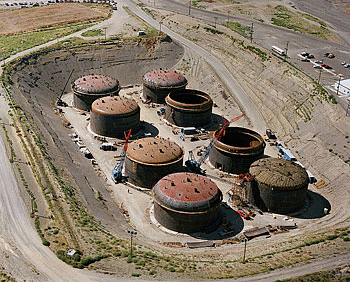
Soaring costs but limited progress in cleanup of “scariest” nuclear sites https://www.salon.com/2019/05/18/soaring-costs-but-limited-progress-in-cleanup-of-scariest-nuclear-sites_partner/
The progress to clean up nuclear waste sites appears to be slowing down though still devouring billions of dollars, PHIL ZAHODIAKIN, MAY 18, 2019 THE PROGRESS OF A DEPARTMENT OF ENERGY PROGRAM TO CLEAN UP THE NATION’S MOST DANGEROUS NUCLEAR WASTE SITES APPEARS TO BE SLOWING DOWN EVEN THOUGH IT’S STILL DEVOURING BILLIONS OF DOLLARS.
That discouraging picture emerges in the latest report by the federal Government Accountability Office on the long-running cleanup effort. Launched in 1989, it was designed to clean up 107 sites engaged in research or production of enriched uranium or plutonium for making nuclear weapons.
Cleanup work at 91 of the Cold War-era sites is finished. But the remaining 16 pose the greatest health risks — especially those with underground storage tanks leaking highly radioactive waste.
Testifying last week before the House Subcommittee on Oversight and Investigations, a GAO official said that for reasons that are unclear, estimated cleanup costs at the 16 ”biggest and scariest sites” have increased by $214 billion despite the Department of Energy (DOE) spending $48 billion since 2011.
David C. Trimble, the GAO’s director for natural resources and the environment, said the soaring costs ”are getting worse as the growth in cleanup liabilities vastly outpaces [the DOE’s] ability to reduce them.”
DOE officials are trying to pin down the reasons for delays and cost overruns, Trimble said, “but they haven’t finished their ‘root cause’ analysis.”
Rep. Jan Schakowsky (D-Ill.) asked Trimble and Ann Marie White, director of the DOE’s Office of Environmental Management how they would “explain to the taxpayers this astonishing cost increase when the number of cleanup sites hasn’t changed.” White replied that the 56 million gallons of radioactive liquids and sludge in the underground tanks at the immense Hanford Nuclear Reservation in southeastern Washington are driving “much of the increase.”
But the GAO has cited other problems, too, including DOE providing Congress with inconsistent and misleading information. For example, Trimble said, legislation passed in 2011 required DOE to annually report on its funding needs, but the reports have been submitted in only two of the years since.
“So, what are [the taxpayers] buying for all this money?” Rep. Joseph P. Kennedy (D-Mass.) asked, observing that the latest estimate to complete the work at all 16 sites has reached $377 billion.
Rep. Ann M. Kuster (D-N.H.) pointed out that, besides costs, the risk of accidents or sabotage at the 16 sites only increases with time. And Trimble drew an analogy to a type of mortgage popular during the housing bubble of the early 2000s.
By spending billions to contain radioactive soil, water, and nuclear materials at their sites of origin without a path to completing cleanups, “There’s a danger that, at some point, the dynamic starts to look like an interest-only loan that doesn’t require you to pay down the principal amount of the loan,” Trimble said.
Trimble said he was encouraged by DOE’s willingness to accept management improvements recommended by GAO
But Ed Lyman, acting director of the nuclear safety project for the Union of Concerned Scientists, told Fair Warning that “GAO issues one report after another about DOE’s mismanagement of the nuclear cleanup program but the reports don’t seem to move the ball.”
Pointing out that the experiments to condense and vitrify (or turn into glass) the liquid wastes at Hanford and Savannah River, S.C., “have not been going well,” Lyman added that the long disposal delays leave the safety of the sites in a nether world of “borrowed time.”
Besides Hanford, where cleanup activities are expected to continue at least until 2070, and the Savannah River Nuclear Reservation, which will keep producing radioactive tritium during its cleanup, some of the other, major sites among the 16 left to clean up include the World War 2-era facility in Oak Ridge, Tenn.; and the gaseous diffusion plants in Piketon, Ohio and Paducah, Ky.: formerly principal source of enriched uranium.
Britain’s Committee on Climate Change calls for challenging climate action from government and community

Sussex Energy Group 17th May 2019 , Another climate report and another urgent call for action, along with a dizzying array of graphs and figures. The Committee on Climate Change (CCC), who advise the UK government on policies and planning for a low carbon economy, have produced their analysis and recommendations on how to stop UK’s contribution to global warming by 2050.
This follows the “Paris Agreement” signed in December 2015 where the UK, along with 196 other countries, agreed to reduce their nation’s greenhouse gas emissions in efforts to limit global warming to 1.5°C above pre-industrial levels.
The CCC’s excellent and thorough report makes for some tough reading; not for its 277 pages and plethora of statistics and figures, but for the scale of collective effort required. The benign-sounding estimate of costs – 1-2% of GDP – disguises the extent of system change and efforts required, not only of government and businesses, but households as well.
http://blogs.sussex.ac.uk/sussexenergygroup/2019/05/17/net-zero/
Iran’s top diplomat presses efforts to save nuclear deal
Concerns about a possible conflict have flared since the White House ordered warships and bombers to the region to counter an alleged, unexplained threat from Iran that has seen America order nonessential diplomatic staff out of Iraq……
mposing sanctions while seeking talks is like “pointing a gun at someone and demanding friendship,” said Iranian Gen. Rasool Sanaeirad, according to the semi-official Mehr news agency.
That comment was echoed by Majid Takht-e Ravanchi, Iran’s ambassador to the United Nations.
“They want to have the stick in their hands, trying to intimidate Iran at the same time calling for a dialogue,” Ravanchi told CBS. “What type of dialogue is this?”…..https://www.apnews.com/04eabdee60dc4a399b22a2c6a5f0c672
Scotland stepped up its response to the Climate Emergency
Business Green 17th May 2019 Scotland stepped up its response to the ‘climate emergency’ earlier this
week as Glasgow and Edinburgh adopted zero-carbon targets in swift
succession and the Scottish Parliament provided further details on how it
plans to meet its new target of building a net zero emission economy by
2045.
ScottishPower pledged on Monday to help make Glasgow the first UK
city to reach net-zero carbon emissions, setting a target for meeting the
goal of 2045. In related news, SSE announced this week that the last of 84
offshore wind turbines was commissioned this week at Beatrice, Scotland’s
largest offshore wind farm. The company said the project – which is a joint venture development led by SSE Renewables, Copenhagen InfrastructurePartners and Red Rock Power Limited – has been completed on time and under
budget after three years of construction. The final 7MW Siemens Gamesa
turbine was installed in the Outer Moray Firth, around 13km off the coast
of Caithness, bringing the site’s total installed capacity to 588MW –
enough to provide clean, low carbon energy to over 450,000 homes.
British climate activists urge ad industry to use its power for good
Extinction Rebellion urges ad industry to use its power for good, Guardian, Seth Jacobson, 19 May 2019 Letter to senior figures urges them to use their power to influence public opinion on climate change Environmental activists Extinction Rebellion have turned their fire on the advertising industry in a public letter, encouraging it to use its expertise in manipulating public opinion for good or risk mass public protests against it.
Speaking to the Guardian, one of the authors of the letter, which was written by Extinction Rebellion members with decades of experience of the advertising industry, said the group was not “singling out advertising, as we previously disrupted fashion week and are systematically challenging all industries who have the platform, influence and skills to tackle this epoch-defining crisis but are failing to do so in any meaningful way”.
“Though our letter is addressed to the boardroom, we ask everyone within the industry to ‘Tell the Truth’ about the climate and ecological emergency,” he continued. “This is the first of Extinction Rebellion’s demands, to business and governments; the vital step required to wake everyone up and drive action to deal with this crisis……. https://www.theguardian.com/environment/2019/may/19/extinction-rebellion-urges-ad-industry-to-use-its-power-for-good
Comment from USA on Australia’s election result
Trrump is doing it here. I hope people will act.
Jeffrey St. Clair, an old time antinuclear advocate, now says the nuclear issue is more serious, than the climate issue. It is in America for sure.
The northern midwest, has been flooding around several nuclear reactors in Minnesota, Nebraska, and Iowa where there are nuclear reactors. Many close calls this spring . The ground there is saturated with water.
The same for the south. Texas, Louisiana, Tennessee. 5 feet of water in Houston. Small towns wiped out, all the way to the STP reactor on the coast of Texas.
Hurricane season is starting . Many places with reactors have flooded with high and have high, geound saturation levels. Trump and Perry have gutted supervision, of reactors in the USA. A fukushima event or two here, will effect the whole world. It will effect australia too.
USA community resists federal govt’s plan for a radioactive waste dump
This Town Didn’t Want to Be a Radioactive Waste Dump. The Government Is Giving Them No Choice. Earther, Yessenia Funes , 17 May 19,PIKETON, OHIO—David and Pam Mills have grown tomatoes, peppers, cucumbers, and okra on their secluded Appalachian property for about 18 years now. This will be the first year the retired couple doesn’t. They just can’t trust their soil anymore. Not with what’s being built barely a five-minute walk away.Past the shed and through the gray, bare trees that grow in the backyard, bulldozers and dump trucks are busy scooping tan-colored dirt atop an overlooking hill on a brisk January afternoon. They’re constructing a 100-acre landfill for radioactive waste. …..On a short metal fence marking where the Mills property ends, a sign reads, “U.S. PROPERTY, NO TRESPASSING,” in big, bold letters with red, white, and blue borders.
The landfill—or “on-site waste disposal cell,” as the department calls it—would extend about 60-feet down and house 2 million tons of low-level radioactive waste comprised of soil, asbestos, concrete, and debris. It’ll be outfitted with a clay liner, a plastic cover layer, and a treatment system for any water that leaches through it. When finished, it will be one of the largest nuclear waste dumps east of the Mississippi.
“It’s gonna contaminate everything,” David says, after he shows me how close the landfill sits to his property. “It’s just a matter of time.”
A lot of community members worry that the town will continue to be impoverished and devoid of business opportunities so long as it’s home to the landfill. Who’s going to want to invest in a place that’s a nuclear dumpsite?
And Piketon officials don’t trust the DOE at all. Neither does the plant’s former chief scientist, David Manuta, who worked there for nearly 11 years and has seen firsthand the operations that went on.
As the Ferguson Group points out in its analysis, fractures deeper than 20 feet exist throughout the entirety of where the landfill will be built, with some reaching as deep as 70 feet.
Regardless of whether the DOE is concerned, the evidence suggests demolition of the plant and construction of the landfill may already be spreading some contaminants via the air. Add in the threat of the landfill impacting groundwater, and opponents see several additional health risks in a regional already overburdened by cancer.
Jeanie Williams, a 63-year-old who’s lived in a spacious trailer home since 1972 right alongside the plant—not far from where the Mills live—knows that statistic all too personally. Cancer took Williams’ brother in 1999. Her dad worked at the plant and died of lung disease about 10 years ago. Her stepfather worked there and died last year from cancer. Her daughter is battling colon cancer. https://earther.gizmodo.com/this-town-didnt-want-to-be-a-radioactive-waste-dump-th-1834789264?IR=T
Women excluded, disparaged, in the “priesthood” that runs nuclear security

| The Nuclear Weapons Sisterhood, It’s hard for women to be hired, promoted or taken seriously in the national security establishment. NYT, By Carol Giacomo, Ms. Giacomo is a member of the editorial board, May 15, 2019 In the mid-1990s, Laura Holgate, then a senior Defense Department official, was in Moscow leading a delegation to discuss ways the United States could help the Russians secure plutonium from dismantled nuclear weapons.
After a male Russian official gave a confusing explanation about the Kremlin’s storage plans, she sought clarification. The Russian, his voice dripping with sarcasm, offered to “put this in terms a woman would understand” and then described loading plutonium into a “cooking pot and putting a lid on it.” ……. For women, people of color and transgender people, sexism, discrimination and harassment are often barriers to being hired, promoted or taken seriously in the national security bureaucracy — overseas and at home. …….Women are particularly underrepresented in senior positions dealing with nuclear issues, according to a study by New America, part of a growing effort involving various groups and individuals to make the fields more welcoming to women. Part of the problem is the discipline itself, the study found. Policies involving the building, deployment, targeting and use of nuclear weapons have long been the province of an insular, innovation-averse group of men. Discussions by this “priesthood” conflate national security and manliness with sexualized jargon about vertical erector launchers and thrust-to-weight ratios. The demand for nuclear orthodoxy has excluded outsiders, particularly women, placing them in a “consensual straitjacket” of conformity in a male-dominated world. Just consider Donald Regan, the former White House chief of staff, who before President Ronald Reagan’s summit with Mikhail Gorbachev in 1987 said women were “not going to understand throw-weights” or other national security issues raised at the meeting. The numbers show how this order became so entrenched. From the 1970s to 2019, the study found, women held 11 of 68 of senior positions dealing with nuclear weapons, arms control and nonproliferation at the State Department, 13 of 109 of these jobs at the now-defunct Arms Control and Disarmament Agency, five of 63 at the Defense Department, five of 36 at the Energy Department and two of 21 national security adviser positions. …… o be successful in these posts so critical to national security, women pay a “gender tax,” performing “the constant mental and emotional calculus that comes with implicit sexism; explicit sexism and discrimination; gender and sexual harassment; and gendered expectations,” according to the New America study, based on interviews with 23 women who held senior government positions. Nearly all of the 23 said they were harassed or saw others harassed, and when a foreign official was involved, the stress was magnified because it could cause an international incident. During a round-table discussion with Global Politico in 2017, Laura Rosenberger, who spent 11 years at the State Department and the National Security Council, talked about wearing more pantsuits and baggier tops as a defense mechanism “to make myself seem less attractive in the workplace.”
To encourage progress, Pamela Hamamoto, who served as United States ambassador to the United Nations in Geneva, began a program called Gender Champions to identify international leaders committed to advancing women, and Ms. Holgate, a former United States ambassador to the United Nations in Vienna, replicated it in the United States. …..https://www.nytimes.com/2019/05/15/opinion/women-national-security.html |
If America launched a nuclear war -335 Million Dead, and that’s only in the immediate attack
Overall, an all-out U.S. attack on the Soviet Union, China and satellite countries in 1962 would have killed 335 million people within the first seventy-two hours.
As devastating as these projections are, all readily admit they don’t tell the entire story. While these three studies model the immediate effects of a nuclear attack, long-term problems might kill more people than the attack itself. The destruction of cities would deny the millions of injured, even those who might otherwise easily survive, even basic health care. What remains of government—in any country—would be hard pressed to maintain order in the face of dwindling food and energy supplies, a contaminated landscape, the spread of disease and masses of refugees.
While the threat of nuclear war between the United States and Soviet Union has ended, the United States now faces the prospect of a similar war with Russia or China. The effects of a nuclear war in the twenty-first century would be no less severe. The steps to avoiding nuclear war, however, are the same as they were during the Cold War: arms control, confidence-building measures undertaken by both sides and a de-escalation of tensions.
 335 Million Dead: If America Launched an All-Out Nuclear War https://nationalinterest.org/blog/buzz/335-million-dead-if-america-launched-all-out-nuclear-war-57262 “Under SIOP, “about 1,000” installations that were related to “nuclear delivery capability” would be struck.” major draw of U.S. nuclear weapons to Soviet cities would have also been the presence of local airports, which would have functioned as dispersal airfields for nuclear-armed bombers. On the other hand, the Soviet attack would largely hit ICBM fields and bomber bases in low-population-density regions of the Midwest, plus a handful of submarine bases on both coasts.
It is no exaggeration to say that for those who grew up during the Cold War, all-out nuclear war was “the ultimate nightmare.” The prospect of an ordinary day interrupted by air-raid sirens, klaxons and the searing heat of a thermonuclear explosion was a very real, albeit remote, possibility. Television shows such as The Day After and Threadsrealistically portrayed both a nuclear attack and the gradual disintegration of society in the aftermath. In an all-out nuclear attack, most of the industrialized world would have been bombed back to the Stone Age, with hundreds of millions killed outright and perhaps as many as a billion or more dying of radiation, disease and famine in the postwar period.
During much of the Cold War, the United States’ nuclear warfighting plan was known as the SIOP, or the Single Integrated Operating Plan. The first SIOP, introduced in 1962, was known as SIOP-62, and its effects on the Soviet Union, Warsaw Pact and China were documented in a briefing paper created for the Joint Chiefs of Staff and brought to light in 2011 by the National Security Archive. The paper presupposed a new Berlin crisis, similar to the one that took place in 1961, but escalating to full-scale war in western Europe.
Although the war scenario was fictional, the post-attack estimates were very real. According to the paper, the outlook for Communist bloc countries subjected to the full weight of American atomic firepower was grim. The paper divided attack scenarios into two categories: one in which the U.S. nuclear Alert Force, a percentage of overall nuclear forces kept on constant alert, struck the Soviet Union and its allies; and a second scenario where the full weight of the nuclear force, known as the Full Force, was used. Continue reading
1 This month

of the week – Australians for War Powers Reform (AWPR)
To see nuclear-related stories in greater depth and intensity
 Antinuclear