15 November REneweconomy news
-
 WA wind, solar industry in turmoil as green fund cements govt monopolySynergy’s new “green fund” will cement its near monopoly powers, and put up to $1bn of wind and solar developments at risk, industry warns.
 -
Rooftop solar changes unsettle industry, raising fears worse to comeConfusion over RET regulation changes has revealed large cracks in the faith of the renewable energy industry, which – still recovering from the Abbott years – is spooked by the National Energy Guarantee, and possible future policy changes, just as the market is hitting its stride.
-
Elon Musk: Tesla semi truck event will “blow your mind”Elon Musk tweets that the Tesla Semi Truck unveiling will “blow your mind clear out of your skull and into an alternate dimension.” Let’s see.
-
Carnegie jacks up CETO capacity in bid to take wave power mainstreamCarnegie boosts nominal capacity of CETO unit from 1MW to 1.5MW, in bid to make wave power cost competitive with mainstream renewables.
-
RCR preferred contractor for the Clermont and Woman solar farm projectsRCR is pleased to announce that it has been selected as the Preferred EPC Contractor for two major contracts, totalling approximately $260 million.
-
Hear from Leading Solar Researchers in Melbourne in December 2017The rate of change of progress is rapid and to stay current with the latest in technology developments and deployment, each year, Australia’s leading solar researchers get together in an annual conference, with international and regional colleagues.
-
Lincoln Gap may treble battery size, as wind and solar lead new eraLincoln Gap wind farm may treble amount of battery storage, as it seeks new formula to escape dominance of big energy retailers.
-
Even IEA says coal boom is dead, hails the solar ageEven the conservative IEA is calling the end of the coal era, and hailing new age of renewables as the world addresses climate, energy poverty and health.
-
Sungrow’s ESS system – PowCube4.8 LaunchSungrow presents its residential energy storage system (ESS) – the PowCube4.8.
13 November REneweconomy news
 RenewEconomy
-
Know your NEM: Queensland poll – what are the odds?Queensland energy politics has something for everyone – including a new coal plant – but bookmakers are backing the state Labor. Meanwhile, on the NEM…
-
Wind turbine collapse under investigation at Antarctic research centreOne of two wind turbines that help to power Australia’s Mawson research station in Antarctica has partially collapsed.
-
Sugar vs solar, round 2: 60MW Qld project stalls after opposition from cane farmersESCO Pacific’s proposed 60MW Mirani Solar Farm has failed to win approval from the local council, after strong opposition from local sugar can growers.
-
Climate change spurs Medibank fossil fuel divestmentMedibank’s announcement it will divest tens of millions of dollars from fossil fuels due to the ‘health effects of climate change’ has been welcomed by environmental finance group Market Forces.
-
South Australia’s new power plant ready before summerSouth Australia now has access to an additional 276 MW of electricity generation, with the state’s new power plant installed in time for the warmer summer months.
-
Wind farm researchers found to have no human ethics approvalA new research paper into the health impacts of wind farms has raised serious concerns over academic credibility.
-
Qld Labor ups ante on renewables – more ambition, new technologyLabor commits to “at least” 50% renewables by 2030, and promises $50m for first large scale solar tower and storage plant. Premier hails technologies that can power Queensland 24 hours a day, 7 days a week.
-
CWP proposes 250MW solar thermal + storage near TownsvilleCWP Renewables proposes 250MW solar tower and storage project near Townsville, while SolarReserve looking at six different projects in Queensland.
-
100% global renewable electricity more cost-effective than current systemMaking a global transition to 100% renewable electricity grid has long been a dream of many, and new research shows it is a viable reality.
-
NEG – behavior, details, details?The more we look at the NEG, the more bizarre it gets. And it seems disrespectful, or even arrogant, of the ESB to think an overnight thought bubble is going to be superior to carefully developed process in overseas markets.
-
Impact Investment Group appoints new CEO: Daniel MadhavanLeading Australian impact fund manager Impact Investment Group is proud to announce the appointment of Daniel Madhavan as Chief Executive Officer (CEO).
11 November REneweconomy news
-
Koutsantonis slams NEG, says it is an attack on renewablesSA energy minister Tom Koutsantonis says cannot support NEG, says it an attack on renewables, designed to keep alive dirty coal.
-
Graphs of the Day: Australia the global climate laggardIf the Turnbull government was setting the standard for global climate action… we’d be going to hell in a handcart, says new report.
-
Renewable energy for industry next big thing for Australia, says IEAInternational Energy Agency says solar, hydro and and wind have enormous potential for use in industrial processes – particularly in places like Australia, where the cost will be $USUS30/MWh.
-
Energy incumbents are going on a ‘gorging spree’Big fossil-fuel-based utilities are overcharging their customers, going on a “’gorging spree” while they still can.
-
Australia adds 107MW rooftop solar in October as 2017 heads for record yearCommercial solar growth helps push Australia’s total PV installs to 107MW in October, almost guaranteeing 1GW record for 2017.
10 November More REneweconomy news
-
We’ll keep lights on, states can worry about emissions: ESBESB chair Kerry Schott says it will be up to the states to act if they want higher emissions targets.
-
Schott defends NEG modelling, says wind and solar at “low end”Schott says NEG modelling assumes “low end” of wind and solar costs, defying recent evidence. But ESB did admit there is much work to do on policy, dispatchability had yet to be defined, new coal unlikely to get a look in, and states free to pursue own targets.
-
Queensland coal plant has a photo – now all it needs is a massive subsidyA mock-up image of a new coal plant has been created, as part of the increasingly intense campaign to have one built – and funded by taxpayers – in north Queensland.
-
Video of the Day: The end of coal generation in South AustraliaBoilers of old Northern coal fired generator brought down, bringing end of coal era in South Australia and paving way for huge investment in renewables and storage.
-
DP Energy appoints contractors to build Australia’s largest hybrid renewable power stationInternational renewable energy company DP Energy has appointed preferred suppliers Vestas and Downer to develop Stage 1 of its Port Augusta Renewable Energy Park, which when complete will be Australia’s largest hybrid renewable power station
-
JinkoSolar claims record 23.5% efficiency for PERC solar cellJinko sets new efficiency record for PERC solar cell and sees big future in “half cell” modules.
-
10 Nov REneweconomy news
RenewEconomy-
We need to talk about rooftop solarSo you’ve installed rooftop solar – but is it performing as well as you expected? A new APVI web-based survey aims to help improve the quality of PV system components, installations and system designs.
-
Flinders Island makes switch to renewables, with solar, wind and energy storage HubFlinders Island’s Hybrid Energy Hub is already taking the previously diesel powered Tasmanian island to levels of 80% renewables, and should manage to supply 100 per cent of demand before the year is out.
-
Chevy Bolt set to catch Tesla in US EV raceLuxury price tags have not stopped Tesla from dominating the US electric vehicle market so far, but is all that about to change?
-
WA’s Synergy to bring in Dutch fund to bankroll wind and solar farmsWA government owned utility Synergy looking to bring in outside investors to bankroll investments in new wind and solar farms and meet RET obligations.
-
Wind, solar costs continue fall, and fossil fuels can’t stop themLatest analysis from Lazard points to continuing falls in cost of wind and solar, and a growing divide between renewables and fossil fuels. And the cost of storage is falling too.
-
You heard right: Trump administration is bailing out coal plantsConsumers paying more on electric bills is exactly what might happen if the US DoE goes through with plan to bail out uneconomic coal plants.
-
Photon Energy reports a profitable third quarterBuilding on the strong half-year results, the company confirmed continuing revenue growth at 6.8% compared to 2016Q3 and a 2,5-fold increase in net profit compared to last year’s result.
-
Australia wins early Fossil award as Syria leaves US alone on climateAustralia wins first Fossil of the Day award at Bonn climate talks, as Syria signs up to leave the US isolated as the world’s only non-member state.
Decentralised energy solutions looking better than centralised
Will Tasmania be the ‘battery of the nation’? http://reneweconomy.com.au/will-tasmania-battery-nation-43911/ By Jack Gilding on 7 November 2017 Lately we have been subjected to Prime-ministerial statements on energy policy that jump from Snowy 2.0 to propping up aged coal-fired power stations in NSW, to government support for a new “clean” coal power station in Queensland and back to pumped hydro in Tasmania. Long term strategy seems to have gone missing.
The latest announcement is a feasibility study of pumped hydro in Tasmania supported by ARENA.
Is investing in Tasmania as the ‘battery of the nation’ likely to be a sensible idea?
Tasmania itself doesn’t need more centralised energy storage. At full capacity, our dams hold more than a year’s supply of electricity. Tasmania’s problem is lack of renewable generation, which leaves our energy security dependent on imports from Victoria and increasingly expensive gas fired electricity.
The mainland grid would certainly benefit from more large scale renewable generation backed by storage. Implementing this would require both a bipartisan consensus on closing down aged coal infrastructure and a long term policy in support of low emission renewable energy.
Pumped hydro is the most cost-effective form of large scale energy storage but it requires a stable investment climate, and in some locations, significant investment in transmission infrastructure.
Snowy 2.0 does have the advantage of being well connected to the NSW and Victorian grids. If the national battery is located in Tasmania it would require a billion dollar second interconnector to the mainland.
The sorts of big national project preferred by politicians are not the only solution. Our electricity system is rapidly moving from centralised energy generation to distributed generation and storage.
CSIRO and the Australian electricity network operators have developed one of the most credible scenarios for the future of the grid.
It anticipates that by 2050, 30-45% of our electricity would come from customer owned generators. The plan identifies the need for incentives to ensure that customer battery systems provide benefits to the network as well as to customers.
A recent ANU study has identified 22,000 potential sites for off-river pumped storage around Australia in a range of sizes. Only a few of these are likely to provide viable but they offer possible advantages in being smaller investments that can address local requirements and reduce rather than increase the need for network enhancements.
If there is a role for large scale pumped hydro storage, is Tasmania likely to be the most cost effective place to build it?
As Everett Dirksen never actually said, “A billion here, a billion there, pretty soon, you’re talking real money”. At over $1bn for a second interconnector, $2bn for a 600 MW wind farm on King Island or over $1bn for the Robbins Island and Jim’s Plain wind farms, and Hydro Tasmania’s estimate of $5bn to build 2500 MW of pumped storage, we are talking ‘real money’.
And it is ultimately our money, whether the infrastructure is built as a regulated asset (added to our electricity bill), by government grant (our taxes) or by private investment (including our super).
Investments on this scale take the best part of a decade to plan, fund and build, and are paid for by users over a 40 year period or more.
We need to be very sure that this is the most cost effective way to meet our energy security in an electricity market where the significant trends are to increased energy efficiency, local generation and storage, and demand management.
The detailed analysis of pumped hydro funded by Hydro Tasmania and ARENA will be a welcome contribution to the public debate. But big schemes may well have had their day.
Hydro Tasmania dropped work on the King Island project and the Tamblyn report on the viability of a second interconnector was lukewarm on its viability to say the least.
My prediction is that the market will have provided decentralised solutions to the challenge of reliable, affordable clean electricity long before these big schemes see the light of day. The flurry of announcements and feasibility studies mainly serves to convince the public that the politicians are dealing with the problem.
Jack Gilding is the Executive Officer of the Tasmanian Renewable Energy Alliance but the views in this article are entirely personal. This article first appeared in The Mercury and is republished here with permission of the author,
8 November REneweconomy news
-
Will Tasmania be the ‘battery of the nation’?Tasmania itself doesn’t need more centralised energy storage. Tasmania’s problem is lack of renewable generation.
-
Chile solar auction sets new record low for solar PVChile energy auction attracts record low bid for solar, with average prices for renewables down 75% since its first auction in 2015.
-
Is this the end for big wind and big solar in Australia?All eyes are on Victoria and the corporate sector for the future of large-scale renewables in Australia. With the renewable energy target now largely met, there is little else on offer for the pipeline of 20GW of wind and solar projects.
-
Graphs of the Day: A really bad day for so-called “reliable” coalMultiple fault with multiple coal generators on Monday highlight the perils of relying on “baseload” coal to keep the lights on.
-
Understanding the “Emissions Gap” in 5 ChartsFive charts that help explain the 2017 emissions gap report from UNEP.
-
Five things that should happen at the Bonn climate talks but probably won’tThis year’s climate talks in Bonn is not expected to be a deal-clinching, make-or-break one like Paris in 2015 or Copenhagen in 2009, but that doesn’t make it insignificant.
-
Albany Wave Energy Project activities underwayCarnegie Clean Energy has now commenced the Albany project design and development activities.
The world is watching South Australia’s record consumer-powered electricity grid
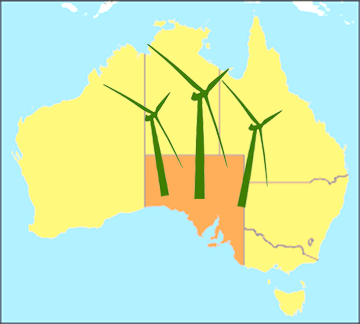 “South Australia gets half of its electricity from wind and solar …. and they are
 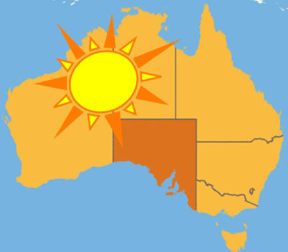 in the process of overcoming their problems and making systems of high penetration of renewables work,” Garnaut said. That is of international interest.”
Battery storage will also play an interesting role. South Australia has the Tesla big battery under construction – and due to be in operation in three weeks – as well as two other grid-scale batteries at Wattle Point wind farm, and proposed for Whyalla.
 South Australia’s stunning transition to consumer-powered grid http://reneweconomy.com.au/south-australias-stunning-transition-to-consumer-powered-grid-20463/ [good graphs] By Giles Parkinson on 6 November 2017 South Australia is already being hailed – or in some quarters demonised – for its leadership on renewable energy technology. But a new report from the Australian Energy Market Operator highlights how far out front it is in the tradition to a consumer-powered grid.
The new AEMO report highlights that 9.2 per cent of the electricity generated in the state over the last financial year came from small-scale (sub 100kW) of solar PV on the rooftops of households and businesses in the state.
That level of rooftop solar penetration is a record for any major grid in the world, and the contribution of rooftop solar is likely to have been well over 10 per cent in the last year when larger rooftop solar installations of more than 100kW are included.
The total will likely at least double over the next 10 years – according to AEMO forecasts – to more than 20 per cent, at which time rooftop solar will be pushing “minimum demand” from the grid to zero on occasions.
It’s already having an impact. As we report here, rooftop PV sent grid demand to a new record low of 554MW on Sunday, just six weeks after a previous low – which had in turn beaten the earlier low set a week earlier than that by nearly 25 per cent.
It’s a taste of what is to come. Major studies by the likes of the CSIRO and the networks association predict that by 2050, half of all demand will be met by what they describe as “distributed generation” – a mix of rooftop solar, battery storage, and “localised” generation.
This represents a major shift from the recent and current state of the industry from centralised energy controlled by major corporations, to local supply and demand – leading to new players and new business models.
But in South Australia – as is the case with so much of the energy transition – it could come quicker than that. By 2025/26, AEMO says rooftop solar could generate 2,500GWh a year. That would be around 22 per cent of total demand in the state.
Add in the proposals by the Liberty OneSteel, the new owners of the Whyalla steelworks, and more than one third of the state’s demand could be met by such distributed solar, and possibly up to half if its plans for 600MW of solar – for itself and other business users – comes to fruition. Continue reading
Australian Institute of Company Directors finds that corporate leaders want renewable energy growth
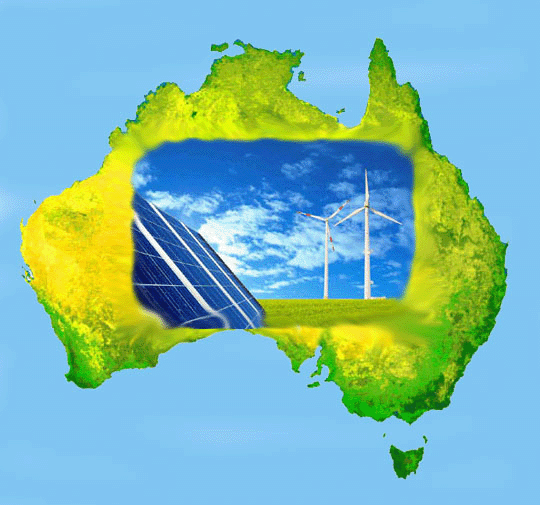 What Australia’s corporate leaders really think about renewable energy https://arena.gov.au/blog/company-directors/ @DanielSilkstone 6 Nov 17, Renewable energy is so hot right now.
That’s the key message that emerges from a new study of corporate Australia, undertaken by the Australian Institute of Company Directors.
The Director Sentiment Index, released twice each year, maps the thoughts and priorities of the nation’s company directors. It provides an excellent window into the issues and concerns that are cropping up in boardrooms around the country.
There has been plenty of speculation in recent times about whether the political disagreement that has sometimes accompanied debates around the nation’s energy needs was acting as a handbrake on investment.
But the survey makes clear that the nation’s corporate leaders both want and expect the growth of renewable energy to continue. Continue reading
Record low electricity demand in South Australia, due to rooftop solar
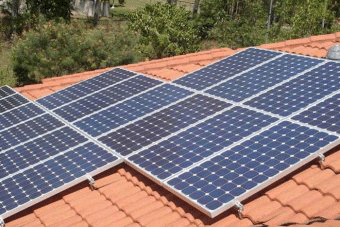
 Rooftop solar pushes South Australia to record low demand (again) http://reneweconomy.com.au/rooftop-solar-pushes-south-australia-to-record-low-demand-again-47836/By Giles Parkinson on 6 November 2017
The combination of growing rooftop solar installations, mild temperatures and sunny weather has pushed South Australia’s grid demand to yet another record low, this time shaving around 6 per cent off the previous low set just six weeks ago.
The new low was set just before 1.30pm in South Australia (just before 2pm on National Electricity Market time) when the minimum grid demand hit 554MW.
This shaved some 33MW off the previous low of 587MW set on September 17,which itself was nearly 200MW or 25 per cent the previous record low demand of 786MW set just a week earlier.
For six hours, according to the APVI solar map, rooftop solar PV provided more than 30 per cent of the state’s demand. For nearly three hours, rooftop solar provided more than 40 per cent of the state’s demand. As we explore in this article here, rooftop solar provided 9.2 per cent of the state’s local generation in 2016/17 and would likely be more than 10 per cent if larger rooftop solar installations were included.
Within a decade, that share is expected to double to more than 20 per cent, at which times on days like this Sunday, minimum demand may actually fall to zero because of the amount of solar being generated.
The Australian Energy Market Operator, which includes these forecasts in a new report into the South Australia grid, suggests that by that time it will be necessary to store some of that excess solar for use later in the day.
The same situation may occur in West Australia, too, because of the amount of rooftop solar being installed in a small grid. The uptake of rooftop solar is accelerating because of high grid prices and the falling cost of solar technology, and grid demand fell in W.A. to an 8-year low last week.
“At these times, South Australia could store or export its excess generation to the rest of the NEM via the interconnectors, provided they are in service,” AEMO notes in its report.
“This, in turn, will provide market participants with greater opportunity to manage their energy use.”
AEMO noted, as it has previously, that South Australia is the first region in the NEM in which high rooftop PV penetration has caused minimum demand to shift from overnight to near midday – a transition that occurred five years ago.
Many argue this is a good reason to shift the “controlled load” of electric hot water systems from the night-time to the mid-day hours, particularly since the closure of the coal fired generators which could not be switched off at night and needed something to power during the night time.
However, problems with the nature of the metering, and the potential expense of the shift, are barriers to the migration of hot water systems to the day-time hours.
6 November More REneweconomy news
RenewEconomy-
New solar investment fund seeks up to $300 million in ASX listingNew Energy Solar is hoping to bankroll big solar buy up in US, and Australia and other markets, with $300m IPO.
-
South Australia’s stunning transition to consumer-powered gridRooftop solar expected to provide more than 20% of local generation by 2025, ushering in transition to consumer focused grid in South Australia. Meanwhile, S.A. begins to benefit from renewables, with prices so far in 2017/18 lower than coal-dominated Victoria and NSW.
-
China wind giant buys 100MW wind project in NSWBeijing Jingneng Clean Energy adds Biala wind farm, approved for development in NSW Southern Tablelands, to growing Australian portfolio.
-
Garnaut says NEG may do little for prices, certainty or competitionGarnaut says proposed National Energy Guarantee may fail on price reductions, emissions, and reliability, and may serve to simply reinforce the power of the big energy incumbents.
-
Council approves 350MW PV farm, stage 1of massive solar and storage hubFirst phase of 1GW+ solar and battery storage hub in Gympie approved for development by local council.
-
Germany’s solar, wind generation hits high in OctoberPV and wind power systems generated 15 billion kWh of electricity in Germany in October, with renewables accounting for 44.1% of demand
-
Bonn voyage: climate diplomats head into another round of talksAt the Bonn climate talks that start today, Australia will cop some flak for its lack of reductions ambition, and action.
6 November REneweconomy news
RenewEconomy-
Defence seeks 12.5MW solar for Darwin barracks, RAAF baseDefence department seeks 15.5MW of solar for Darwin barracks, RAAF base to cut energy costs and boost energy security. More are planned.
-
Know your NEM: NEG’s windfall for big three power utilitiesThe proposed NEG is already delivering big gains for the big three gentailers, as Adani emerges as major Queensland issue, and REC prices fall.
-
Future-driven show heads to clean-energy hub AdelaideThe Australian Energy Storage Conference and Exhibition (AES 2018) is heading to the nation’s clean-energy leader, Adelaide, in 2018. Registrations to exhibit and sponsor are now open.
-
Rooftop solar pushes South Australia to record low demand (again)Rooftop solar – along with sunny weather and mild temperatures – push grid demand in South Australia to yet another record low.
-
Herbert Smith Freehills advises New Energy Solar on its ASX listing and A$300 million public offeringThe IPO is expected to be priced at between A$1.45 and A$1.55 per stapled security, which will raise between A$100 million and A$300 million for a projected market capitalisation of between A$387.4 million and A$587.4 million.
-
Redflow aims for 250 batteries per month from ThailandASX-listed Redflow announced last month that it has started installing battery production equipment at its new factory in Thailand, putting it on track to commence initial operation by the end of this year.
4 November REneweconomy news
- ABB microgrid technology to power Robben Island
-
Microgrid and wireless technologies will integrate renewable solar energy and reduce the use of fossil fuels to power World Heritage Site in South Africa.
-
Ausgrid turns to rooftop solar to save on network costsAusgrid offers big incentives for rooftop solar in Sydney, so it can save on network costs. It’s a welcome change from the usual narrative about how rooftop solar is a burden to networks and consumers. Are battery storage and micro-grids next?
-
Australia among the world’s worst on biodiversity conservationAustralia is among the top seven countries worldwide responsible for 60% of the world’s biodiversity loss between 1996 and 2008, according to a study published last week in the journal Nature.
-
Rooftop solar installer caught out for fraudulent STC creationClean energy regulator takes action against solar company found to have installed rooftop PV systems without compliant Certificates of Electrical Safety.
-
Oil Search’s Alaskan oil play ignores climate realityJust days out from the start of the latest climate talks, PNG-based Oil Search has delivered a slap in the face to its Pacific neighbours.
-
Is your company disclosing its climate risk?Investors and activists have new ammunition to encourage public company disclosures on climate change risks and opportunities. They should use them.
-
Swan Hill solar farm secures debt funding to go “merchant”Impact Investment Group secures $16.5m from specialist outfit Infradebt for 19MW merchant solar farm in northern Victoria.
Clean Energy Finance Corporation triples investment in renewable projects to $2 billion
 CEFC triples investment in renewable projects to $2bn, http://www.theage.com.au/business/energy/cefc-triples-investment-in-renewable-projects-to-2bn-20171102-gzd8uf.htmlThe Age, Cole Latimer,
 The CEFC, in its annual report, said it had invested more than $2 billion in new capital to support renewable energy projects valued at more than $6.5 billion. Over the previous two years, the CEFC had only committed $1.32 billion in total.
Its total portfolio of investments now sits at $3.4 billion.
The CEFC said for every dollar it had invested in a project it helped to leverage an additional $2.10 from the private sector.
As well as investing in renewable energy projects, the group announced funding for a lithium mine, tapping into the growing demand for the metal that supplies rechargeable batteries.
CEFC’s projects are forecast to produce an annual abatement of nearly 7.3 million tonnes of carbon dioxide equivalent, or more than 121 million tonnes of CO2-e over its projects’ lifetimes.
The investments have had a positive yield for the nation beyond decarbonisation, CEFC chief executive Ian Learmonth said.
“Our $3.4 billion portfolio of investment commitments had a forecast lifetime investment yield of more than 5 per cent,” he said.
In the future, the Clean Energy Finance Corporation said it would invest in distributed energy, energy storage, improved grid transmission, network security and demand-response management.
The CEFC’s pipelines of investment has more than doubled since it began in 2014.
“This growth reflects increased interest in clean energy investment, coupled with a broader understanding of the role of the CEFC in working with investors and project developers,” the company said in its annual report.
3 November: More REneweconomy news
RenewEconomy-
ESB to use inflated costs for wind and solar to justify NEGEnergy Security Board to use vastly inflated costs of wind and solar to justify its National Energy Guarantee. By using prices around 30-40 per cent above actual costs, will support its argument for little new wind and solar to be built in the coming decade.
-
Lets be honest: Australia is well behind on renewablesAustralia’s fossil fuel share of electricity generation is higher than that of our peers. This chart is ugly for Australians who care about doing our bit in the 21st century.
-
RES drops 758MW wind farm proposal, amid Victoria boomAnti-wind resistance appears to win the day as RES Australia confirms Penshurst Wind Farm no longer an ongoing development opportunity.
-
NE: A rushed job that takes us backwards, not forwardsNational Energy Guarantee appears to be a plan to get through the Coalition Party Room, and then a plan to have a plan. Unfortunately, that means many more months of uncertainty.
-
Musk says Tesla big battery now more than 80% completeElon Musk says Tesla big battery in South Australia now more than 80% complete, but even bigger storage installations likely to follow.
-
Tesla falls behind on Model 3 production, burns cash at record rateProduction line “bottlenecks” at Tesla’s Nevada Gigafactory push Model 3 delivery target out 3 months. Musk says, “we’ve got it covered.”
-
China contractors and finance may help Adani’s mega coal mineThe potential involvement of China state-owned contractors and financiers may help Adani in its push for the mega coal mine in Queensland.
-
Rejected teenagers: the trend of closing young coal plantsIt’s not just old coal power plants that are being closed down. In Italy, the US, and the Netherlands, coal plants that are barely teenagers are being targeted for closure.
1 This month
Chernobyl: The Lost Tapes – A good documentary on Chernobyl on SBS available On Demand for the next 3 weeks– https://www.sbs.com.au/ondemand/tv-program/chernobyl-the-lost-tapes/2352741955560
15 April – Zoom –Nuclear Power is Not the Solution
Apr 15, 2026 01:00 AM in Canberra, Melbourne, Sydney

Join the International Physicians for the Prevention of Nuclear War (IPPNW) on Tuesday, April 14th for a timely webinar exploring the risks associated with nuclear power and challenging the myth that it offers a simple, safe, carbon-free solution to the climate crisis

21 April Webinar: No Nuclear Weapons in Australia
Start: 2026-04-21 18:00:00 UTC Canberra, Melbourne, Sydney (GMT+10:00)
End: 2026-04-21 19:30:00 UTC Canberra, Melbourne, Sydney (GMT+10:00)
Event Type: Virtual
A virtual link will be communicated before the event.
Host Contact Info: australia@icanw.org

of the week – Australians for War Powers Reform (AWPR)
To see nuclear-related stories in greater depth and intensity
 Antinuclear