Power bills to fall by $40 as New South Wales Central West becomes wind and solar power hub,
|
Power bills to fall by $40 as Central West becomes wind and solar power hub, Central West Daily News, David Fitzsimons 26 Nov 19
The Central West will become the focus of wind and solar energy generation in NSW under a state government plan that would see 450 construction jobs created and household electricity bills cut by $40 a year. Energy Minister Matt Kean said Australia’s first Renewable Energy Zone would be developed in the Central West over the next few years. Mr Kean said the 3000 megawatt pilot program was aimed at attracting up to $4.4 billion in private sector investment into the region for clean energy generation…….
The Central West project is the first of three planned for NSW as part of the NSW Electricity Strategy which was unveiled by Mr Kean. It said the Central West was chosen for the pilot because it has “significant existing investment and investor interest.”…… https://www.centralwesterndaily.com.au/story/6508798/power-bills-to-drop-by-40-as-central-west-becomes-hub-for-wind-and-solar-power/?fbclid=IwAR0WqMLLb5ODbAA0EU-h8VPtnfVoU8PYrvFIEhNhuTeOVKunqnhR4f3PWms |
|
|
Former PM Kevin Rudd says Assange faces ‘unacceptable’ and ‘disproportionate’ punishment
Rudd says Assange faces ‘unacceptable’ and ‘disproportionate’ punishment https://www.theage.com.au/politics/federal/rudd-says-assange-faces-unacceptable-and-disproportionate-punishment-20191125-p53duj.html By Rob Harris, Kevin Rudd says Julian Assange would pay an “unacceptable” and “disproportionate” price if he is extradited to the United States, arguing the WikiLeaks founder should not take the fall for Washington’s failures to secure its own classified documents.
In a significant intervention into Mr Assange’s extradition fight, the former Australian prime minister said US prosecutors had not made any specific allegations that anyone was seriously harmed as a consequence of the release of highly classified documents relating to the Iraq and Afghanistan wars in 2010.
The Morrison government is resisting a rising tide of demands to intervene in the case of the 48-year-old Australian citizen, as his supporters grow increasingly concerned over his deteriorating health in a British prison.
Mr Rudd, himself targeted in WikiLeaks’ publication of more than 250,000 leaked diplomatic cables nine years ago, said while he had “serious reservations” about Mr Assange’s character and conduct, he did not believe he should be extradited to face an “effective life sentence” in the US.
In a letter to the Bring Julian Assange Home Queensland Network, seen by The Age and The Sydney Morning Herald, Mr Rudd said he could not see the difference between Mr Assange and the editors of many American media outlets that reported the material he had provided them.
“If [the US prosecutors’] case is essentially that Mr Assange broke the law by obtaining and disclosing secret information, then I struggle to see what separates him from any journalist who solicits, obtains and publishes such information,” Mr Rudd wrote.
“In other words, why should Mr Assange be tried, convicted and incarcerated while those who publicly released the information are afforded protection under provisions of the US constitution concerning press freedom?”
The group was briefed by barrister Jen Robinson, a member of Mr Assange’s London legal team, as well as Greg Barns from the Australian Assange Campaign and human rights and due process advocate Aloysia Brooks.
Mr Rudd said he was “deeply opposed” to the leaking of classified diplomatic or intelligence communications, which needed to be protected to maintain Australia’s national security interests and that of its allies.
“Ultimate responsibility for keeping sensitive information secure rests with governments. The United States government demonstrably failed to effectively secure the classified documents relevant to this case,” he wrote.
“The result was the mass leaking of sensitive diplomatic cables, including some that caused me some political discomfort at the time. However, an effective life sentence is an unacceptable and disproportionate price to pay. I would therefore oppose his extradition.”
More than 60 doctors from the United Kingdom, Australia, Europe and Sri Lanka, wrote to British Home Secretary Priti Patel on Monday asserting that Mr Assange urgently needs medical treatment at a university hospital.
The doctors said in a letter, distributed by WikiLeaks on Monday, that he was suffering from psychological problems including depression as well as dental issues and a serious shoulder ailment.
Mr Barns welcomed Mr Rudd’s intervention saying his comments, like his former colleague Bob Carr, rightly pointed to the threat to freedom of the media.
“The Australian government and all MPs we hope will place pressure on the US to make it understand that the treatment of an Australian citizen this way is not something that should happen,” Mr Barns said.
“Mr Rudd and Mr Carr could never be described as anti-Washington but they clearly understand the need for Canberra to take action to prevent this gross injustice.”
Mr Assange will return to court briefly next month before a full hearing of a US extradition request in which he faces a 175-year jail sentence if found guilty on 18 charges relating to computer fraud and obtaining and disclosing national defence information.
Religiosity of Scott Morrison – about global heating and bushfires
 Scott Morrison’s religion and the bushfire crisis https://independentaustralia.net/politics/politics-display/scott-morrisons-religion-and-the-bushfire-crisis,13344, By Jennifer Wilson | 25 November 2019, As firefighters in four Australian states struggled to contain unprecedented bushfires that threatened life, property and wildlife, Prime Minister Scott Morrison argued that there is no direct link with Australia’s greenhouse gas emissions.
Morrison claimed there is no “credible scientific evidence” that cutting our emissions could reduce the intensity of bushfires.
The Prime Minister even went so far as to suggest that we could
“… increase our emissions without making the current fire season worse.”
This last claim is a bizarre one to make, obviously calculated to appeal to a base that apparently doesn’t know very much about these matters. Yes, we likely could increase our emissions without impact on the current Australian bushfires. However, emissions must be accounted for on a global scale and, while central, are one part of the complex story of the impact of climate change.
Morrison was swiftly contradicted by Climate Council head of research Dr Martin Rice. Dr Rice stated that there is indeed a direct link between climate change and heightened bushfire risk. CSIRO research scientist Dr Pep Candell agreed with Dr Rice. Morrison did not cite any scientific research to back up his claim that the two are not linked, leaving the impression that it is little more than his opinion. If politicians do have evidence to back up their claims, they are not usually coy about revealing it.
It is well established by major science agencies that while climate change does not create fires it can and does make them worse. The above link is an excellent explainer of a complex situation.
It’s high time that any statement by Morrison on emissions and their effects on climate is required to include a disclaimer noting that the Prime Minister is a follower of the evangelical Pentecostal religion. This sect is not known for its interest in science, and some followers believe the Earth is only 6,000 years old.
As James Boyce wrote in his Monthly essay, ‘The Devil and Scott Morrison’:
Belief in Satan and the imminent return of Christ also helps explain the Prime Minister’s less-than-passionate response to the most pressing environmental issue of our time. It is not surprising that Pentecostal activism about climate change is non-existent — the end of the known world is not a matter for mere mortals to decide. When Morrison proudly showed off a piece of coal in parliament, there is no reason to doubt that he believed what he held in his hand was a gift from God.
Morrison also shares the Pentecostal belief in “divine providence” — that is, everything under the sun – past, present, and future – is the will of God, including natural disasters, such as we are currently experiencing in four states.
his goes some way to explaining why
… taking further action on reducing carbon emissions to counter the environmental damage wrought by climate change may have little intellectual purchase with the PM. If the end of the world through climate change is part of God’s providential plan, there is precious little that we need to or can do about it.
Given these beliefs are core contributors to the Prime Minister’s environmental agenda it seems reasonable to demand they be disclosed whenever he comments on climate, emissions, bushfires or other natural disasters. A man who is convinced that everything is God’s will is unlikely to take any action he perceives might thwart that will.
He is also unlikely to be overly troubled, and there is no doubt that since the first bushfire broke out, Morrison has appeared largely untroubled, even going so far as to post this jolly tweet as people in four states endured all manner of horror and fear:
It’s tempting to conclude that Morrison is too stupid to understand the magnitude of what we are facing this summer, however, I’d argue that his belief in the tenets of Pentecostalism has granted him immunity against mere human concerns, particularly when they don’t directly affect him and his family.
But that’s not all. In Morrison, we see the confluence of religious belief and venal profitability that results from his passionate belief in the fossil fuel industry. This is one example of how neoliberalism and evangelical Christianity most conveniently complement one another. Coal is “God’s will”.
In the Prime Minister we encounter a most unholy alliance of the fossils fuel industry and religion.
Morrison is in deep with the coal industry — many of his closest advisors come from that industry.
We have not seen any leadership from the Prime Minister during this current outbreak of bushfires. Leadership might include immediate consultation with a wide range of experts in an effort to prepare as best we can for the coming conflagrations, of which there are likely to be many across the country. It might be a commitment to the purchase of more aircraft capable of dumping fire retardant. It might be a commitment to a system of payment for volunteer firefighters, who currently give up their jobs, holidays and family time to do their absolute best for the rest of us.I cannot think of one reason why women and men who do a far more significant, dangerous and essential job than Scott Morrison should be expected to continue to do it for free. Given the horrific projections for the coming summer, volunteer firefighters are going to be busy. While he’s at it, Morrison could organise some one-off payments to the states to fund the purchase of equipment for the volunteers, so they don’t have to send what time they have left between fighting fires, doing their day jobs and being with their families, organising cake stalls and raffles to raise money for some new hoses.
One odd thing about Morrison’s attitude is that most politicians do not turn down the opportunity to appear heroic, especially in catastrophes such as this one. He has not availed himself of any such opportunities. One can only conclude that the combination of his religion and his commitment to the coal and extraction industries take precedence over his desire to shine. Sadly, he must rely on carrying water for football teams.
None of this augurs well for our future. If, like me, you are affected by the bushfires in any way, you may have the sense that you have been utterly abandoned by Coalition politicians, on a state and Federal level. No word of what these governments plan to do over the coming summer — no word because they haven’t planned anything. It beggars belief. It breaks the heart. And it fills any sensible person with foreboding. Fasten your seatbelts. It’s going to be a bumpy ride.
All Australians can vote – no nuclear waste dump in the Flinders Ranges. *
 Cindi Drennan, No Nuclear Waste Dump Anywhere in South Australia. November 21
Dear Australia, I am voting on behalf of you all, no waste dump in the Flinders Ranges. *
Having researched as much as I can, I can’t agree to a nuclear waste dump that on all evidence is a badly planned political project that hasn’t even defined a suitable site or method of transport. I wish to pay respects to the wishes of the adnyamathanha and first nation elders who have said no, to the geologists who have said no, and the tourism and pastoral businesses who have said no. I appreciate so many would love to see new industry in the Flinders Ranges and I too am in agreement that sustainable developments will be fantastic, but we must be sure new industry is fully fleshed out, supports renewables and sustainability, and planned and implemented ethically. I don’t feel confident in the process or the proposed product being done well, nor confident it can be ethically managed for generations into the future.
One last thing: huge appreciation to FRC council and community members on both sides of the fence for your months and years of work dealing with this matter in such professional ways. I’m saddened by the impact on the region, of a “debate” that was not invited and you all amaze me with your generous time and efforts to keep this a peaceful argument over a hot issue. Much respect.
*As an eligible voter in this ballot, it greatly upsets me that it is put to a tiny community and region of less than 2000 people to make a decision for all of Australia. It is unethical – especially considering nuclear waste is against the law in SA! If you do not live in this region and you wish to make your voice heard, please : have your say by contacting the federal government or the state minister for mining and energy… details are here. https://www.foe.org.au/have_your_say
ANSTO’s reply on nuclear crash report – that reply debunked
 Kim Mavromatis No Nuclear Waste Dump Anywhere in South Australia, Nov 19, MY REPLY TO ANSTO’s DENIAL : FROM OFFICIAL POLICE RECORDS / REPORTS / FACTS / QUESTIONS
ANSTO Claim : “The accident in the 1980s did not involve material or vehicles associated with ANSTO’s predecessor, the Australian Atomic Energy Commission (AAEC), nor did it originate from Lucas Heights”.
The following is my reply to ANSTO’s denial in relation to the 1980 fatal accident on the Pacific Highway involving highly radioactive Americium 241 and Cesium 137 (and 2012 incident involving road workers at the accident site) featured in our documentary :
“Nuclear Waste Crash COVERUP – Poisoned Police Speak Out”.
At the accident site, a ruptured drum labelled ‘Americium 241’ was lying on the road and a broken open canister of ‘Cesium 137’ was on the side of the road (both photographed).
So where did the Americium 241 and Cesium 137 come from? Americium 241 is a radioactive decay element of Plutonium created from nuclear weapons and nuclear reactors (in high-level nuclear waste / spent nuclear fuel). The Lucas Heights nuclear reactor is the only place in Australia capable of creating Americium 241 from Plutonium (other than British Nuclear testing at Maralinga). At the time it was operated by Australian Atomic Energy Commission (AAEC now ANSTO).
The truck driver involved in the accident stated the radioactive materials came from Lucas Heights.
The Americium drum was labelled as the property of and destined to “Gulf Nuclear, Texas”.
Police officers Deards and Clifton attended the accident. Instructions were given by AAEC at Lucas Heights to move the Americium drum off the road into a cool place because it was a hot December day and if the paraffin wax around the inner lead container melted, radioactive materials could escape. How did AAEC know the makeup of the contents of the drum if they didn’t load it?
After the policemen did as instructed and moved the drum (photographed), the AAEC representative arrived at the scene and reported that the drum of Americium 241 was safe, even though police officers Deards and Clifton clearly saw the drum was ruptured and material was oozing out of it. The police officers experienced a strong acid like smell coming from the drum which affected their mouths, noses and eyes. Radioactive poisoning can occur by inhaling radioactive particles. A geiger counter reading at the scene was not taken by the AAEC representative.
The truck driver stated he was en route to Brisbane wharf and was instructed to cover the load so no one could see radioactive material being illegally transported through Brisbane streets.
After the accident, police officers Deards and Clifton suffered major health issues, lost their jobs, were cast aside and abandoned, and received threats to shut up or else.
In the following years many of the people who attended the accident and buried the tonnes of toxic chemicals on the side of the road, died prematurely from cancers.
THERE ARE MANY MORE QUESTIONS
If a nuclear waste accident occurred today, how would the affected community be treated by the govnt?
Why were police officers Deards and Clifton threatened and their official accounts disregarded?
Why was this highly radioactive material being shipped to Gulf Nuclear, Texas?
How many radioactive consignments like this were made over the years? Were they legal?
What was Gulf Nuclear (20 years in operation) doing with it ?
How was the Americium 241 extracted from Plutonium? https://www.facebook.com/groups/1314655315214929/
Kim Mavromatis is an Award-Winning documentary filmmaker. mav@mavmedia.com.au
Nuclear Waste Crash COVERUP – Poisoned Police Speak Out
Nuclear Waste Crash COVERUP – Poisoned Police Speak Out Kim Mavromatis No Nuclear Waste Dump Anywhere in South Australia https://vimeo.com/372781616?fbclid=IwAR0im5Vuz_UbrDAklOuNImdf1RRDuN7Z9pnLDOVO_84JaM9qa6IaVUuNn50
2 policemen, cast aside and abandoned, speak out about the poisoning, trauma and nightmares they faced, after attending a fatal road accident on the Pacific Highway involving nuclear waste from Lucas Heights.
Nuclear Waste from Lucas Heights in NSW that was heading to Brisbane wharf along the Pacific Highway to be shipped to Gulf Nuclear in Texas.
WAKE UP CALL
A wake up call for all South Australians as the federal govnt propose to dump nuclear waste in SA.
THREATS AND COVERUPS
“Shut your mouth, don’t talk to the media, or you’ll get a bullet in the back of your head”.
“It was a cover up from day one”.
“It was disgusting the way we were treated. Really was”.
NUCLEAR WASTE TRANSPORT ACCIDENTS
“The more they transport, the greater the risk”. “It will happen again, one day, somewhere – It will happen”.
SPECIAL THANKS to Bob and Terry for sharing their story.
THERE ARE MANY QUESTIONS ABOUT THIS CONSIGNMENT?
Why were Bob and Terry (policemen) treated sooo badly, threatened and told to shut up about the accident?
Why was Aust Atomic Energy Commission (AAEC now ANSTO) at Lucas Heights shipping this
highly radioactive material to Gulf Nuclear in Texas?
How many consignments like this were made over the years?
Was it legal?
What was Gulf Nuclear (20 years in operation) doing with it ?
How did AAEC (now ANSTO, Lucas Heights) create Americium 241 and Cesium 137 – did they have authority to do so?https://www.facebook.com/groups/1314655315214929/
Previous Prime Minister intervened to help political prisoner: Scott Morrison could do this for Julian Assange
“This is how diplomacy works,” “You can pick up the phone, Mr Morrison, and  speak with whoever the United Kingdom’s next prime minister is; requesting that Julian Assange not be extradited to the United States to face the very real possibility, if not the certainty, that he will die in prison.”
 Former political prisoner pleads for Scott Morrison to not let Assange ‘die in jail’, The Age By Rob Harris, Filmmaker James Ricketson, who spent 15 months as a political prisoner in a Cambodian jail, has implored Prime Minister Scott Morrison to “pick up the phone” to his British counterpart to ensure Julian Assange does not die in prison.
There are growing fears for the psychical and mental health of the 48-year-old WikiLeaks founder, who is in a London prison fighting an extradition request to the United States, where he faces espionage charges relating to the release of classified files on the Iraq and Afghanistan wars.
In an open letter to Mr Morrison, Mr Ricketson has joined a “rising tide of voices” in support of Australian government intervention to bring Mr Assange back to Australia before full extradition proceedings in February.
“The evidence that Julian Assange is not being ‘treated fairly’ in accordance with UK law is now overwhelming, as is evidence of the psychological torture he is being subjected to in Belmarsh Prison,” Mr Ricketson writes.
“If Julian Assange does die in prison, will you, with a clear Christian conscience, be able to inform the Australian public, in all honesty, that you did all within your power (and more) to protect Assange’s legal and human rights.”
Mr Ricketson was arrested and charged with espionage in June 2017 for flying a drone over an anti-government rally in Phnom Penh. He was held in the notoriously overcrowded Prey Sar prison for 15 months until he was pardoned by Cambodian authorities.
The filmmaker said it was former prime minister Malcolm Turnbull who intervened to secure his release, despite the Department of Foreign Affairs and Trade’s insistence that it could not interfere with another country’s legal proceedings.
“This is how diplomacy works,” he writes. “You can pick up the phone, Mr Morrison, and speak with whoever the United Kingdom’s next prime minister is; requesting that Julian Assange not be extradited to the United States to face the very real possibility, if not the certainty, that he will die in prison.”
A newly formed federal cross-party parliamentary group, comprising 11 MPs dedicated to advocating for the return of Mr Assange, will meet formally for the first time on Monday in Canberra. ….
Mr Morrison and Foreign Minister Marise Payne have repeatedly ruled out any intervention in the case, with the PM saying last month he believed Mr Assange should “face the music” in court.
The former Australian high commissioner to Britain earlier this month mocked the idea of Mr Morrison acting on calls from Mr Assange’s supporters to do all he could to bring him home from Belmarsh Prison, where he has been held since his April 11 arrest at the Ecuadorian embassy, which gave him asylum for almost seven years. https://www.theage.com.au/politics/federal/former-political-prisoner-pleads-for-scott-morrison-to-not-let-assange-die-in-jail-20191124-p53dks.html
Cuddling coal and people: does Scott Morrison think that Australians are that stupid about climate change?
 Scott Morrison and the big lie about climate change: does he think we’re that stupid? Guardian, Richard Flanagan, 25 Nov 19, Australians everywhere are ready to get on with the job of dealing with the climate crisis. We just need a prime minister to lead us
Of all the horrors that might befall the burnt out, the flooded, the cyclone ravaged and the drought stricken Australian this summer, perhaps none could be viewed with more dread than turning from their devastated home to see advancing on them a bubble of media in which enwombed is our prime minister, Scott Morrison, arriving, as ever, too late with a cuddle….
In Australia we are all now being treated as children, quietened Australians, most especially on the climate crisis. While the climate crisis has become Australians’ number one concern, both major parties play determinedly deaf and dumb on the issue while action and protest about the climate crisis is increasingly subject to prosecution and heavy sentencing.
In Tasmania, the Liberal government intends to legislate sentences of up to 21 years – more than many get for murder – for environmental protest, legislation typical of the new climate of authoritarianism that has flourished under Morrison. As Australia burns, what we are witnessing nationally is no more or less than the criminalisation of democracy in defence of the coal and gas industries.
n this regard, the climate crisis is a war between the voice of coal and the voice of the people. And that war is in Australia being won hands down by the fossil fuel industry.
Which brings us back to that industry’s number one salesman, the prime minister, standing there in the ash in the manner of Humphrey B. Bear on MDMA, as, mollied up, he pulls another victim in the early stages of PTSD into his shirt, his odour, his aura – such as it is – and holds them there perhaps just a little too long. Sometimes, at his most perplexing, he lets that overly large head loll on the victim’s shoulder and leaves it there. Prayers and thoughts naturally follow.
Perhaps it is just his way. Certainly, the prime minister is an unusual issue of two stock types frequently derided in broader Australian culture: the marketing man and the happy-clappy. But in fairness to both tribes, he seems to draw on the worst in both traditions and make of them something at once insincere, sinister and vaguely threatening…..
All this theatre hides a deeply cynical calculation: that Australians will keep on buying the big lie, a lie given historic expression last Thursday morning when on national radio the prime minister declared that Australia’s unprecedented bushfires were unconnected to climate change…….
Two days before saw the release of a major UN report that forecast Australia to be the sixth largest producer of fossil fuels by 2030. Between 2005 and 2030 Australia’s extraction-based emissions from fossil fuel production will have increased by 95%. By 2040, according to the report, on current projections the world’s annual carbon emissions will be 41 gigatonnes, four times more than the maximum amount of 10 gigatonnes required to keep global heating below 1.5 C.
According to the Economist: “The report lays much blame on governments’ generosity to fossil-fuel industries.” The report details at length how Australia supports its fossil fuel industries.
Actively working through legislation, subsidy, and criminalisation of opposition to enable Australia to become one of the world’s seven major producers of fossil fuels makes Australia’s actions directly and heavily responsible for the growing climate catastrophe we are now witnessing in Australia. It gives the lie to the nonsense that we will make our Paris commitments “in a canter”.
It cannot be explained away. It cannot be excused. Australia is actively working hard to become a major driver of the global climate crisis. That is what we have become.
The same day Morrison went to the Gabba, got photographed with cricketers and tweeted: “Going to be a great summer of cricket, and for our firefighters and fire-impacted communities, I’m sure our boys will give them something to cheer for.”
To the question does he think we are that stupid, the answer was implicit in an interview the same day when the prime minister justified not meeting with 23 former fire chiefs and emergency services leaders calling for a climate emergency declaration in April, claiming the government had the advice it needed.
He went on to say that: “We’re getting on with the job, preparing for what has already been a very devastating fire season.”
Only he’s not.
Getting on with the job would be calling a moratorium on new thermal coalmines and gas fracking. Getting on with the job would be announcing a subsidised transition to electric vehicles by 2030. Getting on with the job would be working to close down all coal-fired powered stations as a matter of urgency. Getting on with the job would be calling a summit of the renewable energy industry and asking how the government can help make the transition one that happens now and one that creates jobs in the old fossil fuel energy communities.
And getting on with the job would be going to the world with these initiatives and arguing powerfully, strongly, courageously for other countries to follow as we once led the way on the secret ballot, women’s suffrage, Antarctic protection, the charter of human rights.
We are not a superpower, but nor are we a micronation. We have an economy the size of Russia’s. Our stand on issues whether good or bad is noted and quoted and used as an example. And one only has to look at the global standing of New Zealand to see the power of setting a moral and practical example, and the good that flows from it for a nation and its people. Australians everywhere are ready to get on with the job of dealing with climate change. We just need a prime minister to lead us. In the meantime though we are left with a mollied-up Humphrey B. Bear……
The man who brandished a lump of coal and told us not to be scared, the man who last October told farmers to pray for rain, the man who says there is no link between the climate emergency and bushfires, the man whose party has for 30 years consistently and effectively sought to prevent any action on carbon emissions nationally and internationally will finally have to answer for the growing gap between his party’s ideological rhetoric and the reality of a dried out, heating, burning Australia. And as the climate heats up ever quicker, and as the immense costs to us all become daily more apparent, that day draws ever closer. …..https://www.theguardian.com/australia-news/2019/nov/25/scott-morrison-and-the-big-lie-about-climate-change-does-he-think-were-that-stupid
Australian government rushing laws to crack down on protestors
The government is under fire from within its own ranks for trying to “rush” anti-protest laws through Parliament in the last sitting week for the year.
Liberal member for Clark and Speaker Sue Hickey said she would listen to debate before casting her vote on the laws – as did Independent member for Clark Madeleine Ogilvie.
How are Australian States progressing on renewable energy? South Australia way ahead
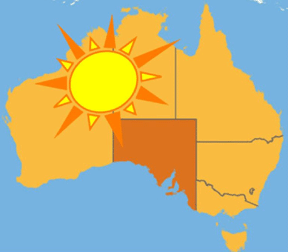 South Australia leading the nation in renewable energy, https://thenewdaily.com.au/news/national/2019/11/25/renewable-energy-winners/ Samantha Dick
South Australia is shifting to renewable energy faster than any other state or territory.
This is despite the federal government’s “lack of leadership” and continued support for major fossil fuel projects, says the Climate Council.
|
Progress is based on how much electricity is derived from renewable energy, proportion of households with rooftop solar, large-scale wind and solar capacity per capita, and policies to support the transition. South Australia earned this year’s top spot for generating more than half of its electricity from wind and solar, and for setting a target of net 100 per cent renewable energy in the 2030s. Following closely in second place was the Australian Capital Territory, which is on track for 100 per cent renewable energy from 2020. The ACT has also announced impressive plans to achieve net zero emissions by 2045 by cutting emissions from transport and cities. Tasmania was in third place for making headwinds toward 100 per cent renewable energy by 2022, and for researching three pumped hydro sites that could supply energy to Victoria over the next 10 to 15 years. Victoria was ranked fourth, winning points for planning the nation’s most ambitious large-scale wind and solar projects, and for legislating a renewable energy target of 50 per cent by 2030. However, more than 80 per cent of the state’s power still comes from fossil fuels, meaning it has a long way to go to catch up to the frontrunners. Further behind in fifth place was Queensland, where nearly half of Australia’s large-scale renewable energy projects were completed last year. But despite making big improvements, the Queensland government lost marks for continuing to support new fossil-fuel projects like the Adani coal mine. The Adani coal mine, backed by the federal government, will put out an estimated 7.7 billion tonnes of greenhouse gases over 60 years through extracting 2.3 billion tonnes of coal. It is also unlikely the Sunshine State will meet its target of 50 per cent renewable energy by 2030.
|
|
A tiny percentage of South Australian people coerced into the decision on nuclear waste dump
This is a decision which will affect all South Australians, not just a tiny percentage of people who have experienced four years of federal government promises and pressure to acquiesce.
the Minister failed to mention the main component of the project — long lived intermediate level waste from the Lucas Heights reactor
 Farmers and Traditional Owners decry SA nuclear more
  https://www.eurekastreet.com.au/article/farmers-and-traditional-owners-decry-sa-nuclear-vote, Michele Madigan,20 November 2019
-
- On 12 November, Senator Canavan, federal Minister for Resources, took a question from the rather more junior Senator Alex Antic. The questioner wondered whether there was any recent progress on the federal nuclear facility proposed for Antic’s own state of South Australia.
Union spokespeople are under no illusion that accidents are inevitable and about who will be automatically called for the cleanup. As Jamie Newlyn, South Australian Branch Secretary of the Maritime Union of Australia, warns: ‘MUA members work in critical points of the logistics cycle and therefore the safe handling and above ground storage for decades is of great concern to the MUA … ‘
A day of high temperatures and strong winds last month did nothing to deter opponents of the federal government’s nuclear plans from the latest Port Augusta Rally. Terry Schmucker, who owns a farm in nearby Poochera, had no vote in the recent poll. He was scathing about the inability of the nuclear industry to guarantee project safety when ANSTO has been unable to prevent radioactive leaks even on site.
After the rally, Aboriginal Co-Chairs of the Australian Nuclear Free Alliance (ANFA), Dwayne Coulthard and Vicki Abdulla, led a strong contingent to present ANFA’s petition to the office of South Australia’s Minister for Energy and Mining, Dan van Holst Pellekaan: ‘South Australia has legislation that makes such waste facilities illegal: The Nuclear Waste Storage (Prohibition) Act 2000 … We ask you to act now and protect South Australia and its people from Minister Canavan’s site selection process that has caused so much distress to South Australian communities … ‘
No, Senator Canavan, South Australians don’t believe that 452 people in one small town have the right to agree to burden us with all the nation’s nuclear waste — and forever.
In fact the Barngarla Determination Aboriginal Corporation has just set another challenge. With the results of their own Australian Electoral Company internal members vote showing 83 No and zero Yes votes, the Barngala have issued a statement which reads in part: ‘BDAC has written to Minister Canavan advising him of the result. BDAC has requested that given the first people for the area unanimously have voted against the proposed facility that the Minister should immediately determine that there is not broad community support for the project. ‘
With the arrival of the voting papers for the proposed alternative Flinders Ranges site on 14 November, the intensity of the division between potential yes and no voters in the small towns and hinterlands of Hawker and Quorn seems to have hit fever pitch. The potential yes voters welcoming of a new ‘industry’ to the area seem to disregard the effect a nuclear facility will have on the major tourism industry and Adnyamathanha heritage; not to mention the threats to groundwaters in an area subject to seismic activity and floods.
This is a decision which will affect all South Australians, not just a tiny percentage of people who have experienced four years of federal government promises and pressure to acquiesce.
Scott Morrison’s devious and incorrect claim about emissions and bushfires
 Scott Morrison contradicted on link between emissions and bushfires, https://www.brisbanetimes.com.au/politics/federal/scott-morrison-incorrect-on-link-between-emissions-and-bushfires-20191121-p53crh.html, By Mike Foley Scott Morrison contradicted on link between emissions and bushfires, https://www.brisbanetimes.com.au/politics/federal/scott-morrison-incorrect-on-link-between-emissions-and-bushfires-20191121-p53crh.html, By Mike Foley
November 21, 2019 Experts have contradicted Scott Morrison’s claim that Australia’s level of greenhouse gas emissions could not have increased the current level of risk from bushfires.
The Prime Minister said on Thursday climate change is a “global phenomenon” and Australia is doing its bit to reduce emissions. He has acknowledged that climate change increases bushfire risk, but said there could be no link drawn between our emissions and any current bushfires. “To suggest that with just 1.3 per cent of global emissions that Australia doing something differently, more or less, would have changed the fire outcome this season, I don’t think that stands up to any credible scientific evidence at all,” Mr Morrison said. “If anything Australia is an over-achiever on global commitments.” Mr Morrison made the comments on a day when several homes were lost to fires in South Australia while Melbourne recorded its hottest November day since 1894 when the mercury hit 40.9 degrees at Olympic Park in the mid-afternoon. Climate Council head of research Dr Martin Rice said there was a direct link between climate change and heightened bushfire risk. Global carbon project executive director and CSIRO research scientist Pep Canadell said Mr Morrison was “incorrect” to argue there was no link between Australia’s emissions and climate change. “It’s the tragedy of the commons. Below the biggest emitters in China and the US you have dozens and dozens of countries contributing between 1.5 and 0.8 million tonnes, which adds up to the climate problem,” Dr Canadell said. Because all the individual contributions are small no one feels responsible. “Another way to put it is on my next tax bill, because my contribution to the country’s revenue is so small, that it doesn’t matter if I don’t pay.” A recent analysis by RMIT ABC Fact Check estimated Australia’s domestic emissions of about 1.3 million tonnes, coupled with the emissions embedded in its exports, represented about 3.6 per cent of global emissions in 2016. CSIRO’s most recent State of the Climate report found “there has been a long-term increase in extreme fire weather and in the length of the fire season across large parts of Australia since the 1950s”. Eight of Australia’s 10 warmest years on record have occurred since 2005 and since the late 1990s there has been about an 11 per cent decline in cool-season rainfall between April and October in the south-east of the country. |
|
Launch of Australia’s National Environmental Defenders Office
 National Environmental Defenders Office launches https://www.lawyersweekly.com.au/sme-law/26968-national-environmental-defenders-office-launches, By Jerome D, oraisamy|21 November 2019 The new EDO will have offices in Adelaide, Brisbane, Cairns, Canberra, Darwin, Hobart, Perth and Sydney, with all state and territory EDOs finalising their merger process over the coming months.
Launched yesterday, the national Environmental Defenders Office will “take high-impact enforcement cases to the courts to make sure the public interest is upheld, and our communities are properly protected by our environmental laws”, it said in a statement.
In explaining why the former environmental legal centres were now coming together under one roof, EDO CEO David Morris said that the environmental problems facing Australia are not bound by our state and territory borders.
“The Murray-Darling crisis spans four jurisdictions. Our iconic koalas are dying right up and down the east coast. Climate change doesn’t stop at any border,” he said.
“Now more than ever, national leadership is required to protect Australia’s natural and cultural heritage. That’s where the new national EDO steps in.”
Moreover, the merger will see us the new EDO become the “largest public interest environmental law centre in the Australia-Pacific region”, Mr Morris told Lawyers Weekly.
“With that additional scale comes opportunities to play a bigger role empowering communities and protecting places. We see big opportunities to increase our presence in the Pacific and to better serve local communities in remote parts of Australia, including northern Australia,” he said.
“Increasingly communities across northern Australia are seeking legal assistance in respect of gas developments and we intend to ensure that our expert lawyers are available to assist them.” Merging also allows the EDO, Mr Morris added, to address the “problems of scale” identified by the Productivity Commission in its Access to Justice Arrangements report.
“That is, we’re able to centralise much of the offices’ administrative, financial and communications work freeing up our legal staff to provide better services to the community. The opportunity is that as a much bigger organisation we can play a bigger role at a national level on national issues, but at the same we’re committed to maintaining and strengthening connections to grass roots communities,” he said.
Another challenge and opportunity I expect will be big issues for us in the next twelve months will be coming to grips with what it means to be a distributed national team across a large area and multiple time-zones and multiple jurisdictions. We’ve got some tools and we’ve got some resourcing to improve our legal technology, rolling that out and implementing it will be crucial to the merger’s success.”
Australia is one of the “most naturally beautiful and biologically diverse places on Earth”, EDO’s statement continued, “but our environment is in decline”.
“There are more than 1,700 threatened species in Australia, we have lost more animals to extinction than any other country in the world. And while the Australian community expects robust accountability and oversight when it comes to environmental protection, trust in government processes and institutions has eroded to an all-time low.
Mr Morris said: “Regulations are regularly not enacted or enforced. Governments have cut resources to departments that are supposed to monitor breaches of environment law.”
“Companies routinely and intentionally breach state and federal environment laws. The problem is systemic and widespread because there is no clear legal deterrent.
“As a merged, national organisation we can share expertise, more closely scrutinise projects and address the widespread culture of non-compliance with environment laws.”
Australia must stop burning coal by 2030- report from Climate Analytics
|
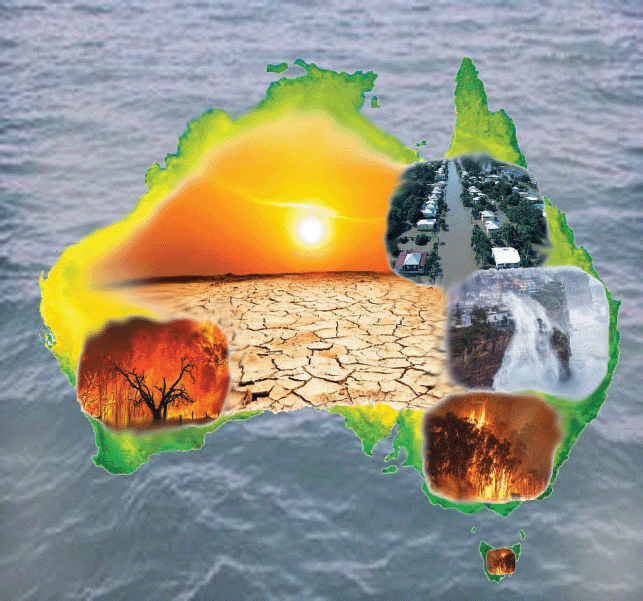
Climate science institute suggests Australia must stop burning coal by 2030, https://www.sbs.com.au/news/climate-science-institute-suggests-australia-must-stop-burning-coal-by-2030 Australia must stop burning coal by 2030 if it is to help contain warming to a 1.5-degree rise, a new climate report suggests. Australia needs to stop burning coal by 2030 if it wants to help limit global warming to 1.5 degrees, a new report warns.Non-profit climate science and policy institute Climate Analytics says the government needs a national plan to phase out remaining coal-fired plants – and must take them offline faster than already planned.
Such considerations would help provide the energy sector with certainty, the report released on Thursday says. The organisation’s chief executive Andrew Hare pointed to the current bushfires in New South Wales and Queensland as a sign the country needed to curb emissions rapidly. The realisation that climate change poses an existential threat to Australia is certainly hitting home right now,” Mr Hare said. “Australia must play its part in fighting climate change, and it could start by switching from coal to renewables in its own electricity system.” The report, using data from the recent report by the Intergovernmental Panel on Climate Change, says phasing coal out completely by 2030 would allow Australia to do its bit. It warns just half a degree more warning above 1.5C would see the death of nearly all of Australia’s coral reefs.t says at the slow rate coal fired plants were being shut down across the country, Australia would still emit twice more than what it was allowed to under the Paris Agreement. The report said 10 plants had closed since 2012 with the 19 remaining plants feeding Australia 60 per cent of its electricity. This made it the only OECD country in the G20 that relied on coal fire more than half of its energy supply. In a decade half of these plants, which the report says were already technically obsolete, would be 40 to 60 years old. The report says Australia had natural advantage when it came to renewable energy resources and should jump on this to move to a carbon free energy system. It warns Australia faced longer bushfire seasons, less rain and more drought due to climate change. |
|
Determined Aboriginal opposition to plan for Federal Nuclear Waste dump in rural South Australia
 National waste dump: Aboriginal groups share support as ballot closure approaches, https://www.transcontinental.com.au/story/6504879/national-waste-dump-aboriginal-groups-share-support-as-ballot-closure-approaches/?fbclid=IwAR04J6eadTBu0gBqaT8IBVIo6jvv3wTo0hjnEbTqvbhRDJg6jOPdravwG2w, Amy Green, 21 Nov 19,
The fate of two outback communities at the centre of the federal government’s nuclear waste management facility could be determined before the end of the year.
A three year consultation clouded in controversy will come to a close on December 12 with the completion of a community vote in Hawker.
General Manager of the National Radioactive Waste Management Facility Taskforce Sam Chard said the government has been working to ‘hear the views of all interested parties including local residents, neighbours, business owners, Traditional Owners and the broader community’.
The Wallerberdina Station site has been opposed by the traditional owners, the Adnyamathanha people, for cultural reasons.
The Seven Sisters songline, one of the most significant creation tracks throughout Australia, runs nearby this site.
“We remain suspicious and frustrated by this flawed process of consultation, and we remain unwilling to support a nuclear waste dump on our country,” Ms Marsh said.
“Under our cultural law of the land it is our duty of care to care for the land, yet we feel we are being forced into accepting this poison.
“We ask all Australians to stand with us and end this flawed process of consultation. No more one-sided discussions, no more half-truths about the danger, no more secret deals behind closed doors.”
Speaking on behalf of the Annggumathanha Camp Law Mob, Ms Marsh said the federal government’s decision to exclude the Barngarla Traditional Owners from the Kimba community vote was another blow to First Nations people.
The proposal had been opposed by the Barngarla Determination Aboriginal Corporation, who battled with the federal government in a series of court proceedings.
“We give our heartfelt support to the Barngala Custodians of the Kimba region, we admire their courage and and hope they succeed in their quest to have their voices heard,” Ms Marsh said.
“The independent ballot conducted by Barngarla Determination Aboriginal Corporation once more highlights the flawed process used by federal government.”
1 This month.
20 September –National Day of Action in Melbourne on the International Day of Peace


Help Aunty Sue Protect Her Land and Sacred Sites From Destructive Rocket Testing.
.

Australians deserve the truth
about
AUKUS – https://aukuspublicinquiry.com/


PETITION – To: Prime Minister Anthony Albanese and the Australian Labor Government

of the week – Australians for War Powers Reform (AWPR)
To see nuclear-related stories in greater depth and intensity
 Antinuclear