With bushfires and floods, Australia now ranks in the top 10 world’s natural disaster counntries
 Chart of the day: Bushfires, cyclones and floods put Australia in the world’s natural disaster top 10 https://www.abc.net.au/news/2018-11-30/natural-disaster-economic-impact-chart/10499688 By business reporter Stephen Letts The annual cycle of summer bushfires, cyclones and floods, all too evident this week, has pushed Australia into the global top 10 for economic damage caused by natural disasters.
The 2018 International Federation Red Cross and Red Crescent Societies’ World Disasters Reportfound Australia’s damage bill over the past decade came in at $37 billion (or $US27 billion).
That ranks us 10th in terms of the cost of natural disasters, but still a fair way behind the big three disaster zones: the US, China and Japan which together account for about two-thirds of the total financial cost the IFRC added up between 2008 and 2017.
Our Asia-Pacific region seems to be the most disaster-prone on the planet, being bit by around 40 per cent of the 335 disasters recorded worldwide in 2017 and suffered almost 60 per cent of disaster-related deaths.
The report notes that in a changing climate, small-scale weather disasters are becoming more frequent and more intense, and in many cases “exceed the coping capacities of households and of authorities”.
The IFRC’s definition of natural disasters includes storms, floods, earthquakes, volcanic activity and droughts, but not epidemics.
Research on Australia’s climate history
RETHINKING AUSTRALIA’S CLIMATE HISTORY https://www.adelaide.edu.au/news/news103762.html, 27 November 2018
Researchers at the University of Adelaide have found evidence of climate change that coincided with the first wave of European settlement of Australia, which effectively delivered a double-punch of drying and land clearance to the country.
The research, published in Quaternary Science Reviews, suggests that eastern Australia, including Melbourne, Sydney and Brisbane, was much drier after 1890 than the Little Ice Age period that preceded it. Continue reading
Queensland Premier sceptical that Adani coal mine will ever eventuate
 We will believe it when we see it’: Palaszczuk on the Adani coal mine , Brisbane Times,By Felicity Caldwell, 30 November 2018 Queensland Premier Annastacia Palaszczuk has expressed scepticism about Adani’s announcement that construction on its Carmichael coal mine would begin.
Adani Australia mining chief executive Lucas Dow on Thursday announced the scaled-back project would be “100 per cent financed” from within the Adani conglomerate.
Ms Palaszczuk said the announcement was “very different to what we have been seeing” and she wanted more details. “There is no taxpayers’ money going into the building of that railway line, they have to have agreements with Aurizon, we haven’t seen any of that evidence as of yet,” she told the ABC on Friday morning.
“And, of course, we will believe it when we see it.”
Ms Palaszczuk said the success of Adani’s project would depend on whether the company met its milestones. “We’ve got a lot of companies that come and say we’ve got finance to begin things and it doesn’t happen,” she said. “I will believe it when it starts happening.”
Adani was previously seeking a $1 billion taxpayer loan from the Northern Australia Infrastructure Facility to finance a 388-kilometre rail line needed to move its coal to port for export.
In September, Adani announced it would save $1.5 billion by scaling down the rail line. It will now build a shorter narrow gauge line to connect with Aurizon’s existing rail plans……….
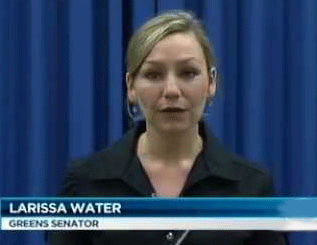 Greens Senator Larissa Waters said there was still time to stop Adani’s Galilee Basin mine.
Greens MP Michael Berkman said Labor had issued the environmental approval and mining leases and set up a royalties deal. “We are so far beyond the point of being able to accept Labor’s ‘we’ll believe it when we see it’ kind of approach,” he said……….https://www.brisbanetimes.com.au/politics/queensland/we-will-believe-it-when-we-see-it-palaszczuk-on-the-adani-coal-mine-20181130-p50jcb.html
Noongar traditional owners challenge settlement that will extinguish native title
The ILUA extinguishes native title over the settlement area in exchange for a benefits package which includes depositing $50m a year over 12 years into the Noongar Boodja perpetual trust and transferring 320,000 hectares of freehold and leasehold land to that trust, to be developed and used by the Noongar community.
“It is not about money, it is about the land, and saving our land from mining,” Smith said. “If this deal goes through, the south-west will not be worth living in.”
|
It is not about money’: Australia’s largest native title settlement challenged again, Guardian, Calla Wahlquist, 30 Nov 18
A group of Noongar traditional owners lodge application for judicial review Australia’s largest native title settlement is facing a second legal challenge from a group of traditional owners who say the process was unfair and did not represent the will of all 35,000 Noongar people. Continue reading |
Renewables to be providing 80 per cent of electricity market by 2030
|
Renewables heading for 80 per cent of electricity market by 2030, putting pressure on future funding: report, ABC News By business reporter Stephen Letts Key points:
|
|
Native title win for Nanda people in Western Australia
Federal Court Justice Debbie Mortimer held an on-country hearing at the Kalbarri foreshore on Wednesday to deliver her judgment.
Nanda Aboriginal Corporation chairman Carrum Mourambine said the hearing was emotional because some Elders had died since the original claim.
“(They) were not here to witness this historic occasion,” he said.
“This determination means that we can continue to pass on our knowledge of culture and traditional customs to future generations.”
The Nanda people native title claim is a combination of two claims.
The first was lodged with the National Native Title Tribunal in 1994 and the second came two years later, then they were combined in 2000.
The determination was by consent, which means it was reached by agreement with other parties to the claim, including the state government.
“The court’s determination will preserve, protect and recognise in contemporary Australian law what the Nanda people already know, and have always known, about their connection by traditional law and custom to their country,” Justice Mortimer said in her judgment.
“They are to be admired for their persistence and determination, in light of the many obstacles facing Aboriginal people and their communities.”
 |
ReplyForward
|
Woomera the suitable site for a nuclear waste dump – Senator Rex Patrick
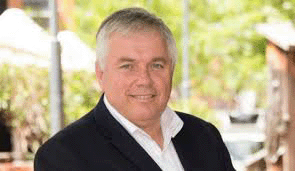 Woomera must be considered fWor radioactive waste facility, Senator Rex Patrick says https://www.adelaidenow.com.au/business/sa-business-journal/woomera-must-be-considered-for-radioactive-waste-facility-senator-rex-patrick-says/news-story/3b8171ca619079bc36b1b35c19861cf9?fbclid=IwAR0FQ-25ObeztDdNn5d9xLWOpJuDHJkaEBAIIT9r6sSpj52tRW_uTaCCLhc Erin Jones, Regional Editor, The Advertiser, November 28, 2018 Renewed calls have been made for Woomera to be considered as the site for the national nuclear waste repository to end the divide in two South Australian country towns.
Centre Alliance Senator Rex Patrick said the 122,000sq km Woomera Prohibited Area should be revisited after a freedom of information document showed the reasons why it was rejected were “shallow”.
His calls come as Kimba and Hawker remain in limbo as to whether they will be chosen to host the low-level waste facility, with community ballots delayed until early next year.
“We have a divided community in both Hawker and Kimba and there is a site that may well be very suitable but has been dismissed on very shallow grounds,” Senator Patrick said
“We need to revisit the defence site properly.”
Renewed calls have been made for Woomera to be considered as the site for the national nuclear waste repository to end the divide in two South Australian country towns.
Centre Alliance Senator Rex Patrick said the 122,000sq km Woomera Prohibited Area should be revisited after a freedom of information document showed the reasons why it was rejected were “shallow”.
His calls come as Kimba and Hawker remain in limbo as to whether they will be chosen to host the low-level waste facility, with community ballots delayed until early next year.
“We have a divided community in both Hawker and Kimba and there is a site that may well be very suitable but has been dismissed on very shallow grounds,” Senator Patrick said.
“We need to revisit the defence site properly.”
Woomera was one of four defence sites in SA to be identified by the Federal Government that met suitability criteria for the repository.
The Defence Department, in 2016, said it did not support the facility at Woomera as it was “incompatible” with its weapons testing range and missile launch site.
However, a 2002 Education, Training and Science Department report found the site would be a preferred location, in part because both low and intermediate-level radioactive waste had been stored there since 1994-95 without incident. This includes the CSIRO storing 10,000 drums of waste at the site.
Resources Minister Matt Canavan told The Advertiser the site was unsuitable due to defence operations. He said waste at the site must be moved outside of the controlled defence area.
Woomera was identified by the Howard Government as the potential repository site in 1998, but was shelved following backlash from the Rann Government.
Community excluded from Australia’s nuclear waste dump Community Consultation
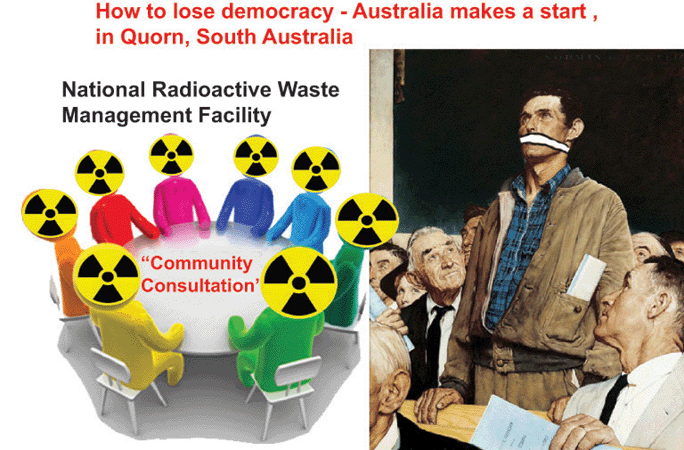 Katrina Bohr No Nuclear Waste Dump Anywhere in South Australia
After a few of us attempted to enter the closed and impenetrable BCC meeting on Tuesday in Quorn, we were left with some guidelines.
‘There will be an opportunity to attend one of the other meetings coming up’
The transcript from this meeting will be available on line.
Why all the community exclusion now, Ian Carter?
More boxes ticked on their Government to-do list….that’s all! https://www.facebook.com/groups/1314655315214929/
Was Woomera rejected as nuclear dump site, because the plan is to later IMPORT NUCLEAR WASTE?
Tim Bickmore , No Nuclear Waste Dump Anywhere in South Australia, 29 Nov 18 , Freedom Of Information released 30 October 2018 to Senator Rex Patrick:
“Defence has a significant holding of radioactive waste awaiting disposal, for which it is legally bound to arrange final disposal under the terms of the ARPANS Act. It is therefore our policy to support the Government’s initiatives in developing a National Radioactive Waste Management Facility in a suitable location. The siting of RWSF outside the Woomera Protected Area would have no compatibility impact on Woomers Test Range activities and is therefore actively supported. Defence is already assisting DIIS, ARPANSA and ANSTO, as a member of the Radioactive Waste Management Inter-Departmental Committee, to drive the development of the National Radioactive Waste Management facility”
Director, Defence Radiation Safety and Environment
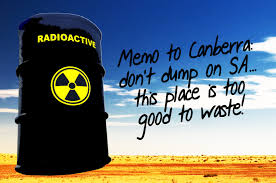 https://www.dropbox.com/…/2ed7ca…/AAB6UaL6iCMWFH2dzwv2q4VBa…
This increases my suspicion that they want a location near our gulf/ports/rail so they can expand it into their dream of an International Nuclear waste business. https://www.facebook.com/groups/1314655315214929/
Western Australia’s uranium promise: 10 years later it’s a complete flop
|
10 years ago this week the Barnett government lifted thpr The reality has been far more like morose miners on methadone. After a decade that has seen sustained Aboriginal and wider community resistance to mining plans, the uranium price plummet in the wake of Fukushima and a surge in renewable energy production, there is not a single operating uranium mine in WA. Uranium exploration companies were a dime a dozen but just four projects surfaced as having potential in WA. Three of them raced through the environmental assessment process under the Barnett government and emerged with environmental, but not final, approvals just weeks before the state election in a clear move to wedge the incoming Labor government. The McGowan government felt the wedge and let the four mines with partial approvals continue ‒a clear breach of Labor’s pre-election promise not to allow mines to proceed unless they had full approvals. But the sustained low uranium price and community opposition has thwarted plans to develop any of the four mines. Cameco has written off the entire value of the Kintyre project, Toro Energy has shelved its uranium plans and is now trying to strike lucky with gold, Cameco’s Yeelirrie project is the subject of a legal challenge by the Conservation Council of WA and three traditional owners and then there is Vimy’s Mulga Rock project. Vimy released its Definitive Feasibility Study for Mulga Rock earlier this year and the company is reportedto be “confident of securing contract prices of about $US60/lb this year or next for delivery in 2021 when it hopes to be in production with Mulga Rock.” There was supposed to be an investment decision by July but instead Vimy was handing out pay cuts and scaling back or bunkering down for the sustained lull in the uranium price (currently around $US30/lb). And while Toro is looking for gold ‒and other uranium companies have diversifiedinto medicinal marijuana production or property development ‒Vimy is hedging its bets by setting up a subsidiary to explore for base metals. Globally there are 115 nuclear reactors undergoing decommissioning‒double the number under construction. The International Energy Agency is warning about the lack of preparation and funding for a “wave of retirements of ageing nuclear reactors” and an “unprecedented rate of decommissioning”. A growing number of countries are phasing out nuclear power, including Germany, South Korea, Switzerland, Belgium and Taiwan. The world’s most experienced reactor builder, Westinghouse, went bankrupt last year and the debts it incurred on reactor projects almost bankrupted its parent company, Toshiba. After the expenditure of at least $A12.4 billion, construction of two partially-built reactors in the US was abandoned last year, and the only other reactor construction project in the US was almost abandoned this year after cost overruns of $A14 billion. No wonder that nuclear lobbyists are themselves acknowledging a “crisis that threatens the death of nuclear energy in the West” and are already writing eulogies about the “ashes of today’s dying industry”. Globally there are 115 nuclear reactors undergoing decommissioning‒double the number under construction. The International Energy Agency is warning about the lack of preparation and funding for a “wave of retirements of ageing nuclear reactors” and an “unprecedented rate of decommissioning”. A growing number of countries are phasing out nuclear power, including Germany, South Korea, Switzerland, Belgium and Taiwan. The world’s most experienced reactor builder, Westinghouse, went bankrupt last year and the debts it incurred on reactor projects almost bankrupted its parent company, Toshiba. After the expenditure of at least $A12.4 billion, construction of two partially-built reactors in the US was abandoned last year, and the only other reactor construction project in the US was almost abandoned this year after cost overruns of $A14 billion. No wonder that nuclear lobbyists are themselves acknowledging a “crisis that threatens the death of nuclear energy in the West” and are already writing eulogies about the “ashes of today’s dying industry”. |
|
Yes, Prime Minister, I’m striking from school: consider it a climate lesson
 Canberra Times, By Veronica Hester 29 November 2018 I am Veronica, 15 years old, from Scott Morrison’s electorate. Despite our Prime Minister’s calls for students not to strike from school on Friday, we’re choosing to no longer be powerless. We will be striking with thousands of other students, to show we will not stand for our government’s inaction on climate change………
Seeing this, we students do not shout at each other across the classroom. We sit in a shocked silence. Afterwards, we shout, with our signs and our demands. Because how can an educated person know all we know, and do nothing?
Mr Morrison and his government continue to overlook the danger of climate change, while not seeming to have a problem helping coal miners such as Adani dig up and burn more coal. It’s surreal to watch nothing significant happening on the parliamentary floor, when the solutions have been made so clear. We are one of the sunniest and windiest countries in the world, yet our government chooses to burn more coal.
When Mr Morrison refuses to implement a climate policy that keeps fossil fuels in the ground and transition to 100 per cent renewable energy, he isn’t representing us, our community, or the majority of Australians who want urgent climate action.
Tackling climate change isn’t just about looking out for our young people. We’ll all live with extreme heat and changing weather patterns, not to mention the sense of helplessness in losing our natural world.
By making a stand and organising our communities, we can push our politicians to represent us, not lumps of coal…….That is all we want – for a serious problem to be treated seriously by our politicians. We need the fire of climate change to be confronted, not left to engulf my generation.
Veronica Hester is a school student from the Sutherland Shire. https://www.canberratimes.com.au/national/yes-prime-minister-i-m-striking-from-school-consider-it-a-climate-lesson-20181127-p50iqd.html
Queensland experiencing fires of unprecedented fury, similar to California’s wildfires
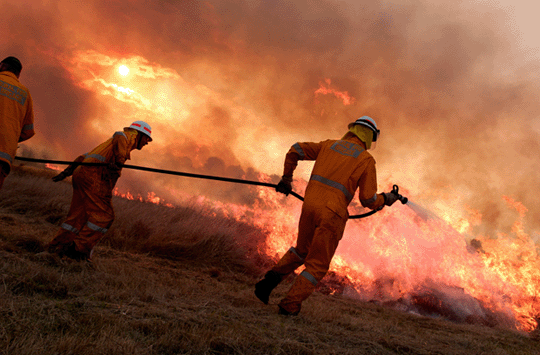
Qld fires compared to deadly US blazes The Queensland fires have been compared to the infernos that recently decimated California. News com.au, Staff reporters, Australian Associated Press, NOVEMBER 28, 2018 Almost 10,000 Queenslanders are being forced to flee to shelter as wildfires fanned by catastrophic conditions bear down on their communities. Firefighters in Queensland are battling almost 140 wildfires, with the worst in central Queensland in destructive conditions that have been compared to those that fanned the infernos that recently decimated California. Mandatory evacuations have been ordered and 37 schools closed amid a new blaze near Rockhampton and monster one farther south that’s already razed at least four homes and scorched tens of thousands of hectares of bush and farmland. A large fire sparked shortly before 3pm on Wednesday has since raced towards Gracemere, prompting authorities to order a mandatory complete evacuation of the 8000 people in the area. Queensland Police Commissioner Ian Stewart told people not to panic but make for the Rockhampton showgrounds around 14km away, where an evacuation centre has been set up. ……..Firefighters have been fighting since Saturday the monster fire near Deepwater, Baffle Creek, Rules Beach and Oyster Creek, Eungella and Dalrymple Heights, where people were ordered to evacuate before fires cut road. Most people got out by road but some had to be ferried over Baffle Creek. ……….Deputy Police Commissioner Bob Gee had bluntly warned people that the conditions were so dangerous people could die if they stayed put. “People will burn to death. Their normal approaches probably won’t work if this situation develops the way it is predicted to develop. It is no different to a Category 5 cyclone coming through your door.” Brian Smith, Regional Manager for the Rural Fire Services Central Region, said experts were comparing the conditions in Deepwater to the Waroona fires in Western Australia, which completely wiped out a town a few years ago, and also to the recent deadly California fires. Interstate crews arrived on Tuesday to help fight the inferno in Deepwater that’s destroyed homes and burnt through at tens of thousands of hectares of bush and farmland since Saturday. Crews from South Australia are expected to arrive on Wednesday, with more from around Australia to arrive later this week. https://www.news.com.au/national/breaking-news/qld-may-lose-lives-in-firestorm-govt/news-story/df1dcf91c83f868bef7ba12caba27c40
|
Manipulations and machinations of UK, USA, Ecuador (?Australia) against Julian Assange

 U.K. and Ecuador Conspire to Deliver Julian Assange to U.S. Authorities https://www.truthdig.com/articles/u-k-and-ecuador-conspire-to-deliver-julian-assange-to-u-s-authorities/
Gareth Porter 28 Nov 18 The accidental revelation in mid-November that U.S. federal prosecutors had secretly filed charges against WikiLeaks founder Julian Assange underlines the determination of the Trump administration to end Assange’s asylum in the Ecuadorian Embassy in London, where he has been staying since 2012.
Behind the revelation of those secret charges for supposedly threatening U.S. national security is a murky story of a political ploy by the Ecuadorian and British governments to create a phony rationale for ousting Assange from the embassy. The two regimes agreed to base their plan on the claim that Assange was conspiring to flee to Russia. Continue reading
Australia’s school students not impressed with PM Scott Morrison’s criticism of their climate change activism
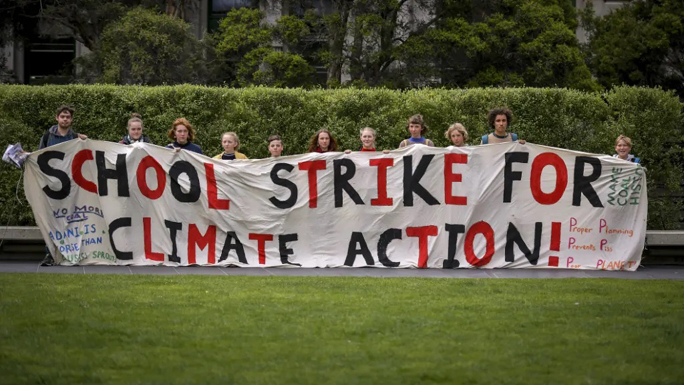 Students hit back at PM after ‘less activism in schools’ climate change comment, SBS, 28 Nov 18 Hundreds of students are planning to leave school this Friday to protest government inaction on climate change. There’s a storm brewing between Prime Minister Scott Morrison and school students planning a national strike on climate change inaction this Friday.
Hundreds of students are vowing to put the books away and converge on MP offices and parliaments around the country in the Big School Walk Out for Climate Action.
On Monday, Mr Morrison implored children to stay in class rather than protesting things that “can be dealt with outside of school”.
What we want is more learning in schools and less activism in schools,” he said.
But students aren’t happy with the response.
Melbourne student Jagveer Singh, who will take part in the protest, said Mr Morrison’s broadside made him “want to go on strike even more”. [We want to] demonstrate that we’re not happy with the federal government for not listening to us and demand that we get a safe climate,” he said.
“It’s our future. We are the ones that will be facing the consequences of the decisions that are made today, and that is why we need to have a say.
“The time that they’re using to debate this issue is time that’s being wasted … We need to act on this.” …….https://www.sbs.com.au/news/students-hit-back-at-pm-after-less-activism-in-schools-climate-change-comment
Western Australia’s “uranium bonanza” just not happening
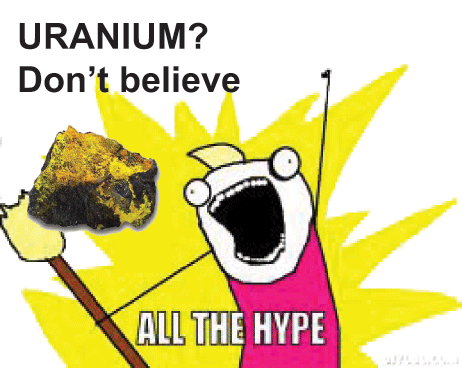 WA’s uranium promises fail to appear, Midwest Times, Dave Sweeney, 21 Nov 18 Ten years ago this week then premier Colin Barnett ended Western Australia’s long-standing ban on uranium mining.
Industry promoters boasted of a new mining sector that would be “iron ore on steroids” and the speculation and exploration began in earnest.
In the intervening decade widespread community concern and resistance, combined with a depressed commodity price and a growing appetite for renewable energy, has seen the uranium dream fade.
Today there is not one commercial or fully approved uranium mine despite years of promotion and preferential treatment, and the few projects that continue to seek approval are strongly contested.
This is good news for WA and beyond as uranium is a mineral with unique properties and risks that cause local damage and fuel global risk.
Thanks to those who have helped keep the brakes on this contaminating trade and who have a perspective that lasts longer than a politician’s promise.
1 This month.
20 September –National Day of Action in Melbourne on the International Day of Peace



Help Aunty Sue Protect Her Land and Sacred Sites From Destructive Rocket Testing.
.

Australians deserve the truth
about
AUKUS – https://aukuspublicinquiry.com/


PETITION – To: Prime Minister Anthony Albanese and the Australian Labor Government

of the week – Australians for War Powers Reform (AWPR)
To see nuclear-related stories in greater depth and intensity
 Antinuclear