All this does not bode well for advocates of climate action. Extreme weather is battering Australia on all fronts: Carbon-warmed oceans are plundering its Great Barrier Reef, and a record-breaking drought is ravaging the country’s well-populated southeast. Yet even its center-right-led, middling attempt at a climate policy is withering on the vine. On Monday, in one of his first public appearances since taking office, Prime Minister Morrison declined to comment on whether climate change is intensifying the country’s drought.
The Global Rightward Shift on Climate Change, President Trump may be leading the rich, English-speaking world to scale back environmental policies. The Atlantic , ROBINSON MEYER, AUG 28, 2018 Last Thursday, Malcolm Turnbull was the prime minister of Australia. By the end of this week, he’ll be just another guy in Sydney.
Turnbull was felled by climate-change policy. His attempt at a moderate, even milquetoast energy bill—which included some mild cuts in greenhouse-gas emissions—proved too aggressive for his co-partisans. On Friday, members of Australia’s center-right Liberal Party voted him out of office…..
Turnbull’s tumble remains a disquieting sign for anyone hoping for an aggressive global climate policy. In Australia—where global warming has contributed to the die-off of half the coralin the Great Barrier Reef since 2016—even a mild climate bill could not pass under a conservative government.
It points to an emerging pattern: Moderate national leaders—on both the center-left and center-right—in some of the world’s richest and most advanced countries are finding it far easier to talk about climate change than to actually fight it.
Simply put: This kind of failure, writ large, would devastate Earth in the century to come. The world would blow its stated goal of limiting atmospheric temperature rise. Heatwaves might regularly last for six punishing weeks, sea levels could soar by feet in a few short decades, and certain fragile ecosystems—like the delicate Arctic permafrost or the kaleidoscopic plenty of coral reefs—would disappear from the planet entirely.
Australia’s recent instability further complicates this unease. The global climate action of 2016 may be producing something like a worldwide climate backlash—especially in countries with powerful fossil-fuel interests, like Australia and Canada. Or—far more worryingly for climate advocates—these changes in policy may be trickling down from the biggest historical emitter of greenhouse gases of them all: the United States.
Richard Glover on climate policy: Australia insignificant? Pathetic and absurd, Brisbane Times By Richard Glover , 24 Aug 18 “……..Australia was a small place of little import, dwarfed by these [overseas] humming centres of real life.
Once you’ve grown up with that idea, as many Australians did, it can be hard to shift gear. That’s why – some years on – I was taken aback when I acquired a copy of the Times Atlas of the World. It had a table listing the great cities of the world, according to the size of their population…….
Australia now has the 13th largest economy in the world, with predictions it will be the 11th largest within a decade. If NSW went it alone, as a separate country, the economy would be the 26th biggest in the world. In military terms, a recent comparison listed the country in 21st position, out of 136.
Do these rankings matter? I think so, if only because the idea of “little ole Australia” is constantly used as an excuse for failure, for accepting the second rate, for shrugging away our responsibilities…..
The latest version of this dire, cringing attitude formed the background to this week’s leadership spill. The Dutton forces kept repeating the same mantra: Australia is so small it has no impact on carbon emissions. We may as well do nothing. Anything else is grandstanding or “virtue-signalling”.
It’s true, of course, that Australia’s emissions are less than those of the United States and China, but that doesn’t mean they are “nothing” or “negligible”, the terms always employed.
Australia was responsible for 1.1 per cent of global emissions in 2016, making us the 16th most polluting country in the world. Per head we’re among the worst.
Then there’s the idea that – due to our size – we should give up the ambition of having a positive impact on the world. Important battles – this is the underlying thought – should be left to others. We can stand on the sidelines and freeload………
It’s the cringe, writ large. It shows neither national pride nor global spirit. It’s also out of step with a balanced understanding of our relatively-significant place in the world.
Radioactive sheep shed light on secret nuclear weapons test, https://nypost.com/2018/08/14/radioactive-sheep-shed-light-on-secret-nuclear-weapons-test/Christopher Carbone, Fox News, August 14, 2018 Newly discovered data from radioactive sheep provides strong evidence that a mysterious “double flash” detected almost 39 years ago near a remote island group was a nuclear explosion.
Ever since the flash was observed by a US Vela satellite orbiting above Earth in September 1979, there’s been speculation that it was produced by a nuclear weapon test by Israel. International researchers in the journal Science & Global Security analyzed previously unpublished results of radiation testing at a US lab of thyroid organs from sheep in southeastern Australia in order to make their determination.
The flash was located in the area of Marion and Prince Edward islands, which are in the South Indian Ocean about halfway between Africa and Antarctica.
“A new publication sheds further light on the Vela Incident of 1979,” said Professor Nick Wilson of Otago University at Wellington, who highlighted the findings but was not involved with the study itself. “[The research] adds to the evidence base that this was an illegal nuclear weapons test, very likely to have been conducted by Israel with assistance from the apartheid regime in South Africa.”
Wilson, an epidemiologist and member of the Australia-based Medical Association for the Prevention of War, said the test would have violated the Limited Test Ban Treaty signed in 1963, and urged the United Nations to mount a full inquiry.
The researchers conclude that iodine-131, which is an unstable radioactive form of the element iodine found in the thyroids of some Australian sheep, “would be consistent with them having grazed in the path of a potential radioactive fallout plume from a [Sept. 22, 1979] low-yield nuclear test in the Southern Indian Ocean.”
Thyroid samples from sheep killed in Melbourne were regularly sent to the US for testing — monthly in 1979 but also in the 1950s and 1980s, researchers say.
According to a report in the New Zealand Herald, the sheep had been grazing in an area hit by rain four days after the flash incident was observed, which would have been in the downwind path from the suspected explosion site.
Researchers also said the detection of a “hydroacoustic signal” from underwater listening devices at the time is another piece of evidence pointing to a nuclear test.
Israel, which has neither confirmed nor denied the existence of a nuclear program, dismissed the claim that it was responsible for the 1979 incident.
srael’s ambassador to New Zealand, Itzhak Gerberg, told the Herald, when asked if Israel was responsible for the explosion: “Simply a ridiculous assumption that does not hold water.”
However, the country’s former Knesset speaker, Avrum Burg, told a conference in 2013 that “Israel has nuclear and chemical weapons” and called for public discussion.
Commenting on the findings, US nuclear weapons expert Leonard Weiss of Stanford University said in the online Bulletin of the Atomic Scientists that the “important” new evidence “removes virtually all doubt” that the flash was a small-yield nuclear explosion.
Weiss added that there was “growing circumstantial evidence” that it was conducted by Israel.
“Israel was the only country that had the technical ability and policy motivation to carry out such a clandestine test,” he said.
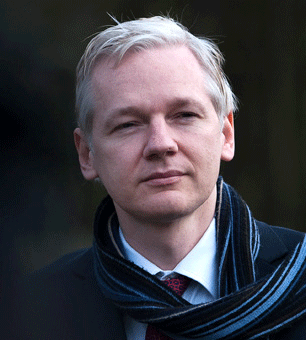
On Thursday WikiLeaks Twitter account posted a screenshot of a letter received by some of the residents of no. 18 Hans Cres, London — an apartment building across from the Ecuadorian Embassy that serves as an asylum for Julian Assange. The letter, which has a BBC News logo in its top right corner, asks permission to install permanent cameras outside residents’ apartments so that they overlook the embassy.
The letter was motivated by a desire to better cover Julian Assange’s story and promised to compensate for any disturbances caused. The letter also contains Jonathan Whitney’s email as a contact for those interested in the offer. According to Whitney’s profile, he is a BBC News Deployment Editor.
WikiLeaks chief editor Julian Assange has been living in Ecuador’s UK Embassy since 2012 fearing the UK may extradite him to the US, where he could face prosecution over WikiLeaks’ publication of leaked US military and diplomatic documents. Recently Ecuadorian President Lenin Moreno touched upon the issue of expelling Assange from the embassy, but noted that the UK must first guarantee the activist’s safety.
His statements followed conflicting media reports that Ecuador might revoke Assange’s asylum and that the whistleblower might leave voluntarily to due increasing health issues.
Assange may finally leave Ecuadorian embassy in London as health worsens – report Julian Assange, who has spent more than 2,230 days in the Ecuadorian embassy in London, is expected to leave the building soon with his health deteriorating, sources say.
This latest information about the WikiLeaks founder, who was already expected to leave the embassy “in the coming weeks,” was Wednesday by Bloomberg which cited “two people with knowledge of the matter.” The news agency reported that the whistleblower’s health “has declined recently.”
The news comes days after Ecuadorian President Lenin Moreno announced that Assange must “eventually” leave the embassy. “Yes, indeed yes, but his departure should come about through dialogue,” the Ecuadorian president said in answer to a reporter’s question on whether he will eventually have to leave.
“For a person to stay confined like that for so long is tantamount to a human rights violation,” Moreno said, stressing that Ecuador wants to make sure that nothing “poses a danger” to the whistleblower‘s life.
The whistleblower’s health is deteriorating, according to the Courage Foundation, a group that fundraises for the legal defense of whistleblowers. Assange is in “a small space” and has “no access to sunlight,” the group , adding that this has a serious impact “on his physical and mental health.”
Rape allegations, stemming from Assange’s visit to Sweden in August 2010, were the main reason that he sought refuge in London’s Ecuadorian embassy in 2012 when a warrant was issued for his arrest. Assange maintained that he could be extradited from Sweden to the US, where he would be prosecuted for his whistleblowing and would not receive a fair trial. Swedish prosecutors dropped the investigation in 2017, but a British warrant for violating bail conditions still stands.
Washington simply “wants revenge” for the “embarrassment” WikiLeaks caused it, and wants it to serve “as a deterrent to others,” human rights activist Peter Tatchell told RT earlier in July. “Someone who’s published that information in the same way that the New York Times or the Guardian publish information, I don’t think they should face risk 30 or 40 years in jail in the United States,” Tatchell added.
Launched in 2006, the WikiLeaks project is aimed at exposing government and corporate secrets. It garnered global attention back in 2010 with its massive release of classified US military documents, which included those detailing how American military equipment was deployed in Afghanistan and Iraq. Assange won thousands of admirers, with many applauding his willingness to speak the truth.
As Gary Cushway points out, under current arrangements, the waste produced in the reprocessing of spent Australian nuclear fuel which was sent to Dounreay in the 1990s will stay at Dounreay; the vitrified waste produced at Sellafield is only being sent to Australia to fulfil a contractual agreement. If the transfer from Sellafield was halted, and the waste currently stored at different locations in Australia was kept where it is, the case for a national radioactive waste management facility in Australia would be drastically eroded.
Cushway believes that the Scottish Government could cancel the 2012 joint waste substitution policy and come to an arrangement with the Australian Nuclear Science and Technology Organisation (ANSTO) regarding management of the reprocessed Australian waste at Dounreay.
At the very least, more pressure should be put on the UK Government to stop the transfer of waste until its final destination is known.
Can Scotland help stop nuclear waste being dumped on Aboriginal land? At the very least, more pressure should be put on the UK Government to stop the transfer of waste until its final destination is known. Scots are yet to fully reckonwith the role that we played in the brutal colonisation of Aboriginal Australia, but the Scottish Government now has an opportunity to offer meaningful solidarity to Aboriginal communities who are still fighting to protect their land and culture.
Linda Pearson @Pearson_LM Linda Pearson, anti-nukes activist and Common Weal policy officer, explains how nuclear waste due to be transferred from the UK to Australia could be dumped on Aboriginal land, and what role the Scottish Government could play in preventing another act of racist disregard of Australia’s indigenous population in what is a long and brutal history of discrimination
APPROXIMATELY 10,000 miles from Scotland in South Australia, Aboriginal traditional owners are fighting against plans to build a nuclear waste dump on their land. It is the latest phase in a struggle to protect land and culture which has lasted over 20 years. Continue reading →
Australia’s dangerous obsession with the Anglosphere, The Conversation, Dennis AltmanProfessorial Fellow in Human Security, La Trobe University, 22 June 18
Over the past three weeks the ABC program Four Corners has presented special reports on American politics, which involved one of our best journalists, Sarah Ferguson, travelling to the US on special assignment. I watched these programs and I enjoyed them. But in part I enjoyed them because they covered ground that is already familiar.
If the same effort had gone into bringing us in-depth special reports from, say, Jakarta or Mumbai they would have been less familiar, but perhaps more interesting. Most important they would not be stories already covered by major English language media to which we have extraordinary access.
As we struggle to make sense of a changing world order, in which the role of the US seems less defined and dependable, our fascination with things American continues to grow. It is one of the ironies of current Australian life that preoccupation with “the Anglosphere”, a favourite phrase of former prime minister Tony Abbott’s, is in practice shared by many who regard themselves as progressive.
What is the Anglosphere? The Merriam-Webster Dictionary defines it as “the countries of the world in which the English language and cultural values predominate”, clearly referring to Britain, the United States, Canada, Australia and New Zealand. A surprisingly recent term, it was coined by the science-fiction writer Neal Stephenson in his 1995 novel The Diamond Age, and then picked up by a number of conservative commentators.
The Churchillian notion of near-mythical bonds created by the English language and British heritage has always attracted Australian conservatives
……… Despite 50 years of governments talking about Australia as part of Asia, now somewhat rebadged in the concept of the Indo-Pacific, our cultural guardians continue to behave as if nothing has changed. We may be wary of Trump’s America, and a little bemused by the reappearance of Little Britain, but we still look unreflectively to the US and Britain for intellectual guidance……..
Australia is not Britain or the United States, and there is a paradox that we are more and more obsessed with them even as their relative importance in the world, and certainly in our region of the world, declines. …….
Australia has a bipartisan record of sending troops overseas to win the gratitude of our “great and powerful friends”.
With an American president who seems uninterested in traditional alliances and unmoved by appeals to protect democracy or human rights, one might expect the government would be more conscious of the reality that US and Australian interests will not always converge. On the contrary: they seem to be working harder to align us with the United States.
……… culture and foreign policy meet: alarm bells about Chinese influence ignore the far greater sway of American, to a lesser extent British, influence on our everyday lives. Yes, China is a repressive authoritarian state which is trying to increase its global influence. Yes, we should be cautious about their expansion. But too often we view this through an American prism, rather than making the effort to understand how the shifting power relations are being understood in countries in our region……..
Australian mining companies have a poor track record operating in Africa. Australian uranium company Paladin Energy has now put two of its mines into ‘care-and-maintenance’ and bankruptcy looms. But who cleans up the company’s mess in Namibia and Malawi, asks JIM GREEN
Many Australian mining projects in Africa are outposts of good governance – this is what Julie Bishop, the country’s Foreign Minister, told the Africa Down Under mining conference in Western Australia in September 2017. The Australian government “encourages the people of Africa to see us as an open-cut mine for lessons-learned, for skills, for innovation and, I would like to think, inspiration,” the minister said.
But such claims sit uneasily with the highly critical findings arising from a detailed investigation by the International Consortium of Independent Journalists (ICIJ). The ICIJ noted in a 2015 report that since 2004, more than 380 people have died in mining accidents or in off-site skirmishes connected to Australian mining companies in Africa.
The ICIJ report further stated: “Multiple Australian mining companies are accused of negligence, unfair dismissal, violence and environmental law-breaking across Africa, according to legal filings and community petitions gathered from South Africa, Botswana, Tanzania, Zambia, Madagascar, Malawi, Mali, Cote d’Ivoire, Senegal and Ghana.”
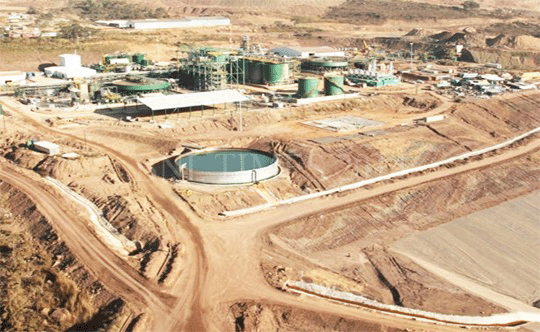
Paladin Energy’s Kayelekera uranium mine in Malawi provides a case study of the problems with Australian mining companies in Africa. Western Australia-based Paladin exploited Malawi’s poverty to secure numerous reductions and exemptions from payments normally required by foreign investors.
United Nations’ Special Rapporteur Olivier De Schutter noted in a 2013 report that “revenue losses from special incentives given to Australian mining company Paladin Energy, which manages the Kayelekera uranium mine, are estimated to amount to at least US$205 million (MWK 67 billion) and could be up to US$281 million (MWK 92 billion) over the 13-year lifespan of the mine.”
“The irony of the North Korean denuclearisation deal could be that everybody else decides to go nuclear. If it fails and Kim remains in power and countries doubt our commitment, then what’s to stop Japan or South Korea or Australia going nuclear?”
Trump triggers talk of Australia going nuclear, SMH, By Peter Hartcher
Should Australia develop its own nuclear weapons? It seems an outlandishly radical thought for such a safe country to consider. But a former adviser to Malcolm Turnbull and Julie Bishop thinks it’s an idea whose time is fast approaching.
In his book Why Australia Slept, launched this week, Peter Hendy says that Australia needs to consider nuclear weapons because “if we could financially afford them, [they] would secure an even more independent foreign policy” for the country.
Hendy, a former Liberal federal MP, former head of the Australian Chamber of Commerce and Industry and now a consultant, is not the first to raise this delicate subject. The way things are going he won’t be the last.
Three former deputy secretaries of Australia’s Defence Department – strategists Hugh White, Paul Dibb and Richard Brabin-Smith – have mooted the idea in the past year. Till these most recent months, it’s been something of a taboo topic in respectable circles.
One big reason? Australia already has the protection of the United States nuclear umbrella. Under this system, the US pledges that if anyone should launch a nuclear strike on one of its allies, Washington would retaliate against the aggressor.
So to suggest that Australia now needs its own atomic arsenal is to suggest that there has been a fundamental breakdown in trust. In short, that the US alliance is dead. Continue reading →
Australia needs to reset the relationship with China and stay cool The Conversation Tony WalkerAdjunct Professor, School of Communications, La Trobe University,
Let’s call it the “China syndrome”. This describes a condition that is a bit compulsive and not always rational.
Australia’s response to China’s continuing rise mixes anxiety, even a touch of paranoia, with anticipation of the riches that derive from the sale of vast quantities of commodities.
Economic dependence on China is two-edged and potentially policy-distorting.
To put this in perspective: Australian exports of goods and services to China in 2016-17 were worth $110.4 billion. That accounts for nearly 30% of total exports. This compares with $20.8 billion for the US, or 5.16% of total exports. The EU (including the United Kingdom) accounted for $30.5 billion, or 9.8%.
In other words, nearly one-third of Australian goods and services trade is hinged to the China market. Putting it mildly, such a level of dependence on a single market is not ideal……….
What is lacking in Australia’s approach to its relationship with China is consistency, so the government speaks with one voice and, where possible, separates domestic politics from the conduct of China policy. ……..
the greatest risk for Australia is that an erratic Trump administration will undermine a rules-based international order critical to Australian security.
Canberra’s diplomatic efforts over many years have been aimed at drawing Beijing into a rules-based system, promoting certainty in China’s behaviour as a “responsible stakeholder”.
That longstanding impulse of Australian foreign policy is now under stress.
The Australian government needs a reset of the relationship that would move the two countries past a difficult stage caused by a combination of misunderstanding and loose talk.
Australian officials also need to bear in mind that, in a region in flux, Australia’s Asian neighbours are accommodating themselves to new realities at warp speed. Old certainties such as the validity of US security guarantees are being questioned.
US calls on Australia to pressure Iran out of nuclear weapons program, Perth Now, Peter MitchellAAP, US Secretary of State Mike Pompeo has called on Australia and other nations to help execute the Trump administration’s tough new campaign to ensure Iran “has no path to a nuclear weapon – not now, not ever”.
Pompeo, in his first major foreign policy speech since becoming secretary of state, on Monday used fiery language to outline America’s strategy after US President Donald Trump earlier this month defied the wishes of Australia, France, Great Britain and other allies and pulled out of the Iran nuclear deal.
He said the US was ready impose the “strongest sanctions in history” against Iran and listed 12 demands the regime must follow, including providing the International Atomic Energy Agency with unqualified access to all sites throughout Iran.
“In the strategy we laid out today, we want the support of our most important allies and partners in the region and around the globe,” Pompeo said in his address to the Heritage Foundation in Washington DC.
“Certainly our European friends, but much more than that.
“I want the Australians, the Bahrainis, the Egyptians, the Indians, the Japanese, the Jordanians, the Kuwaitis, the Omanis, the Qataris, the Saudi Arabians, South Korea, the UAE, and many, many others worldwide to join in this effort against the Islamic Republic of Iran…….. Australian Prime Minister Malcolm Turnbull said on May 9 he regretted Mr Trump’s decision to pull out of the 2015 Iran nuclear deal between Iran and the US, Britain, Russia, France, China and Germany.https://www.perthnow.com.au/politics/donald-trump/us-calls-on-australia-to-pressure-iran-out-of-nuclear-weapons-program-ng-b88843974z
Boost to nuclear-power: Two Australian firms in talks to export uranium to India, The Indian Express, by Anil Sasi | New Delhi May 2, 2018
Two Australian companies BHP Billiton, the world’s biggest mining company, and Heathgate Resources, an affiliate of US company General Atomics, are in discussions with the Department of Atomic Energy (DAE) for exporting uranium to India.
A sales contract for enabling the transfer, which is part of the ongoing commercial negotiations between Australian uranium vendors and India’s DAE on fuel contracts for civil nuclear-power generation, is currently under discussion, officials indicated…..
A steady supply of uranium is good news for the country’s nuclear power sector, something that is expected to boost the performance of Indian nuclear power plants, as well as of several fuel cycle facilities.
Former Australian Prime Minister Tony Abbott had signed an agreement with Prime Minister Narendra Modi for civil nuclear cooperation in September 2014, clearing the way for uranium sales. Australia’s current PM, Malcolm Turnbull, had said in April last year that he was looking forward to exporting uranium to India “as soon as possible” after holding talks with the Indian PM. Ongoing discussions with Melbourne-based BHP and Adelaide-based Heathgate Resources are aimed at formalising commercial contracts to enable uranium shipments to India. …….http://indianexpress.com/article/india/boost-to-nuclear-power-two-australian-firms-in-talks-to-export-uranium-to-india-5159318/
Emmanuel Macron, Malcolm Turnbull fear looming demise of Iran nuclear deal Financial Review 1 May 18by Andrew Tillett
Last-ditch efforts to prevent the Iran nuclear agreement from completely collapsing will feature in talks between Prime Minister Malcolm Turnbull and French President Emmanuel Macron on Wednesday, amid the growing likelihood Donald Trump will ditch the deal.
Australia has expressed its support for retaining the agreement, which requires Iran to curtail the development of nuclear weapons in return for economic and diplomatic sanctions being lifted, in a rare split with the White House.
During Mr Turnbull’s recent European visit, Germany Chancellor Angela Merkel and NATO Secretary-General Jens Stoltenberg both pressed upon him their concerns that Mr Trump will not certify the agreement by the May 12 deadline.
……Foreign Minister Julie Bishop said Australia’s position was that the agreement – formally known as the Joint Comprehensive Plan of Action (JCPOA) – should remain in place until such time as an alternative could be negotiated.
“I have made our views clear to the Trump administration and again during my recent discussion with US Secretary of State Mike Pompeo,” Ms Bishop told The Australian Financial Review.
“Our ongoing political support for the JCPOA is based on advice from the International Atomic Energy Agency that the deal is providing verifiable assurances on Iran’s nuclear program.
…..Lowy Institute non-resident fellow Anthony Bubalo said Australia was a peripheral player in the debate but Canberra would be “very conscious of any implications” a US withdrawal would have for negotiations with North Korea. Far from sending the “right message” to Kim Jong-un, it signalled to North Korea not to trust a deal struck with an US administration.
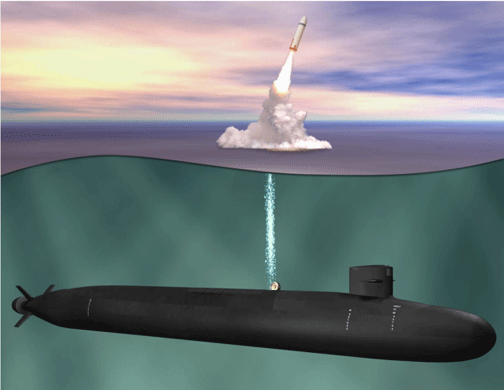
Washington report floats US nuclear attack subs and warships in Perth THE AUSTRALIAN, CAMERON STEWART, Washington correspondent@camstewarttheoz, –25 Apr 18
US nuclear attack submarines and navy warships should be based in Perth in response to China’s growing power projection into the Indo-Pacific, a new US report warns.
The report says Australia and its allies must “spotlight and push back” against China’s stepped-up efforts to project power and build military infrastructure in the region.
……..The report also comes a week after it was revealed that three Australian warships were challenged by the Chinese military as they travelled through the disputed South China Sea early this month.
Tensions between Australia and China have risen sharply, with China’s ambassador to Australia warning last week that the relationship between the two countries had been marred by “systematic, irresponsible and negative remarks” about China.
Beijing has not hosted a senior Australian minister for several months and was highly critical of Malcolm Turnbull’s new security laws announced last year to protect Australia from foreign interference.
Former prime minister Kevin Rudd this week further accused the current Prime Minister of undermining Australia’s relationship with China, saying Mr Turnbull’s public remarks about our largest trading partner were tantamount to “punching the Chinese in the face”……..
the CSIS calls for a range of measures, including a rotational presence of US warships at HMAS Stirling in Perth.
It also calls on the Turnbull government to “consider the possibility of investing in the nuclear support infrastructure necessary for the basing of (US) attack submarines as well”.
These military options have been considered by the Turnbull and Abbott Coalition governments and by the Gillard and Rudd Labor governments but they have never been acted upon.
The two leaders have held bilateral talks in Sydney.
Political editor Barry Soper told Larry Williams it was a charm offensive, and nothing substantial has come out of it.
He says the issues that were outstanding going into the talks remain outstanding, after them.
“It’s important, I guess, to keep a very good relationship with them but I don’t think we should allow ourselves to be bullied and to some degree, I think that’s what the Australians do to them.”







 Antinuclear