Australian governments finally admitting the dire fate of the Great Barrier Reef
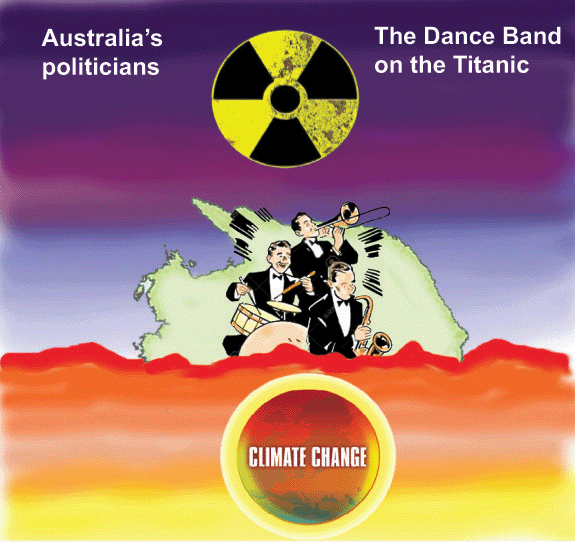 Australian governments concede Great Barrier Reef headed for ‘collapse’ The Age, By Nicole Hasham, 20 July 18 , The world’s climate change path means the Great Barrier Reef is headed for “collapse” according to a plan endorsed by state and federal governments that critics say turns a blind eye to Australia’s inadequate effort to cut carbon emissions.
The federal and Queensland governments on Friday released a “new and improved” Reef 2050 Plan to save the iconic natural wonder, which explicitly acknowledges climate change poses a deadly threat to the reef.
The comments depart starkly from previous official efforts to downplay damage wrought on the reef for fear of denting the tourism industry.
Based on current climate projections, the outlook for coral reefs generally is “one of continuing decline over time, and in many regions, including the Great Barrier Reef, the collapse and loss of coral reef ecosystems”, the plan says.
It concedes that consecutive coral bleaching events and other stressors “have fundamentally changed the character of the reef”, which is one of the most diverse ecosystems on the planet. “Coral bleaching is projected to increase in frequency … those coral reefs that survive are expected to be less biodiverse than in the past,” the plan says.
The reef is the world’s largest living structure, covering an area roughly the size of Italy.
Coral reefs are particularly sensitive to the effects of climate change including higher sea temperatures, ocean acidification and more intense storms and cyclones.
The plan recognised that “holding the global temperature increase to 1.5°C or less is critical to ensure the survival of coral reefs”.
However WWF-Australia head of oceans Richard Leck said Australia’s emissions reduction efforts were not even in line with limiting warming to 2°.
He cited a 2017 report by the United Nations environment program that found Australia’s greenhouse gas emissions were set to far exceed its pledge under the Paris accord. This agreement aims to limit global temperature rises this century to well below 2° and to pursue efforts to limit the increase to 1.5°.
“It is simply not good enough for the revised plan to suggest the global community must work to limit warming when Australia is not doing its fair share,” Mr Leck said.
The Australian Marine Conservation Society’s reef campaign director Imogen Zethoven said increased recognition of climate change as a threat to the reef must be followed by action…….https://www.theage.com.au/politics/federal/australian-governments-concede-great-barrier-reef-headed-for-collapse-20180720-p4zsof.html
Planned nuclear dump sites – Access denied to Barngarla Native Title Representative Body.
 Everybody For A NUclear Free Future, 14 July 18, After claiming there was no aboriginal heritage issues at the proposed Kimba suppositories, DIIS denies entry to Barngarla Native Title Representative Body.
“We wrote to the department on 21 February requesting access for sites, for the purposes of that assessment being carried out, and advising that the DAC would contact the department after that assessment had been complete for the purpose of working a way forward for these consultation processes. The department advised that they couldn’t provide access to the sites. You’ve been provided a redacted version of the report. The material that was provided following our initial submissions—I think that was only provided to you in the last few days—is somewhat compromised, but it has identified that there are nine confirmed sites and nine potential sites that are affected.
As part of that assessment team, which included some of the DAC board members here. Mr Brandon McNamara, who’s a Barngarla elder, invited the department to come along to a board meeting on 3 March and that invitation was declined. There were also statements made to the assessment team that the engagement of Dr Gorring to carry out the assessment was premature, which we find quite surprising. If the department has already issued statements that there’s no heritage and not provided information about what heritage assessments of its own it has made, to then make a comment that for Barngarla to carry out its own heritage assessments was premature is a bit surprising.”
ENuFF[SA]
Office Admin
https://www.facebook.com/sanuclearfree/
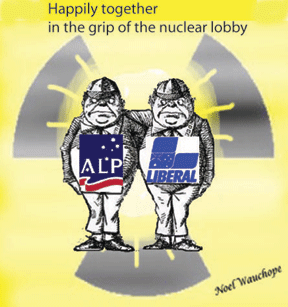
Labor Senator Alex Gallacher shows his pro nuclear colours at Hawker meeting on Nuclear Waste Dump Siting
 Katrina Bohr No Nuclear Waste Dump Anywhere in South Australia, 6 July 18
In a conversation, he declared there is no difference between transporting uranium or radioactive waste.
He condones the continued export of nuclear medicines, which will continue to feed the waste here.
I felt during the proceedings that he wasn’t showing impartiality.
He made disparaging remarks about certain evidence presented during the day.
I like to know who. ….. https://www.facebook.com/groups/1314655315214929
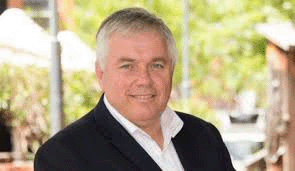
Senator Rex Patrick in Whyalla – concerned that nuclear waste facility in South Australia is already a ‘done deal’
 Senator talks nuclear, Whyalla News, Louis Mayfield , 6 July 18
Centre Alliance Senator Rex Patrick recently visited Whyalla ahead of two public hearings in Kimba and Hawker for the federal inquiry into the selection process for a national radioactive waste management facility.
Senator Patrick, who initiated the senate inquiry, said he was ‘very concerned’ how fair the selection process for the site had been so far.
“At these hearings we want to hear different perspectives from people in the community not so much on whether there should or shouldn’t be a facility, but on whether this process has been run fairly.”
Mr Patrick said there is a site in Western Australia which has ‘considerable support’ as a location for a nuclear waste facility, and believes it should be included in the nuclear discussion.
“We shouldn’t be holding back on that particular site. My worry is that even if we get across the line in Kimba or Hawker, we’ll have a bitterly divided community,” he said.
“It’s simply better to find a site with broad community support and recognise that as a very positive thing for such a facility That’s why I don’t want the Western Australia site ruled out.”
However Mr Patrick is concerned that the decision to establish a low-level nuclear waste facility in South Australia is already a ‘done deal’, given statements made by Resources Minister Matt Canavan……..https://www.whyallanewsonline.com.au/story/5511488/senator-talks-nuclear/
At Liberal National Party Convention, Turnbull will be urged to develop nuclear power, with popular Queensland coast sites recommended
 Seaside gems eyed for nuclear power plants
The Turnbull Government will be urged to consider developing a nuclear power industry under a plan to be debated at the LNP convention, with two of the potential locations being popular seaside areas in southeast Queensland.
https://www.couriermail.com.au/news/queensland/lnp-convention-to-debate-introduction-of-nuclear-power-plants-to-queensland/news-story/9d38d49acd7d6f6fb504f95e8183c311 July 5, 2018
THE Turnbull Government will be urged to consider developing a nuclear power industry under a plan to be debated at the LNP convention.
The controversial resolution, proposed by Fairfax MP Ted O’Brien’s branch, could lead to a plan for generators across the country if it is adopted by the party and then acted on by the government. The branch does not list possible sites for nuclear power plants in the resolution but urges the Federal Government to “consider the feasibility of nuclear powered energy generation in Australia”.
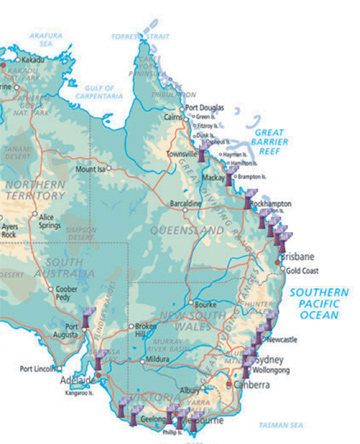
A 2007 Australia Institute study identified 17 suitable sites for nuclear power plants including six in Queensland — Townsville, Mackay, Rockhampton, Bundaberg, the Sunshine Coast and Bribie Island.
That study chose locations using key criteria including existing electricity infrastructure, centres of demand, transport infrastructure and access to large quantities of water for cooling and warned setting up a nuclear industry in Australia could prove unpopular.
“If the Federal Government decided to promote the establishment of a nuclear power industry in Australia, the siting of the power plants is likely to be one of the most politically contentious issues,” the report said.
“In Australia, approximately half of the population opposes nuclear energy and two thirds say they would oppose a nuclear power plant in their local area.”
The Fairfax LNP branch has proposed three separate resolutions on energy policy to be debated at the convention, which starts in Brisbane on Friday. Other resolutions from the branch call on the government to “reduce the high level of subsidy paid to the renewable energy industry” and “support the building of new Coal Fired Power Stations that have the capacity to produce reliable and economic power”.
Resolutions that are adopted by the LNP convention are not binding on the government. Mr O’Brien could not be reached for comment
Liberal National Party Queensland ‘s dead end pursuit of nuclear power for Australia
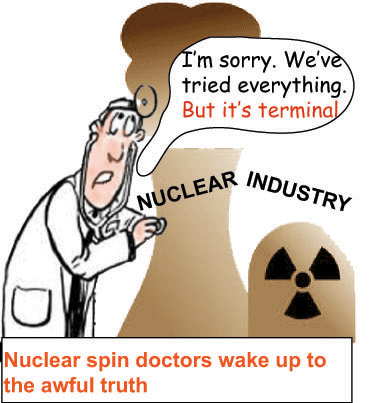 Stop flogging the dead horse of nuclear power
https://www.dailytelegraph.com.au/rendezview/stop-flogging-the-dead-horse-of-nuclear-power/news-story/5925d0dc48f1a7ff7d6a9f90ae07533a, Terry Sweetman 6, 2018
IN the eternal search for a headline, there are few things more predictable than political conventions.
They are places to air outlandish ideas that give the lower party ranks some illusion of influence and to float pet notions. They are also the place to flog dead horses. And there can be few horses more dead than the idea of nuclear power in Australia.
But undaunted by history, Ted O’Brien’s Fairfax branch of the Liberal National Party will urge the Federal Government to consider a nuclear power industry when it takes the floor at the LNP’s state convention beginning today.
Fortunately, the decisions of the convention are not binding on the Government and, I suspect, the suggestion will be allowed to die a natural death.
The problem for the proponents of nuclear power is that we’ve been down this track before and not all that long ago. In fact, we’ve been talking about nuclear power since 1952 when then South Australian premier Thomas Playford confidently proposed that one be built on the shores of Spencer Gulf. The next and probably most serious proposal was to build one on Commonwealth territory at Jervis Bay in 1969 but this idea went into meltdown when the locals got nervous and the unions got aggro.
Ted O’Brien’s Fairfax branch of the LNP will urge the Federal Government to consider nuclear power, despite the fact every party knows it could simply never happen.
 And so it went on over the decades, with the idea intermittently erupting like a dyspeptic belch and then subsiding. It got almost serious in 2006 when Prime Minister John Howard was starting to accept at the very least the idea of containing emissions even if climate change was a bridge too far. He launched what he called a “full-blooded debate” and commissioned a report by former Telstra chief Ziggy Switkowski who reckoned we could have the first nuclear reactor in Australia (he meant power stations as we already have a reactor) in as soon as 10 years. The headline was that we could have 25 nuclear stations producing a third of Australia’s electricity by 2050.
What took the fizz out of the fission was just where these 25 reactors would be built.
Opposition Leader Kim Beazley and Kevin Rudd taunted Howard to name the sites but he refused to be drawn on specifics, leaving others to draw their own conclusions.
The four main criteria for the siting of nuclear power plants in Australian had generally been accepted as proximity to appropriate existing electricity infrastructure; proximity to major load centres (i.e. large centres of demand); proximity to transport infrastructure to facilitate the movement of nuclear fuel, waste and other relevant materials; and access to large quantities of water for cooling.
The Australia Institute took these criteria (plus a few others) and pinpointed 17 places that seemed to fit the bill. Seven of the prospective sites were in Queensland: Townsville, Mackay, Rockhampton, Gladstone, Bundaberg, Sunshine Coast and Bribie Island. (The Sunshine Coast sites are in the seat of Fairfax and Bribie is in Longman, where a crucial by-election is being fought and the LNP quite possibly could do without this distraction.)
The Australian Institute is routinely disparaged as “left leaning” but I saw nothing then or since to challenge its conclusions on prospective nuclear sites.
The earthquake and tsunami in the Miyagi prefecture in Japan sparked a nuclear disaster in 2011.
In 2006 the Institute reckoned about half of the population opposed nuclear energy and “two thirds say they could opposed a nuclear power plant in their local area’’. If the nuclear industry was still looking at the same backyards, it is reasonable to presume it would come up against the same public sentiment.
The other problem was that Switkowski concluded nuclear power was likely to be between 20 and 50 per cent more costly to produce than power from a new coal-fired plant.
Unless they have been major advances in nuclear technology in the past 12 years, that same formula would apply.
In 2006, Switkowski was able to breezily report: “Since Three Mile Island in 1979 and Chernobyl in 1986, the nuclear industry has developed new reactor designs which are safer and more efficient.’’ Then along came Japan’s Fukushima disaster.
These are the sorts of things the old folk seeing out their days in the sun on Bribie have plenty of time to think about.
If the motion is debated seriously this weekend, proponents may be able to produce much in the way of supportive technical and financial evidence, even warming up the Switkowski report. But that will count for nothing when it comes to the Not In My Backyard syndrome and politicians of all shades know it.
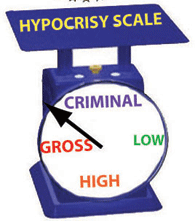
Breathtaking hypocrisy of nuclear enthuisiasts Minister Josh Frydenberg, and Rowan Ramsey
 Paul Waldon Fight To Stop Nuclear Waste Dump In Flinders Ranges SA,
An excerpt from Rowan Ramsey’s news letter…
[“Minister Josh Frydenberg visit to Wilpena and Rawnsley Park.” Members of the SA Department for Environment and Water discussed their pursuit of a nomination for World Heritage for parts of the Flinders ranges with Federal Environment Minister Josh Frydenberg, Rowan and State Tourism Minister David Ridgeway in May.
The department is engaged in conversations with stakeholders to proceed. Both the Minister and Rowan also attended the 50 year celebration of tourism at Rawnsley Park. Congratulations to the Smith family on the world class experience they have created and their role in increasing the profile of tourism in the Flinders Ranges.] So I put it to everyone, what is Josh Frydenberg’s and his coterie’s sudden interest in World Heritage, Tourism or the environment of the Flinders, and politics.? https://www.facebook.com/groups/344452605899556/
Voting in Flinders Ranges Council is open to a broad range of people


Voting in council elections is open to a broader range of people than state and federal elections.
The voters’ roll for council elections consists of two components – the House of Assembly (State) roll, and the council supplementary roll.
If you are on the State (House of Assembly) electoral roll you will automatically receive a voting pack in the mail in late October 2018.
If you are not enrolled on the House of Assembly roll you may be eligible to register on the council supplementary roll if:
You have been resident at your current address for one month and are not on the State Electoral Roll;
You are a sole owner/occupier of rateable property;
You are NOT an Australian Citizen but you have been a resident at your current address for one month;
You are a landlord for rateable property;
You are an organisation/business owner or occupier of rateable property; or
You are a group of owners or occupiers of rateable property.
To register for Council’s Supplementary Voters Roll please download the appropriate form from Councils website here: http://www.frc.sa.gov.au/election
Nuclear enthusiast Matt Canavan keen to quickly wrap up waste dump site in Flinders Ranges
“I would be chuffed if we can find a solution, we’re very close, we have two communities in South Australia that have voted in favour of considering a site.
“In a couple of months time, they will vote again on whether to accept our detailed proposal.
“I’m quietly hopeful, but it’s now in the communities hands.
“If we can’t find a site for low-level waste… the idea that we build a full-blown nuclear power reactor’s probably a pipe-dream.”
He tells Ben the reason government hasn’t acted on nuclear is that Australia has such easy access to other resources.
“We have cheap coal or gas, or we have in the past… so we haven’t probably needed to look for the alternatives as much as some other countries have been forced to do.
“We are the world’s largest producers of uranium but we don’t have any nuclear power plants here.”
Regina McKenzie’s detailed letters to Minister Matt Canavan ask the hard questions about the proposed Barndioota nuclear waste dump
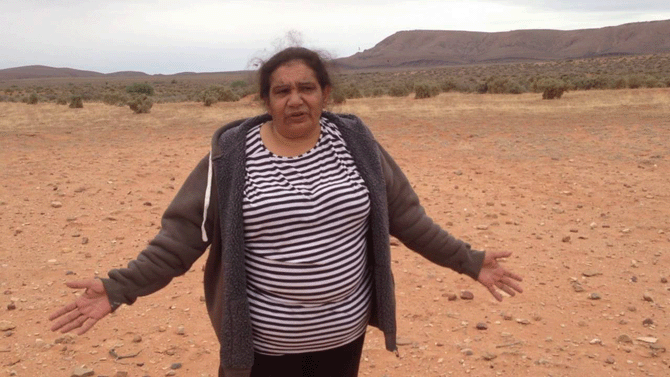
- The Commonwealth Government commitment to not harm Aboriginal cultural heritage has failed and requires urgent reparation/damage assessment.
Senator Rex Patrick questions the government’s big submarine spend-up
Was this much too expensive choice made because these submarines could easily be converted to nuclear submarines?
THIRTY BILLION DOLLARS OF QUESTIONS
Australia’s Future Submarine program could blow out by billions, Senator Rex Patrick warns
This week I revealed in Parliament that the Coalition Government’s choice of the French submarine builder as the preferred partner for the Navy’s Future Submarine will cost taxpayers $30 billion more than the price offered by the unsuccessful German builder.
The Government is refusing to explain the difference in cost.
We’re talking a whopping $30 BILLION. That’s $30 billion that could have been better spent on other defence projects or even health, education and/or infrastructure. I will be pursuing this further.
Here is my question to the Defence Minister this week.
You can also read more here: https://rex.centrealliance.org.au/…/releases/thirty-billion/.
Liberal Coalition attacks on the ABC will rebound against them
James Cogan’s speech at Sydney rally to free Julian Assange
Constant attacks on the ABC will come back to haunt the Coalition government The Conversation Senior Research Fellow in the Centre for Advancing Journalism, University of Melbourne,
In January 1931, as the newly elected United Australia Party government of Joseph Lyons was contemplating the establishment of a national broadcasting service, the prime minister received a deputation of prominent Melburnians, including a barrister and member of the Victorian parliament, Robert Gordon Menzies.
They urged that the new broadcasting service “be organised on an independent basis and that cultural potentialities of the Broadcast Service be considered a matter of primary importance”. The broadcast service came to be named the Australian Broadcasting Commission and went to air for the first time on July 1 1932.
It is a measure of how far today’s Liberal Party has drifted away from the values and ideals of its founder, Menzies, that last Saturday its federal council should have resoundingly adopted a motion that the ABC should be privatised.
One of the proponents of the motion was Mitchell Collier, the federal vice-president of the Young Liberals. He said there was no economic case to keep the broadcaster in public hands.
No economic case. Where the ABC is concerned, that is a false premise on which to proceed. The ABC was explicitly not established for economic purposes or in pursuit of an economic ideology. It was established for social, educational and cultural purposes.
It was also established on an explicitly non-commercial basis: it takes no advertising. Why? Because it was believed advertising would weaken its independence. The policymakers of the 1930s had seen only too clearly how beholden the newspaper proprietors of the day had become to commercial imperatives: the demands of advertisers and the pressure to increase circulation, even at the cost of editorial quality and integrity.
The newspapers of the day had also become mouthpieces for sectional interests. In Melbourne, The Argus stood for the interests of the mercantile classes and conservative political causes; The Age for a kind of Protestant liberalism and social justice. It supported the miners at Eureka.
The bipartisan political vision for the ABC was that it should not be vulnerable to sectional interests or commercial pressures, but should exist to serve the public interest in the widest sense.
The first paragraph of its charter captures the essence of these expectations:………
A motion to privatise the ABC, no matter how vigorously repudiated by the government, is political poison, especially in regional, rural and remote Australia.
These voters have watched as the Abbott-Turnbull administrations have cut the ABC’s funding by $338 million since 2014. They have watched as the ABC has been used – in Guthrie’s words yesterday – as a punching bag by narrow political, commercial or ideological interests
Guthrie was too diplomatic to nail the government or the Murdoch press. But the overt hostility to the ABC shown by the government over the past four years may now reap a political harvest.
That hostility has been demonstrated not only by the funding cuts but by sustained carping criticisms, vexatious complaints and political stunts exemplified by the current competitive neutrality inquiry.
It would be more accurately called the editorial neutering inquiry. Its focus is clearly on the ABC news service, as its own issues paper makes clear. That is the part of the ABC most detested by the government and the politician for whom the government is a cat’s paw in this, Pauline Hanson.
Each Tuesday, I engage in a pro-bono 25-minute segment on media issues with the presenter of ABC Radio Statewide Drive, Nicole Chvastek. The program is broadcast across regional Victoria and southern New South Wales, covering the National seats of Riverina, Mallee, Murray and Gippsland, and the Liberal seats of Farrer, Wannon, McMillan, Corangamite and McEwen.
Yesterday the talkback calls ran hot on this one issue: privatisation of the ABC. Yes, the ABC needed scrutiny; yes, the ABC was a bunch of lefties. But: where would we be without it?
Just after 5pm, the Nationals served up their deputy leader, the Victorian senator Bridget McKenzie, to answer talkback calls on this issue. It was like something from the Colosseum. https://theconversation.com/constant-attacks-on-the-abc-will-come-back-to-haunt-the-coalition-government-98456?utm_medium=email&utm_campaign=Latest%20from%20The%20Conversation%20for%20June%2021%202018%20-%20104619234&utm_content=Latest%
Australian govt rushing decision on nuclear waste dumping, avoiding Senate Inquiry report, and before next election

With the Senate not reporting on this until August 14, it is clear that this selection will be a rushed job. It is no doubt the government’s intention that the Senate Inquiry should be irrelevant.

Race to lock in nuclear dump before federal election https://www.theaustralian.com.au/national-affairs/race-to-lock-in-nuclear-dump-before-federal-election/news-story/b2ea0780ec1e6971cbce51abddb8ee6e MICHAEL OWEN SA Bureau Chief Adelaide @mjowen
A ballot to gauge community support in the small towns of Kimba and Hawker, about 450km north of Adelaide, for the facility will be held on August 20, Senator Canavan said.
“The decision will be made in the second half of this year … one way or another we need to make a decision,” he said. “We do not want this overlapping with a federal election. We have to find a solution.”
Senator Canavan told The Australian that economic benefits, including 45 direct jobs and a $10 million community fund, were behind support of more than 60 per cent in the communities affected by the proposal, following 18 months of consultation.
But Peter Woolfoord, president of a community group opposed to the facility, said Kimba was “completely divided” and insisted a waste repository should not be on agricultural land where “it poses unacceptable risks to our industry”.
Centre Alliance senator Rex Patrick said the site selection process “looks like an absolute sham” and claimed the Turnbull government was “determined to rush to select one of the South Australian sites despite there being a divided community”.
Senator Patrick said the government should properly engage with the remote mining town of Leonora, 240km north of Kalgoorlie in Western Australia, on its bid to host the facility.
Senator Canavan said there was already broad community support for three South Australian properties — two near Kimba, on the Eyre Peninsula, and Wallerberdina Station, near Hawker in the Flinders Ranges.
He said an “aggressive” push by the Azark company and the Shire of Leonora for a site on Clover Downs pastoral station, about 20km northwest of the central WA mining town, was a “plan B”.
“They want to run the facility themselves, which we haven’t ruled out … their initial scope was more focused on also taking overseas radioactive waste, which we definitely do not want,” Senator Canavan said.
“If we can’t get the support in South Australia we’ll most likely return to this other option (Leonora) as a plan B.”
The federal government has tried to find a site for a national radioactive waste management facility for more than a decade.
South Australian Premier Marshall’s pro nuclear stance, in agreement with nuclear stooge MP Troy Bell
 Marshall still open to nuclear power In Daily, Tom Richardson ADELAIDE April 11, 2018 Marshall today embarked on his third regional tour since seizing office at last month’s election, visiting the South-East seat of Mount Gambier where Liberal-turned-Independent MP Troy Bell is a firm advocate for nuclear power.
Marshall and Bell broke bread this morning, their second face-to-face meeting since election day.
Bell quit the party after being charged with dishonesty offences following an ICAC investigation. He is pleading not guilty in an ongoing court case……….
“I’ve always worked with Troy Bell… it’s quite obvious we share a lot of common aspirations for the people of the South-East,” he said.
One of those aspirations could yet be the establishment of a nuclear generator after Marshall last year flagged his interest in considering the industry, despite Royal Commissioner Kevin Scarce rejecting it as a commercially viable option “in the foreseeable future”.
“There will be a time when it may become viable, and desperate times call for desperate solutions – and we are in a desperate situation,” Marshall told media in February 2017.
Bell, who spearheaded the Liberals’ South-East fracking moratorium before he left the party-room, is a strong advocate for nuclear power and told InDaily he was “absolutely happy to lead the discussion” about establishing a local industry.
Asked if he would advocate for a nuclear generator in the South-East, he said: “A small modular one – yes definitely.”….https://indaily.com.au/news/local/2018/04/11/marshall-still-open-nuclear-power/
South Australian site selection for a national radioactive waste facility is a “sham”, as Western Australian private project is revealed

 South Australia nuclear waste site a “done deal: claims Senator Rex Patrick https://www.adelaidenow.com.au/business/sa-business-journal/sa-nuclear-waste-site-a-done-deal-senator-rex-patrick/news-story/08524bb4dc5004f467462b1591a55b1f, The Advertiser, Erin Jones, Regional Reporter, June 13, 2018
Centre Alliance senator Rex Patrick told The Advertiser the decision to establish a low-level facility at one of two sites in South Australia appeared to be a “done deal” following the revelation.
In August, Azark Project made a nomination to include the commercial operation of an underground storage facility, near the remote central mining town of Leonora, north of Kalgoorlie.
The South Australian senator, who visited Leonora, said the proposal appeared to have “considerable support” and unlike the two SA sites near Kimba and Hawker, did not need taxpayer funds to proceed.
“Resources Minister Matt Canavan needs to properly engage the proponents of the proposed site near Leonora or risk the whole selection process being confirmed as an absolute sham,” he said.
“It appears as though the new site is a ‘faster runner’ in the race, but won’t be allowed to participate because the Minister is determined to rush to select one of the South Australian sites despite there being a divided community.”
Azark Project chairman George Gear said the WA site had no environmental, land rights or water issues, and the proposal had support of the 2900 people in Leonora Shire.
Mr Gear said he had no confidence in the specially-formed government taskforce considering sites for the waste facility, given Leonora was not on the table.
“Apart from this being a superior site located in a mining area and in solid rock, this wouldn’t cost the taxpayer any money as it’s a private company that will build this,” Mr Gear, a former minister in the Keating government, said.
“The taskforce to date has either spent or committed $40 million and they haven’t finalised the project.
“Azark has completed all of its due diligence at its own cost and has offered to make it available to the taskforce — this invitation was not accepted.”
Mr Gear said Azark Project had decided to pursue the plan on its own, but was expected to meet Mr Canavan in Perth, today.
The Government is expected to decide in coming months whether to build the waste facility in SA, after a final ballot of Kimba and Hawker districts, on August 20.
Mr Canavan has previously said “broad community support” would be needed for the waste facility to go ahead — although no arbitrary figure has been provided.
The two-year site selection process has divided both communities — those in favour believe it would create economic opportunities, while those opposed say it will jeopardise industries.
The district where the waste facility is located would be rewarded by the government with a $10 million community fund to spend on local projects.
Both districts were already benefiting from a $4 million grants fund as a reward for being involved in the site selection process.
Senator Patrick this year successfully pushed for a Senate inquiry into the site selection process used for the national waste facility and an outcome is expected only days before the ballot, on August 14.
In a submission to the inquiry, Kimba’s mayor said more information on financial rewards and jobs was needed before the community voted in the ballot.
Mr Canavan did not respond to questions before deadline.

1 This month

of the week – Australians for War Powers Reform (AWPR)
To see nuclear-related stories in greater depth and intensity
 Antinuclear