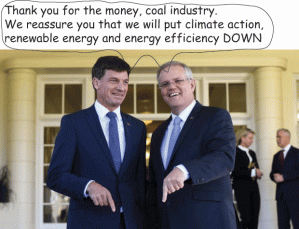
 Scott Morrison contradicts energy advice, saying Paris targets can be met ‘at a canter’, Guardian, Katharine Murphy Political editor@murpharoo 5 Sep 2018
Prime minister claims Australia will easily meet its obligations without an emissions reduction policy Scott Morrison is continuing to insist that Australia will meet its Paris climate commitments “in a canter” despite the government having no emissions reduction policies to achieve that result.The prime minister used a radio interview on Wednesday afternoon to declare “the business-as-usual model gets us there in a canter” –
which contradicts advice from the Energy Security Board that says business as usual will mean the electricity sector will “fall short of the emissions reduction target of 26% below 2005 levels”.
Even if the the ESB projections are wrong, and the electricity sector managed to reduce emissions by 26% with no policy to drive that result, the Paris target applies across the economy, not just to the electricity sector, and the government’s own data shows emissions in other sectors of the economy are rising.
Morrison told 2GB on Wednesday that business as usual “and technology and the amount of renewable technologies that are already in the system and not being subsidised off into the future means these [Paris] targets are hit”.
A summary of modelling undertaken by the ESB and released only a month ago said if no policy was put in place in the electricity sector – which is the business-as-usual case the prime minister refers to – emissions would fall initially, then flatten out and rise towards the end of the decade to 2030 as forecast demand increased, then dip again in 2029-30.
The ESB said if the national energy guarantee wasn’t implemented, the national electricity market would “fall short of the emissions reduction target of 26% below 2005 levels”.
On Wednesday the prime minister initially said that the renewable energy target was driving up power prices “and that’s why we are stripping [subsidies] out of the system”, then said later in the same interview that the biggest driver of higher power prices was gold-plating of the electricity networks.
Asked by his host on 2GB what was ultimately more important, complying with Australia’s international climate obligations, or lowering power prices, Morrison said: “Power prices.” He counselled against being “distracted by ideological debate”.
The ESB has warned that if governments fail to implement the national energy guarantee – the policy Malcolm Turnbull shelved to try and stave off the civil war that ultimately cost him the prime ministership – that will “prolong the current investment uncertainty, and deny customers more affordable energy”……..https://www.theguardian.com/australia-news/2018/sep/05/scott-morrison-contradicts-energy-advice-saying-paris-targets-can-be-met-at-a-canter
September 7, 2018
Posted by Christina Macpherson |
AUSTRALIA - NATIONAL, climate change - global warming, energy, politics |
Leave a comment
 Push to clamp down on activist charities
Senior Coalition government figures are pushing for politically active charities including Greenpeace and the Australian Conservation Foundation to lose their charity status in a pre-election crackdown… (subscribers only)
https://www.theaustralian.com.au/national-affairs/treasury/push-to-clamp-down-on-activist-charities/news-story/8961a55d2d68a488018f8727bb2ea838
September 7, 2018
Posted by Christina Macpherson |
AUSTRALIA - NATIONAL, civil liberties, politics |
Leave a comment
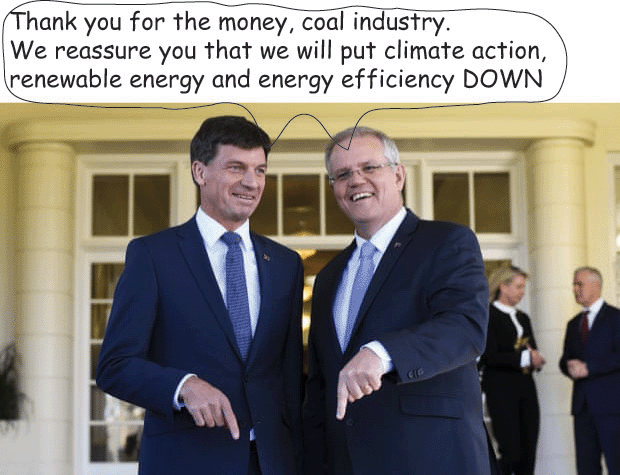
Just as we begin to imagine life without Tony Abbott undermining every sensible interaction between climate and energy policy, his “energy brain” in the form of the new energy minister, Angus Taylor, is now calling the shots.
Taylor has been fighting against the wind industry since the late 1990s, when developers came knocking, wanting to build a windfarm on his parents’ Monaro Plains property. The Taylor family turned down the opportunity, and the Boco Rock windfarm was instead built on the next ridgeline. Last year the windfarm generated enough zero-emissions electricity to power more than 70,000 average New South Wales households, and pumped $6.7m through the local economy.
Ever since that first approach, Taylor has been tilting at windmills.
Just two weeks ago, when Malcolm Turnbull was risking his prime ministership over a policy that would have done practically nothing for emissions, Taylor was busy working conservative talkback radio. Taylor boasted to Ray Hadley that he’s been speaking out against renewables policies “for many many years, well before anyone else … I argued in the party room many times to reduce it … I was able … to reduce the [RET] working with Tony as prime minister”.
While Taylor didn’t get everything he wanted, he did manage to cut 40% out of the renewable development pipeline……
for Australia, the chance of real progress is bleak under Team Morrison. It’s now clear that Taylor will continue Josh Frydenberg’s campaign of half truths and politicisation. When Taylor faced the media (sort of) for the first time in his new role last Thursday, he spoke forcefully of South Australia’s “failed experiment” with renewables.
The truth is that South Australia is an international model of success for energy transition. That such a statement goes so far against the orthodoxy shows the depravity of our national energy conversation – bear with me:
Exhibit A: Wind and solar have pushed coal completely out of South Australia and even displaced some gas. While the state imports 8% of its power from Victoria, it sends more in the other direction.
Exhibit B: Electricity prices in South Australia have always been high, but while its wholesale prices are lower than a decade ago in real terms, prices have risen elsewhere.
Exhibit C: Over the past decade, South Australia has reduced its electricity sector emissions by 56% from 10.1 MtCO2-e to 4.5 MtCO2-e.
Exhibit D: In the same decade SA cut its emissions intensity (measured in kg CO2-e/MWh) from 734 to just 340, five times as fast as the reduction in NSW, Victoria and Queensland.
Exhibit E: And while we’ve been regaled with endless stories about blackouts, the truth is that SA has only been caught short of generating power for 1.9 “load minutes” this decade (0.00004%), down from 16.8 load minutes last decade (0.00032%).
If Taylor genuinely wants to clean up his mess, the prescription is simple:
- Tell the truth – our grid is reliable and renewables aren’t the cause of high prices.
- Depoliticise energy – industry is crying out for bipartisan policy certainty.
- Respond to the science – any policy that’s incompatible with climate science is not credible, and therefore unstable.
Unfortunately Taylor chose to reject all of the above in week one, condemning us to another round of deep stupidity on climate and energy.
Taylor has always been quick to claim he’s on board with the climate science. Yet, as Abbott’s protege, he’s chosen to spend his time in politics actively undermining sensible and effective climate and energy policy.
Angus Taylor is not a climate science denier – he’s much more dangerous.
September 7, 2018
Posted by Christina Macpherson |
AUSTRALIA - NATIONAL, energy, politics |
Leave a comment
 Scott Morrison contradicts energy advice, saying Paris targets can be met ‘at a canter’, Guardian, Katharine Murphy Political editor@murpharoo 5 Sep 2018
Prime minister claims Australia will easily meet its obligations without an emissions reduction policy Scott Morrison is continuing to insist that Australia will meet its Paris climate commitments “in a canter” despite the government having no emissions reduction policies to achieve that result.
The prime minister used a radio interview on Wednesday afternoon to declare “the business-as-usual model gets us there in a canter” – which contradicts advice from the Energy Security Board that says business as usual will mean the electricity sector will “fall short of the emissions reduction target of 26% below 2005 levels”.
Even if the the ESB projections are wrong, and the electricity sector managed to reduce emissions by 26% with no policy to drive that result, the Paris target applies across the economy, not just to the electricity sector, and the government’s own data shows emissions in other sectors of the economy are rising.
Morrison told 2GB on Wednesday that business as usual “and technology and the amount of renewable technologies that are already in the system and not being subsidised off into the future means these [Paris] targets are hit”.
A summary of modelling undertaken by the ESB and released only a month ago said if no policy was put in place in the electricity sector – which is the business-as-usual case the prime minister refers to – emissions would fall initially, then flatten out and rise towards the end of the decade to 2030 as forecast demand increased, then dip again in 2029-30.
On Wednesday the prime minister initially said that the renewable energy target was driving up power prices “and that’s why we are stripping [subsidies] out of the system”, then said later in the same interview that the biggest driver of higher power prices was gold-plating of the electricity networks.
Asked by his host on 2GB what was ultimately more important, complying with Australia’s international climate obligations, or lowering power prices, Morrison said: “Power prices.” He counselled against being “distracted by ideological debate”.
The ESB has warned that if governments fail to implement the national energy guarantee – the policy Malcolm Turnbull shelved to try and stave off the civil war that ultimately cost him the prime ministership – that will “prolong the current investment uncertainty, and deny customers more affordable energy”……..https://www.theguardian.com/australia-news/2018/sep/05/scott-morrison-contradicts-energy-advice-saying-paris-targets-can-be-met-at-a-canter
September 6, 2018
Posted by Christina Macpherson |
AUSTRALIA - NATIONAL, climate change - global warming, politics |
1 Comment
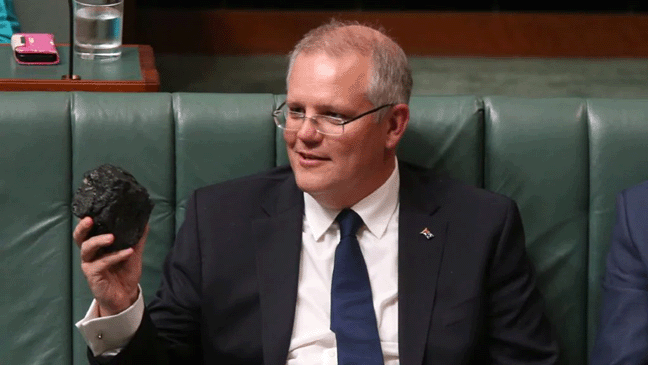
Options on energy policy leave Coalition in a sticky situation, Guardian, Katharine Murphy, 1 Sept 18, The government finds itself in a mess after the national energy guarantee was used as a catalyst to evict Turnbull.
We’ve lost another prime minister in the front bar brawl that is Australian politics, but we’ve lost something else as well, something that’s a bit harder to see.
For the last decade or more, a group of people in the political system have been trying to land a bipartisan consensus on energy policy and climate change, persevering through all the dispiriting cycles of trying to achieve that end, hoping that a corner could be turned.
That animating current in politics, and it’s been a significant one, now seems to have hit a dead end. That’s the feeling. We’ve reached a point of no return
If that supposition proves to be correct, this a profound problem for the country, more profound than the revolving door at the Lodge, which is deeply disconcerting, but just one symptom of a deeper malaise.
The Coalition is in a terrible mess on this issue. The national energy guarantee, the last roll of the dice for consensus, was used as a catalyst to blow up a prime minister, just as emissions trading was deployed for the same end, removing the same party leader, in 2009.
As a consequence of that rancid history, the imperative of emissions reduction now hangs over Liberal leaders like the sword of Damocles. Any leader wanting to do something knows they will have to run the gauntlet of the conservatives, and the brains trust of the conservative faction has proven itself so resistant to facts and evidence that it can’t even count numbers for a leadership spill………
The Morrison government is in a position where it is a signatory to the Paris agreement, yet there are no policies to deliver the outcome. There is a talking point doing the rounds that Australia will meet its Paris commitments “in a canter” – but this is complete nonsense.
It is possible (although the Energy Security Board says otherwise) that we could reduce emissions by 26% in the electricity sector without a settled policy to get us there because emissions in the sector are already falling (because ageing coal is leaving the system and the renewable energy target has pulled forward investment).
But what about the rest of the economy? Emissions are rising elsewhere, and there is no plan or roadmap to curb them.
This government has dithered for years about the imposition of new emissions standards for vehicles. Ministers have not been brave enough to bring forward a concrete proposal because the Coalition party room would limber up for another implosion.
Then there’s agriculture. Many Nationals take it as a personal affront if someone suggests anything be done in agriculture. The fact that their own constituents are now being battered by horrendous drought and hanging on grimly in areas gradually being rendered unviable by inexorable climatic change is an irony that seems lost of many of our elected representatives.
So that’s the outlook on emissions. Now let’s ponder the concept of certainty.
The national energy guarantee was proposed to create policy certainty to help drive the correct mix of investment in Australia’s electricity generation assets. That was its purpose. That policy is now on the back burner.
What isn’t on the back burner is the new Morrison government’s need to deliver a fix on power prices once the prime minister has concluded the healing and stability tour. That’s on the front burner. But this is a problem with no easy fix.
The government slapped together a package of measures in the dying days of the Turnbull regime designed to lower power prices – work that would have normally taken months of careful deliberation in a cabinet subcommittee.
So now we have no over-arching mechanism for investment certainty, and a bunch of expedited measures proposed on the fly, including heavy handed market interventions, such as breaking up power companies if they don’t play ball with the government and lower prices.
Call me crazy, but that doesn’t sound like the building blocks of a stable investment climate……..https://www.theguardian.com/australia-news/2018/sep/01/options-on-energy-policy-leave-coalition-in-a-sticky-situation
September 3, 2018
Posted by Christina Macpherson |
AUSTRALIA - NATIONAL, climate change - global warming, politics, politics international |
Leave a comment
 Last week, I went to Port Augusta and Hawker to meet with residents fighting against the Federal Coalition Government’s plans to build a national nuclear waste dump in South Australia. It was great to see both the Kimba and Flinders Ranges communities working together to show that they are NOT the “willing” communities that the Government was hoping for.
This ill-conceived push by the Federal Government to dump low to intermediate level nuclear waste in regional South Australia has seen farmers, residents, business people, Traditional Owners, community campaigners and the Greens join together, united in their call for the dump to be dumped.
I was pleased to speak at the rally held in Port Augusta on 19 August, outlining the Greens’ continued opposition to the dump and highlighting the grossly mismanaged site selection process that the Federal Government has conducted and how divisive this has been to the affected South Australian communities.
I had timed my visit to the region to coincide with the ballot of local residents to gauge their views on the dump. However, days before the ballot papers were due to be sent out, the vote at both locations was postponed following a Supreme Court injunction brought by the Barngarla people – the Traditional Owners of much of Eyre Peninsula including land in the Kimba region.
The Barngarla people successfully argued that it was potentially a matter of racial discrimination to allow property owners to vote in the ballot, but not Native Title holders. Similar arguments apply to the Adnyamathanha people of the Finders Ranges, all of whom have strong attachments to the land, but most live outside the narrow area to be balloted. The case has now been referred to the Human Rights Commission.
Additionally, the people of Port Lincoln, Whyalla and Port Pirie are seriously concerned that they too have no opportunity to participate in the ballot. The Greens want to see the community consultation and ballot extended to local Traditional Owners as well as those living in the proposed nuclear waste ports or along the nuclear waste transport corridor.
Everyone who is potentially impacted by this plan should be included and their voices should be heard.
To have your voice heard, make a submission to Federal Minister for Resources Senator Matt Canavan via email at radioactivewaste@industry.gov.au by 24 September.
Let’s take this stand together.
August 31, 2018
Posted by Christina Macpherson |
Federal nuclear waste dump, politics, South Australia |
Leave a comment
‘Mad’ and ‘morally irresponsible’: Liberal moderates roast new emissions stance, Canberra Times By Nicole Hasham, 31 August 2018, Senior Liberal figures have labelled the Morrison government’s stance on climate change as “mad” and “morally irresponsible” as the party’s moderate wing reels at the ultra-conservative takeover of Australia’s energy policy.In his first speech as Energy Minister in Melbourne on Thursday, Angus Taylor reiterated the Morrison government’s intention to curb electricity prices, but made no mention of reducing greenhouse gas emissions created by burning fossil fuels for energy.
There will be no ideology in what I do … my goal, the goal of my department and the goal of the electricity sector must be simple and unambiguous – get prices down while keeping the lights on,” he said.
Mr Taylor did not take questions after the speech at the Council of Small Business of Australia summit in Melbourne, reportedly avoiding waiting media by retreating to a meeting room then leaving via a back door.
Prime Minister Scott Morrison on Thursday confirmed that responsibilities for meeting Australia’s emissions reduction targets under the Paris treaty will now fall to new Environment Minister Melissa Price.
The Coalition’s plans to legislate emissions reduction as part of its energy plan were shelved in the final days of Malcolm Turnbull’s prime ministership following a backlash from conservative backbenchers who threatened to cross the floor.
Fairfax Media spoke to several moderate senior Liberal Party figures dismayed at the direction of the Morrison administration’s energy policy and concerned at the appointment of Mr Taylor, who has campaigned against wind farms and renewable energy subsidies.
A senior NSW government source said the federal Coalition’s avoidance of emissions reduction was “just putting off the inevitable”.
“[They] are going to have to deal with it because that’s what the Australian public wants. Kicking it down the road is unhelpful,” the source said.
It’s been 10 years now and we are still no closer to getting this issue resolved. Nobody in Canberra can hold their heads up high in regards to this.”
A senior NSW Liberal MP said any politician who acknowledged the science of climate change was “morally obliged to do something about it”…….https://www.canberratimes.com.au/politics/federal/mad-and-morally-irresponsible-liberal-moderates-roast-new-emissions-stance-20180830-p500r2.html
August 31, 2018
Posted by Christina Macpherson |
AUSTRALIA - NATIONAL, climate change - global warming, politics |
Leave a comment
Business-SA published a regional survey today & despite widespread opposition they continue to pursue an international radioactive suppository. Like their Federal cronies, the ignorant BS credulity can only deliver divisive smokescreens of vain leadership divorced from the lives of the people they claim to provide for.
Anecdotally, some regional business owners in the Far North, members of B-SA; claim they had no knowledge of the survey prior to it’s release……
High Level Waste mentioned on pages:
p15 = 55% against overall;
p24 = Eyre Peninsular 41% anti 41% pro;
p27 = Far North including Port Augusta & Whyalla 50% pro 39% anti;
p32 = Murray/Riverland 50% anti:
p74 = Barossa 80% anti + KI 74% anti + SE 63% anti
http://business-sa.com/getmedia/35736f09-7f57-4cc7-bbff-e30bd4856077/Regional-Voice_Brochure
August 29, 2018
Posted by Christina Macpherson |
Federal nuclear waste dump, politics, South Australia |
Leave a comment
 ‘Kick This Mob Out’: Hanson-Young Takes Aim Over Climate Policy Paralysis https://newmatilda.com/2018/08/28/kick-mob-hanson-young-takes-aim-climate-policy-paralysis/ By Sarah Hanson-Young on August 28, 2018
The Liberal Party of Australia is now officially a party split in half by climate denial. Greens Senator Sarah Hanson-Young explains. We have no chance of seeing the Liberal Government take any type of climate policy to the election.
After dumping Malcolm Turnbull for daring to utter the words “carbon emissions”, Scott Morrison, the man who brought a lump of coal into the Parliament, has appointed a climate sceptic as Environment Minister. He has put an anti-wind farm campaigner at the helm of the Energy Ministry.
While Scott Morrison’s new front bench will spend the week sopping up blood and repeating unconvincing lines of “unity and renewal”, the rest of the country looks on in disgust.
As the nation burns in winter, drought ravages New South Wales, and the Murray Darling River runs to a trickle, the mob governing the country couldn’t give a damn.
In a last-minute attempt to save his own job, Malcolm Turnbull served a fatal blow to the environment making it near impossible for the Coalition to have a climate policy for at least a generation.
Roughly half of the Liberal Party room don’t believe in the science of climate change, and now their leader is a bloke whose pet rock is a lump of coal. A growing number of Australians, tired of waiting for leadership out of Canberra, are taking matters into their own hands. And the good news is, there’s plenty of ways to make a difference.
Whether it is about the waste we create, the food we eat and putting solar panels on our homes to reduce power bills and pollution, we all have the opportunity to help reduce our impact on the planet and environment. But, while everyday Australians are chipping in, our politicians are tapping out, and unfortunately, some problems can’t be solved without political leadership.
The environment needs a strong political advocate. Sadly, the people Scott Morrison has put in place will do nothing to alleviate fears of Australians worried about our impact on the health of the planet.
New Environment Minister Melissa Price is a climate sceptic and advocate for the mining industry, and Angus Taylor, a known anti-windfarm campaigner will put a wrecking ball through renewables as Energy Minister.
After all the internal drama that stopped the Government from governing last week, political leadership on climate change is further away than ever. Dumping any emissions reduction target means there is now no prospect of a roadmap to help drive pollution down or support a transition to renewables. This is worse than policy paralysis, it is policy regression.
We need strong action to save the Murray Darling River system for future generations, arrest climate change by reducing pollution, protect our oceans and stop the extinction crisis in its tracks.
The battle lines are clear. The only way to do any of this now is to kick this mob out.
August 29, 2018
Posted by Christina Macpherson |
AUSTRALIA - NATIONAL, climate change - global warming, politics |
Leave a comment
 Can’t vote Liberal ‘in good conscience‘: Alex Turnbull blasts climate stance , Brisbane Times, By Peter Hannam, 27 August 2018
 Alex Turnbull blamed “rent-seekers” backing the coal industry for
felling his father Malcolm Turnbull as prime minister, saying it’s “impossible” to vote for the Liberal-National coalition “in good conscience” because of its climate stance.
In a wide-ranging interview just days after his father lost power in a party room putsch, the Singapore-based fund manager told Fairfax Media the Liberal Party faced being hijacked by financial interests that stood to make windfall profits if coal-related assets were bolstered by taxpayers.
Those interests “have their hooks into the Liberal Party … which has no money”, Mr Turnbull said, adding that returns could be “100 to 1” if policies fall investors’ way.
Mr Turnbull’s experience includes a stint at investment banking giant Goldman Sachs. Some of his work has also involved trading debt for Australian-based coal-fired power plants, giving him insights into that industry’s outlook.
“If you create such an environment – with such a high rate of return – you’ll see a lot more of that [influence peddling],” he said……..
“It’s impossible to vote for the LNP in good conscience,” Mr Turnbull said, adding he had no intention of entering politics himself. “My father fought the stupid and the stupid won.”
Mr Turnbull was also critical of the government’s overall climate action, saying that pulling the Paris Agreement – as conservative MPs and pundits have been demanding – was irrelevant at this point.
“It’s like being in a university course, final exams are coming and you haven’t done three-quarters of the work,” he said. “You’re going to fail anyway.”……
He predicted Labor’s left would keep that party “honest” on climate change.
Bill Shorten “doesn’t really care about climate change – he just wants the jobs”, Mr Turnbull said, adding that there were lots of them in Victoria and elsewhere as the renewable energy boom rolls on.
Two terms of federal Labor should mean Australia’s electricity sector “would have crossed the magic line” – such as exceeding 40 per cent of supply from wind and solar. “They’re not going to be able to go back.”
Taking serious action on climate change “should be the response of any sane leader”, he said. https://www.brisbanetimes.com.au/environment/climate-change/can-t-vote-liberal-in-good-conscience-alex-turnbull-blasts-climate-stance-20180827-p50018.html
August 29, 2018
Posted by Christina Macpherson |
AUSTRALIA - NATIONAL, climate change - global warming, politics |
Leave a comment
Climate change is World War III, and we are leaderless, ABC News, 28 Aug18 By David Shearman
“,World War III is well and truly underway. And we are losing,” writes environmental activist Bill McKibben, so when Malcolm Turnbull implied that the insurgency that demolished his government was based on climate ideology, what lessons are there for Scott Morrison?
As a child in Britain during WWII, I lived in a street of mothers and children. ……..
Britain was a united and cohesive community. Young and old worked daily in small ways for the common cause. But most importantly, in the free world, two countries — Britain and the US — had leaders in Winston Churchill and Franklin D Roosevelt who could explain the need for duty and sacrifice.
Their like is yet to emerge today, and indeed the Western world is bereft, perhaps apart from French President Emmanuel Macron, who explained to Congress and the American people that secure borders are irrelevant to this threat, and all of us are world citizens needing to act in concert. “There is no Planet B,” he said.
He challenged Malcolm Turnbull to show leadership on climate change.
US and Australia trading ideology for human lives
Two of the world’s highest per capita carbon emitters, the United States and Australia, have deserted the trenches of WWIII by trading ideology for human lives and health.
Climate change litigation rising with the seas
The US response to the climate threat has been withdrawal from the Paris agreement and a full-frontal attack on the US Environmental Protection Authority, a national defence against climate change, pollution and ill-health — as irrational as if the Germans had demolished their “Siegfried Line” of WWII.
As a doctor, I know that they will compromise the health of children and families from relaxation of pollution standards on coal-fired power stationsand from weaker fuel standards. Their actions are an attack on all humanity and thereby the US has abandoned world leadership.
Australia’s response to climate change is devious; under the guise of action, the transition to renewable energy has been carefully modulated to maintain coal. Policy was corrupted by deference to a party clique of climate deniers who proudly named their group after Australia’s most illustrious WW1 general John Monash, and were deaf to his descendants pleading for his name to be removed.
Like the US, Australia is failing to save the lives of its citizens by prolonging the life of polluting coal-fired power.
As a wealthy, technological nation failing to assist others in a transition from fossil fuels, and soon to become the leading exporter of coal and gas in the world, Australia has failed to temper its quest for prosperity and serve the needs of humanity……..http://www.abc.net.au/news/2018-08-28/climate-change-is-world-war-3-and-we-are-leaderless/10168962
August 29, 2018
Posted by Christina Macpherson |
AUSTRALIA - NATIONAL, climate change - global warming, politics |
Leave a comment
|
 PM Scott Morrison evades climate change link to drought, 9 News PM Scott Morrison evades climate change link to drought, 9 News
4:22pm Aug 27, 2018 Scott Morrison won’t say if human-induced climate change is associated with the drought in Queensland and NSW because it doesn’t help solve practical problems.The new prime minister visited a drought-stricken Quilpie farm in rural Queensland in his first visit in the job, but refused to say if he thought climate change was affecting the drought.
“Climate is changing, everybody knows that,” he told reporters today.
“It’s not a debate I’ve participated a lot in in the past, because I’m practically interested in the policies that will address what is going on here right and now. “I’m interested in getting people’s electricity prices down and I’m not terribly interested in engaging in those sorts of debates at this point.”…….Labor attacked Mr Morrison for making Barnaby Joyce a special drought envoy, calling the decision a slap in the face for farmers.
Opposition agriculture spokesman Joel Fitzgibbon said the position would allow the former Nationals leader to campaign across Australia at public expense.
“The appointment of climate change denier Barnaby Joyce as his drought envoy is a joke and a slap in the face for all in the sector who want meaningful drought policy reform,” Mr Fitzgibbon said. ……Mr Fitzgibbon said Mr Morrison had made a bad start, accusing the prime minister of using drought as a plaything to improve his image. https://www.9news.com.au/2018/08/27/15/46/prime-minister-scott-morrison-visits-drought-hit-southern-queensland
|
|
August 29, 2018
Posted by Christina Macpherson |
AUSTRALIA - NATIONAL, climate change - global warming, politics |
Leave a comment

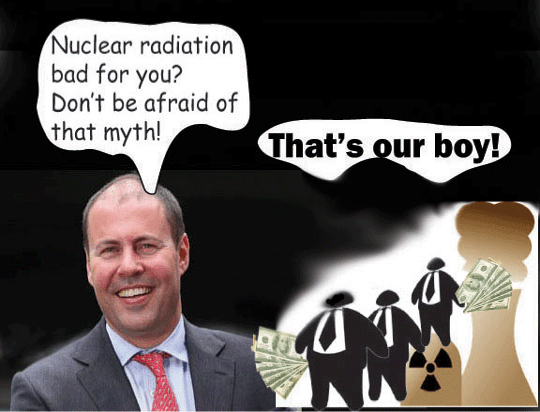
 Mathias Cormann, Minister for Finance, Special Minister of State, Leader of the Government in the Senate: WA senator pushes benefits of nuclear energy
A WA Liberal Senator, Mathias Cormann, is pushing the merits of Australia developing nuclear energy …….But, Mr Cormann was unable to say where waste would be buried.
“Longer term, very clearly we do have to find ways to store or to dispose of it in deep geological disposal arrangements but we have time for that“….http://www.abc.net.au/news/2009-12-04/wa-senator-pushes-benefits-of-nuclear-energy/1168286
Michael McCormack, Deputy Prime Minister, Minister for Infrastructure and Transport. “
 Josh Frydenberg, Treasurer Six sites for nuclear dump revealed by Josh Frydenberg https://www.theaustralian.com.au/national-affairs/six-sites-for-nuclear-dump-revealed-by-josh-frydenberg/news-story/beb13af3f67278e688f7cf115eabf618
Steve Ciobo, Minister for Defence Industry Steve Ciobo overturned mining loan ban without consulting department The minister for trade, Steve Ciobo, overturned a ban on government-backed loans to domestic miners last year without consulting his department.
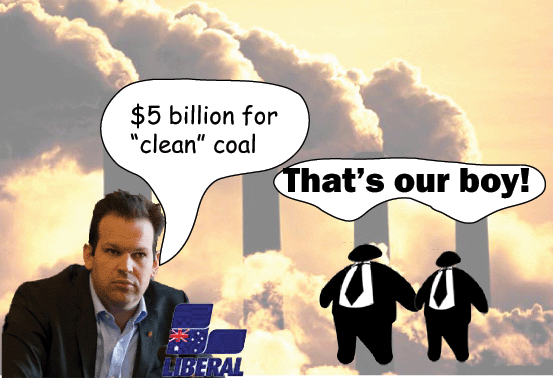
The controversial decision meant the federal government could start funding coalmining projects at a time when Australia’s major banks are increasingly distancing themselves from investing in coal.
 Matthew Canavan, Minister for Resources and Northern Australia
Resources Minister Matt Canavan is deceptive in his statements about “Low Level  “nuclear waste https://antinuclear.net/2018/08/17/resources-minister-matt-canavan-is-deceptive-in-his-statements-about-low-level-nuclear-waste/
Matt Canavan’s optimistic coal forecast contradicts his own department https://www.theguardian.com/australia-news/2018/jul/02/matt-canavans-optimistic-coal-forecast-contradicts-his-own-department
Melissa Price, Minister for the Environment. This one is a bit of an unknown quantity. Unlike the rest of them, she actually knows something about the environment. Expect the rest of them to bully her into shape
August 27, 2018
Posted by Christina Macpherson |
climate change - global warming, energy, politics |
Leave a comment
 It looks like being Melissa Price – who seems to have a good background in environment, and even believes in climate change! On the other hand, she previously worked for Crossland Resources, (they may or may not be connected to Crossland Uranium Resources).
WA regional MP Melissa Price set to be new federal environment minister , WA Today By Nathan Hondros, 26 August 2018 Western Australian MP Melissa Price will be promoted to the environment portfolio as part of Prime Minister Scott Morrison’s Cabinet shake up.
Ms Price, who represents the North West seat of Durack – the largest single member electorate in the world, assisted former environment minister Josh Frydenberg in the role and is understood to have supported Mr Morrison for the Liberal party leadership……..
Ms Price was a lawyer before entering parliament, working as general counsel for CBH Group and Crosslands Resources Ltd.
She has served on parliamentary committees for Agriculture and Industry, Indigenous Affairs, Infrastructure and Communications, and Northern Australia.
August 26, 2018
Posted by Christina Macpherson |
AUSTRALIA - NATIONAL, environment, politics |
Leave a comment
if all other countries were to follow Australia’s current policy settings, warming could reach over 3°C and up to 4°C.
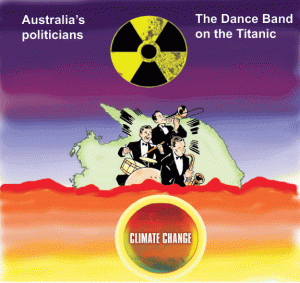 Climate Change Policy Toppled Australia’s Leader. Here’s What It Means for Others, New York Times, By Somini Sengupta Aug. 24, 2018
Climate change policy toppled the government in Australia on Friday.
How much does that really matter?
It is certain to keep Australia from meeting its emissions targets under the Paris climate agreement.
It’s also a glimpse into what a potent political issue climate change and energy policy can be in a handful of countries with powerful fossil fuel lobbies, namely Australia, Canada and the United States.
In Australia, the world’s largest exporter of coal, climate and energy policy have infused politics for a decade, helping to bring down both liberal and conservative lawmakers.
This week, the failure to pass legislation that would have reined in greenhouse gas emissions precipitated Malcolm Turnbull’s ouster as prime minister. He was elbowed out by Scott Morrison, an ardent champion of the Australian coal industry who is known for having brought a lump of the stuff to Parliament.
It could be a bellwether for next year’s Canadian elections, expected in October, in which Prime Minister Justin Trudeau faces a powerful challenge from politicians aligned with the country’s oil industry. Conservatives have pledged to undo Mr. Trudeau’s plans to put a price on carbon nationwide if they take power. At the provincial level, conservatives won a majority in Ontario after campaigning against the province’s newly enacted cap-and-trade program.
The Australian parallels with the United States are striking. The Trump administration has promised to revive the coal industry, rolled back fuel emissions standards and announced the country’s exit from the Paris pact altogether. Climate change is not a driving issue in the United States midterm election campaign, though it is for liberal Democrats, a recent study by the Yale Program on Climate Change Communication has shown.
Environmental policy and global warming are top priorities for those who describe themselves as liberal Democrats, the study found, after health care and gun control.
……… Robert C. Orr, dean of the School of Public Policy at the University of Maryland, pointed to another parallel: In both Australia and the United States, local leaders have embraced renewable energy even as national politicians promote fossil fuels.
“Australia is a lot like the U.S.,” said Dr. Orr, who is also the special adviser on climate change to the United Nations secretary general. “Climate policy has really been driven from below, from the state, local and business level. That is not going to change.”
Most Australian states have renewable energy targets, and Australians are powering their houses with solar energy at one of the highest rates in the world. But Australia’s emissions have continued to rise.
Australia is among several industrialized nations that are not on track to reduce greenhouse gas emissions to keep global warming below two degrees Celsius as the Paris accord promises, according to independent analyses.
Climate Action Tracker, an alliance of European think tanks that tracks countries’ climate pledges under the agreement, concluded recently that “if all other countries were to follow Australia’s current policy settings, warming could reach over 3°C and up to 4°C.” Those are levels that climate scientists consider “highly insufficient” to stop the worst effects of climate change. https://www.nytimes.com/2018/08/24/climate/australia-climate-change.html
August 25, 2018
Posted by Christina Macpherson |
AUSTRALIA - NATIONAL, climate change - global warming, politics |
Leave a comment














Three months before he entered parliament in 2013, Taylor wrote a paper for the Coalition party room advocating for the immediate end to the renewable energy target (RET). In the middle of Abbott’s attempt to implement the vision, Taylor boasted to constituents (captured on film) that he had party backing.