Australian government ‘won’t be replacing’ renewable energy target – Angus Taylor, (Minister For Fossil Fuel Energy)
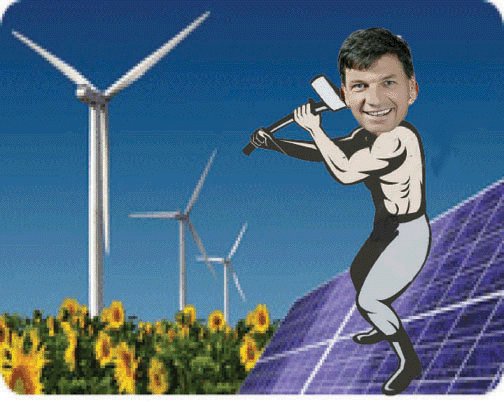 Angus Taylor confirms government ‘won’t be replacing’ renewable energy target Canberra Times, 18 Sept 18, Energy Minister Angus Taylor has confirmed the Morrison government will not replace the renewable energy target after it peaks in 2020, officially creating a policy vacuum that opponents say will stifle clean energy investment and lead to higher prices.
In question time on Tuesday, Greens MP Adam Bandt challenged Mr Taylor to extend the target until 2022 to avoid a disastrous plunge in renewables investment when the current target ends.
“The renewable energy target is going to wind down from 2020, it reaches its peak in 2020, and we won’t be replacing that with anything,” Mr Taylor said……..
“We will drive prices down, that’s our policy, those opposite will drive them up,” he said.
An annual index released on Tuesday put Australia in the bottom three ranking for environmental policy among wealthy nations.
The Center for Global Development’s commitment to development index said the environment was “one of Australia’s weaker policy fields … largely due to its poor performance curbing climate change”….
Defence officials become military lobbyists
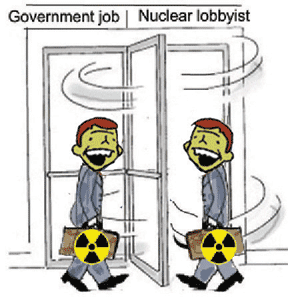
| Defence officials turn lobbyists, sometimes weeks after leaving government
Eight former defence figures, most high-ranking, are now lobbyists for military contractors, Guardian, Christopher Knaus, @knausc, 18 Sep 2018 Senior defence officials and military figures are taking paid jobs with firms lobbying for arms manufacturers, sometimes within weeks of leaving their government posts. Guardian Australia has identified eight former military officers or defence bureaucrats, most of whom were high-ranking, who have publicly registered themselves as lobbyists for firms that represent military contractors. But many other defence lobbyists operate largely in secret, either because they work directly for military contractors, or because they simply refuse to put themselves on the lobbyist register, avoiding scrutiny for themselves and their clients without any real repercussion. One recent example of a lobbyist who placed himself on the lobbyist register is Tyson Sara, a former assistant secretary in defence’s naval shipbuilding taskforce, whose role was described as “leading the implementation of the Australian naval shipbuilding plan”. Sara left defence in March and soon after joined lobbying powerhouse Cmax Advisory as its chief operating officer and vice-president for strategy and government. Cmax represents the shipbuilder Navantia Australia, defence contractor Northrop Grumman, and the Israeli weapons manufacturer Rafael Advanced Defense Systems………. Military officers who held a rank above colonel or its equivalent are banned from lobbying for 12 months on “any matter they had official dealings with” during the last year of their employment. Senior executive service officers in the public service face the same cooling-off period. But the lobbying code of conduct, already weak by international standards, is rarely enforced and staff movements are poorly monitored. The code also fails to consider former defence employees who are employed directly by weapons companies, either as in-house lobbyists or senior executives. That means it does not apply to individuals such as Sean Costello, who worked as chief of staff to the then defence minister David Johnston between June 2014 and January 2015, as the government planned its $50bn future submarines program, according to evidence in Senate estimates. Costello left Johnston’s department and two months later became the chief executive of the Australian arm of French submarine manufacturer DCNS, a Senate committee heard. That company, now known as Naval Group, eventually won the submarines contract in 2016. In Senate estimates in 2015 Defence conceded that it was “a fair assumption” that Costello, in his role as chief of staff, would have had access to confidential documents and briefings on the submarine project. Defence said in evidence to the Senate that it provided Johnston’s office with 34 pieces of written advice relating to the submarine project in the time Costello worked in the office, on top of material provided to the minister in a daily briefing pack. ……. Tim Costello, chief advocate for World Vision and the executive director of Micah Australia, said the sheer value of defence contracts meant it was necessary to apply added scrutiny to the sector. “They are so lucrative,” Costello said. “It means that the transparency and accountability must be higher and commensurate with the goldfields they represent of taxpayer dollars.” The Centre Alliance senator Rex Patrick said it was clear the lobbying code needed to be enhanced for former defence personnel. Patrick said senior defence personnel were often exposed to privileged and sensitive information on policy, strategy, and commercial and tender requirements. “While I wouldn’t suggest that this information is shared amongst a lobbyist’s clients, when former officials service their clients, it’s simply not possible to unknow this information when formulating advice,” he said.
|
Scott Morrison’s lump of coal not enough: he needs a fairy tale on climate change
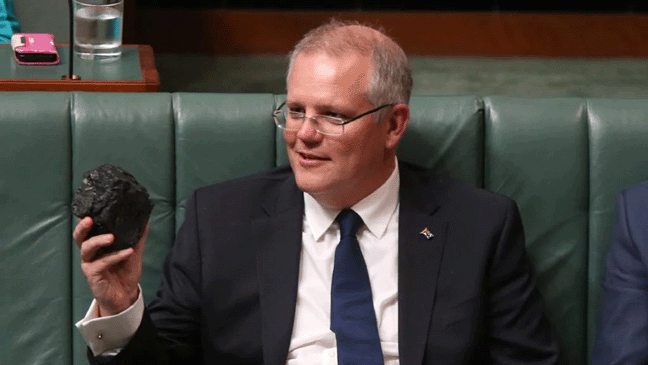
Scott Morrison needs a plan to cut emissions but all he has is a fairytale
Tony Abbott – the mad monk and Ziggy Switkowski are spruiking nuclear power – again!

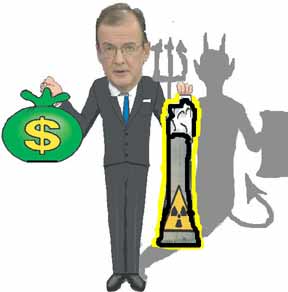
Abbott’s election advice to Morrison: it’s time to hit the nuclear switch https://www.theaustralian.com.au/national-affairs/abbotts-election-advice-to-morrison-its-time-to-hit-the-nuclear-switch/news-story/11b479d55f4d52ce7e84a2a3f19390b2 JOE KELLYPOLITICAL REPORTER @joekellyoz 15 Sep 18
Tony Abbott has called on the Morrison government to sharpen the political contest with Labor ahead of the election by moving to lift the prohibition on nuclear power, as Bill Shorten leaves the door open to reviving the now “dead” national energy guarantee.
The former chair of the Australian Nuclear Science and Technology Organisation and current chair of NBN Co, Ziggy Switkowski, told The Weekend Australian yesterday it was sensible to clear the regulatory pathway for the next generation of small nuclear reactors.
A revived debate over nuclear power was also backed by North Queensland MP Warren Entsch, a supporter of the NEG, who said all elements of energy policy should be on the table.
Speaking on 2GB radio in Sydney yesterday, Mr Abbott said there was “absolutely no reason why, when it’s economic, we shouldn’t have nuclear power generation in Australia”.
“One of the things that we could easily do is go into the parliament (and) seek to change the law here. When you’re seeking a third term, when you’re defending a one-seat majority, when you’ve got a few self-inflicted wounds, when you’ve got the unions and GetUp and the Greens as well as Labor against you, you’ve got to be prepared to create a contest.”
The push to revive the nuclear debate follows Scott Morrison declaring the NEG dead, while opposition energy spokesman Mark Butler this week held out the prospect of Labor moving to revive the policy in government following engagement with industry.
Dr Switkowski said the future for nuclear power was “likely to be defined by the arrival of small modular reactors (SMRs) of a 100MW scale” that could provide power for up to 100,000 people.
“They will be affordable, low-risk and an investment that business will find attractive,” he said. “That is likely to happen later in the 2020s, but will have special relevance to Australia where we have towns and industries and mines and desalination plants, all of (which) could be served by one of these SMRs.
“The opportunities for … large reactors have now largely disappeared … It is, however, very sensible to clear away the regulatory obstacles to developing business plans and evaluating technologies in order to have an option in the 2020s to adopt these SMRs.”
Mr Entsch told The Weekend Australian a fresh discussion on lifting the 1998 prohibition on nuclear power “made sense”, saying technological improvements made it possible to build smaller and safer reactors. “The reality is that nuclear power … is clean and green,” he said. “There is zero emissions. If they made a decision to do it, there wouldn’t be an objection from me.”
LNP MP Luke Howarth, in the Queensland seat of Petrie, said the nation “should be having the discussion about how to build a nuclear industry” because it would help drive the “jobs of the future”.
Others rejected the push to revive the debate. South Australian Liberal MP Tony Pasin said: “Whilst I respect the view of Mr Abbott, in my view our government’s policy agenda needs to be focused on proposals which will put serious downward pressure on energy prices over the course of the immediate term.”

Senator Cory Bernardi believes in nuclear power, but doesn’t believe in climate change
 Doesn’t Cory Bernardi get it? – that the nuclear lobby now loves to believe in climate change – so it can pretend that nuclear power is the cure.
Cory Bernardi writes to Angus Taylor, asking for nuclear moratorium removal, 2GB LUKE GRANT , 14 Sep 18, Senator Cory Bernardi has written to the Federal Energy Minister,  asking him to remove the moratorium on nuclear energy.
The Australian Conservatives’ leader has asked Angus Taylor to support a bill to lift the blanket ban on nuclear. With 40% of the world’s uranium resources residing in Australia, Bernardi says the government would be “mad” not to pursue the power option………….
Bernardi adds that the Morrison Government needs to withdraw from the Paris Agreement, to show that they have fully liberated themselves from Turnbull’s beleaguered energy agenda.
“It’s a symbolic gesture that shows they’re setting out on a new path of Australian sovereignty to make sure every business, family, pensioner and household can afford to turn on the lights.” https://www.2gb.com/cory-bernardi-writes-to-angus-taylor-asking-for-nuclear-moratorium-to-be-lifted/
Contrary to Scott Morrison’s deceptive boast – Australia is on track to miss Paris climate targets
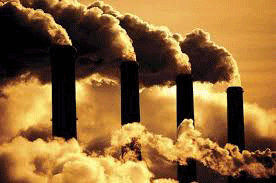 Australia on track to miss Paris climate targets as emissions hit record highs https://www.theguardian.com/australia-news/2018/sep/14/australia-on-track-to-miss-paris-climate-targets-as-emissions-hit-record-highs Australia on track to miss Paris climate targets as emissions hit record highs https://www.theguardian.com/australia-news/2018/sep/14/australia-on-track-to-miss-paris-climate-targets-as-emissions-hit-record-highs
NDEVR Environmental data suggests Australia will miss targets by 1bn tonnes of carbon dioxide under current trajectory, Guardian, Lisa Cox, 14 Sept 18, [good graphs on original] Australia remains on track to miss its Paris climate targets as carbon emissions continue to soar, according to new data. The figures from NDEVR Environmental for the year up to the end of June 2018 show the country’s emissions were again the highest on record when unreliable data from the land use and forestry sectors was excluded. It is the third consecutive year for record-breaking emissions. NDEVR replicates the federal government’s national greenhouse gas inventory (NGGI) quarterly reports but releases them months ahead of the official data. Previous NDEVR figures have been within 1% of the official figures when eventually released. The government has yet to publish any emissions data for 2018. Its last update was for the year to December 2017, which it published in May and showed Australia’s emissions continue to soar. NDEVR’s report projects Australia will miss its Paris targets by about a billion tonnes of carbon dioxide if emissions continue on their current trajectory. It projects that emissions, excluding land use, will be 558m tonnes, the highest since records began in 2002. It finds that transport emissions were the highest on record in the final quarter of the 2018 financial year and continue to rise. NDEVR said this was due to the rapid increase in the use of diesel fuel in both passenger cars and heavy transport. Emissions from stationary energy and fugitive emissions continue to trend upwards. The rise in stationary emissions is mostly attributable to energy industries excluding electricity generation NDEVR’s report projects a drop in emissions from the electricity sector for the final quarter of the 2018 financial year because of a reduction in total electricity generation in the national electricity market states and an increase in generation from renewables. But Matt Drum, the managing director of NDEVR Environmental, said Australia was still not on track to meet its Paris targets. “Tracking the Paris trend line, they’re still heading north and missing Paris by a long way and our 2050 two-degree target by an even greater margin,” he said. “The data’s telling us clearly again that we’re not on a trajectory to meet our targets, there’s no effective policy to meet our targets, but we’re still hearing commentary from the government that we’re on track to meet our targets.” |
|
Senator Matt Canavan ridicules climate health report, days after climate health expert wins Liberal safe seat
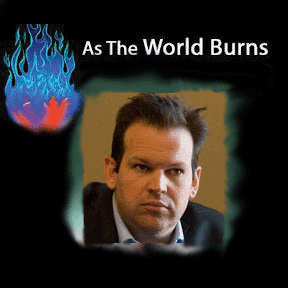 Canavan ridicules climate health report, days after climate health expert wins Liberal safe seat, REneweconomy, 12 September 2018
But Canavan, who appears to have a new role in the Coalition Cabinet as minister for Not Taking Climate Science Seriously, dismissed the work as seemingly drug influenced, and based on “imaginary” threats.
“This report reads like it was written during poetry slam night at the happy herb cafe,” the senator reportedly told The Courier-Mail, a Murdoch newspaper, on Wednesday……..https://reneweconomy.com.au/canavan-ridicules-climate-health-report-days-after-climate-health-expert-wins-liberal-safe-seat-73431/
68% of Australians want govt to set genuine emissions targets to meet our Paris climate commitments
 Climate poll shows Morrison politically vulnerable as more voters back action https://www.theguardian.com/environment/2018/sep/12/climate-poll-shows-morrison-politically-vulnerable-as-more-voters-back-action
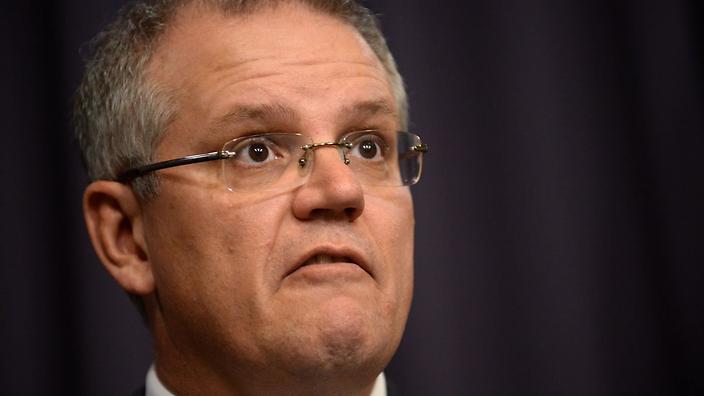
Number of Australians concerned about impact of climate change and wanting coal phased out rises, Guardian, Katharine Murphy Political editor @murpharoo12 Sep 2018 A growing number of Australians are concerned about the impact of climate change, and more than half of a survey of 1,756 voters believe the Morrison government needs to stay in the Paris agreement, despite Donald Trump’s decision to withdraw the US.
A study tracking voter sentiment for more than a decade, funded first by the Climate Institute and now by the Australia Institute, finds 73% (up from 66% in 2017) of respondents concerned about climate change, and a clear majority, 68%, believes the government should set domestic targets to comply with our Paris commitments.
An increased 67% want coal-fired power to be phased out within 20 years, up from 61% in 2017.
The findings suggest the Morrison government is politically vulnerable on climate change at the next federal election. The prime minister has declared Australia will not pull out of Paris but also abandoned the national energy guarantee that imposed an emissions reduction target on the electricity sector. Continue reading
Australia is going backwards on climate change action, as Morrison govt, Trump-like, spruiks “success”
Just before Christmas last year, the Australian Government published a report which suggests that — without significant policy change — Australia will miss that commitment by a long way. Emissions in 2020 will be just 5 per cent below 2005 levels, according to the official projections and — without further measures to cut them — emissions will grow by 3.5 per cent on 2020 levels in the 10 years to 2030.
In other words, we’ll go backwards in the coming decade..
There’s a certain Trump-like quality to Australia’s discourse on emissions reductions, ABC 11 Sep 18 By Stephen Long ,
It seems to be high on the list of the Morrison Government’s talking points: the claim that we’re “on track” to meet our commitments to cut greenhouse gas emissions under the Paris climate accord.
The PM reckons we’ll meet the targets “in a canter”.
“We’re on track to achieve them,” the new Environment Minister, ex-mining industry lawyer and mining executive Melissa Price, also reassured radio listeners, adding that she supports the construction of new coal-fired power stations.
Foreign Minister Marise Payne — back from meeting Pacific Islands leaders whose nations literally face an existential threat from climate change — joined the chorus, as did Energy Minister Angus Taylor.
Australia is on track to “meet and exceed” the Paris commitments, according to Trade Minister Simon Birmingham.
“We are already more than meeting the 26 per cent that was set down in the Paris agreement,” National Party leader Michael McCormack confidently told David Spears on Sky News, though when pressed, he was a bit unsure about what information that claim was based on. Continue reading
Victorian homeowners will be paid nearly $5000 towards the cost of household solar batteries if Labor is re-elected
 Victorian Labor offers a $4838 battery bonanza for homes with solar panels , The Age ,By Noel Towell & Benjamin Preiss, 10 September 2018 Victorian homeowners will be paid nearly $5000 towards the cost of household solar batteries by a re-elected Andrews government in the latest move aimed at making the state Australia’s leader in domestic-scale renewable energy.
The latest promise of subsidies for small-scale renewable energy will see households who already have solar panels able to claim half the cost – up to $4838 – of batteries that can store energy generated on their rooftops.
The announcement comes as the Andrews government commits to building six new renewable energy plants across regional Victoria, generating enough power for 640,000 homes.
The three solar and three wind farms, producing 928 megawatts of power, will be built by private companies.
Labor has been encouraged by more than 9000 registrations of interest in its subsidised solar program in the three weeks since it began its announcements. The new batteries policy will cost an estimated $40 million, with 10,000 households expected to take part, lured by the chance of cutting up to $650 from their annual power bills with the rapidly improving battery storage technology.
The announcement is part of a suite of subsidies and payments aimed at putting solar technology in 720,000 Victorian homes. The centrepiece of the government energy renewable election pitch, a $1.2 billion subsidies scheme offering free solar panels to 650,0000 households, was announced in August.
It was followed by a $60 million promise to pay $1000 toward the installation of solar hot water systems in homes that are not suitable for rooftop solar panels.
The latest announcement will open up subsidies to even more households – those already using solar panels to generate power – as Labor looks to build a strong cost-of-living policy platform heading into November’s election………
The government says technology is in development that will allow neighbourhoods to link their batteries, creating “micro-grids” of shared stored power to lower electricity prices even further.
Labor says it will spend $10 million to preparing the state’s ageing power grid for an influx of hundreds of thousands of household micro-generation operations………https://www.theage.com.au/politics/victoria/labor-offers-a-4838-battery-bonanza-for-homes-with-solar-panels-20180910-p502wc.html?crpt=index
Morrison government ignores climate change, and so imperils the health of Australians
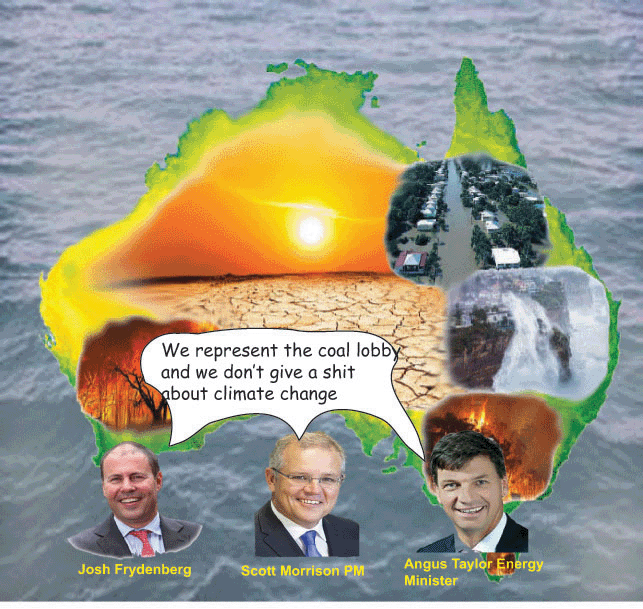 The Morrison Government: An extraordinary health hazard The Morrison Government: An extraordinary health hazard
Doctors for the Environment 10 September 2018, Climate change denial is the denial of many public health casualties.
For example, the increasing number of injuries and deaths from extreme weather events and the psychological and economic trauma consequent to severe climatic change. New Prime Minister Scott Morrison, who when Treasurer carried coal into Parliament, has appointed avid anti-wind farm campaigner, Angus Taylor, as Energy Minister and ex-coal-company lawyer, Melissa Price, as Environment Minister. There has been no mention of climate change in either portfolio. If there is any doubt about the PM’s lack of commitment to Australia’s COP21 agreement to emissions reduction, also consider for a moment that his new chief-of-staff, John Kunkel, spent six years as deputy CEO of the Minerals Council, followed by two years as head of government affairs (that is, lobbying) for Rio Tinto! Furthermore, PM Morrison says climate change doesn’t have to be part of the consideration of drought, yet the science is increasingly secure that Australia is becoming drier and land will be subject to increased evaporation. Now the Government’s signature power policy, the National Energy Guarantee (NEG) is gone, what will replace it? Nothing! Minister for Home Affairs Peter Dutton who headed the leadership challenge against Malcolm Turnbull, may not be prime minister, but the conservative vandals have succeeded in the wanton destruction of even a holding pattern on carbon emissions. The renewed attack on renewable energy generation will lead to more illness and death from pollution because it will slow the transition away from coal-fired power generation. The thinking is doubly wrong because pollution-related illnesses also cost us, the end-users, about the same in dollar terms as the polluting generators collect in charges — equivalent to politicians throwing away our money!………https://independentaustralia.net/environment/environment-display/the-morrison-government-an-extraordinary-health-hazard,11876 |
|
Anonymous pro nuclear “engineers” lobbied Canberra ministers and premiers.
 Steve Dale, 8 Sept 18 In the lead up to the leadership spill, there has been a concerted push for nuclear power. A letter written and financed (supposedly) by 5 veteran engineers was sent to all Canberra ministers and premiers.
. There have also been a series of articles in the Australian newspaper based on this letter, eg. “Nuclear offers an answer on cost and emissions”
I was hoping that the article would give the names of the so-called engineers, but unfortunately it doesn’t. From the Australian article –
“The paper, prepared and circulated to MPs as a public service by what is claimed to be “a small group of professional engineers and scientists experienced in various aspects of electricity and distribution” ….
“The claims and costings no doubt will be challenged, but in it we have a contest of ideas.”
The claims and costings can not be challenged if only the Australian newspaper and the cabinet ministers have seen this “paper”. Who knows, the claims and costings of the paper may have excited the pro-nuclear MP’s to the point of losing self-control, running amok, bullying their peers (especially the female ones) and triggering a mutiny.
There seems to be an obscene amount of money being used to promote nuclear. I would still like to see a scan of the exact letter sent to MP’s, but not sure how to achieve that.
Australia’s Liberal Coalition government abandons plans to combat climate change
Josh Frydenberg says government will focus on power prices over emissions reduction, Canberra Times By Stephanie Peatling, 9 September 2018 Treasurer Josh Frydenberg has conceded the Australian Parliament has failed to deal with the challenge of climate change as he confirmed the new Morrison government will concentrate on lowering power prices ahead of reducing greenhouse gas emissions.
“What you will hear from us, which you will not hear from the Labor Party, is that we will put reducing people’s power bills first, over emissions. You will not hear the Labor Party say that,” he said……..
Mr Frydenberg’s comments on Sunday followed those made by Prime Minister Scott Morrison on Saturday when he said he would formally ask the Liberal party room to ditch the policy when it meets this week.
Mr Morrison repeated his commitment to Australia meeting its international greenhouse gas reduction targets under the Paris agreement but said the target would no longer be legislated. New Energy Minister Angus Taylor is working on a revamped energy policy to take to cabinet.
…….Mr Frydenberg said the issue of climate change was one which had bedevilled Australian politics for more than a decade…….
Mr Frydenberg said he was confident Australia would still meet is international greenhouse gas reduction targets but people wanted to see the government acting on power prices.
“The people of Australia want to see their power bills come down, and they want to see the government take whatever measure possible to do that,” Mr Frydenberg said.
Labor’s energy spokesman Mark Butler said the government’s decision to walk away from the policy was a capitulation to the more conservative elements inside the Coalition.
“In an abject surrender to the hard-right, to the Tony Abbott forces within his own party room, he’s [Scott Morrison] decided to walk away from his government’s own policy, and households will end up paying the price,” Mr Butler told Sky News.https://www.canberratimes.com.au/politics/federal/josh-frydenberg-says-government-will-focus-on-power-prices-over-emissions-reduction-20180909-p502oe.html?crpt
Australia stands to REALLY lose face on climate change at coming international summits
Morrison will face mounting pressure from the vocal band of conservatives in his party room not to commit to anything on climate change, be it symbolic or tangible.Australia is neither a small nation nor one of the most powerful, but for many years it has been a trusted nation. Historically, Australia has been seen as a good international citizen, a country that stands by its international commitments and works with others to improve the international system, not undermine it.
With Australia’s new foreign minister, Marise Payne, attending instead of the prime minister – not a good look, albeit understandable in the circumstances – the government came under yet more international pressure to state plainly its commitment to the Paris climate agreement.
Pacific nations may be divided on many issues, but climate change is rarely one of them.
Before the meeting, Pacific leaders urged Australia to sign a pledge of support for the agreement and to declare climate change “the single greatest threat to the livelihoods, security and wellbeing” of the region.
The government now has a chance to catch its breath before international summit season begins in earnest in November with the East Asia Summit in Singapore, followed quickly by APEC in Papua New Guinea and then the G20 summit in Buenos Aires on November 30 and December 1, not to mention the next round of UN climate negotiationsin Poland in December. Continue reading
Dr Joe McGirr, independent and supporter of climate action, is set to win Wagga Wagga by-election
 Wagga Wagga by-election: Antony Green calls it for Dr Joe McGirr ABC News , By Nick Sas and Jennine Khalik 9 Sept 18, ABC election analyst Antony Green has called the Wagga Wagga by-election for independent candidate Dr Joe McGirr.
Speaking on ABC News on Sunday night, Green said he felt safe calling Saturday’s by-election, slightly more than 24 hours after the polls closed.
“He is a certain winner,” Green said.
The race for the seat, which had been vacated by disgraced Liberal MP Daryl Maguire, became a two-man battle between Labor’s Dan Hayes and Dr McGirr after the Liberals were hit with a 29 per cent swing against them…..
Dr McGirr, a medical doctor and academic at the University of Notre Dame Australia, has lived in central Wagga since 1991 and only decided to run for the seat three weeks ago……http://www.abc.net.au/news/2018-09-09/antony-green-calls-by-election-for-joe-mcgirr/10219584
1 This month
17 October, Free Public Talk on Nuclear Issues in South Australia
David Noonan will speak on public interest concerns over the new Roxby Downs Indenture Act 2026 on BHP copper-uranium mining and ore processing in SA, and on how AUKUS may face SA with a High-Level nuclear waste agenda.
Dr Jim Green will discuss international developments in the field of nuclear power including ‘small modular reactors’ and Generation 4 ‘advanced’ nuclear reactor concepts.


Help Aunty Sue Protect Her Land and Sacred Sites From Destructive Rocket Testing.
.

Australians deserve the truth
about
AUKUS – https://aukuspublicinquiry.com/

PETITION – To: Prime Minister Anthony Albanese and the Australian Labor Government

of the week – Australians for War Powers Reform (AWPR)
To see nuclear-related stories in greater depth and intensity

