Submission: Medical Association for the Prevention of War (MAPW) supports a new Intermediate Level Solid Waste Storage Facility at Lucas Heights

MAPW supports the construction of a new Intermediate Level Solid Waste Storage Facility at Lucas Heights.
MAPW strongly recommends:
• an open and independent review of nuclear waste production and disposal in Australia, and
• progressing a shift to cyclotron rather that reactor-based production of isotopes for nuclear medicine as rapidly as feasible.
Arguments that radioactive waste should all be at one site overlook the ongoing need for hospitals to store clinical waste. After nuclear medicine is used in a patient, the vast majority of the residual material and radioactively-contaminated equipment is stored on site while the radioactivity decays away. Within a few days, it has lost so much radioactivity that the material can go to a normal rubbish tip. There will always need to be multiple waste storage locations at sites which utilise radiopharmaceuticals.
Clean cyclotron production of Tc99m has recently been approved and is being implemented in
Canada. This should rapidly become the future of isotope production
Medical Association for the Prevention of War (MAPW) 30 July21, Submission to the Public Works Committee regarding Australian Nuclear Science and Technology Organisation Intermediate Level Solid Waste Storage Facility Lucas Heights, NSW.
SUMMARY
MAPW supports the construction of a new Intermediate Level Solid Waste Storage Facility at Lucas Heights. As noted in the ANSTO submission, there will be minimal expected impact on the community and ANSTO has excellent existing security.
This contrasts with the massive distress and community division in regional and remote communities that has been created by a succession of nuclear waste storage proposals.
This facility will be useful over a much greater timeframe if ANSTO’s rapidly expanding production of isotopes for nuclear medicine is reined in. This very heavily subsided export business has only a small minority of the radiopharmaceuticals produced being utilised in the care of Australians. There is no evidence whatsoever of more than minimal cost recovery. The burgeoning amounts of ILW produced will be a liability for Australians or many generations.
More reliable, safer, cheaper and much cleaner cyclotron production of technetium99m (Tc99m) has been shown to work and is being implemented in Canada. Japan, the USA, the UK and several European countries are all looking to implement cyclotron.
The proposed new ILW facility provides an opportunity to identify and implement world’s best practice ILW disposal options and update and reset nuclear medicine production tocleaner, cheaper and more reliable methods.
MAPW strongly recommends:
• an open and independent review of nuclear waste production and disposal in
Australia, and
• progressing a shift to cyclotron rather that reactor-based production of isotopes for nuclear medicine as rapidly as feasible.
Individual criteria will now be addressed.
Continue readingAustralian Labor Party does not trust Angus Taylor’s ”moronic” approach to energy and economics
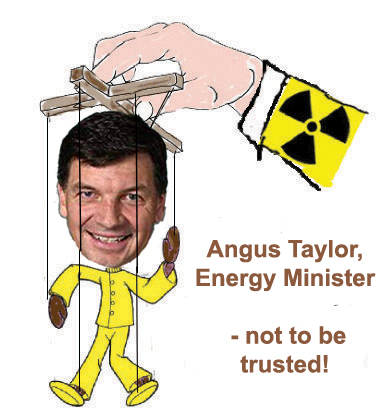
“Nothing better demonstrates the Liberals’ deeply moronic approach to energy and economics,” Josh Wilson, federal MP for Fremantle, tweeted on Friday.
“Nuclear power is not only ferociously expensive, but also slow, inflexible and toxic to the environment and human health.”
Top union leader backs Angus Taylor’s nuclear deal with UK, Jacob Greber AFR, Senior correspondent 30 July 21 One of Australia’s leading union leaders has lent support to Energy Minister Angus Taylor’s decision to enable Australian scientists to work with the UK on next-generation nuclear power development even as two Labor MPs slammed the idea of such power plants as “deeply moronic” and “toxic” to the environment and human health.
Daniel Walton, head of the Australian Workers Union called for “open and pragmatic energy solutions” to reduce carbon footprints at reliable and affordable rates.
If nuclear energy “ticks those three boxes, we should give it serious consideration,” Mr Walton told AFR Weekend. “If it doesn’t tick those boxes, we should move to the next solution.”
Mr Taylor signed a letter of intent this week with his British counterpart, Kwasi Kwarteng, for both countries to collaborate on low-emissions technology, including “advanced nuclear designs and enabling technologies”.
It is understood the co-operation will involve “leveraging” the expertise of the Australian Nuclear Science and Technology Organisation in waste processing and advanced materials to help advance development of small modular reactors, which are about the size of a standard shipping container……….
Reports of the UK-Australia nuclear tie-up triggered an immediate backlash from two West Australian Labor MPs.
“Nothing better demonstrates the Liberals’ deeply moronic approach to energy and economics,” Josh Wilson, federal MP for Fremantle, tweeted on Friday. “Nuclear power is not only ferociously expensive, but also slow, inflexible and toxic to the environment and human health.”
………….Mr Taylor said many Australians, particularly younger Generation Y and X voters, are looking at nuclear plants as a way of getting reliable power.
“All of it comes down to the genuine economic argument. If it’s uncompetitive against existing fossil fuels, then it won’t stack up,” he said. “But we’ll never know that if we never explore nuclear development. https://www.afr.com/policy/energy-and-climate/top-union-leader-backs-angus-taylor-s-nuclear-deal-with-uk-20210730-p58eiz
Submission Noel Wauchope: to Federal Inquiry into nuclear waste storage.
Noel Wauchope 27 July 21, To: Parliamentary Standing Committee on Public Works Inquiry: “ANSTO Intermediate Level Solid Waste Storage Facility Lucas Heights, NSW” Public Submission. I do not write as someone who is opposed to Australia having a plan for the permanent disposal of the nuclear wastes that are generated at Lucas Heights. Quite the reverse. Australia must face up to the necessity for such a plan.
However, ANSTO’s proposal for a temporary storage of these long lasting toxic wastes, at Napandee, South Australia, is NOT such a plan. As the licensing body, ARPANSA, has acknowledged, these highly hazardous nuclear fuel wastes can be safely and securely stored at Lucas Heights. Indeed ARPANSA has licensed this storage for at least 40 years to come. There is absolutely no need to trek this highly dangerous stuff for 1700 km to a small rural community, in a richly agricultural area – for so-called ”temporary” storage . At Napandee, they may well become ”stranded wastes”, while the necessity for permanent disposal remains ”a can kicked down the road”.
ARPANSA is still to consider the licensing application for the Napandee nuclear waste facility plan. ANSTO should not be able to continue with its process for the Napandee plan before this; ARPANSA Approval for proposed indefinite duration above ground nuclear fuel waste and Intermediate Level Waste storage in SA may not be granted.
Therefore, it is up to the Public Works Committee to require and confirm ANSTO public works that will comply with the Contingency to keep
Intermediate Level Wastes at Lucas Heights until a final disposal option is available.
It has not been made clear that there are really two separate proposals by the National Radioactive Waste Management for radioactive waste storage in South Australia
- for Low-Level Waste disposal facility in SA for an indefinite period.
- above ground nuclear fuel waste and ILW storage
ARPANSA will expect separate License Applications for these two proposals.
On transparency. ANSTO has been secretive about its plans regarding Intermediate Level Wastes. At least two significant reports to ARPANSA, required as part of
ARPANSA Licensing Conditions and due to the regulator by 30 June 2020, and ARPANSA’s reply, should be made available to the PWC, and publicly available.
On safety and security. As ARPANSA has noted, the double handling of Intermediate Level Waste in transporting it from one temporary storage to another temporary storage, is not consistent with international best practice. The safety and security problems of course also involve the communities en route, over such a long distance. Yet the NRWM taskforce has not engaged with these communities, surely that engagement must be a requirement for such a plan
On the undemocratic process. The National Radioactive Waste Management plan for this facility at Napandee rides roughshod over the rights of South Australians, who have had no say in this decision. It is an affront to South Australia, with its clear law prohibiting nuclear activitis. THe Eyre Peninsula region ‘s communities have had no say. Importantly, the traditional owners of the area.the Barngarla people, were eluded from the local vote, and are clearly against the dump plan.
On the hypocritical claim of ”medical necessity”. The publicity from ANSTO and from MInister Pitt has portrayed this facility as a ”medical necessity”, which it very obviously is not. As this submission primarily concerns the public works at ANSTO, I won’t go into that issue now. But it is pretty obvious to all but the somewhat brainwashed Kimba supporters of the plan, that the mostly short-lived medical radioactive wastes are dealt with at the local level, with no need for the elaborate centralised plan for Napandee. https://www.aph.gov.au/Parliamentary_Business/Committees/Joint/Public_Works/ANSTOLucasHeights/Submissions
Victoria’s Bayside Council call on Australian government to support the UN nuclear weapons ban treaty
Bayside Council supports nuclear prohibition,, https://www.miragenews.com/bayside-council-supports-nuclear-prohibition-601949/ 26 July 21, Bayside City Council has become the 11th Council in Victoria to join the call for the Australian Government to sign and ratify the United Nations (UN) Treaty on the Prohibition of Nuclear Weapons.
In a unanimous decision at the July 2021 Council Meeting, Bayside Councillors declared their support and are now calling on the Australian Government to sign the Treaty without delay.
Nuclear weapons pose a threat to communities throughout the world, and we believe all people, including our residents, have the right to live in a world free from this threat,” Mayor Cr Laurence Evans said.
“Any use of nuclear weapons, whether deliberate or accidental, would have catastrophic, far-reaching and long lasting consequences for people and the environment.”
Australia has not signed or ratified the Treaty, despite committing to pursue nuclear disarmament under the 1970 nuclear Non-Proliferation Treaty.
“It’s time for Australia to sign and get on the right side of history,” Cr Evans said.
Part of the Council resolution includes writing to the Foreign Affairs Minister, and the local Federal member of parliament, advising of Council’s support to the Treaty.
t was also resolved that Council will take steps to ensure that funds administered by Bayside City Council are not invested in companies that produce nuclear weapons.
Bayside City Council is the 11th Victoria Council to join the International Campaign to Abolish Nuclear Weapons (ICAN) Cities Appeal- a global call from cities and towns in support of the UN Treaty on the Prohibition of Nuclear Weapons.
(ICAN) is a coalition of non-governmental organisations in 100 countries promoting the implementation of the United Nations Treaty on the Prohibition of Nuclear Weapons. Founded in Melbourne in 2007, ICAN was awarded the 2017 Nobel Peace Prize
Submission: AZARK PROJECT says that Kimba nuclear waste plan is completely unnecessary, and irrelevant to nuclear medicine.
national nuclear waste facility at Kimba the existence or otherwise of which will have no effect whatsoever on the production of nuclear medicine by ANSTO

the importance and use of nuclear medicine locally is significantly
decreasing as there is a general reluctance and reduction by modern medicinein using nuclear isotopes for medical purposes in preference to much safer means to diagnose and treat medical conditions which were previously the
subject of nuclear medicine.
Parliamentary Standing Committee on Public Works Inquiry into the Australian Nuclear Science and Technology Organisation Intermediate Level Solid Waste Storage Facility at Lucas Heights
SUBMISSIONS BY AND ON BEHALF OF AZARK PROJECT PTY LTD, Peter Remta 26 July 21
INTRODUCTORY SUMMARY OF SUBMISSIONS
A. The proposed increase in the nuclear waste storage capacity at Lucas Heights by constructing a new storage facility is a completely unnecessary and expensive exercise which is only perpetuating the government’s inappropriate plans for a waste management facility at Kimba.
B, Serious and urgent consideration should be given to the establishment of the underground nuclear waste facility at Leonora by Azark Project due to its international recognition and acceptance for its unsurpassed suitability and safety.
C. Several members of the Committee should be excluded from any participation in deciding the merits of establishing or funding of the facility for the additional storage since they have previously made ill-founded and unjustified statements praising the proposals for Kimba…….
Continue readingSubmission: Barry Wakelin – ”interim” storage of nuclear waste at Kimba is a poor plan, with no commitment to planning for a permanent solution
Despite assurances from responsible Ministers, that a permanent ILW site selection process decision is in train, there is no evidence that the Parliament is making any endeavour to fulfil that promise, particularly when it is recalled that the construction (in 2007) of the OPAL nuclear reactor was conditional upon that promise being kept ,which it is too apparent never happened.
Sumission No. 4 Public Works Submission – Barry Wakelin OAM, Kimba, S A, 23 Juy 21,
I present this submission as someone with 15 years of Federal Parliamentary Service: and as a former Public Works Committee member and citizen of Kimba observing the machinations of a proposed “temporary” site for ILW (Intermediate Level Waste at KImba.) Mainly, promoted as a Low Level Waste site by government representatives .
I was closely involved with the Woomera attempt at a nuclear waste site. The great thing about being free of party politics is the time to become better informed and to develop my own clearer, fairer and individual opinions.
Despite assurances from responsible Ministers, that a permanent ILW site selection process decision is in train, there is no evidence that the Parliament is making any endeavour to fulfil that promise, particularly when it is recalled that the construction (in 2007) of the OPAL nuclear reactor was conditional upon that promise being kept ,which it is too apparent never happened.
Small communities like Kimba and its 95% agricultural dependence, have no government guarantee against health and economic damage from a ILW nuclear waste facility.
The defacto international nuclear waste via the suggested sixfold increase in the ANSTO export of nuclear medicine is in conflict with South Australian government policy and should not be inflicted upon a small rural community which is ignored by policy enforcers.
The question must be asked: why should a community of 0.00004% of Australians be bribed or emotionally blackmailed by the government using taxpayers’ funds to bludgeon 400 people at $200,000 each, in to accepting a nuclear Dump on behalf of 25million Australians who predominantly say NO . Not least of all are
government organisations like the Department of Defence who say the nuclear waste is too dangerous to be placed on their land ,the size of Tasmania.
If it takes this much money from government to convince a small community to accept the government’s argument which only gives the country a”temporary” nuclear waste facility of very limited value it is a a sad waste of taxpayer’s funds.
A commitment to the search for a permanent disposal site for ILW has not occurred and considering
2037 is the timeline; it is reasonable to accept that a “temporary” storage will not be required due to the new facilities at Lucas Heights The nuclear reactor will always have some temporary ILW storage.
It is clear to me that there is a reasonable prospect over the next fifteen years to find a suitable site
for permanent disposal of ILW suitably geologically and seismologically.
It is a privilege to be able to offer from my long term involvement in this difficult issue a view on the
justice or otherwise, which has been inflicted upon my magnificent community for the past six years.
I offer my best wishes to the Committee for your considerations.
.
Resources Minister Keith Pitt and his bald-faced lies about the Leonora nuclear waste proposal

26 July Kazzi Jai on Whyalla Pitt lies
“Federal Resources Minister Keith Pitt said the government did not receive detailed information to independently assess a site at Leonora, and couldn’t accept “unverified information” which could “cut short” the consultation and assessment process.”
This is the BIGGEST BALD FACED LIE Minister Keith Pitt has said yet!!
The current Leonora site proposal HAS been actively giving the Feds detailed information since 2017 I believe…..at EXACTLY the SAME TIME as Kimba was allowed to SUBMIT AGAIN into the mix after being taken COMPLETELY OFF the list in April 2016, after being deemed unsuitable!
Can’t have it both ways!
In fact ANOTHER site in Leonora Western Australia WAS in the mix back in 2015, as one of the SEVEN short listed sites deemed suitable by the Feds – by the then Josh Frydenberg as Minister at the time!
It was a different site in Leonora – but nevertheless, echoes the SAME SITUATION as Kimba in many ways!
Let the Australian nuclear spin begin – in earnest

‘‘until we can have the nuclear [power] discussion then carbon farming will play an important role.’‘ Michael McCormack of the Nationals Party , The Age , 18/7/21
You can bet your boots that Michael Mc Cormack knows about as much about nuclear power as a kindergarten kid does.
He is supposed to be an enemy of Nationals leader Barnaby Joyce, but on nuclear opinion, and nuclear knowledge, they’re in lockstep.
I was meaning to leave until Ausgust, this very NOW story of the renewed nuclear spin in Australia. I just couldn’t let this one pass – as Mc Cormack just slipped this in to a story that purports to be all about supporting agriculture and carbon farming.
Australia’s weapons lobby drumming up fear of nuclear attack by China, against all logic

Those in Australia beating the “drums of war” point to Taiwan as the flashpoint for the next major global conflict. To what end does a first strike on Australia achieve China’s goals in relation to Taiwan?
War with China: zero logic yet the weapons lobby has 42% of Australians believing it Michael West Media, by Marcus Reubenstein | Jul 16, 2021 Incredibly, a survey finds 42% of Australians believe China will attack Australia, this despite exports to China surging 36% over in the last six months, and despite there being no logical rationale for war with China, or an attack by China. Marcus Reubenstein analyses the ludicrous position of Australia’s China hawks and the mainstream media pushing their agendas.
“Cry ‘Havoc!’ and let slip the dogs of war.”
William Shakespeare, Julius Caesar Act 3, Scene 1
China is a rapidly growing economic power, seeking to exert considerable influence in its region and beyond. And like every great power it is a bully which tries to entice, cajole or intimidate other nations into adopting its view of the world.
How is this such a difficult concept for Australians to embrace?
Since Federation we’ve tied our fortunes to two great powers, the declining British Empire then the rising, and rising even more, US global hegemony……….
Who is threatening whom?
A new report from the Australia Institute begins with the following words:

“In April this year, Australians were warned by no less an expert than the former Minister for Defence, Christopher Pyne, that they may need to engage in a ‘kinetic’ war with China in the next five to ten years.”
Perhaps, in the realm of China policy, ‘no lesser expert’ better describes his authority on the subject.
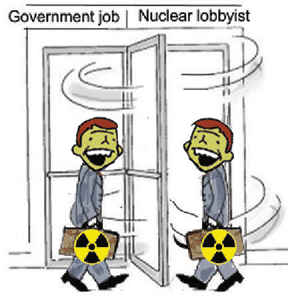
The same Pyne, famously discussed his role as a defence industry consultant with EY whilst he was a sitting member of the Federal Cabinet, a matter which prompted a Senate investigation.
He still works for EY, sits on the board of defence contractor XTEC, is Chair of the Advisory Board of another defence contractor NIOA, and in June last year Arawa Capital announced him as Chair of its Advisory Board and Investment Committee for a fund investing in weapons systems.
In heralding that appointment Arawa specifically referred to the, still unsubstantiated, Scott Morrison announcement of a malicious cyber attack by an unnamed “state-based” actor. Arawa trumpeted Pyne has “unrivalled knowledge of the cyber, intelligence and national security landscape.”
With Pyne on board, Arawa said it “anticipates closing out the initial $50mil capital raising swiftly.” It transpired there was a swift “closing out”, ASIC records show six months later Arawa Capital Pty Ltd was deregistered as a company.
According to research from Michael West Media’s “Revolving Doors” series, Pyne’s numerous board memberships and consultancies put him in direct, or indirect, contact with more than a dozen weapons makers and contractors.
Clearly, talking up a war with China is of no financial benefit to these companies.
Why would China attack Australia?
Should Australia go to war with China in defence of Taiwan? is the title of the Australia Institute report and 42% of its six hundred respondents think China is poised to attack Australia.
How and why?
Those in Australia beating the “drums of war” point to Taiwan as the flashpoint for the next major global conflict. To what end does a first strike on Australia achieve China’s goals in relation to Taiwan?
If Australia has something China wants, it is many times cheaper and easier to buy it than to send your army half way around the world to steal it.
China’s current leadership is presiding over a great deal more diplomatic disasters than triumphs but, if nothing else, the Chinese are pragmatic.
Australia’s rabid China hawks will no doubt dismiss such assessments, saying China doesn’t need to deploy military assets it would simply launch a nuclear strike on a target—which they ignore is home to 1.2 million ethnically Chinese people.
My counter argument?
The policy wonks in Washington, who made you their lapdogs, didn’t throw you a bone because they thought you were smart, they threw you the bone because they knew you were dumb enough to catch it!
This survey’s inconvenient truth
The same number of respondents were polled in Taiwan and only a few more (49 percent) expressed fears of an attack from the mainland. Bear in mind the Taiwanese are of the same Han ethnicity as the majority of Chinese, who moved over from the mainland in the 1680s; the PRC has never given up its claim to what was once part of China; and the island sits just 161 kilometres off the coast of China.
That four in ten Australians should think Beijing—a mere 9,000 kilometres from Canberra—is gearing up for invasion is staggering.
Report author Allan Behm noted, “Given Australia and Taiwan’s historical and geographical differences, it is astounding that Australians could be more fearful than Taiwan in anticipating an attack from China.”
This anticipation is undoubtedly fuelled by Australia’s China hawks, all with close ties to US-funded research groups and patronage from US weapons makers.
However, they should not be too smug in thinking their “drums of war” are resonating.
73 percent of Australians regard the United States as an aggressive nation, while only six in ten Australians believe the US would come to our aid in the event of war with China.
Given Australia has followed the United States into 100 percent of its wars, that Australians would only rate America a 60 percent chance of leaping to our defence is a sobering statistic.
Totally at odds with Prime Minister Morrison and Foreign Minister Maris Payne’s unquestioned support of the US antagonism towards China, 75 percent of Australians think it is in our interests that China and the US “work together towards world peace”. Of concern to the spin merchants inside the government an even higher number of coalition supporters, 79 percent, think peace with China is a good idea.
Despite the US, and Morrison’s, rhetoric of Taiwan being a like-minded democracy of shared values, 76 percent of Taiwanese rate America as an aggressor. Should the US come to Taiwan’s aid in a war with China, only 18 percent of Taiwanese people think they would win.
How reliable are drummers?
By any sensible strategic logic, the dogs of war should remain in their box. Let the drums of war continue to drum up business for the China threat industry and their death-merchant patrons. …..
Liberal-led committee raises concerns about Morrison government’s charity crackdown
Liberal-led committee raises concerns about Morrison government’s charity crackdown, Concetta Fierravanti-Wells fears the regulations could curb political protest and freedom of speech Guardian Daniel Hurst, 16 July 21, A Coalition-chaired committee has raised concerns about the Morrison government’s crackdown on charities suggesting the new regulations could curb certain types of political protests and freedom of speech.
In a newly released letter, the conservative Liberal senator Concetta Fierravanti-Wells also says the government has been too vague in explaining what sorts of offences could lead to charities being deregistered.
An alliance of more than 30 charities welcomed the intervention, with Tim Costello saying it sends “a clear signal that these laws are unprecedented and an unjustified regulatory overreach”.
Late last month, the government said it would press ahead with new regulations to expand the types of offences for which charities could be deregistered, prompting the sector to raise fears the crackdown could silence their advocacy work.
Under the changes, which the government says will reinforce trust and confidence in the sector, the regulator would be empowered to investigate charities engaging in or promoting serious unlawful acts of trespass, vandalism, theft or assault and threatening behaviour.
This will apply regardless of whether they are classified as an indictable offence or the less serious category of summary offences under state and territory laws.
Charities will be prohibited from using their resources – including social media accounts – to “actively promote” others to engage in unlawful activities.
Fierravanti-Wells has written to the assistant treasurer, Michael Sukkar, seeking a response to a range of concerns, including the potential effect on the implied freedom of political communication in Australia.
Fierravanti-Wells is chair of the parliamentary committee that monitors how ministers are making use of their powers to issue regulations.
In her letter to Sukkar on behalf of the committee (PDF), she says while the government has provided some examples of the type of offences to which the rules may apply, “it is unclear what the full scope of the offences may be”.
The government has not provided enough detail about the charities commissioner’s discretionary powers, why they are needed, and any safeguards – even though that information “is important to enable charities to clearly understand their obligations”.
“The committee concerns are particularly amplified noting that the discretionary powers to be exercised by the commissioner may relate to the determination of whether a criminal law has been breached,” Fierravanti-Wells writes.
Similarly, she says, the government has not provided information about whether the measure “may limit registered entities’ implied freedom of political communication, by preventing them from engaging in, or supporting certain activities”.
“This may include limiting their ability to engage in, or support, certain types of political protest,” she writes, without making any assessment as to whether the regulations are constitutional.
Fierravanti-Wells asks Sukkar to explain by 28 July “how the instrument is compliant with the implied freedom of political communication, and whether the explanatory statement can be amended to include this analysis”.
Costello, the chair of the Community Council for Australia and former chief of World Vision Australia, said it was “heartening to see that this important committee shares the concerns of charities from across the sector, which have formed a broad alliance to condemn these egregious regulations”.
“Giving the charity commissioner power to shutter a charity for a minor offence by a member is the equivalent of the electoral commissioner having discretion to deregister the Liberal party because a party member damages someone’s lawn when putting up a sign,” Costello said in a statement on Friday.
Dr Cassandra Goldie, the head of the Australian Council of Social Service, said a healthy democracy was “one where communities and their charities are free to speak up and act in the interests of the people they represent and serve”………… https://www.theguardian.com/australia-news/2021/jul/17/liberal-led-committee-raises-concerns-about-morrison-governments-charity-crackdown
Australian Members of Parliament from right and left parties call on US President Biden to drop charges against Julian Assange,
Australian MPs call on US President Biden to drop charges against Assange, https://www.smh.com.au/politics/federal/australian-mps-call-on-us-president-biden-to-drop-charges-against-assange-20210629-p585a1.html By Rob Harris, June 30, 2021 Former security analyst turned federal Labor MP Peter Khalil has joined a group of Australian politicians directly lobbying the United States to drop an appeal over a British court’s ruling against the extradition of the WikiLeaks co-founder Julian Assange.
In a video message to US President Joe Biden released on Wednesday evening Australian time, 11 federal MPs from across the political spectrum have also appealed to Washington to drop its espionage charges against the Australian citizen and for the British government to allow him to return home.
Before entering politics Mr Khalil, the member for the Victorian seat of Wills, was director of National Security Policy of the Coalition Provisional Authority in Iraq. As a national security adviser to former prime minister Kevin Rudd, he was personally named in diplomatic cables sent to Washington by the US Embassy, which were later released by Wikileaks.
While he has previously criticised Mr Assange’s actions in helping obtain and leak classified information on the wars in Afghanistan and Iraq, Mr Khalil said the case was “not just about one individual”.
“In an era where rising authoritarian regimes are denying and attacking freedom of the press, such as the shut down of Hong Kong’s Apple Daily by the Chinese Community Party, it is more important than ever that when it comes to condemning the denial of press freedom the rhetoric of liberal democracies is actually matched with substantive actions to protect the right of journalists and the media to do their work freely to hold governments to account,” Mr Khalil said.
He said while the Obama administration had clearly chosen not to indict Mr Assange because it would set a damming precedent against journalistic practice and behaviour, the Trump administration aggressively pursued the case.
“Therein lies the problem. These charges are so broad-based that if successful they would go well beyond this individual case – they would impact investigative journalism and open up prosecutions of countless media doing this journalism, they would have a chilling effect on all journalists reporting on national security and foreign affairs matters,” he said.
The 49-year-old Mr Assange has been in Belmarsh Prison since April 2019 trying to avoid extradition to the US to face charges on multiple counts of conspiring with and directing others, from 2009 to 2019, to illegally obtain and release US secrets.
In doing so he aided and abetted hacking, illegally exposed confidential US sources to danger and used the information to damage the US, according to the charges. If convicted on all counts he faces a prison sentence of up to 175 years.
In 2012 Mr Assange sought asylum at the Ecuadorean embassy to avoid extradition to Sweden on a rape allegation that he denied. An investigation into the 2010 rape allegation has since been dropped by Swedish prosecutors.
He was awarded a Walkley award, Australian journalism’s highest honour, in 2011 for a “most outstanding contribution to journalism” for his “brave, determined and independent stand for freedom of speech and transparency”.
In March this year Nationals MP George Christensen, Independent Andrew Wilkie and Labor’s Julian Hill personally met with the US embassy’s charge d’affaires, Michael Goldman, arguing that Mr Assange should be allowed to return home.
A 24-member parliamentary group established to support Mr Assange’s bid to return home contains members from all major parties, including now Deputy Prime Minister Barnaby Joyce.
Prime Minister Scott Morrison said in January Mr Assange would be allowed to return to Australia if all charges were dropped. He said consular support had consistently been offered to Mr Assange, but made clear the government were “not parties to those set of proceedings”.
.
Keith Pitt, Minister for Resources, enthuses about nuclear power.
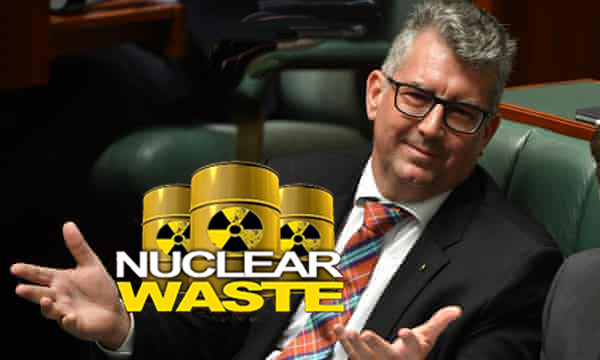
Keith Pitt MP, Minister for Resources, Water and Northern Australia / LNP member for Hinkler, wants Australia to follow Poland, with a plan to developi nuclear power.
Mr Pitt is one of the Morrison government’s most outspoken advocates for nuclear power who previously quit the frontbench over his opposition to the Paris Agreement. https://www.4bc.com.au/podcast/will-poland-transitioning-to-nuclear-be-a-blueprint-for-australia/
Barnaby Joyce is back as Deputy PM – pushing for nuclear and coal
Barnaby Joyce says Australia needs low-emission coal stations and backs nuclear power
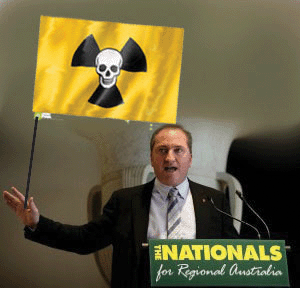
Joyce said small modular reactors could “power the city of Tamworth, the city of Armidale and a lot of other towns beside” with technology you could transport “on the back of a truck”
Deputy prime minister also blasts banks for managing carbon risk and supports coal exports in Sky News interview, Guardian, Katharine Murphy and Amy Remeikis 29 June 21
The newly returned Nationals leader and deputy prime minister Barnaby Joyce says Australia needs high-efficiency, low-emission coal power stations, as well as revenue from continuing exports of thermal coal, to bankroll social services.
While metropolitan Liberals have made it clear they will not support new coal-fired power, and the International Energy Agency has advised wealthy countries to phase out coal power plants by the end of the decade, Joyce used an interview on Sky News to champion modern coal plants, and declare he was in favour of nuclear reactors………..
Joyce told Jones he was a supporter of Australia adopting nuclear power if people wanted zero-emission power generation. But he said whether the nation went down that road was ultimately a matter for voters.
“I can’t change the nuclear position,” the Nationals leader said. “I believe we should have nuclear power and, and I believe that anything to make our nation a stronger place, this is the path we should be going down,………
Joyce said small modular reactors could “power the city of Tamworth, the city of Armidale and a lot of other towns beside” with technology you could transport “on the back of a truck”.https://www.theguardian.com/australia-news/2021/jun/29/barnaby-joyce-says-australia-needs-low-emission-coal-stations-and-backs-nuclear-power
Australian Local Gov Association support Mount Isa nuclear weapons ban motion
Australian Local Gov Assoc pass Mount Isa nuclear weapons motion https://www.northweststar.com.au/story/7316487/australian-local-gov-assoc-pass-mount-isa-nuclear-weapons-motion/
Derek Barry ocal Government Association has supported Mount Isa City Council’s letter to the federal government looking for a nuclear weapons ban……..(subscribers only)
Napandee still the targeted site for nuclear waste? South Australia’s radioactive nightmare.

The Senate’s nuclear waste dilemma, Pearls and Irritations, By Noel Wauchope, Jun 27, 2021 ”……….. Australia’s obligations mount – to have some credible plan for long term management of its nuclear waste from its present Opal, and previous HIFAR nuclear reactors.The new amendment made this very significant change – and a real career-on -knife edge situation for Keith Pitt. Instead of specifying Napandee as the site for – let’s face it – just another temporary nuclear waste dump – the Bill now says that a selection is to be made from one of the listed sites. …
Well this seems to boil down to just one site anyway……… after all the promotional activity, and significant funding already granted to Kimba, it looks as if Napandee is still the targeted site….
Legal challenges to this site selection ? …….. the first consideration will be the Barngarla Native Title Owners………. [There] are farmers, local residents and business leaders, who are asking the government for funding for an independent review and assessment of the dump project. Up till now, information on the project has been confined to government and ANSTO promotion of the dump as a ”medical necessity” for Australia.
Then there are residents of the wider Eyre Peninsula, who have had no say in the Kimba decision. There are the various communities whose residents are likely to object to having radioactive waste transported through their area. There’s South Australia, too, which has clear laws prohibiting the establishment of a nuclear waste dump in that State, the Nuclear Waste Storage Facility (Prohibition) Act 2000.
But even those who have no ”local” interest in this project have been raising objections, with that rather old-fashioned motivation – the greater good. Thirteen of Australia’s top non government organisations rejected the Napandeed plan and the original Act as deeply flawed There were many submissions to the Senate Committee’s Inquiry into the plan, raising well-argued doubts about economic problems with the plan, about geological unsuitability of the location, environmental risks, and the likely outcome of Kimba being burdened with ”stranded wastes”
It is an issue of national concern, but it has been pitched by the government as a matter only for the 824 eligible voters of the Kimba Shire.
Looking at this in the wider and historical context, the plan is not so new. The federal government and ANSTO have been aiming for years to transfer the responsibility of the reactor wastes to some distant location, preferably out of New South Wales. ANSTO, under the recently departed CEO Dr Adi Paterson had grand plans for expanding its operations, to build a marketing empire for medical radioisotopes, This is a dubious plan, as now these isotopes are being produced in a safer, more practical way, using non nuclear cyclotrons.
A greater dream, (or perhaps nightmare) lies behind the nuclear lobby’s push for a radioactive waste dump. It’s the idea, promoted by the company PANGEA, in 1999, of Australia becoming the importer of international nuclear waste – the world’s nuclear waste hub. PANGEA has been reborn as ARIUS, with the same dream. In 2016, that dream was pushed by the South Australian Nuclear Fuel Cycle Commission, which failed to convince South Australians. Two Citizens Jury processes rejected the plan, and the South Australian Premier Steven Marshall announced that it was definitely axed.
There’s still more. The dream of plutonium and other end products of nuclear reactors coming to Australia was tied to the aspirations for an Australian nuclear future, first with the goal of the full nuclear fuel cycle, with advanced nuclear reactors, small nuclear reactors, thorium reactors, (that need plutonium to kick-start the fission process), nuclear submarines, nuclear-propelled spacecraft and so on……..
[Ed. note – the Bill was passed by the Senate on 22nd June]
Australian Conservation Foundation Nuclear Free Campaigner David Sweeney said “The return of legal review is important but it is extraordinary that the Minister ever thought its removal was reasonable,” Mr Sweeney said.“A day in court is a fundamental right and to seek to remove this was deeply flawed – as is the government’s wider plan.”
The ACF along with other peak environmental, health and community organisations, has spelt out its objections in a document on its website, stating that the plan for the Kimba waste dump is unnecessary and deeply flawed. More importantly, they are calling for what is instead really needed . They demand a properly funded and expert independent review of Australia’s radioactive waste management, based on evidence and global best practice.
https://johnmenadue.com/the-senates-nuclear-waste-dilemma/
1 This month


Help Aunty Sue Protect Her Land and Sacred Sites From Destructive Rocket Testing.
.

Australians deserve the truth
about
AUKUS – https://aukuspublicinquiry.com/

PETITION – To: Prime Minister Anthony Albanese and the Australian Labor Government

of the week – Australians for War Powers Reform (AWPR)
To see nuclear-related stories in greater depth and intensity

