Australian government obsessed with preventing legal appeals against its nuclear waste dump plan
Commenting on the opinion piece: They have let it come: now build it , In Daily Dave Sweeney, Australian Conservation Foundation InDaily 25 Feb 21
Sean Edwards’ defence of the federal governments push for a hotly-contested national radioactive waste facility near Kimba on the Eyre Peninsula fails to recognise that the deeply flawed plan has once more hit the rough.
Mr Edwards speaks of respect, but there is nothing respectful in the governments new legislation seeking to remove people’s rights to legally appeal or challenge the plan.
Access to a day in court is a fundamental democratic right, and the governments obsession with removing this should sound alarm bells in the wider community, just as it has in the Senate where the planned law was again deferred this week after it failed to garner broad political support.
The plan shirks the hard questions about responsible long-term radioactive waste management in favour of a sub-optimal short-term political ‘fix’.
The waste comes from the Lucas Heights reactor in Sydney. There is a growing call that it should stay at this secure federal site until there is a credible pathway for its long-term management. Moving it to an area in regional South Australia where there are far fewer management assets and resources is both unnecessary and irresponsible.
This is not a decision about on which hill to put a mobile tower. Deciding on Australia’s first purpose-built national radioactive waste facility requires much more evidence, effort and evaluation than has occurred to date.
If radioactive waste lasted as long as our politicians it would hardly be a problem. But it doesn’t. This is Australia’s most serious radioactive waste and some of it needs to be isolated from people and the environment for 10,000 years.
Our nation needs a credible, evidence-based approach to the long-term management of radioactive waste.
Sadly, neither Minister Pitt’s plan nor Mr Edward’s assurances deliver this. It is time the current approach was scrapped and the federal government got serious about advancing responsible waste management. – https://indaily.com.au/opinion/reader-contributions/2021/02/26/your-views-on-nuclear-waste-submarines-and-jobseeker/
Legislation banning nuclear power in Australia should be retained

Murdoch papers and Murdoch’s Sky News have ramped up their campaign to have nuclear laws repealed, and far-right Coalition MPs and former MPs are along for the ride. The post Legislation banning nuclear power in Australia should be retained appeared first on RenewEconomy.
Legislation banning nuclear power in Australia should be retained — RenewEconomy
State parliaments in NSW and Victoria have completed nuclear inquiries over the past two years but the governments of both states have no intention of repealing laws banning nuclear power.
The Morrison government established an inquiry into nuclear power in 2019 but made it clear that the federal ban would be retained regardless of the findings of the inquiry.
Nevertheless, supporters continue to campaign for the repeal of federal and state laws banning nuclear power. The Murdoch papers and Murdoch’s Sky News have ramped up their campaign to have those laws repealed.
Far-right Coalition MPs and former MPs are along for the ride.
And a tangled web of far-right conspiracists and fossil fuel interests: for example a recent article promoting nuclear power in Australia was written by a Policy Associate at the impressive-sounding Institute for Energy Research — the impressive-sounding, Koch-founded, fossil fuel-funded Institute for Energy Research.
There’s conflict within the Coalition, as demonstrated by the unwillingness of the federal and NSW Coalition governments to repeal legal bans, and submissions opposing nuclear power to the federal inquiry from the SA and Tasmanian conservative governments as well as the Queensland Liberal-National Party.
Coalition Senator Matt Canavan is at war with himself, previously noting that nuclear power would increase power bills but now supporting taxpayer funding for nuclear power through the Clean Energy Finance Corporation.
Yes, it’s entertaining watching the Coalition at war with itself over an energy source that has well and truly priced itself out of the energy debate and has instead found a home in the culture wars.
Former PM Malcolm Turnbull describes nuclear power as the “loopy current fad … which is the current weapon of mass distraction for the backbench”.
But there’s a serious side to the problem.
Firstly, the promotion of nuclear power muddies the energy debate and helps to delay the transition from fossil fuels to renewables. Economist Prof. John Quiggin notes that, in practice, support for nuclear power in Australia is support for coal.
Secondly, politicians who are silly enough to promote nuclear power over cheaper renewables would probably be silly enough to gift billions of dollars of taxpayer subsidies to nuclear companies.
And not all of these MPs are fringe figures like Craig Kelly — some have real clout such as NSW Deputy Premier John Barilaro, former Deputy Prime Minister Barnaby Joyce, and former PM Tony Abbott (who thinks the Coalition should promote nuclear power to “create a contest” with unions, GetUp, the Greens, the ALP and the “green left“.
There are plenty of recent examples demonstrating how badly nuclear power projects can go wrong.
All of the recent projects in the US and western Europe have cost about A$20 billion per reactor and all of them are at least A$10 billion over budget and many years behind schedule.
Multi-billion-dollar taxpayer and ratepayer subsidies for these failed projects have been ever-expanding. It would be naïve to expect a better outcome — in other words, a non-disastrous outcome — in Australia given our lack of experience and expertise.
Thirdly, culture wars based on lies and conspiracy theories can escalate beyond anyone’s wildest imagination, as we see with the MAGA movement in the US.
There has to be push-back against irrational ideologues lest they become dangerous irrational ideologues.
The rest of this article summarises the reasons to oppose nuclear power in Australia and to keep legal bans in place. This summary comes with the caveat that rational arguments won’t shift the culture warriors; a cult deprogrammer might shift them, but not rational arguments.
Nonetheless, the rest of the population needs to be inoculated against the misinformation of the ideologues. Continue reading
Wise warning to Australian government to withdraw embarrassing Nuclear Waste Dump Bill
 Peter Remta, 21 Feb 21, to Senator Slade Brockman
I am aware that the Waste Management Amendment (Site Specification, Community Fund and Other Measures) Bill 2020 has been listed in the Senate’s order of business for Tuesday 23 February but with respect suggest that this a completely futile exercise on the part of your government and the responsible minister
The bill will not be passed because of the unwavering opposition by the crossbench and any preceding debate could be extremely embarrassing for your government because of the untoward and disingenuous information previously put out by Pitt and his department and its agencies being raised by the opposing senators
If Pitt then falls back on the existing legislation he will be subject to administrative and judicial and now because of the High Court decision earlier this month in the New Acland Coal case(1) will be completely stopped with his proposals if the opposing community at Kimba start their legal action since their situation is one real and not just apprehend bias as in that case
Should that litigation ensue then practically all written material held by the government in all its guises will be fully disclosed through the litigation procedure of discovery
From my limited personal knowledge of some of that material it will prove extremely embarrassing and your government will not be able to claim any privilege to prevent its disclosure
This is the view of several senior lawyers including some retired superior court judges but ask the attorney should you have any doubts
Perhaps the most pertinent aspect of the whole situation is the proposal for Kimba will in any event fail to get any of the necessary licences as ARPANSA is already being criticised for not carrying out its proper regulatory functions with respect to ANSTO and as a result the licence applications will be subject to an overseas peer review which will completely remove the licensing process from your government and its agencies
In any case ANSTO is already under a cloud due to its dismal performance and awkward responses at the Senate estimates hearing on 29 October 2020 which will I understand be subject to further extensive questioning and explanations
Please bear in mind that I was the source of the information for the questioning senators and the further questions to be asked due to the complete inadequacy of the responses by ANSTO to the notified questions(2)
I therefore suggest that you and Dean Smith as the government whips withdraw the bill before it becomes a further embarrassment to your government in a possible election year
With kind regards
Peter Remta
(1). Oakey Coal Action Alliance Inv v. New Acland Coal Pty Ltd & Ors
High Court Case No.B34/2020
(2). SENATE ECONOMICS LEGISLATION COMMITTEE Estimates
Hansard THURSDAY 29 OCTOBER 2020
Senator Abetz pages 11 to 13 and Senator Carr pages 5 to 11
Nationals add nuclear enthusiasm to the government’s energy bill
 Nationals’ nuclear flare-up on energy bill https://au.news.yahoo.com/nuclear-ideal-cutting-emissions-joyce-222058648.html?guccounter=1&guce_referrer=aHR0cHM6Ly9uZXdzLmdvb2dsZS5jb20v&guce_referrer_sig=AQAAAG3X514QPdgktFOrKbKPrnzoSz6joD3PVpI6uSj2DBv3oIZTOIzUDZWnifcsw_SXXPYtt3h1orA3QYlShoI_rlgBn5o675_PqDys5-xmgpGOEFmBJ1ooQWfTzK9RMofsPeZk-CfshnVXybppn5h7kGhpqKtNAaeAVwv0YCeavNKn, Thu, 18 February 2021, The Nationals have gone nuclear on energy policy, flagging another amendment to their own government’s plans.
The government wants the bill to pass parliament next week so a raft of projects go ahead.
Former Nationals leader turned backbencher Barnaby Joyce has already wedged his colleagues by introducing an amendment which would allow the Clean Energy Finance Corporation to invest in coal-fired power stations.
Now the Nationals Senate team wants the green bank to invest in nuclear power as well as carbon capture and storage.
The five Nationals senators led by Bridget McKenzie and Matt Canavan fronted a media conference promoting their plan.
“We compete against the world with one hand behind our back while other nations avail themselves of cutting edge, low emissions technologies,” Senator McKenzie said.
There is a longstanding moratorium on nuclear energy generation which has been maintained by both Labor and coalition governments.
The coal and nuclear-pushing Nationals are putting renewed pressure on current leader Michael McCormack.
By introducing amendments to the government’s own bill they are forcing their colleagues to either vote for or against the original plan.
Treasurer Josh Frydenberg said Mr McCormack has been a resilient leader, having already batted off an attempt from Mr Joyce to snatch back the party’s top job.
Mr Frydenberg said the Nationals and Liberals had so far worked effectively on energy under the current leaders.
“It’s a pretty complex area, as I know,” he told reporters in Canberra.
“If I took off my jacket I could show you the scars from being the energy minister.”
Mr Frydenberg was the minister behind the previous coalition government’s National Energy Guarantee, which played a role in Malcolm Turnbull’s downfall as prime minister.
Mr Joyce claims small modular nuclear reactors are ideal to replace decommissioned coal-fired power stations and reduce emissions.
“Nuclear reactors can do it,” he told reporters in Canberra.
“Why not, if you want zero emissions.”
Opposition Leader Anthony Albanese said nuclear energy in Australia doesn’t stack up.
“What we are witnessing here is just a part of the chaos that is the coalition when it comes to energy policy,” he said.
The Nationals argue the $1 billion grid reliability fund to be run out of the CEFC should support small nuclear energy projects and get involved in developing the technology.
The Australian Conservation Foundation says there’s nothing clean about nuclear, coal or gas.
“Nuclear is not a credible climate response and has been repeatedly rejected by the market and the community,” ACF spokesman Dave Sweeney said.
Australia a renewables leader – or the Saudi Arabia of nuclear energy”

Northern Territory Senator Dr Sam McMahon says she is “delighted” her push for nuclear has been backed, after the Nationals announced new amendments to a bill in favour of nuclear energy and carbon capture and storage.
Nationals Senators, led by Matt Canavan and Bridget McKenzie have announced a raft of amendments to the Clean Energy Finance Corporation (CEFC) bill to invest in nuclear power.
Senator McMahon says the drafted legislation supports her long-established calls to unlock nuclear energy…..
The Northern Territory, with our abundance of Uranium and potential nuclear fuel Thorium, should be the Saudi Arabia of nuclear energy.
But political activist group Get Up’s national director Paul Oosting says that as Australia forges ahead with solutions to the climate crisis, such as solar technology, the push for nuclear could delay climate action.
“Nuclear power is dangerous, unnecessary and colossally expensive. It would take more than a decade to build a nuclear reactor in Australia and cost billions. It’s the ultimate climate action delay tactic,” Mr Oosting said.
“Australia has an opportunity to position itself as a world leader in renewables. It’s critical this pivotal moment in our history not be squandered on obsolete and failing technologies that will lock in irreparable climate damage.”
Mr Oosting said he was concerned the clean energy corporation could become a “slush fund” for the coal, gas, and nuclear industry, and cautioned politicians from backing the bill.
“When Taylor’s Bill comes before Parliament, politicians who accept the seriousness of the climate crisis we face – of all parties and none – must act to ensure coal, gas, and nuclear are excluded from any definition of ‘low emissions technology’, the return-on-investment requirement is kept, and the independence of the CEFC board is maintained,” he said………….he said…………. https://www.hepburnadvocate.com.au/story/7134825/the-nt-should-be-the-saudi-arabia-of-nuclear-energy-senator-mcmahon/
Australian Liberal National Coalition enthusiastic for nuclear power
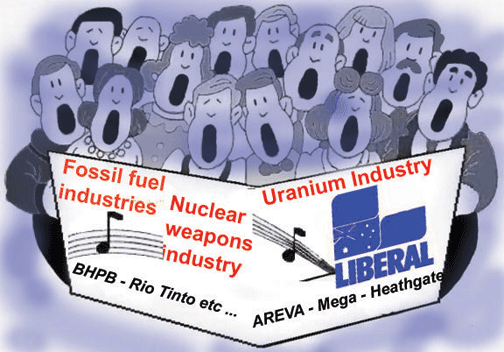
Coalition MPs in drive for nuclear energy, THE AUSTRALIAN, 17 Feb 21, Nationals senators have drafted legislation allowing the Clean Energy Finance Corporation to invest in nuclear power as two-thirds of Coalition MPs backed lifting the ban on the controversial fuel source.
The block of five Nationals senators, led by Bridget McKenzie and Matt Canavan, will move an amendment to legislation establishing a $1bn arm at the green bank to allow it to invest in nuclear generators, high-energy, low-emissions (HELE), coal-fired power stations and carbon capture and storage technology.
The Nationals’ move comes as a survey of 71 Coalition backbenchers conducted by The Australian revealed that 48 were in favour of lifting the longstanding prohibition on nuclear power in the EPBC act.
Liberal MPs Andrew Laming, John Alexander and Gerard Rennick are among backbenchers who want Scott Morrison to take a repeal of the nuclear ban to the upcoming election ……
The new amendment proposed by the Nationals would go further than Mr Joyce’s push by ensuring the CEFC — established by the Gillard government in 2012 to invest in green energy initiatives — could help kick-start nuclear projects as well as new clean coal plants……..
Out of the 71 Coalition backbenchers surveyed by The Australian, only Queensland senator Paul Scarr was opposed to changing the nuclear prohibition enshrined in the EPBC Act, citing a lack of community support “at this stage”. A further 22 backbenchers were undecided or did not respond to questions.
Other supporters of lifting the ban on nuclear generation, including Trent Zimmerman, Ted O’Brien and Rowan Ramsey, believe the government should not move ahead with legalising the energy source while the proposal is bitterly opposed by Labor.
In-principle support for lifting the nuclear prohibition is prevalent by members in every faction of the Coalition, which has been divided over climate change action since Tony Abbott became prime minister in 2013.
City-based Liberal MPs ……. including Jason Falinski, Tim Wilson, Katie Allen, Andrew Bragg and Dave Sharma — argue that nuclear should be an option in a technology-agnostic approach …..
The Prime Minister has signalled he will not move ahead with legalising nuclear energy unless there is bipartisan support with Labor. MPs told The Australian Mr Morrison was unlikely to pursue a policy change on the issue in this term of parliament. However, small modular nuclear reactors were included as a potential technology in the federal government’s technology investment roadmap discussion paper………..
Mr Tim Wilson attacked Labor and the Greens as nuclear science deniers. …….
Many government MPs acknowledge the power source is not currently competitive on price, but say investment decisions should be a matter for private companies and lifting the nuclear ban would encourage technological advancement..
Other Liberal MPs in favour of lifting the prohibition are: Warren Entsch, Russell Broadbent, James Stevens, Ian Goodenough, Rick Wilson, David Fawcett, Concetta Fierravanti-Wells, Sarah Henderson, Hollie Hughes, James McGrath, Jim Molan, Julian Simmonds, Bert van Manen, Ben Small, Dean Smith, David Van, Terry Young and James Paterson.
Nationals MPs who want the energy source legalised include Anne Webster, Damian Drum, Perin Davey, Llew O’Brien, Sam McMahon, Susan McDonald and Ken O’Dowd.
Boothby MP Nicolle Flint has previously publicly backed nuclear power.
‘Clean Coal’ – ridiculed by experts, as just a marketing scam
 ‘Clean coal’ is nothing but a marketing scam: Energy experts, New Daily, Cait Kelly, Reporter 17 Feb 21, The Nationals’ pitch for taxpayers to invest in ‘clean coal’ is nothing but a marketing scam designed to make Australians feel better about burning carbon emissions, leading energy experts say.
It comes as the Morrison government pushes key changes to Australia’s Clean Energy Finance Corporation that would allow the green bank to invest in fossil fuel projects, and give Energy Minister Angus Taylor the power to control which investments receive funding.
Mr Taylor’s proposed bill would undo laws that stop the corporation from investing in fossil fuels and loss-making projects.
But outspoken backbencher Barnaby Joyce served up an amendment to allow for investment in clean coal, blindsiding the government and derailing the passage of the bill through Parliament on Wednesday.
Debate on the legislation started in the House of Representatives on Monday and the push was on to get ‘clean coal’ a spot at the investment table.…….
On Wednesday, Nationals Senate leader Bridget McKenzie backed Mr Joyce’s amendment intended to allow for new investment in “high efficiency, low emissions” coal-fired power.
Doctors also joined the chorus of voices warning the changes would negatively affect environment targets, saying our love of fossil fuels is already killing 5700 Australians each year, and will continue to do so until we phase it out.
Clean coal ‘doesn’t exist’
Richie Merzian, the climate and energy program director with the Australia Institute, said ‘clean coal’ was nothing more than spin.
“Clean coal doesn’t exist. That’s the first thing,” Mr Merzian told The New Daily.
“Over the last 15 years, Australian governments have invested $1.3 billion into making clean coal work.
“There isn’t a single commercial clean coal, carbon capture storage power plant in Australia. And there are hardly any overseas – you can count them on one hand.”
Australia has only one carbon capture and storage gas plant. It’s currently leaking emissions into the atmosphere, because it doesn’t work.
The Gorgon gas project in WA received $60 million in federal funding but did not start storing emissions until 2019, three years after productions started.
Recently, it has been leaking high levels of emissions out into the atmosphere because its pressure management system is broken.
“It’s still not fully operational,” Mr Merzian said.
“The level of the emissions released in the atmosphere are about the same as Australia’s annual domestic emissions of flights.
“It’s been a massive failure.”
All it boiled down to was a marketing tool, he said……… https://thenewdaily.com.au/news/2021/02/17/clean-coal-scam/
Australian Government could face an unwinnable legal case if Senate passes the Kimba Nuclear Waste Dump Bill

sources outside of the government.
5. The government has been notified in writing that its concept for one national centralised facility has been badly planned and not anywhere as safe as claimed – in fact the government and its entities have been asked to withdraw their claims and express the concerns of the holders and the contractors but have refused to do so.
The Australian government’s Radioactive Waste Bill does not meet required IAEA standards
Peter Remta, 30 Jan 21, National Radioactive Waste Management Amendment (Site Specification, Community Fund and Other Measures) Bill2020 I understand that Minister Pitt has brought on the bill for debate in the Senate on Thursday 4 February 2021 as he has been threatening the opposing senators that if the bill fails to pass it will become a trigger for the federal government to call early election by means of a double dissolution.
establishment of the facility at Napandee which will only show up the inefficient and disingenuous conduct of the government and its agencies such as ANSTO and even ARPANSA.
*****
Below is the email message I sent out yesterday which includes in red my suggested draft for an amendment to the Labor
Party’s proposed amendment to the bill The effect of this draft is to require such strict compliance with the codes and standards prescribed by the International Atomic Energy Agency that would be possible for the government to continue with establishing the facility
*****
3A Section 4Insert:
Joint Convention means the Joint Convention on the Safety of Spent Fuel Management and on the Safety of Radioactive Waste Management, done at Vienna on 5 September 1997, as amended and in force for Australia from at any time and includes without limitation the Safety Standards established or adopted by the International Atomic Energy Agency which provide the fundamental principles,requirements and recommendations to ensure nuclear safety for the purposes of among other things giving full effect to the Joint Convention.
Australian Labor Party’s removal of Mark Butler as Shadow Environment Minister – an ominous sign for the nuclear-free movement
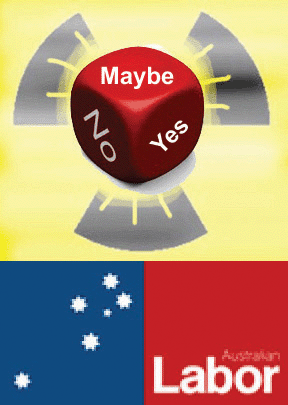 Noel Wauchope 30 Jan 21, Anthony Albanese’s removal of Mark Butler as Shadow Environment Minister is an ominous sign – for the environment, the climate, and for a nuclear-free Australia. Having followed the Labor Party’s efforts (or lack thereof) on nuclear issues, over several years, I am not optimistic. When I wrote individually to each ALP politician, a few years back, I got standard answers from all, just quoting Labor policy, but not answering my question. Only Mark Butler and Sam Dastyari gave me straight answers, affirming their personal anti nuclear opinion. Labor has a sad history of caving in on uranium/nuclear issues.
As new climate spokesman, Chris Bowen has good climate change and environment credentials, and good ideas on connecting clean energy technologies with employment opportunities. BUT, this appointment looks like a Labor swing to the Right, and appeasing the fossil fuel fans (and ? the nuclear fans)
Labor leader Anthony Albanese used to be a strong anti-nuclear force in Labor. The former leader, Bill Shorten, was ever ready to make a deal with the nuclear lobby, if he thought that would help him win. But – what has happened to Albo lately ?
Butler dumped as Labor’s climate opposition collapses at a truly pivotal moment

Labor to dump Mark Butler as its opposition to Morrison’s inadequate climate and energy policies evaporates. Renew Economy, 28 Jan 21,
It’s odd how climate news tend to rhyme and counter itself across the world in perfect unison. Joe Biden has just announced a huge raft of major new climate policies, after coming to power off a campaign that focused heavily on climate. It’s a big moment, and it’s being received well by both the American energy industries and by the progressive activists that helped shape Biden’s policies.
Back in Australia, the news that opposition climate spokesman Mark Butler is losing the climate change portfolio to a member of the party’s right wing was leaked to media. What a contrast. As the federal government sinks even deeper into a climate and energy funk, the opposition marks this major global climate moment by sacking one of their best.
The total absence of any countering force to pressure a government that’s become stunningly and openly destructive on climate is a dark moment for Australia, and it’s worth exploring how we got here.
Missed opportunities are the norm
If you trace back through every big climate and energy moment of the past two years (and before that, too), the Labor party has failed catastrophically to summon any might or certainty or even bare sufficiency in their opposition to the federal government’s fossil expansion fantasies.
The climate-intensified bushfires were mostly ignored and there has been near zero debate about where COVID19 recovery cash flows.
In December last year, a crucial moment for Australia’s climate came and went. In the lead up to the moment when Australia’s government had to submit an ‘update’ to its 2030 Paris Agreement targets (known as ‘Nationally Determined Contributions, or NDCs), the Prime Minister and ‘Energy and Emissions Reductions Minister’ Angus Taylor were badly exposed.
Scott Morrison claimed to have been invited to an event held by the United Kingdom government – another climate summit talk-fest type thing. Turns out that Australia never made it onto the list; purely because Morrison’s government had steadfastly refused to upgrade their 2030 NDC from something weak, old and insufficient to something newer and better aligned with the country’s potential for climate action and level of ambition. Morrison was furious: he’d saved up a big announcement to promise not to cheat on those already-weak 2030 targets (a shift made possible only because renewable energy has outperformed expectations, and because a deadly disease dented emissions) – where was his congratulations?
2030 is what counts. The world’s performance this decade will largely decide whether net zero by 2050 is a pipe-dream or possible. And in the last months of 2020, Australia federal opposition, the Labor Party, had a brilliant opportunity to pressure the government into upgrading their 2030 climate ambitions to something more aligned with what’s required to keep the planet to 1.5C of warming (around 66% is a good indicator; a new ‘Climate Targets Panel’ announced today, suggests somewhere above 50% for 2C and 75% for 1.5C).
Of course, that didn’t happen. The absolute peak of opposition was leader Anthony Albanese labelling the rescinding of the Kyoto trick ‘pathetic‘. The reason why? Labor has itself not established what a 2030 target should be; they haven’t even set an interim pre-2050 target for emissions reductions.
There’s a popular conception that Labor’s 45% 2030 target, which it took to the 2019 federal election, was a major part in their loss. That’s generally justified on an ‘election review‘ that blamed opposition to the Adani coal mine for their loss; along with too-ambitious climate policies. “Labor should recognise coal mining will be an Australian industry into the foreseeable future and develop regional jobs plans based on the competitive strengths of different regions” said the review. It was co-chaired by Dr Craig Emerson, who recently wrote in the AFR that ending fossil fuel extraction is akin to an act of white supremacy. Albanese now reminds voters that Australia will be digging up and selling coal in 2050; the year the world ought to be mostly free from all emissions.
Of course, it only ‘cost’ Labor in 2019 due to a mixture of half-heartedness from Labor right leader Bill Shorten, severe misreporting of climate policy from media outlets (“What about the costings!!”) and the government’s relentless and ludicrous scare campaign around zero emissions transport. The alternative – of doing climate advocacy in an effective way, immune to those immature attacks – wasn’t even considered in that review.
The internal fight was won by the fossil industry
Mark Butler was one of the remaining forces for stronger climate action within the Australian Labor party is Mark Butler. He’d come into conflict with the party’s most aggressive advocate of higher emissions, Joel Fitzgibbon, who represents a coal-mining area in New South Wales. Whatever slight momentum existed within the party for climate ambition seems now to have been sidelined.
The alternative vision offered up by Labor – modelled on Ross Garnaut’s ‘superpower’, in which Australia becomes enriched through the export of zero carbon energy – is grand but still vague. There is little detail on the short term benefits that strong climate action would bring. There’s no commonly stated policy about a just transition for fossil workers, as that would entail admitting the likelihood that the industry’s on the way down – unthinkable for an unashamedly pro-fossil-mining party.
Butler is tipped to be replaced by Chris Bowen, a member of Labor’s right faction. Bowen’s Twitter history features no mention of wind, solar, coal, oil or gas, and the majority of climate mentions are criticisms of Liberal backbencher Craig Kelly. Bowen reassured voters prior to the 2019 election that he would not ban the Adani coal mine, but has also signalled potential enthusiasm about some parts of the US Democrat’s ‘Green new deal’ policy package. Bowen also led a push to make climate change a health priority, just prior to the onset of Australia’s Black Summer. bushfire season. It may not be all bad, but whether it translates into sufficient ambition seems highly questionable.
Albanese’s reshuffle was welcomed by Joel Fitzgibbon. “Fitzgibbon, who stood down from the resources portfolio after his clashes with Mr Butler at the end of last year, welcomed the news about the reshuffle but signalled he wanted a change on policy as well”.
It’s a weird request, given there is literally no policy to change, save for reaching ‘net zero’ domestic emissions in 2050 while still pumping out fossil fuels to the world. Presumably what Fitzgibbon is requesting is creating new policy, doing things like using government power to build new fossil fuel power stations, subsidising fossil mining operations even more, and changing regulations to roadblock renewables, EVs and other forms of decarbonisation. Capitulating to pro-fossil forces means that miles will be taken, after inches are given. Time will tell what this new-found position entails, but chances are that it won’t be good.
A new opportunity to waste again
This is all happening in the context of two global shifts.
First, the US Democrats won against an extremely popular authoritarian figure (for both the presidency and control of the Senate) by making climate action – and in particular, justice-driven climate action – a central focus. Today, Biden has made climate a central focus, announcing a wide range of additional initiatives that focus on communities of colour in the US. Biden just announced a plan to replace the government’s fleet of 650,000 vehicles with all-electric alternatives, cancelled the Keystone XL oil pipeline from Canada and has rejoined the Paris agreement. Of course, Biden has his own Fitzgibbon to contend with, but it hasn’t resulted in a reshaping of the party around total silence on climate.
It’s a winning formula: at least try to do what’s needed on climate, rather than hand-wringing about potential attacks from the opposition – which will always be in bad faith, and will always happen to matter the level of ambition. Make it about people – about jobs, and benefits and air and cities and land. Make it real. That seems to work.
Second, a major global climate conference will be held in November this year, in the UK. If you think the snub from the UK last year was bad, wait until you see what happens after another full year of fossil fuel advocacy and government support from Morrison and Taylor. The lead up and duration of this massive global climate event ought to be a red hot, near-perfect time to establish a clear alternative to the government’s stonewalling.
The final year of this stretch of government seems like it’ll end up the same as the first two: Morrison and Taylor worsen climate harm, while the opposition fails to oppose.
We can say with total confidence that if the Labor party had already created and popularised a climate plan that targets today’s ills, like the need for cleaner cities, more accessible transport, cheaper power and more varied and secure work, they’d be soaring in the polls even despite COVID19.
Of course doing this would paint a target on their back – but literally anything would invite bad-faith attacks from the government and the media. The best option in the face of those attacks is to build a plan so strong that it can withstand attacks, not to abandon climate policies altogether. The current approach means the party is hurtling towards an election loss, up against one of the most stunningly clumsy, pro-fossil governments in the world. https://reneweconomy.com.au/butler-dumped-as-labors-climate-opposition-collapses-at-a-truly-pivotal-moment/
Joel Fitzgibbon Demands Labor’s Climate Change Policy Be Solely Based On Keeping Him In A Job
Joel Fitzgibbon Demands Labor’s Climate Change Policy Be Solely Based On Keeping Him In A Job Betoota Advocate, WENDELL HUSSEY | Cadet | CONTACT, 28 Jan 21, As storms begin to brew in regards to Anthony Albanese’s leadership, Joel Fitzgibbon has today hit the media junket with another big demand.
This time, the Member for Hunter has called for the Labor Party to give up on trying to combat climate change and instead focus upon developing a policy solely based on keeping his parliamentary salary rolling in.
The man involved in every single federal Labor leadership spill since 2006 because the party never seems to be heading in the direction he wants, says ‘Labor needs to return to its roots.’
But, by roots, he doesn’t mean trying to develop policy that improves the lives of his predominantly working-class constituents in a long term sense, he means dropping all climate targets and continuing to try and cosy up to the dying coal industry despite the fact even giant profit-driven banks and investment funds are saying it’s not economically viable going forward…. https://www.betootaadvocate.com/entertainment/joel-fitzgibbon-demands-labors-climate-change-policy-be-solely-based-on-keeping-him-in-a-job/
Murdoch’s Australia Day award — brought to you by miners and bankers
 Murdoch’s Australia Day award — brought to you by miners and bankers
Those who promote and profit from fossil fuels have appropriated the phoney awards handed out by the obscure Australia Day Foundation. https://www.crikey.com.au/2021/01/27/rupert-murdoch-australia-day-foundation/– DAVID HARDAKER, JAN 27, 2021
On the face of it it looks to be an extraordinary decision: a prestigious honour bestowed on the media mogul whose recent hits in the United States include helping fan an insurrection against democracy via Fox News and in Australia leading the way on climate change denialism in cahoots with the Morrison government it supports.
The foundation and its awards are backed by a group of international conglomerates including mining giants BHP, Rio Tinto, Woodside and Anglo-American. Australia’s big banks, the National Australia Bank and Westpac, are also in on the act. Another leading name is CQS, the wealthy London hedge fund founded by Australian business figure Sir Michael Hintze.
Hintze is not well known in Australia, but he is at the centre of a powerful network of business and conservative UK and Australian politicians. As we reported last year he has been a force behind the climate-sceptic Global Warming Policy Foundation which has given voice to the views of Tony Abbott and Cardinal George Pell.
Nominally a business outfit, the foundation also blurs the lines with government. It is sponsored by Austrade and uses Australia House, home to the Australian High Commission, in London to hand out its “Australia Day” awards to UK and Australian figures of its choosing.
This year it gave its honorary Australian of the Year in the UK award to Conservative British MP Liz Truss who promoted the cause of Abbott as a trade adviser to the UK government. Past recipients have included Prime Minister Boris Johnson.
Hintze is not well known in Australia, but he is at the centre of a powerful network of business and conservative UK and Australian politicians. As we reported last year he has been a force behind the climate-sceptic Global Warming Policy Foundation which has given voice to the views of Tony Abbott and Cardinal George Pell.
Nominally a business outfit, the foundation also blurs the lines with government. It is sponsored by Austrade and uses Australia House, home to the Australian High Commission, in London to hand out its “Australia Day” awards to UK and Australian figures of its choosing.
This year it gave its honorary Australian of the Year in the UK award to Conservative British MP Liz Truss who promoted the cause of Abbott as a trade adviser to the UK government. Past recipients have included Prime Minister Boris Johnson.
Hintze is not well known in Australia, but he is at the centre of a powerful network of business and conservative UK and Australian politicians. As we reported last year he has been a force behind the climate-sceptic Global Warming Policy Foundation which has given voice to the views of Tony Abbott and Cardinal George Pell.
Nominally a business outfit, the foundation also blurs the lines with government. It is sponsored by Austrade and uses Australia House, home to the Australian High Commission, in London to hand out its “Australia Day” awards to UK and Australian figures of its choosing.
This year it gave its honorary Australian of the Year in the UK award to Conservative British MP Liz Truss who promoted the cause of Abbott as a trade adviser to the UK government. Past recipients have included Prime Minister Boris Johnson.
Australian Capital Territory politicians join calls for Australia to sign nuclear ban treaty
|
ACT politicians join calls for Australia to sign nuclear ban treaty https://www.canberratimes.com.au/story/7097235/act-politicians-join-calls-for-australia-to-sign-nuclear-ban-treaty/, Jasper Lindell 24 Jan 21,
ACT politicians have renewed their calls for the federal government to join a United Nations treaty banning the use of nuclear weapons, which came into force on Friday. Politicians and members of the international diplomatic corps gathered on Saturday at the Canberra Rotary peace bell in Nara Peace Park to mark the entry-into-force of the treaty. Greens member for Ginninderra Jo Clay said Australia’s continued relationship with uranium mining and the creation of nuclear weapons was unacceptable.
“With climate change upon us, the ACT Greens believe that there has never been a more urgent time for Australia to join its 86 international counterparts and show its commitment to a more peaceful and sustainable future for all of us,” Ms Clay said in a statement. All Greens members of the Legislative Assembly have signed the International Campaign to Abolish Nuclear Weapons’ parliamentary pledge.
Some Labor members, including Chief Minister Andrew Barr and Deputy Chief Minister Yvette Berry, have signed the pledge. Federal member for Canberra Alicia Payne has also signed. The Australian government has not signed the treaty, which compels signatories to stop developing, testing, producing or stockpiling nuclear weapons. Signatories are also banned from threatening to use the weapons. Fifty countries ratified the treaty in October, which was condemned by the United States. Red Cross International humanitarian law adviser Tara Gutman welcomed the treaty, saying the law was the cornerstone of a world free of nuclear weapons. “There has been no humanitarian response developed that is remotely capable of being applied to a nuclear weapon attack. We simply will not be there to assist victims,” she said. “These weapons are an inhumane response to any military threat … They decimate populations, cause untold and needless suffering, and their environmental impact would accelerate climate change making some areas of the planet uninhabitable. |
|
Resignation of Dr Adi Paterson from Australian Nuclear Science and Technology Organisation- Australian government keeps mum.
2020-2021 Budget estimates – Parliament of Australia more https://www.facebook.com/groups/344452605899556
- Some examples of government answers to Senators’questions.
 Sen Kim Carr” (Question No 85) : “Did Dr Paterson resign or was he asked to resign by the ANSTO board?
ANSWER. “There was no correspondence between the ANSTO Board and the Minister about Dr Paterson’s performance.”
1 This month


Help Aunty Sue Protect Her Land and Sacred Sites From Destructive Rocket Testing.
.

Australians deserve the truth
about
AUKUS – https://aukuspublicinquiry.com/

PETITION – To: Prime Minister Anthony Albanese and the Australian Labor Government

of the week – Australians for War Powers Reform (AWPR)
To see nuclear-related stories in greater depth and intensity

