Nuclear weapons ban treaty: more than a symbolic victory
Nuclear weapons ban treaty: more than a symbolic victory, https://www.croakey.org/nuclear-weapons-ban-treaty-more-than-a-symbolic-victory/ Editor: Nicole MacKeeAuthor: Sue Warehamon: January 18, 2021
As the Treaty on the Prohibition of Nuclear Weapons (TPNW) comes into force later this week, Dr Sue Wareham of the Medical Association for Prevention of War outlines the local and global implications. And, she calls on the Federal Government to make an explicit declaration that nuclear weapons must never be used again under any circumstances.
Sue Wareham writes:
Here’s a good news story about health to kick off 2021. It’s not about vaccines (despite their critical importance), but about the only weapons that threaten all of us and the environment we depend on: nuclear weapons.
On Friday 22 January, the Treaty on the Prohibition of Nuclear Weapons (TPNW), or nuclear weapons ban treaty, will legally come into effect. From that date, nuclear weapons – and every aspect of their existence including their development, testing, production, transfer, use and even possession – will be illegal under international law.
This is a huge achievement, and celebrations will be held around the globe, including in Australia.
Health professionals push
The legal prohibition stemmed from the health and humanitarian impacts of the weapons. They incinerate cities, kill, maim, burn and irradiate humans by the million, and destroy just about everything that health professionals need in the event of disaster. Their use could well trigger a nuclear winter that reduces food crops to starvation levels. By any measure, that’s an unconscionable affront to the healing professions.
Similarly, the momentum that led to the ban treaty was driven by health and humanitarian organisations and practitioners, in collaboration with progressive governments.
The message of prevention, especially of catastrophes for which there would be little that health professionals could do in response, was key, and remains so.
 The ban treaty is an especially proud achievement for health professionals in Australia, where in 2007 the Medical Association for Prevention of War (MAPW) initiated the International Campaign to Abolish Nuclear Weapons (ICAN), which played a leading role in the achievement of the Treaty.
The ban treaty is far from a symbolic victory; the  are huge, even without all nations – including those with the weapons – yet coming on board.
Associated with illegality
Nuclear weapons and those nations that possess or promote them will now be associated with illegality, which provides strong political leverage with which to press for abolition of the weapons.
This has certainly been the experience with the prohibition by treaty of other unacceptable weapons systems such as chemical and biological weapons, landmines, and cluster bombs.
Pressure will be brought to bear on financial, academic and other institutions that receive funding from, or invest in, the companies that make the weapons, to dissociate themselves from the purveyors of illegal goods; this has already begun (see, for example, here, here, and here) and will increase.
This is not only morally and medically repugnant, but such implicit threats of nuclear terror will now be, as of 22 January, illegal under international law.
The ban treaty comes none too soon. The Bulletin of the Atomic Scientists warned in January 2020 of the undermining of “cooperative, science- and law-based approaches to managing the most urgent threats to humanity”, and that “civilisation-ending nuclear war – whether started by design, blunder, or simple miscommunication – is a genuine possibility”.
The risk of nuclear war was assessed as higher than it’s ever been. If any further evidence were needed of the perilous state in which humanity exists, we were reminded recently that the US nuclear arsenal can be launched by one person, the president, regardless of whether that person happens to be an unhinged narcissist.
Call for change
Australia’s policy must change. There must be an explicit declaration that nuclear weapons must never be used again under any circumstances. And there must be a commitment to the urgent abolition of these weapons as the only way to ensure this.
Preventive health demands nothing less, and the Treaty on the Prohibition of Nuclear Weapons is the only global initiative that is leading us towards these goals. Australia must sign and ratify it.
The nuclear weapons ban treaty is supported by peak Australian and global health bodies, including the Australian Medical Association, the World Medical Association, the Australian Nursing and Midwifery Federation, the International Council of Nurses, the Public Health Association of Australia, and the World Federation of Public Health Associations.
MAPW is calling on the Health Minister Greg Hunt to declare that:
- Nuclear weapons must never be used, under any circumstances; and
- It is a medical and public health imperative to prohibit and eliminate nuclear weapons.
Readers are encouraged to join the call; you can do so here. It will be delivered to the Minister on 22 January, the day the TPNW comes into force. It will also be sent to the Shadow Health Minister Chris Bowen. Pleasingly, ALP policy is to support the TPNW when in government; that commitment must remain solid.
Since the first – and, thus far, the only – use of nuclear weapons in war in 1945, health professionals have played leading roles in the quest for their elimination. This critically important role continues. We have the weight of medical authority, moral authority and now unequivocal legal authority with which to exert political pressure.
Dr Sue Wareham OAM is President of the Medical Association for Prevention of War, and board member, ICAN (the International Campaign to Abolish Nuclear Weapons) Australia.
Australia’s environmental scientists intimidated, silenced by threats of job loss
 Australia’s environmental scientists intimidated, silenced by threats of job loss, Michael West Media, by Elizabeth Minter | Jan 17, 2021 The silencing of environmental scientists, as revealed in a study late last year, profoundly damages our democracy, wastes taxpayers’ money, takes a huge personal toll, allows fake news to proliferate and short-changes the public. Elizabeth Minter reports. Australia’s environmental scientists intimidated, silenced by threats of job loss, Michael West Media, by Elizabeth Minter | Jan 17, 2021 The silencing of environmental scientists, as revealed in a study late last year, profoundly damages our democracy, wastes taxpayers’ money, takes a huge personal toll, allows fake news to proliferate and short-changes the public. Elizabeth Minter reports.
“I declared the (action) unsafe. I was overruled and … was told to be silent or never have a job again.” “We are often forbidden (from) talking about the true impacts of, say, a threatening process […] especially if the government is doing little to mitigate the threat.” “I was directly intimidated by phone and Twitter by (a senior public servant).” “… governments allow (industry) to treat data collected as commercial in confidence. This means experts most able to comment on the details of big mining and construction projects are hopelessly conflicted and legally gagged from discussing these projects in public.” “(Government) staff are rewarded or penalized on the basis of complying with opinions of senior staff regardless of evidence.” “I proposed an article in The Conversation about the impacts of mining […] The uni I worked at didn’t like the idea as they received funding from (the mining company).” All in a day’s workAll these comments, straight from the mouths of some of Australia’s most esteemed scientists, highlight the threats faced by ecologists, conservation scientists, conservation policy makers and environmental consultants, whether they are working in government, industry or universities. The scientists were responding to an online survey as part of a study conducted by academics Don Driscoll, Georgia Garrard, Alexander Kusmanoff, Stephen Dovers, Martine Maron, Noel Preece, Robert Pressey and Euan Ritchie. In an ironic twist, one of the research team’s initial members declined to contribute to the project for fear of losing funding and therefore their job. As the study’s authors note, scientists self-censor information for fear of damaging their careers, losing funding or being misrepresented in the media. In others, senior managers or ministers’ officers prevented researchers from speaking truthfully on scientific matters. This means important scientific information about environmental threats often does not reach the public or decision-makers, including government ministers. This information blackout, termed “science suppression”, can hide environmentally damaging practices and policies from public scrutiny. Survey methodology……….Ministers not receiving full informationSome 75% of the scientists surveyed reported having refrained from contributing to public discussion when given the opportunity – most commonly in traditional or social media. A small number self-censored conference presentations (9%) and peer-reviewed papers (7%). For scientists working in government, the main reasons they didn’t comment was because of attitudes of senior management (82%), workplace policy (72%), a minister’s office (63%) and middle management (62%). Fear of what would happen to their career prospects (49%) and concern about media misrepresentation (49%) also discouraged those working in government from speaking publicly. Almost 60% of scientists working in government and 36% of scientists in industry reported that internal communications were modified………… Critical conservation issues suppressedThe most common issue on which information was suppressed was threatened species. About half of industry and government scientists, and 28% of academics, said their commentary was constrained. Scientists working in government also reported not being able to comment on logging and climate change………….. The system is brokenOf those scientists who had spoken publicly about their research, 42% had been harassed or criticised for doing so. Of those, 83% believed the harassers were motivated by political or economic interests……. Change is neededAs witnessed by the past four years of Donald Trump’s presidency, it has never been more important to ensure that the public are exposed to facts and information from trusted sources……. The study was published late last year in Conservation Letters, a journal of the Society for Conversation Biology. https://www.michaelwest.com.au/australias-environmental-scientists-intimidated-silenced-by-threats-of-job-loss/ |
|
ANSTO gets a blank cheque for its nuclear waste production at Lucas Heights?
 Greg Phillips, No nuclear waste dump anywhere in South Australia , 13 Jan 2021, Congratulations Canada! “Cyclotron-produced technetium-99m approved by Health Canada”. Why rely on a global network of aging, unreliable, toxic spewing nuclear reactors when you can have a local network of clean, reliable cyclotrons? Especially when pandemics hobble global freight networks. From the article: “The process is safe and precise, employing stable targets and producing little to no long-lived radioactive waste. And, with the right target and extraction systems, these cyclotrons can be used to reliably create technetium-99m regionally and without the need for reactor-based materials.”
Government’s Kimba nuclear waste dump slush fund – benefit goes straight to Kimba’s mayor
 Community grants from the National Radioactive Waste slush fund..
Of particular interest in Kimba is the 2nd largest amount allocated = $141,667 – apparently for the Mayor to get a commercial bakery in his supermarket.
Whilst in the Flinders it appears that no $ allocations were given to any individual/family owned commercial premises.
(From: National Radioactive Waste Management Facility New Community Benefit Program 2019-2022 https://www.business.gov.au/grants-and-programs/national-radioactive-waste-management-facility-community-benefit-programme/grant-recipients-2019-2022 )
Rupert Murdoch’s News Corpse rises in ABC Insiders !
 What’s happening with ABC ‘Insiders’? Independent Australia, By Alan Austin 2 January 2021 The capture of ABC Insiders by Murdoch’s minions was a topic of debate all year, with this April Alan Austin piece attracting in excess of 35,000 unique views.
…………Has the ABC’s Insiders program become a vehicle for the promotion of News Corp? Alan Austin has been watching with interest and alarm.
AN INTRIGUING development in Australia’s media landscape this year is that it appears ABC’s Insiders, a substantial television program paid for by taxpayers, has become a vehicle for the rehabilitation and promotion of Rupert Murdoch’s tawdry media empire.
The first 12 Insiders episodes since Speers’ arrival as host, have featured 36 guest appearances. Of these, 12 have been current News Corp employees and another four, recent departees. So 44 per cent of all guests from one stable.
There is no need for the ABC to reference anything from News Corp — certainly not as the key source of information. Australia has more than 30 important media organisations. It is itself a well-resourced generator of news and news analysis. Murdoch’s minions are entirely dispensable.
News Corp a legitimate news organisation?
News Corp is not a reliable source of information. It has long since abandoned any commitment to media codes of ethics. The Australian Press Council routinely finds News Corp outlets violate media codes of ethics. Fact-checkers in the UK and the USA have found the same.
Murdoch’s Fox News in the USA is the go-to outlet for President Donald Trump whenever he wishes to share his fabrications and falsehoods. According to the Washington Post, the U.S. President told 16,241 clearly identified lies in his first three years in office. Many of these were Fox exclusives.
In Australia, several senior Murdoch employees have been found guilty of serious falsehoods — and were then rewarded by their employer.
In the celebrated racial discrimination case Eatock v Bolt, Murdoch’s Andrew Bolt was found to have concocted at least 19 damaging false assertions against the Indigenous people he was attacking.
In the wrongful dismissal case of former editor Bruce Guthrie, the judge found two senior News Corp executives had been untruthful in their testimony before the court.
In Britain, Murdoch’s publications have lied, cheated, bribed police and engaged in an extensive range of criminal misconduct. A British Parliamentary Inquiry in 2012 found that Rupert Murdoch was ‘not a fit person’ to run a company in Britain.
As a result of police investigations into Britain’s phone-hacking scandal, a large number of News Corp personnel were arrested and convicted of criminal offences.
Political bias and the ABC
News Corp outlets spruik the commercial interests of the owners, which almost inevitably means supporting right-wing political parties. Normally this is not a great problem. Political biases are fine, provided they are balanced by other political biases. The issue with News Corp is much more insidious than just bias, as shown above.
Ruthless and remorseless
Among Australia’s most profound wrongdoings in recent times have been The Australian’s malicious condemnations of men and women who have served the nation well.
Professor Robert Manne of La Trobe University wrote this of the recent campaign against the Australian Human Rights Commission and its former president:
The attack launched by The Australian on Gillian Triggs and the Human Rights Commission has been obsessive, petty, relentless, remorseless and ruthless. In ‘Bad News‘ I documented similar campaigns – against Larissa Behrendt and Julie Posetti. But neither reached either the level of malevolence or the cultural significance of the current anti-Triggs campaign … What is happening to Gillian Triggs – a fine lawyer, a fine Australian, a fine human being – must be resisted with all the moral and rhetorical muscle liberal Australians can muster.
Other prominent people The Australian has sought to tear down with its frenzied campaigns of hate, include Carmen Lawrence, Joan Kirner, Wendy Bacon, Natasha Stott Despoja, Margaret Simons, Christine Nixon, Roz Ward, Clover Moore, Margo Kingston, Anna Bligh, Kristina Keneally, Julian Disney, Emma Husar, Yassmin Abdel-Magied, Julia Gillard and Jacinda Ardern. ……… https://independentaustralia.net/politics/politics-display/4-top-story-of-2020-whats-happening-with-abc-insiders,14657
“Ecomodernists” – Ben Heard, Oscar Archer, Barry Brook, Geoff Russell, – Australia’s pro-nuclear fake environmentalists
 Aboriginal First Nations and Australia’s ‘pro-nuclear environmentalists’ Aboriginal First Nations and Australia’s ‘pro-nuclear environmentalists’Jim Green – Nuclear Monitor | 10th July 2018 Australia’s Aboriginal people have long been mistreated by governments and industry in the pursuit of nuclear projects. The attitudes of ‘pro-nuclear environmentalists’ or ‘ecomodernists’ towards Aboriginal people is as disrespectful as those of governments and industry, argues JIM GREEN.The plan to turn South Australia (SA) into the world’s nuclear waste dump has lost momentum since 2016 though it continues to be promoted by some politicians, the Business SA lobby group, and an assortment of individuals and lobbyists including self-styled ‘pro-nuclear environmentalists’ or ‘ecomodernists‘. In its 2016 report, the SA Nuclear Fuel Cycle Royal Commission established by the state government promoted a plan to import 138,000 tonnes of high-level nuclear waste (about one-third of the world’s total) and 390,000 cubic metres of intermediate-level waste. The state Labor government then spent millions on a state-wide promotional campaign under the guide of consultation. …….. The Royal Commission Royal Commissioner Kevin Scarce ‒ a retired Navy officer ‒ didn’t appoint a single Aboriginal person to the staff of the Royal Commission or to his Expert Advisory Committee. Aboriginal people repeatedly expressed frustration with the Royal Commission process…… No analysis but favourable conclusions Despite its acknowledgement that it had not systematically analysed the matter, the Royal Commission nevertheless arrived at unequivocal, favourable conclusions, asserting that there “are frameworks for securing long-term agreements with rights holders in South Australia, including Aboriginal communities” and these “provide a sophisticated foundation for securing agreements with rights holders and host communities regarding the siting and establishment of facilities for the management of used fuel.” Such statements were conspicuously absent in submissions from Aboriginal people and organisations. There is in fact an abundance of evidence that land rights and heritage protection frameworks in SA are anything but “sophisticated.”……. Enter the ecomodernists
Ben Heard from the ‘Bright New World’ pro-nuclear lobby group said the Royal Commission’s findings were “robust”. Seriously? Failing to conduct an analysis and ignoring an abundance of contradictory evidence but nevertheless concluding that a “sophisticated foundation” exists for securing agreements with Aboriginal rights-holders … that’s “robust”?
In a November 2016 article about the nuclear waste import plan, Ben Heard and Oscar Archer wrote: “We also note and respect the clear message from nearly all traditional owner groups in South Australia that there is no consent to proceed on their lands. We have been active from the beginning to shine a light on pathways that make no such imposition on remote lands.” In Heard’s imagination, the imported spent nuclear fuel would not be dumped on the land of unwilling Aboriginal communities, it would be processed for use as fuel in non-existent Generation IV ‘integral fast reactors‘. Even the stridently pro-nuclear Royal Commission gave short shrift to Heard’s proposal, stating in its final report: “[A]dvanced fast reactors and other innovative reactor designs are unlikely to be feasible or viable in the foreseeable future. The development of such a first-of-a-kind project in South Australia would have high commercial and technical risk.” Heard claims his imaginary Generation IV reactor scenario “circumvents the substantial challenge of social consent for deep geological repositories, facilities that are likely to be best located, on a technical basis, on lands of importance to Aboriginal Australians”. But even in Heard’s scenario, only a tiny fraction of the imported spent fuel would be converted to fuel for imaginary Generation IV reactors (in one of his configurations, 60,000 tonnes would be imported but only 4,000 tonnes converted to fuel). Most of it would be stored indefinitely, or dumped on the land of unwilling Aboriginal communities. Honoured in the breach Heard says he “respects” the opposition of Traditional Owners to the waste import plan, but that respect appears to be honoured in the breach. Despite his acknowledgement that there was “no consent” to proceed from “nearly all traditional owner groups in South Australia”, Heard nevertheless wrote an ‘open letter‘ promoting the waste import plan which was endorsed by ‘prominent’ South Australians, i.e. rich, non-Aboriginal people. One of the reasons to pursue the waste import plan cited in Heard’s open letter is that it would provide an “opportunity to engage meaningfully and partner with Aboriginal communities in project planning and delivery”. There is no acknowledgement of the opposition of Aboriginal people to the waste import plan ‒ evidently Heard believes that their opposition should be ignored and overridden but Aboriginal people might be given a say in project planning and delivery. A second version of Heard’s open letter did not include the above wording but it cited the “successful community consultation program” with Aboriginal communities. However the report arising from the SA government’s community consultation program (successful or otherwise) stated: “There was a significant lack of support for the government to continue pursuing any form of nuclear storage and disposal facilities. Some Aboriginal people indicated that they are interested in learning more and continuing the conversation, but these were few in number.” Beyond offensive Geoff Russell, another self-styled pro-nuclear environmentalist, wrote in a November 2016 article in New Matilda: “Have Aboriginals given any reasons for opposing a waste repository that are other than religious? If so, then they belong with other objections. If not, then they deserve the same treatment as any other religious objections. Listen politely and move on. “Calling them spiritual rather than religious makes no difference. To give such objections standing in the debate over a repository is a fundamental violation of the separation of church and state, or as I prefer to put it, the separation of mumbo-jumbo and evidence based reasoning. “Aboriginals have native title over various parts of Australia and their right to determine what happens on that land is and should be quite different from rights with regard to other land. This isn’t about their rights on that land. “Suppose somebody wants to build a large intensive piggery. Should we consult Aboriginals in some other part of the country? Should those in the Kimberley perhaps be consulted? No. “They may object to it in the same way I would, but they have no special rights in the matter. They have no right to spiritual veto.” Where to begin? Russell’s description of Aboriginal spiritual beliefs as “mumbo-jumbo” is beyond offensive. His claim that Traditional Owners are speaking for other people’s country is a fabrication. Federal native title legislation provides limited rights and protections for some Traditional Owners ‒ and no rights and protections for many others (when the federal Coalition government was trying to impose a national nuclear waste dump on Aboriginal land in SA in 2003, it abolished all native title rights and interests over the site). National nuclear waste dump The attitudes of the ecomodernists also extend to the debate over the siting of a proposed national nuclear waste dump. Silence from the ecomodernists when the federal government was passing laws allowing the imposition of a national nuclear waste dump in the Northern Territory without consent from Traditional Owners. Echoing comments from the Liberal Party, Brook and Heard said the site in the Northern Territory was in the “middle of nowhere”. From their perspective, perhaps, but for Muckaty Traditional Owners the site is in the middle of their homelands. Heard claims that one of the current proposed dump sites, in SA’s Flinders Ranges, is “excellent” in many respects and it “was volunteered by the landowner”. In fact, it was volunteered by absentee landlord and former Liberal Party politician Grant Chapman, who didn’t bother to consult Adnyamathanha Traditional Owners living on the neighbouring Indigenous Protected Area. The site is opposed by most Adnyamathanha Traditional Owners and by their representative body, the Adnyamathanha Traditional Lands Association (ATLA). Indigenous Protected Area Heard claims there are “no known cultural heritage issues” affecting the Flinders Ranges site. Try telling that to the Adnyamathanha Traditional Owners who live on Yappala Station, in the Indigenous Protected Area adjacent to the proposed dump site. The area has many archaeological and culturally-significant sites that Traditional Owners have registered with the SA government over the past decade. So where did Heard get this idea that there are “no known cultural heritage issues on the site”? Not from visiting the site, or speaking to Traditional Owners. He’s just repeating the federal government’s propaganda. Silence from the ecomodernists about the National Radioactive Waste Management Act (NRWMA), which dispossesses and disempowers Traditional Owners in every way imaginable:
Uranium mining Silence from the ecomodernists about the Olympic Dam mine’s exemptions from provisions of the SA Aboriginal Heritage Act. Silence from the ecomodernists about sub-section 40(6) of the Commonwealth’s Aboriginal Land Rights Act, which exempts the Ranger uranium mine in the Northern Territory from the Act and thus removed the right of veto that Mirarr Traditional Owners would otherwise have enjoyed. Silence from the ecomodernists about the divide-and-rule tactics used by General Atomics’ subsidiary Heathgate Resources against Adnyamathanha Traditional Owners in relation to the Beverley and Four Mile uranium mines in SA. Adnyamathanha Traditional Owner Dr Jillian Marsh, who in 2010 completed a PhD thesis on the strongly contested approval of the Beverley mine, puts the nuclear debates in a broader context: “The First Nations people of Australia have been bullied and pushed around, forcibly removed from their families and their country, denied access and the right to care for their own land for over 200 years. Our health and wellbeing compares with third world countries, our people crowd the jails. “Nobody wants toxic waste in their back yard, this is true the world over. We stand in solidarity with people across this country and across the globe who want sustainable futures for communities, we will not be moved.” Now, Traditional Owners have to fight industry, government, and the ecomodernists as well. Silence from the ecomodernists about the divide-and-rule tactics used by General Atomics’ subsidiary Heathgate Resources against Adnyamathanha Traditional Owners in relation to the Beverley and Four Mile uranium mines in SA. Adnyamathanha Traditional Owner Dr Jillian Marsh, who in 2010 completed a PhD thesis on the strongly contested approval of the Beverley mine, puts the nuclear debates in a broader context: “The First Nations people of Australia have been bullied and pushed around, forcibly removed from their families and their country, denied access and the right to care for their own land for over 200 years. Our health and wellbeing compares with third world countries, our people crowd the jails. “Nobody wants toxic waste in their back yard, this is true the world over. We stand in solidarity with people across this country and across the globe who want sustainable futures for communities, we will not be moved.” Now, Traditional Owners have to fight industry, government, and the ecomodernists as well. |
|

Australia’s lying Minister for Resources gets an “F” in assessment of govt ministers

Peter Remta 26 Dec 20, How long can Keith Pitt remain with ministerial responsibility for such nationally important portfolios as water and mining and effectively the nuclear industry
He continues to make statements that are in many instances plainly wrong and show his ignorance and in some cases his complete disingenuity without attracting any parliamentary sanctions or chastising
His comments seem to be aimed purely at gaining public credibility and attempting to sway the senators opposing his ill advised proposals
He cannot rely on his advisers and ministerial staff for his comments as the ultimate authority and control lies solely with him as the responsible minister
No wonder The West Australian newspaper and its allied media sources gave Pitt an F for his ministerial efforts with the highest grading of course being A +
Silent Steven Marshall – cowardly silence from South Australia’s Premier on nuclear waste dump plan
|
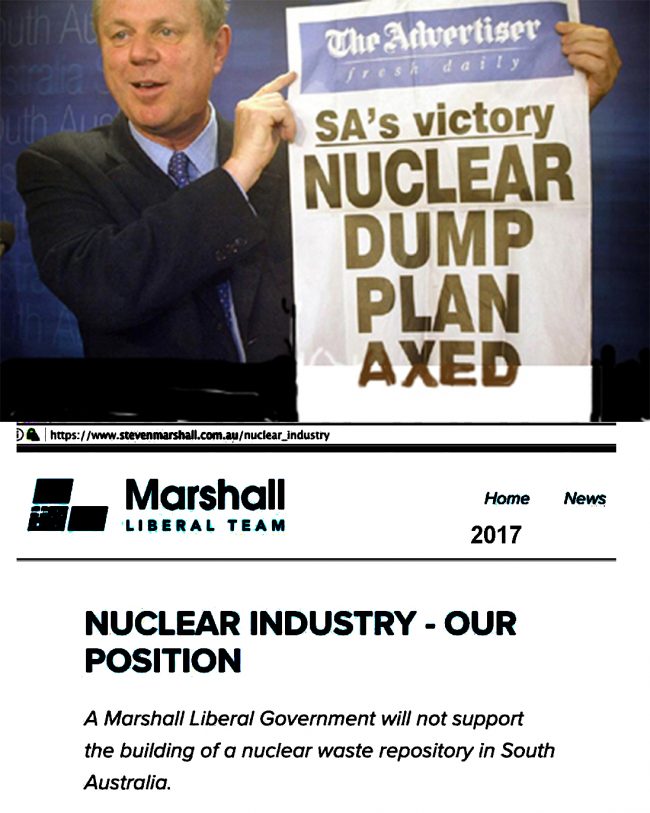
SILENT STEVEN
Last week I posted about Minister Dan van Holst Pellekaan threatening me with legal costs in response to a Freedom of information (FOI) request for all correspondence between the Federal and SA State Government on the National Radioactive Waste Management Facility since Steven Marshall had become Premier of SA.
********
In 2016, when in opposition, Marshall stated he would not support the facility. After the SA ‘Citizens Jury’ handed down their verdict on a waste facility to Premier Weatherill, Marshall proclaimed, “Jay Weatherill’s dream of turning South Australia into a nuclear waste dump is now dead”.
********
What I got back under FOI was heavily redacted but shows Marshall, like a good lapdog to the Prime Minister, has remained silent on the issue.
********
It’s the same with keeping Submarine Full Cycle Docking work in SA, as the PM considers sending that work to WA – silence. Its the same with the Federal Government’s appointment of a irrigation supporting former NSW National to the position of Inspector-General of (Murray-Darling) Water Compliance – silence.
********
The Premier is free to determine his political position on these issues which affect South Australia’s interests. But he is obliged as Premier to share his position with South Australians and he should be prepared to defend whatever his view is. That’s what leaders do. Instead, on so many important issues, he’s just Silent Steven.
|
|
Senator Rex Patrick calls on South Australian govt to come clean about nuclear waste dumping
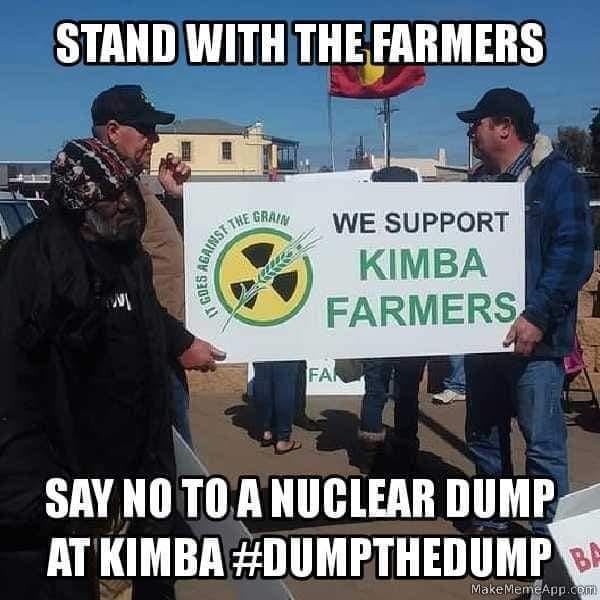 Patrick has Kimba nuclear question, https://www.whyallanewsonline.com.au/story/7058277/patrick-has-kimba-nuclear-question/?fbclid=IwAR3o2cKC_SU9yV-Q-d_xa470gmY0xG5CXkYRiA-LOJuXRDV76e8ls0v1n04, Luca Cetta, 17 Dec 20, The state government has remained silent on its stance relating to the planned Kimba nuclear waste site and South Australian Independent Senator Rex Patrick has called on the government to make known its position on the proposal.
The federal government has talked with the Kimba community about creating the site near the town with a majority of residents favouring the facility.
Senator Patrick said he had lodged a freedom-of-information (FOI) request seeking access to correspondence from the time of the last state election in 2018 to today and was “surprised” there had been only a few pieces of correspondence between Minister for Energy and Mining Dan van Holst Pellekaan and the federal government.
“I was very interested as there was a lot taking place between the federal government and the community in Kimba, and I was interested in what the state government has been doing through the process,” he said.
“The state has a role to play … and I was surprised there was only one letter to the Premier and a letter from former federal Resources Minister Matt Canavan and response. That is all we have seen. That is the only part the state government has had to play.”
While acknowledging it was a federal facility and issue, Senator Patrick said the state government should be involved by way of communication with federal leaders and community engagement.
“While I respect it is a national facility, there is no question the state government has skin in the game and I question why there is silence publicly,” he said.
“They should come out and support or oppose it so their position is known.
“They do need to be engaging the community as well to make sure all state-related issues that will flow from the facility are addressed.”
He said parts of the correspondence included redactions relating to the proposed site.
In a letter from Mr van Holst Pellekaan to Senator Patrick, which has been obtained by the Whyalla News, Mr van Holst Pellekaan said “the FOI Act provides that an agency may refuse access to a document if it is an exempt document” and that there was cause to provide “partial access” to three documents.
The letter outlines why parts should be redacted, including that a document can be exempt if “it contains information from an intergovernmental communication to the Government of South Australia”, while he also pointed to how the Act notes a document could be exempt if it “would, or could reasonably be expected to, cause damage to relations between the Commonwealth and a State”.
Senator Patrick said Mr van Holst Pellekaan made a “fundamental error” in thinking the correspondence was exempt under federal law as he was “not entitled to make that decision”.
He said he would take the matter to the South Australian Civil and Administrative Tribunal (SACAT) to “uncover what is underneath this”.
“There should be transparency about what has been communicated between the government of South Australia and the federal government,” he said.
“The Minister has made a decision. He relies on the fact he thinks it would be exempt under federal law and he is not entitled to make that decision. You can’t say ‘I think it is exempt’, you have to say ‘I think it is exempt because it would harm release in a particular way…’.”
Mr Patrick said the state FOI Act granted people and parliamentarians a positive right to documents and was only subject to restrictions consistent with the public interest and preservation of personal privacy.
He said the Act burdened the agency with establishing their case if they wanted to restrict access.
Both Commonwealth and state constitutions establish a democracy underpinned by a responsible system of government. Democracy and responsible government both require participation by people and, just because this is communication between the state and federal government, it doesn’t mean it automatically gets to be confidential. The Minister does not meet his burden by simply stating that the communications are confidential,” he said.
“This is now a fight between myself and Mr van Holst Pellekaan. This is Senator against Minister in SACAT. The Minister needs to be transparent with me, but more important with the people of SA.
“Governments work for the people, everything they do is paid for by the people. The people have a right to know what it is they are up to and how they are going about what they are up to.”
Mr van Holst Pellekaan did not respond to questions for this article.
Australia’s Industry Department is bluffing in employing staff for non existent nuclear waste project

|
Kazzi Jai, Fight to stop nuclear waste in South Australia, 19 Dec 20,
Have I missed something? Or two things actually?
Unless Minister Pitt has DECLARED the Napandee site right now as per current legislation….NOPE…or Senate passed the Amendments at last sitting ….NOPE….then is this a case of DIIS bluffing it yet again? If you ain’t got it bluff it?
And AWRA has employed ANSTO – who by the way is the MAIN CUSTOMER OF THIS DUMP – to tender for it for them! In their own words…
“ANSTO has been engaged by ARWA to provide a broad range of services to develop the NRWMF engineering design, and associated safety, security and operational framework. This tender is for the appointment of a lead engineering consultant (Consultant) to support ANSTO in progressing the project from the current concept design through to preliminary design”
BIZARRE!
Oh…and by the way Ms Chard –
THERE WAS NO BROAD COMMUNITY SUPPORT ACHIEVED!
Just because you say it and want it …. doesn’t actually make it so!
The FACTS speak for themselve
New engineering partner to assist with design on radioactive waste facility https://www.industry.gov.au/news/new-engineering-partner-to-assist-with-design-on-radioactive-waste-facility?fbclid=IwAR0RnDaKhcv6r07tmyQvhBRzRNDuyn4VfpLhf6KLyWb9bE7T8IFJ09EeCWI |
|
Minister Dan van Holst Pellekaan resorts to threas when asked to be transparent
The Usual Suspects: oil and gas majors star in Australian tax heist
The Usual Suspects: oil and gas majors star in Australian tax heist, Michael West 16 Dec 20,
Angus Taylor’s rescue package for the oil industry is a testament to governments getting gamed by large corporations. The latest Tax Office transparency data shows oil and gas juggernauts are Australia’s biggest tax cheats, again, yet now they are crying for public subsidies – and getting them – to prop up their oil refineries. Michael West reports on the good and the bad in multinational tax dodging land.
2020 in Australia – a successful year for resistance to nuclear pollution

DAVE SWEENEY | Nuclear Free Campaigner, Australian Conservation Foundation | www.acf.org.aua 15 Dec 20,
A year ago today the then federal resources/radioactive waste Minister Matt Canavan read the room in the Flinders Ranges and stated: “I will no longer consider this site an option for the facility”. https://www.minister.industry.gov.au/ministers/canavan/media-releases/national-radioactive-waste-management-facility-wallerberdina
Viva!! This decision was a great tribute to Adnyamathanha, the FLAG crew and wider community resistance.
In the year since
- Canberra has turned to Kimba where they are facing a stiff fight and have failed in an attempt to rewrite the laws to remove people’s right to legally challenge the waste plan
- SA Labor, Unions SA and many more civil society groups and state and national voices have come on board against the waste plan
- The Australian Human Rights Commission acknowledged the three sisters – Vivianne and Regina McKenzie and Heather Stuart as Human Rights Heroes for their radwaste efforts
- ARPANSA – the federal nuclear regulator – has confirmed that Australia’s worst waste can securely remain at Lucas Heights ‘for decades”
- Matt Canavan is gone and we have a new Minister – the sixth in as many years – if radioactive waste had the same longevity as federal ministers it wouldn’t be an issue.
- Collectively we are stalling the deeply flawed federal plan and shifting the story from the search for a postcode to the need for a credible process
Congratulations to all those who successfully defended the Flinders – and strength to those now actively contesting the dodgy Kimba plan.
Australia’s Liberal and National Parties got their arithmetic wrong on nuclear waste dump opinion polls
LIBS NATS FAILED MATHS, Kim Mavromatis, 8 Dec 20, Where did these people go to school? – I expect they failed maths because they can’t do % sums.
452 in favour of the dump from 824 eligible Kimba voters = 54.85% of the Kimba community.Not 62%.And Barngarla Native Title Holders, who were deliberately left out of the Kimba ballot,had their own vote : 0 in favour of the dump from 209 eligible voters.Combined Kimba and Barngarla votes = 43.75% in favour of the dump from eligible voters, Does Not equate to Broad Community Support.No mention by Pyne that the Govt want to dump radioactive Spent Nuclear Fuel, and reprocessed SNF on SA farmland that is 10,000 x more radioactive than uranium ore.No mention by Pyne that the Dump legislation removes Judicial Review – no rights of appeal or independent scrutiny.No mention by Pyne that all SA surveys consistently overwhelmingly Do Not support the dump on SA farmland near Kimba.And Christopher, my mum died of an inoperable brain tumour 2 years ago – using nuclear medicine as an excuse to dump radioactive nuclear waste on SA farmland is BS.Why on earth would you knowingly dump radioactive nuclear waste on SA Farmland????
Senate Debate on Nuclear waste dump Bill postponed till at least February 2nd 2021
 Kazzi Jai, NoNuclear Waste Dump Anywhere in South Australia, 7 Sec 20
1 This month


Help Aunty Sue Protect Her Land and Sacred Sites From Destructive Rocket Testing.
.

Australians deserve the truth
about
AUKUS – https://aukuspublicinquiry.com/

PETITION – To: Prime Minister Anthony Albanese and the Australian Labor Government

of the week – Australians for War Powers Reform (AWPR)
To see nuclear-related stories in greater depth and intensity

