Farmers to Canberra, to protest the law that forces a nuclear dump on Kimba’s agriculutral land
 We are members of the Kimba community and proud and productive grain farmers who have travelled to Canberra to meet with Labor, Green and cross-bench Senators to put a face to those directly impacted by the proposed legislation to name Kimba as the site for Australia’s radioactive waste dump.
In our view the process the Government has employed to site this facility in Kimba over the last five years has been unfair, manipulative and completely lacking in transparency.
We are extremely concerned that the Governments proposed legislation currently awaiting Senate consideration intentionally removes our right to contest the decision and denies basic protections .
It is clear that productive farming land in Kimba is not the best, or even the right place for our nations radioactive waste. We urge the federal government to step back and review their selection process rather than continue trying to force this decision through via Parliament.
Quotes can be attributed to Toni Scott – Secretary, No Radioactive Waste on Agricultural Land in Kimba or SA Committee Media Contact – Kellie Hunt – 0428 572 411
Out of site out of mind – Australian govt has NO PLAN for nuclear waste disposal.
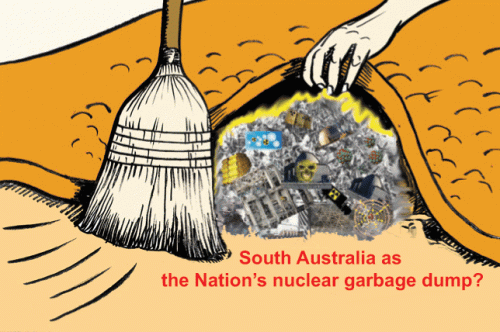
Divisive campaign on South Australian facility highlights urgent need for long term nuclear waste management plan, Croakey, 6 Nov 20, Tillman Ruff
“……..No long term management plan for nuclear waste
Australia needs to develop a plan for long-term management and disposal of long-lived intermediate level nuclear waste, which must be kept strictly isolated from people and the environment for 10,000 years.
More than 90 percent of Australia’s radioactive waste comes from nuclear reactors managed by the Australian Nuclear Science and Technology Organisation (ANSTO) at Lucas Heights in southern Sydney. This waste is stored there in a dedicated Interim Waste Store facility at Australia’s principal nuclear facility, with the best expertise and capacity in the country to manage this safely, monitored 24/7 by the Australia Federal Police.
A serious, open, transparent, evidence-based process is required to carefully consider the options, and develop the most responsible plan for ongoing long-term management and disposal of this waste.
nstead, successive governments — both Coalition and Labor — have sought to impose a succession of ill-considered waste dump plans on SA and NT remote communities. All have previously failed because of deeply flawed processes and strong community opposition.
Transport, taxpayer burdens absent health need
The risks of accident or theft are greatest during transport of nuclear materials. Kimba is 1,700 km from Lucas Heights. Road or sea transport of radioactive waste would involve lengthy routes potentially traversing many communities in multiple states.
The nuclear regulator, the Australian Radiation Protection and Nuclear Safety Agency (ARPANSA) has recently confirmed to a Senate inquiry that Lucas Heights has the capacity to safely store Australia’s radioactive waste for several decades, and that there is no urgent need to relocate it.
The Senate Inquiry last month recommended the South Australian plan go ahead, but there was a split among the committee membership, with Senators Jenny McAllister (Labor), Sarah Hanson-Young (Greens) and Rex Patrick (Independent) dissenting.
The government’s repeated claim that an immediate interim radioactive waste dump is needed to ensure the continuation of nuclear medicine in Australia is false.
Every sizeable hospital currently manages their radioactive waste on a ‘delay and decay’ basis on site; the residual waste rapidly loses its radioactivity and is stored on-site until it has decayed and can be discarded with normal waste. This doesn’t need to and won’t change.
The emotive but fallacious claim that provision of nuclear medicine services needed for diagnosis and treatment of cancer will be jeopardised if a new nuclear waste dump is not urgently progressed is being dishonestly but persistently promoted.
To support passage of the government’s amendments, Federal Resources, Water and Northern Australia Minister Keith Pitt is believed to be planning a “nuclear medicine roundtable” at Parliament House on Monday 9 November.
The true driver of increasing need for waste management is ANSTO’s institutional nuclear ambitions, reflected in its current massive ramp-up of production of medical isotopes for export — from around one percent to a target of 25-30 percent of global supply over the next several years.
Not only are we left with the waste legacy of this expanding isotope export business, Australian taxpayers also pick up the bill, paying $400 million for the Lucas Heights OPAL reactor, and subsidising ANSTO on an annual basis for its nuclear operations.
ANSTO received $313.8 million in 2019-20, and was given an additional $238.1 million over 4 years in last month’s Budget.
Cost analyses in several other countries have found that medical isotope sales usually only recover 10-15 percent of the true cost of production once waste, decommissioning, insurance and other costs are factored in.
ANSTO’s export expansion push is increasing domestic nuclear waste pressures, and this is happening without proper public and parliamentary accountability and scrutiny………..
Out of sight, out of mind
The government’s approach, codified in the proposed amendments, would see long-lived radioactive intermediate level nuclear waste transported long distances from the best and most secure site to manage radioactive waste in Australia, to a distant site in South Australian farming country with no current expertise, facilities or experience in securely managing long-lived hazardous radioactive waste.
Effectively, this “temporary” storage facility for waste that must be kept safe from the environment for over 10,000 years will be a large shed.
There is currently no plan and no process to develop a plan for the long-term management and eventual disposal of this waste. Therefore the intermediate level waste will likely languish indefinitely above ground in a facility inadequate for safe long-term storage or disposal, but out of sight and out of mind from Canberra or Sydney.
Australia needs an open, transparent, evidence-based and independent review of Australia’s current and projected radioactive waste production. This review should examine and make recommendations on the best practice long-term management of Australia’s radioactive waste production and disposal.
It should be conducted independently of ANSTO, given their role as proponent of the current proposal and plans to significantly increase nuclear waste production over the next decade for reasons which are not based on the health or other needs of Australians.
It should be open to input from Indigenous organisations, civil society organisations, experts and the public, and be undertaken before any soil is turned for a dump in Kimba and before any waste is moved from Lucas Heights. We have ample time to do this properly.
Tilman Ruff AO is Associate Professor at the Nossal Institute for Global Health, University of Melbourne. He is Co-President of International Physicians for the Prevention of Nuclear War, and co-founder and founding chair of the International Campaign to Abolish Nuclear Weapons, both Nobel Peace Prize laureate organisations. https://www.croakey.org/divisive-campaign-on-sa-facility-highlights-urgent-need-for-long-term-nuclear-waste-management-plan/
Australian government’s Nuclear Waste Bill – divisive, undemocratic and racist processes
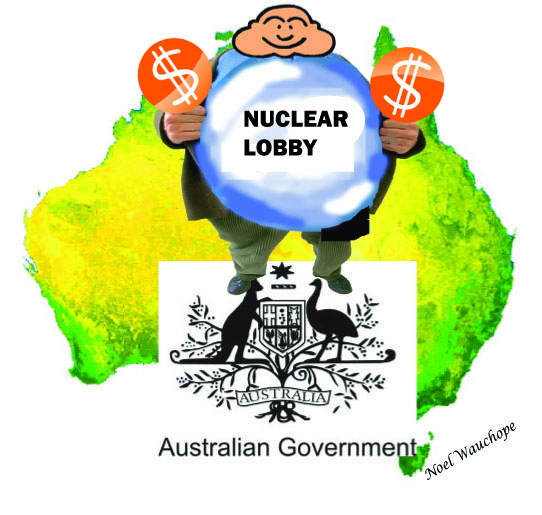
Divisive campaign on South Australian facility highlights urgent need for long term nuclear waste management plan, Croakey, 6 Nov 20,
Tilman Ruff writes: Radioactive waste production and management need a sound evidence-based plan, not shoddy and racist imposition based on misguided nuclear ambition.
On Tuesday 6 October, under the cover of the Federal Budget, the Government planned to introduce controversial amendments to laws on radioactive waste management in the Senate.
The amendments were dropped from the Senate list the following day, only to reappear the following day, the last sitting day for this parliamentary session. They were ultimately not tabled, for reasons unstated, but most likely because the government was concerned it did not have the numbers to pass them.
The National Radioactive Waste Management Amendment (Site Specification, Community Fund and Other Measures) Bill 2020 seeks to confirm the siting of a national radioactive waste facility near Kimba in regional South Australia. It would also remove any legal right to review this decision.
These laws were opposed by Labor, minor party and independent members when they passed in the lower house in June, and remain actively contested in Parliament and more so in the community.
Nonetheless $103.6 million was allocated in the budget over the next four years for the planned radioactive waste dump at Kimba, a clear sign the government remains committed to this flawed legislation, which is again scheduled to be debated in the Senate next week.
The radioactive waste management plans it would lock in deserve greater public scrutiny than they have received to date…………
Divisive, undemocratic and racist processes
The government campaign to persuade the residents of Kimba to accept a radioactive waste dump has been misleading and divisive, with much inaccurate information about risks and benefits, inflated employment promises, and very poor process to assess genuine community views.
The people selected to vote on this proposal (with shifting and nebulous goalposts) were town-based, excluding many farmers who actually live closer to the site than those in Kimba township. The local community has become divided.
Crucially, despite multiple requests, Barngarla Native Title holders were explicitly excluded from the government’s community ballot, and remain actively opposed to the planned waste facility. The Barngarla people unsuccessfully attempted to have their exclusion from the consultation process struck down in the Federal Court in March on the grounds that it contravened the Racial Discrimination Act.
When the Barngarla people commissioned a survey themselves, 100 percent of those surveyed were opposed. Nonetheless the process has proceeded, despite government promises that Aboriginal views would be taken into account.
Minister Pitt visited Kimba for the first time in months on 3 November. His media release thanking the Kimba community and chronicling his meetings with the mayor, proposed waste site landowner and various local organisations mentions Barngarla people not once.
Removing the right to legal review
The clear and unacceptable rationale of the proposed amendments are to remove the right of legal challenge to the choice of a national radioactive waste facility near Kimba.
Minister Pitt already has the power under the existing National Radioactive Waste Management Act (2012) to advance the planned Kimba facility, however this would be subject to legal review.
The right to independent legal recourse is a fundamental principle of our democracy and should not be jettisoned without compelling reasons – especially on an issue with such significant long-term implications and impacts as radioactive waste.
To remove the right to judicial review for affected people is unfair, unnecessary and unjustified. It violates the rights of Aboriginal people. ……….. https://www.croakey.org/divisive-campaign-on-sa-facility-highlights-urgent-need-for-long-term-nuclear-waste-management-plan/
Australian Nuclear Science and Technology Organisation (ANSTO) – disingenuous and inept promotion of Kimba nuclear waste dump

If anyone has viewed the Senate estimates hearing on Thursday 29 October 2020 with regard to ANSTO then I am sure they will be concerned at the ill-prepared and unconvincing explanations by its management which at times verged on being completely disingenuous. If this is the major federal government entity on which there is so much reliance for the establishment of the planned nuclear waste facility at Kimba in South Australia then the whole nation and not just the local community should be seriously worried about the capability of ANSTO which contrary to its self serving promotion and publicity is not held in high regard internationally
This extends to the Department of Industry Science Energy and Resources and the other agencies involved with the proposed nuclear waste facility at Kimba and demonstrates the ineptness and lack of competence on the part of the government in its various capacities in trying to establish the facility
Because of this it is very likely that the facility will not obtain the necessary licence for its establishment and operations and in any case the enabling legislation will be rejected by the Senate
It therefore defies logic for the government’s continued persistence with the Kimba proposal including the ministerial visit to Napandee farm yesterday which apparently failed to achieve anything as to a resolution of the inherent communityproblems – perhaps a political photo opportunity or confirmation at last that Napandee is a farm and not a community?
http://www.aph.gov.au Watch parliament Senate, Economics Legislation Committee
(Senate Estimates) Thu, 29 Oct 2020 Part 1 at 9.00 am EST
Problems re the planned nuclear waste dump: Some tough questions for the Kimba Council
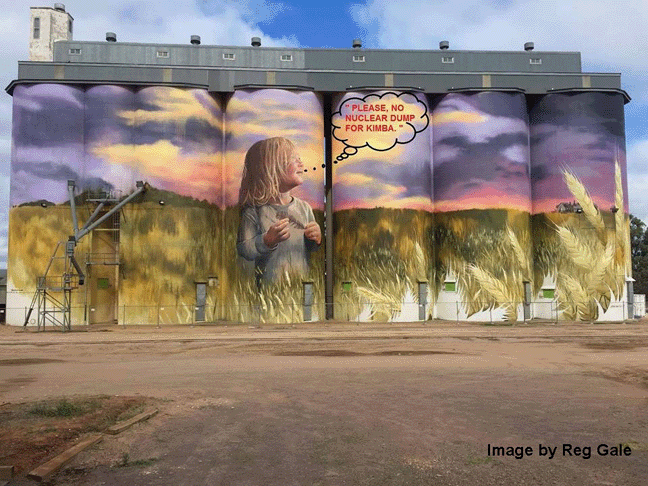
1. Based on overseas experience every place where some nuclear facility for waste storage and disposal has been established has seen a dramatic reduction in property values
2. Has the Kimba District Council considered this probable and economically debilitating situation
3. Is so how and what precautions have been taken by the Council to prevent it and what notification has it given to the community in that regard
4. If it has not been considered by the Council please explain why having regard to the duty of care that the Council owes to its community to ensure that they do not incur any financial loss
5. Has it ever been raised by the Council with the government and the responsible ministers and if so what responses has it received
6. Having now been given notice of this probable economic reversal what does the Council propose to do to prevent or at ameliorate the potential losses in property values for the Kimba community
7. Has or will the Council seek any financial assistance from the government towards the losses incurred by the community on their properties?
8. Has the Council sought any financial and legal advice with regard to this impending and major financial problem particularly as any economic advantages promoted by the government wold be only a pittance of the losses?
Labor aims to amend the Nuclear Waste Bill, removing Napandee as the stipulated dump site
Penny Wong office reply to Josephite SA Reconciliation Circle letter before the last Senate session 27 October 2020
From: “Wong, Penelope (Senator)” <Senator.Wong@aph.gov.au>Subject: RE: We plead with Labor Senators to vote NO to the undemocratic, unfair National Radioactive Waste Management Amendment Bill 2020
Date: 26 October 2020Dear Michele,
RE: NATIONAL RADIOACTIVE WASTE MANAGEMENT FACILITY PROPOSALThank you for your correspondence on the proposal for a national radioactive waste management facility in South Australia and the National Radioactive Waste Management Amendment (Site Specification, Community Fund and Other Measures) Bill 2020.Senator Wong is aware of different views in the community about this proposed facility.It is clear the Government’s proposal gives rise to issues surrounding Indigenous heritage, environmental concerns, public safety, as well as differing opinions on necessity of such a facility, all of which must be adequately resolved.Australians depend on nuclear technology for medicines used in the diagnosis of heart disease, skeletal injuries, as well as a range of cancers. Radioactive substances and wastes must be handled safely and with care.One effect of the Bill would be to amend the National Radioactive Waste Management Act 2012 to set aside the existing site selection and approval process, and instead specify the site selected and enable the acquisition of additional land for the facility.On 11 June 2020, the Bill passed the House of Representatives. As you noted, Labor opposed the Bill in the House. As you are aware, the Senate Economics Legislation Committee completed an inquiry into the Bill, and now it is up to the Government to decide when this bill will be debated in the Senate. Senator Wong followed the progress of the committee inquiry, in which Labor senators actively participated. We are pleased to see that you quoted from Labor senator Jenny McAllister’s dissenting report in your correspondence.Senator Wong encouraged members of the South Australian community to engage with the Senate Economics Legislation Committee inquiry in order to ensure committee members and parliamentarians more broadly are aware of community attitudes. Along with consultation that has taken place with stakeholders, as well as community views expressed to Labor parliamentarians in community meetings and through organised petitions and campaign emails, this informed Shadow Cabinet and Caucus as they finalised Labor’s position on the legislation.Labor has decided move an amendment to the legislation in the Senate that will remove the section of the Bill that nominates the site at Napandee, near Kimba, as the location of the national radioactive waste management facility, whilst maintaining the Community Fund established in the Bill for whatever community eventually hosts the site. Should our amendment be unsuccessful, we will oppose the Bill in the Senate.Labor’s proposed course of action does not prevent the Government from nominating the site under the existing legal process, something it could do today. However, retaining the existing process ensures this significant decision will be subject to judicial review so that the community can be assured the decision about where to locate the facility was reached as a result of a fair and properly conducted process. This is something we are aware that the representatives of the Barngarla People have expressed is particularly important to them.Ten years ago, Federal Labor deliberately amended the current legislation to include judicial review so that an affected party could challenge a decision made by the relevant minister. This is a contentious issue and should have the highest levels of scrutiny to ensure that the principles of procedural fairness and natural justice have been applied given the national significance of this matter.Thank you again for your correspondence.Yours sincerely,OFFICE OF SENATOR THE HONOURABLE PENNY WONG
South Australian Upper House reaffirms the State’s law opposing nuclear waste dump

Mark Parnell MLC , It was a great day back in 2016 when we won the campaign to stop the ill-conceived proposal to turn South Australia into the World’s dumping ground for deadly high-level radioactive waste. However, domestic nuclear waste and other radioactive subjects are still on the agenda of State Parliament.
Proposed Kimba Nuclear Waste Dump
Whilst the Federal Liberal Government seeks to push this unnecessary and divisive project through the Senate, the South Australian Upper House has reaffirmed its commitment to State law by opposing a domestic nuclear waste dump at Kimba or anywhere else in South Australia. Dangerous long-lived radioactive waste currently stored under guard at Lucas Heights should stay there until a permanent solution is found, not shipped 1700kms to another temporary storage site in SA. If this project proceeds, the Greens will ensure that a South Australian Parliamentary inquiry is held that properly consults all stakeholders, including the Barngarla Traditional Owners who were shamefully excluded from the original community ballot.
Banning Nuclear weapons
State Parliament has recognised the 75th anniversary of the dropping of atomic bombs on Hiroshima and Nagasaki. This horror has inspired 47 countries to ratify a 2017 UN Treaty that would ban nuclear weapons forever. Only 3 more nations are needed for the Treaty to become International Law. So far, Australia is refusing to sign, for fear for offending our US allies. You can add your voice here: https://icanw.org.au/
STOP PRESS: We’ve just learnt that the 50th nation has ratified the Treaty, which will now come into effect in 90 days.
Radiation Regulation
The State Government has re-written South Australia’s radiation protection laws. Whilst most changes were administrative, there are still some fundamental problems, not least of which is that BHP’s Olympic Dam mine at Roxby Downs continues to be exempt from most State laws. Both Liberal and Labor joined forces to ensure that BHP’s special treatment continues with their “Indenture” overriding laws that all other mining companies must comply with.
On a more positive note, a number of Green amendments to increase accountability and transparency were accepted. We also secured an amendment that allows South Australia to set its own safety standards for radiation exposure and not be limited to outdated and weak standards applied elsewhere.
Nuclear waste storage in Australia
Japan plans to dump a million tonnes of radioactive water into the Pacific. But Australia has nuclear waste problems, too The Conversation,October 23, 2020 Tilman Ruff. Associate Professor, Education and Learning Unit, Nossal Institute for Global Health, School of Population and Global Health, University of Melbourne, Margaret Beavis, Tutor Principles of Clinical Practice Melbourne Medical School .
|
Nuclear waste storage in Australia This is what happens at our national nuclear facility at Lucas Heights in Sydney. The vast majority of Australia’s nuclear waste is stored on-site in a dedicated facility, managed by those with the best expertise, and monitored 24/7 by the Australian Federal Police. But the Australian government plans to change this. It wants to transport and temporarily store nuclear waste at a facility at Kimba, in regional South Australia, for an indeterminate period. We believe the Kimba plan involves unnecessary multiple handling, and shifts the nuclear waste problem onto future generations. The proposed storage facilities in Kimba are less safe than disposal, and this plan is well below world’s best practice. The infrastructure, staff and expertise to manage and monitor radioactive materials in Lucas Heights were developed over decades, with all the resources and emergency services of Australia’s largest city. These capacities cannot be quickly or easily replicated in the remote rural location of Kimba. What’s more, transporting the waste raises the risk of theft and accident. And in recent months, the CEO of regulator ARPANSA told a senate inquiry there is capacity to store nuclear waste at Lucas Heights for several more decades. This means there’s ample time to properly plan final disposal of the waste. The legislation before the Senate will deny interested parties the right to judicial review. The plan also disregards unanimous opposition by Barngarla Traditional Owners. The Conversation contacted Resources Minister Keith Pitt who insisted the Kimba site will consolidate waste from more than 100 places into a “safe, purpose-built, state-of-the-art facility”. He said a separate, permanent disposal facility will be established for intermediate level waste in a few decades’ time. Pitt said the government continues to seek involvement of Traditional Owners. He also said the Kimba community voted in favour of the plan. However, the voting process was criticised on a number of grounds, including that it excluded landowners living relatively close to the site, and entirely excluded Barngarla people. Kicking the can down the road Both Australia and Japan should look to nations such as Finland, which deals with nuclear waste more responsibly and has studied potential sites for decades. It plans to spend 3.5 billion euros (A$5.8 billion) on a deep geological disposal site.https://theconversation.com/japan-plans-to-dump-a-million-tonnes-of-radioactive-water-into-the-pacific-but-australia-has-nuclear-waste-problems-too-148337
|
|
|
South Australian Parliament rejected Kimba nuclear waste dump, but Morrison govt could still impose it
It sounds good that this Motion passed in SA Parliament Legislative Council – credit to Mark Parnell MLC & SA Greens.
Even though Mark Parnell’s motion in the South Australian Parliament was successful last week it may be an illusory outcome as it seems that the Commonwealth government will have the constitutional superiority to override state laws with regard to the nuclear waste facility at Kimba
This is because the Commonwealth will rely on the free trade provision under section 92 of the Constitution as to the transport interstate of the nuclear waste while its storage and disposal falls under the external affairs power of section 51(xxix) as the safe management and disposal of nuclear waste is regulated under international convention and treaty rights
Regrettably the High Court in recent years has based many of its decisions rejecting state legislation on a broad interpretation of the external affairs power which in some circumstances has lead to virtually nonsensical conclusions
For this reason it is still essential to prevent the government’s proposals being carried out by legislative action
Kimba residents have been sold a lemon – dubious financial gain from nuclear waste dump
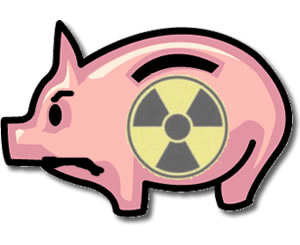 Sandra Kanck Nuclear Fuel Cycle Watch Australia, 22 Oct 20,
Nuclear waste dump: Will the Australian government compensate Kimba landowners for fall in their property values?
If the federal government’s proposed nuclear waste facility were built at the chosen site at Kimba and as a result property values in the region decreased as has been the case in other places around the world in not dissimilar circumstances what will the federal government do for the those who have suffered a diminution in their property values because of the facility
Based on past experience I suspect nothing
However if the government has promised huge economic benefits for the Kimba region – and it has certainly done so consistently for the past five years in order to win community support – and these promises proved to be incorrect then would the residents and even general community members who have suffered a loss have a right of action against the federal government for what is tantamount to misleading and deceptive conduct in the normal legal context
On the face of it they would but unfortunately the government as a Crown instrumentality is exempt from any legal responsibility and liability in that regard
However the District Council of Kimba has been fully complicit in misleading or misinforming the community and should be liable for any damages incurred as a result of the Council’s actions and conduct
Unlike the government the Council will not be treated as an instrumentality of the Crown and will therefore be fully liable with the liability extending personally to the individual councillors since there could be no limitation on their personal liability like in a normal corporate situation
What I would suggest – but please ensure that I am not mentioned and it is recognised that I am not offering any legal advice – is for several ratepayers to formally approach the mayor and councillors asking them to obtain a proper legal opinion for open publication for the Kimba community addressing these issues and the possible outcomes
Any resistance on the part of the councillors in acceding to this request will only worsen their situation as it could be argued very strongly that this is necessary in order to ensure the continued stability and solvency of the District Council and protect the financial position of the ratepayers
You may need the help of a lawyer but the District Council should pay all expenses in investigating what has been suggested and in obtaining any legal and if necessary financial advice so that the ratepayers and other community members can be protected
Best of luck!
Keep South Australia’s Nuclear Waste Storage Facility (Prohibition) Act 2000

Kimba’s potential water problem, if radioactive waste dump goes ahead
 Paul Waldon Fight to Stop a Nuclear Waste Dump in South Australia 12 Oct 20, Know Your Environment.
Australian government’s controversial Nuclear Waste Bill delayed – not yet debated in Senate
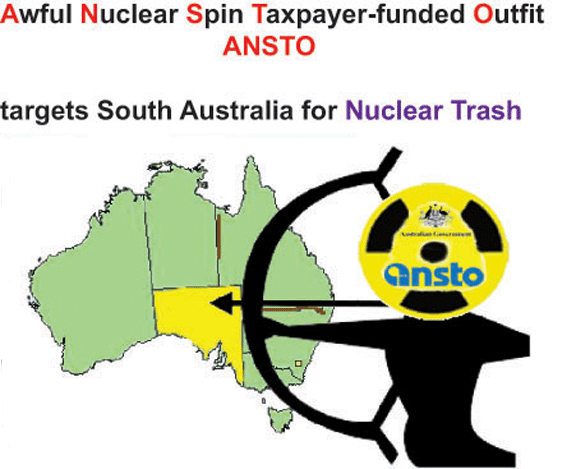 10 Oct 20, The dump legislation didn’t make it on to the Senate floor for debate and voting …
I think the government just ran out of time, they didn’t withdraw the Bill
So over the next week Non Government Organisations, and farmers and Traditional Owner s will be discussing how best to use the next month
Labor likely to amend the Nuclear Waste Bill, removing certainty about the Napandee dump happening
 Labor’s position on nuclear waste bill means uncertainty remains over South Australian site, Guardian, Paul Karp @Paul_Karp 5 Oct 20, Labor will try to amend a government bill so that the federal resources minister has to nominate the site for a nuclear waste dump, despite concerns within the ALP caucus the change could pave the way for the decision to be challenged in court.On Monday, the Labor caucus agreed it would try to amend the bill by removing a schedule which states the dump should be located at Napandee some 20km north-west of Kimba in South Australia. The caucus resolved to oppose the bill if the change was not supported. Labor’s position on nuclear waste bill means uncertainty remains over South Australian site, Guardian, Paul Karp @Paul_Karp 5 Oct 20, Labor will try to amend a government bill so that the federal resources minister has to nominate the site for a nuclear waste dump, despite concerns within the ALP caucus the change could pave the way for the decision to be challenged in court.On Monday, the Labor caucus agreed it would try to amend the bill by removing a schedule which states the dump should be located at Napandee some 20km north-west of Kimba in South Australia. The caucus resolved to oppose the bill if the change was not supported.
The caucus resolution follows a recommendation by the shadow science minister, Brendan O’Connor, and despite vigorous opposition from senators Alex Gallacher and Kim Carr. They argued that making the minister select the site could leave the decision vulnerable to challenge. The government’s bill, as it stands, nominates Napandee as the location for the dump and provides a compensation package – a formulation that prevents judicial review of the site selection…… https://www.theguardian.com/environment/2020/oct/05/labors-position-on-nuclear-waste-bill-means-uncertainty-remains-over-south-australian-site |
|
1 This month
15 April – Zoom –Nuclear Power is Not the Solution
Apr 15, 2026 01:00 AM in Canberra, Melbourne, Sydney

Join the International Physicians for the Prevention of Nuclear War (IPPNW) on Tuesday, April 14th for a timely webinar exploring the risks associated with nuclear power and challenging the myth that it offers a simple, safe, carbon-free solution to the climate crisis

of the week – Australians for War Powers Reform (AWPR)
To see nuclear-related stories in greater depth and intensity
 Antinuclear