Resources scientist questions management of tailings and water for Wiluna uranium project
 Dr Mudd also highlighted the use and contamination of ground water
sources in the area as a key issue, saying there have been issues at
other uranium mines across Australia and it remains unclear where
water for this site will come from or what techniques will be used to
source it
Monash mining expert examines Wiluna uranium proposal
Science Network, 23 December 2012 AN AUSTRALIAN expert on mining
sustainability has highlighted some of the key environmental aspects
for West Australia, as the state moves closer to its first uranium
mine.
Resources company Toro Energy recently received state government
environmental approval to develop WA’s first uranium mine near Wiluna,
with the company now seeking federal environmental approval.
Monash University mining expert Gavin Mudd says the primary issues
concern the management of tailings and waste rock, as well as water
use, contamination and other aspects local to the mine site. Continue reading
Groups demand Queensland’s Federal MPs retain protection of the State’s environment
 “We have been witnessing a wholesale removal of environmental protections in Queensland on a completely unprecedented scale and at a pace that is breath-taking – and certainly beyond the capacity of the community to respond”
“Our organisations together represent tens of thousands of Queenslanders who are extremely alarmed at the prospect of the economic development driven Newman government having sole responsibility for the future of Queensland’s special places like Cape York and World Heritage areas like the Great Barrier Reef”
Queensland Conservation Council, 6 Dec 12 Queensland’s state and regional conservation groups meeting in
Brisbane today have demanded that Deputy Prime Minister Wayne Swan and other Queensland Labor MPs act to prevent the handing over of environmental approval powers to the States. Continue reading
Scientists appeal to Australian government not to give up its environmental powers
 Scientists warn against environmental powers being handed to states, December 4, 2012, Lenore Taylor National Affairs Correspondent for The Sydney Morning Herald Federal environmental powers that saved the Franklin River and the Great Barrier Reef need not be abandoned in a quest for faster development approvals, the respected Wentworth Group of Concerned Scientists says, in a last ditch appeal to the Gillard government to rethink a deal with the states.
Below – Miranda Gibson, in the observer tree, Tasmania

At the urging of the Business Council of Australia, the Prime Minister and premiers are due to sign the first stage of the controversial agreement at the Council of Australian Governments on Friday.
It will see the Commonwealth hand over environmental assessment and approval to state governments under specific ”standards” in a bid to remove ”green tape”. Continue reading
Australia at risk of losing its national environmental protection laws
The Business Council of Australia hastily prepared a discussion paper and released it the day before the Forum, calling for a slashing of so-called green tape. The Prime Minister agreed to the business demands and took the proposals to COAG. State and Territory leaders duly fell in line. As is the practice with COAG, the first official notification of the detail of the proposals was in the communique following the meeting.
It is a broad-ranging package of measures but most significant is the proposal for the Commonwealth to hand over responsibility for administration of national environmental laws to the States by March next year.
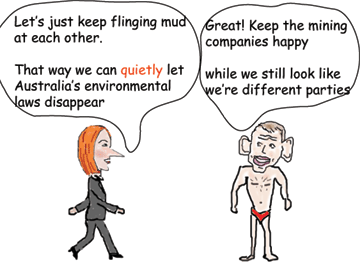
COAG’s Green Tape Agenda Is Undemocratic, New Matilda By Brendan Sydes, 4 Dec 12 The unelected Business Advisory Forum has been given special access to this Friday’s COAG meeting – and it’s calling for national environmental laws to be wound back. Brendan Sydes explains what’s wrong with the process
The goings on in Parliament last week might not provide the best vantage point to reflect on what we value in our democratic system of government.
Imagine, however, an alternative system where the executive arms of government meet behind closed doors and make crucial decisions on matters of national policy, where the agenda is not published beforehand and where the detail of policy only comes to light in a communique published after decisions have been made.
Consider further a refinement of that system which means that unelected vested interests get a seat at the table in the lead up to the secret meeting and get make their demands heard on key parts of the policy agenda.
That in a nutshell is how the Council of Australian Governments (COAG) and the recently-developed Business Advisory Forum (BAF) interact. COAG meets again in Canberra this Friday. The meeting will be preceded by a meeting on Thursday of the BAF, a new institution that appears to have been hastily cobbled together prior to the first COAG meeting in April this year. Its precise membership and terms of reference appear never to have been announced. Quite where or from whom the idea even came from is unclear.
Unsurprisingly, given these hazy origins, the idea that we ought to have a business body with special access to COAG has gone largely unscrutinised. The first meeting of the BAF took place the day before the April COAG meeting. Continue reading
Secret Labor and Liberal plans to gut Australia’s environmental laws
 Minister Burke: Don’t hand your powers to the states 22 Oct 2012 | Larissa Waters In April this year, a special meeting of big business leaders hijacked a meeting of state and federal governments (COAG). They demanded the weakening of Australia’s environment laws.
Now the Labor and Liberal parties are preparing to do just that. Secret discussions are now underway to gut our national environment laws by giving away the Environment Minister’s approval powers to state governments.
Our environment is under attack like never before. If environmentprotection were left to the states, they would have dammed the Franklin River, put oil rigs in the Great Barrier Reef and built Traveston Dam.
This December, the state Premiers and the Prime Minister will meet again at COAG to take the next step to gut Australia’s environment laws before final sign off at a meeting in March 2013. Before this happens, tell the Labor and Liberal parties not to gut Australia’s environment laws. Continue reading
Alice Springs water supply from aquifer is dwindling
 This is a very bad omen for the water intensive uranium mining industry – C.M.
Talks focus on alternative Alice water supplies http://www.abc.net.au/news/2012-11-15/talks-focus-on-alternative-alice-water-supplies/4373848 By Ruby Jones Nov 15, 2012 The deputy director of the National Centre for Groundwater Research says alternative water supplies need to be found for Alice Springs.
Peter Cook says the aquifer that provides the town’s fresh water supply is being drawn down. Professor Cook says the centre is negotiating with the Northern Territory Government on investigating alternatives.
“We’ve had some very preliminary discussions with the Territory Government about whether we should develop a project to look at the options for future water supplies for Alice Springs because I’m aware that the current aquifer …. [is being] drawn down and there is a need to look for alternative supplies for the future,” he said.
“We’re already doing some work in the Ti Tree [area] and we’re keen to do some more work in Alice Springs and where there might potentially be new supplies.
“We would definitely expect what we learn in Ti Tree would really help us understand better what happens in Alice Springs and other aquifers in central Australia.”
Move to cleanup radioactive water at Ranger uranium mine
Mine equipment transport to disrupt weekend travellers ABC Radio 105.7 Darwin, By Clare Rawlinson , 8 Nov 12 Energy Resources Australia has asked for motorists’ patience as the uranium miner prepares to transport heavy equipment from Darwin to Jabiru at speeds of 30kmph this weekend.
ERA chief executive Rob Atkinson said the company would use police escort down the Stuart Hwy and Kakadu Hwy over two days of travel. The equipment will be used in a new $220m “brine concentrator” – a machine being built at the Jabiru Ranger Uranium Mine to treat 30 years of contaminated waste water… Continue reading
Danger to Townsville’s water supply, if Ben Lomond uranium mine is re-opened
 Labor raises concern over north Qld uranium mine
http://www.abc.net.au/news/2012-11-06/labor-concern-over-north-qld-uranium-mine/4356092?section=business By Megan Woodward, 6 Nov 12 The Queensland Opposition has warned any resumption of uranium mining near Townsville in the state’s north risked contaminating the city’s water supply.
The State Government recently announced plans to resume uranium mining across Queensland.
The Ben Lomond uranium mine, 50 kilometres west of Townsville, closed more than 20 years ago amid serious environmental concerns. The mine is in the Thuringowa electorate of Liberal National Party (LNP) MP Sam Cox.
Deputy Opposition Leader Tim Mulherin today called on Mr Cox to become more involved in any proposals to reopen the mine. Mr Mulherin says nearby residents needed a guarantee environmental concerns do not still exist.
“The concerns related to the tail dams, cyclonic rain events and the impact the heavy metals and radioactive materials,” he said. Mr Mulherin says when the mine was closed there was concern radioactive tailings would reach the Burdekin River, which supplies water to the Townsville region.
The ABC has approached Mr Cox for comment.
VIDEO: Gutless Australian government is gutting environmental protection laws
 VIDEO Australian Government Abandons World Heritage Sites http://larissa-waters.greensmps.org.au/content/media-releases/australian-government-abandons-world-heritage-sites 01 Nov 2012 | Larissa Waters Australia’s World Heritage sites, such as the Great Barrier Reef, Kakadu and the Franklin River, will be abandoned by the Federal Government and left to the whim of the state governments, as revealed in Senate Question Time today.
“Senator Evans has confirmed today that, in a reversal from the Prime Minister’s statements in April, the protection of World Heritage sites will indeed be given to the pro-mining states, and the federal government will no longer have any right to intervene,” Australian Greens environment spokesperson, Senator Larissa Waters, said. Senator Waters’ Take Note Speech
“The Australian Government has taken another step towards the complete gutting of environment protection in this country.
“Only uranium mining will still require federal oversight – and as the Australian Government is intent on shipping uranium to India, it would seem that they’re keeping this power to ensure the uranium gets dug up, not to protect the environment from its toxic effects.
“The major environment wins of the past – like the Franklin River – are now up for grabs again. This is the Labor Government using John Howard’s laws to trash Bob Hawke’s legacy.”
Australia’s uniquely beautiful cuttlefish in need of protection
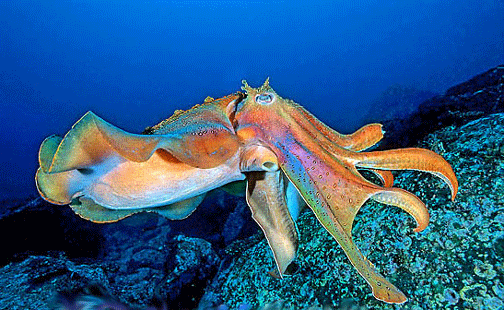 Christina’s note: The cancelling of BHP’s plan for a mega uranium mine at Olympic Dam has had one bit of very good “fallouT – in that they now probabaly won’t want the desalination plant at Spencer Gulf. That would have alomost certainly resulted in the extinction of this unique and beautiful animal, which depends on the delicate balance of salt and fresh water for its breeding area
More protection urged for cuttlefish http://www.abc.net.au/news/2012-10-19/more-protection-urged-for-cuttlefish/4323270 Oct 19, 2012 Greens MP Mark Parnell is urging an immediate listing of the giant
Australian cuttlefish as a protected species. Some Whyalla locals say cuttlefish numbers in upper Spencer Gulf fell
from an annual aggregation of about 200,000 to about 6,000 for the most recent breeding season. Research is yet to pinpoint a cause.
Mr Parnell said even if over-fishing was not the cause, there would be no harm in giving the cuttlefish more protection.
“There are some simple actions they can take – protect these fish under state law, seek their protection under federal law and put in place an emergency recovery plan that involves all the best science, and not just throw your hands up in despair and say ‘Well they’re disappearing and there’s nothing we can do about it’,” he said.
Critics on all sides as Australia leads way on Antarctic protection BY: MATTHEW DENHOLM, TASMANIA CORRESPONDENT The Australian October 18, 2012 AUSTRALIA and France have developed a plan to protect 1.9 million square kilometres of east Antarctica as new marine parks, although a report today will call for an even larger reserve.
The Australia-France proposal, backed by the EU, covers seven coastal zones in east Antarctica…. (subscribers only)
http://www.theaustralian.com.au/national-affairs/foreign-affairs/critics-on-all-sides-as-australia-leads-way-on-antarctic-protection/story-fn59nm2j-1226498135791
Giant cuttlefish – a unique species under threat – especially relating to Olympic Dam uranium mine
Let us not forget that the giant cuttlefish has only one breeding ground in the whole world. And that is in Upper Spencer Gulf – where BHP Billiton would put its desalination plant -as part of its project for the world’s biggest uranium mine at Olympic Dam. The breeding ground depends on a very special, and delicate, balance of fresh and salt water.– CM
Green group demands cuttlefish study’s release http://www.abc.net.au/news/2012-08-08/green-group-demands-better-giant-cuttlefish/4185184 August 08, 2012 The Conservation Council of South Australia is calling on the State Government to release the results of a recent study on the population of giant Australian cuttlefish near Point Lowly.
Conservation Council CEO Tim Kelly says the Government needs to announce a plan of action and immediately put the cuttlefish on a protected species list. Continue reading
Western Australia governs on behalf of mining companies. as Kimberley’s natural wonderland is threatened
 over the past weeks, the WA Premier Colin Barnett has sent hundreds of police to the once placid town to protect the interests of the mining company Woodside, ….
Is this the way we conduct business in Australia in 2012? The WA Premier has effectively sent his own army to Broome at a cost of over $1 million to Australian tax payers in order to protect the interests of one of our largest mining companies….
Kimberley under threat from mining boom, The Drum, Wade Freeman, 11 June 12 “……. one of the world’s most untouched and iconic regions was granted National Heritage protection last August. Australia’s beautiful Kimberley, which stretches all the way from Broome, north up around the Buccaneer Archipelago, and east as far as the NT border – was declared of great national significance due to its cultural and environmental values to the nation.. Continue reading
Uranium mining will leave Western Australian tax-payers with virtually permanent toxic pollution
Preventing tailings contamination even after a uranium mine has closed has proved impossible in every uranium mine in Australia to date there is no former Australian uranium mine that has been rehabilitated successfully — all are still radioactive no-go zones because of radionuclide dispersal from waste stockpiles and water seepage. We will be fooling ourselves if we think that “best practice” regulation can somehow contain tens of millions of tonnes of finely powdered carcinogenic wastes for thousands of years.
 Uranium mine tailings leave an enduring toxic legacy http://au.news.yahoo.com/thewest/opinion/post/-/blog/13904615/uranium-mine-tailings-leave-an-enduring-toxic-legacy/ Alison Xamon , June 8, 2012, The Environmental Protection Authority’s approval of a uranium mine in Wiluna should concern all West Australians. This is no longer a theoretical discussion. Research shows a serious risk that uranium mining will cause long-term harm to WA communities. Uranium mining has caused a string of accidents across Australia and has proved impossible to regulate appropriately.
Yet the highly radioactive waste produced by uranium mines — known as uranium mine tailings — remain radioactive for thousands of years. The State Government has given a commitment to seek to regulate uranium mining through “world’s best practice”, including isolating uranium tailings for at least 10,000 years. This is a worthy commitment but it is unclear how it will be achieved, especially when it is apparent that no uranium site in Australia has successfully accomplished this for even 10 years.
The best regulations will not stop chronic radioactive waste seepage. Preventing tailings contamination even after a uranium mine has closed has proved impossible in every uranium mine in Australia to date, Continue reading
Call for moratorium on industrial development at Point Lowly, to save Giant Cuttlefish from extinction
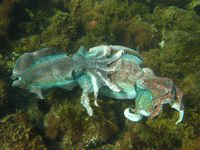 CUTTLEFISH numbers at a key breeding ground in Spencer Gulf have plummeted, the Greens say.http://www.adelaidenow.com.au/news/south-australia/cuttle-fish-numbers-plummet-at-point-lowy-say-australian-greens/story-e6frea83-1226389582466 Greens state MP Mark Parnell said local divers at the Point Lowly site
have reported a huge drop in numbers during the current breeding season.
“This annual marine breeding spectacle is of worldwide significance, not to mention how important it is for the local tourism industry,” Mr Parnell said in a statement on Friday. He said the state government must conduct an immediate investigation
to determine the cause of the slump in numbers. “First step is commissioning some urgent research by marine scientists
to find out exactly what is going on,” he said.
“Next is a moratorium on all industrial development at Point Lowly until the cause of the decline is discovered.” Mr Parnell said the annual breeding of the giant Australian cuttlefish at Point Lowly is the world’s only known mass cuttlefish spawning
event. “The permanent loss of this annual breeding event would be devastating,” he said.
1 This month

of the week – Australians for War Powers Reform (AWPR)
To see nuclear-related stories in greater depth and intensity
 Antinuclear