Gambling Central Australia’s future, with nuclear wastes
A major omission in Dr Switkowski’s comments concerns what effects over thousands of years that leaking and leeching radioactive waste might have upon Australia’s precious subterranean aquifers. For a nation as reliant as we are on underground water, that represents a massive gamble to say the very least.
NUCLEAR UNDER TONES?, Larry Buttrose, 15 March, 2010, “…Dr Switkowski continues: “Eventually spent fuel is transported to a national repository, a well-engineered deep hole in the ground, probably in central Australia.” Continue reading
Biodiversity is for future ages. Uranium mining is short term
When a respected institution known for its measured and considered responses to issues of public importance, such as the Museum, asks the Government to pay attention, it would be foolish to do otherwise.
A time to err on side of conservation, The Advertiser Editorial, March 16, 2010 THERE are certain places in the state and the nation which should be off limits for mining. Continue reading
Muckaty nuclear waste dump plan threatens groundwater
Muckaty station sits above an ancient aquifer which is used by both the aborigines for drinking water and white station owners to water their cattle. It also experiences large intermittent rainfalls during the year.
A heresy is occurring in Australia, anthropologyworks by Helen Caldicott, 8 March 2010, “….the current abuse and desecration of several aboriginal tribes inhabiting their land in the Northern Territory. This land called Muckaty station is conveniently located adjacent to the railway line, constructed recently by Dick Cheney’s former company Halliburton, which bisects Australia connecting Darwin, a port in the north, to Adelaide a port in the south. Continue reading

Uranium mining’s damage to Native Americans
Throughout the Diné Nation, Diné families have been subject to decades of radioactive contamination
Uranium Mining Begins Near Grand Canyon: Thousands of Claims Threaten Public Health & Sacred Lands :: Peace, Earth & Justice News Feb 24, 2010 Grand Canyon, AZ — In defiance of legal challenges and a U.S. Government moratorium, Canadian company Denison Mines has started mining uranium on the north rim of the Grand Canyon. Continue reading

Water, not money, might kill off nuclear industry
 Water could the be issue that sinks this project, or it could be numerous other funding and safety issues related to nuclear power.
Water Issues Derailing Nuclear Power in Utah SpeakEasy by Tara Lohan , February 26, 2010 Nuclear power has been a hot topic these past few weeks with Vermont’s leaking reactor, Continue reading
BHP’s Yeelirrie uranium mining poses riskes to groundwater, and to biodiversity
the report had “glazed over” a lot of the research into the mine’s
BHP uranium report unveils risks, MICHAEL BENNETT, The West Australian February 27, 2010,
BHP Billiton documents have revealed the company’s proposed $17 billion Yeelirrie uranium mine could threaten vulnerable animal species previously found in the area. Continue reading
Water issues could finish nuclear industry
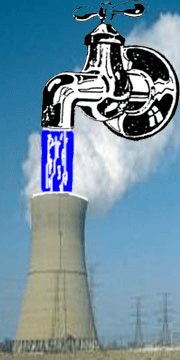
Water could the be issue that sinks this project
Water Issues Derailing Nuclear Power in Utah SpeakEasy by Tara Lohan February 26, 2010 Nuclear power has been a hot topic these past few weeks with Vermont’s leaking reactor, Georgia’s plans for new ones (thanks to Obama), and the press’s blind approval of all things nuclear. ….
While there are lots of reasons that nuclear power is a bad idea, residents in Utah are particularly concerned about water. Waldholz writes: Continue reading
Renewable energy is viable for South Africa and the world
“Contrary to what Eskom says, South African winds are constant and predictable. South Africa has an almost perfect wind regime,” he said.

‘Renewable energy is viable’ Times LIVE (Africa) Feb 21, 2010 By ZWELI MOKGATA Eddie O’Connor is adamant that 90% of the world’s electricity could easily come from renewable sources by 2050 if only world governments would commit to key energy policies in time. Continue reading
Vermont Yankee – just one of many aging, leaking nuclear power plants
 Indeed, a desperate national industry now pushing for massive federal subsidies to build new reactors may not survive a flood of elderly clunkers being forced to close by the weight of their own contamination….
Vermont’s radioactive nightmare FDL The Seminal Harvey Wasserman
February 10, 2010
Like a decayed flotilla of rickety steamers, at least 27 of America’s 104 aging atomic reactors are known to be leaking radioactive tritium, which is linked to cancer if inhaled or ingested through the throat or skin. Continue reading
Angela Pamela uranium mine – a threat to Alice Springs’ water supply?
Uranium mine’s future depends on water supply ABC Rural News , 09/02/2010 The project manager for uranium exploration at the Angela Pamela deposit, 25 kilometres south of Alice Springs, says mining will only go ahead if the company can prove that it won’t harm the town’s water supply.
The Angela Pamela exploration site lies close to the aquifer that supplies the town with water.
Stephan Stander says it won’t be known until the end of this year whether or not Cameco Paladin will apply for a mining licence.”The joint venture partners are committed to the fact that we won’t develop the project or even consider it if we can’t, technically, for ourselves, prove that we won’t impact on the town’s water supply,” he says.
Highly radioactive leaking water continues from Ranger uranium mine
The Office of the Supervising Scientist is the environmental regulator of the Ranger uranium mine, which is owned by Energy Resources of Australia. Continue reading
Radioactivity found in wells near nuclear power plant
SENECA, S.C. (AP) – Officials say they’ve found elevated levels of a radioactive form of hydrogen in water in two wells at a South Carolina nuclear reactor site.Duke Energy said Tuesday that samples from two wells at Oconee Nuclear Station near Seneca showed tritium levels above the nuclear industry’s voluntary reporting level.
W.A’s Chamber of Minerals and Energy doesn’t want public inquiry on uranium mining
Chamber snubs uranium inquiry call ABC News February 4, 2010 The Chamber of Minerals and Energy has rejected the call for a public inquiry into proposed uranium projects in Western Australia.The Government yesterday upheld a decision by the Environmental Protection Authority to use an environmental and management review program to assess Toro Energy’s uranium project near Wiluna.

The Conservation Council of Western Australia wants a public inquiry, the highest level of assessment, and says it should be applied to all proposed uranium projects.
Chamber snubs uranium inquiry call – ABC North West WA – Australian Broadcasting Corporation
Nuclear reactor leaking radiation into groundwater
 Today’s groundwater is tomorrow’s drinking water. “Tritiated water” is chemically identical to water. Only now, it is radioactive water with a half-life of 12.3 years. That means that it can pose a biological hazard for 120 years.
(USA) Uncontrolled radiation releases still getting out of Vermont Yankee, Beyond Nuclear 6 Feb 2010, New test wells sunk around the Vermont Yankee nuclear power station have revealed rising radiation levels in groundwater on the banks of the Connecticut River near the town of Vernon, Vermont. Continue reading
Media ownership in Australia
Media ownership in Australia
28 Dec 2009 Australian media ownership is one of the most concentrated in the world. The last review of media ownership in Australia (1999) found that of 12 capital city and daily papers, seven are owned by Rupert Murdoch’s News Corporation and three by John Fairfax Holdings. The West Australian and the Canberra Times were the only independently owned dailies, however, the Canberra Times is now part of the Farirfax group and The West Australian is now part of Kerry Stokes’ media group.
The Impact of Ownership on the Dissemination of Information Continue reading
1 This month
To see nuclear-related stories in greater depth and intensity
– go to https://nuclearinformation.wordpress.com/


 Antinuclear