Review: Nuke waste resisted, Radiation and Breast Cancer
 Australia: Muckaty Aboriginal owners take their fight internationally. To public outcry, Paul Howes pushes for uranium mining in Arkaroola Wilderness Sanctuary. Martin Ferguson manages to avoid supporting real progress in renewable energy. Tony Abbott promises to slow renewable energy. Calls to phase out Victoria’s brown coal, and move to job intensive renewables.
International: Renewed concern over special cancer dangers for women and the young, from ionising radiation. Water issues threaten nuclear industry’s future. UK’s new govt raises doubts on new nuclear. Iran does uranium swap deal with Turkey. Cannes film festival launches “Countdown to Zero”. Indian community action stops uranium mining in National Park.
Nuclear power a “no-go” in a water-short world
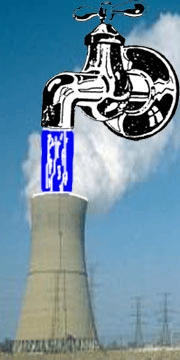
“The best alternatives from a water perspective are wind and photovoltaics, that require effectively no water”
Water Adds New Constraints to Power, NYTimes.com By ERICA GIES May 17, 2010 “……In the United States, thermoelectric power generation — mainly coal, nuclear and natural gas — accounted for 41 percent of U.S. freshwater withdrawals in 2005, U.S. Geological Society data show………..
But there is a growing awareness in California and throughout the United States that the use of water for energy generation may be reaching its limits. Continue reading
Mothers against uranium mining
Lila Watson, Australian aboriginal leader, said: “If you have come here to help me, you are wasting your time. But if you have come here because your liberation is bound up with mine, then let us work together.”………

A Mother’s Day Call to Protect the Earth, Care 2, 9 May 2010, Our team of eight dynamic women – legal, policy, and business experts -convened in Elko, Nevada, to begin our journey……….. Finally, we traveled to the magnificent Grand Canyon, where Havasupai leader Carletta Tilousi explained the grave threat of uranium mining to the tribe’s sacred Red Butte mountain, to the community’s health, and to the safety of the regional aquifer. Continue reading
AREVA’s radioactive water contamination in Niger
VIDEOLeft in the Dust – Areva’s uranium mining in Niger | Greenpeace International

Left in the Dust – Areva’s uranium mining in Niger | Greenpeace International 6 May 2010, Operations of Nuclear giant AREVA put lives at risk in Niger Uranium mines in Niger operated by the state-owned French nuclear giant AREVA continue to create a radioactive hazard for the people living nearby.
A new report released today by Greenpeace reveals contamination levels in the air, water and soil above internationally accepted limits.“Radioactivity increases poverty because it creates more victims. With each day passes we are exposed to radiation and continue to be surrounded by poisoned air, polluted water and earth – while AREVA makes hundreds of millions from our natural resources.”
said Almoustapha Alhacen, President of the local Nigerian NGO Aghir in’ Man (which means “the shield of the soul” in the Touareg language, is a local environmental and human rights organization).Last November, Greenpeace carried out soil, water and air tests in Arlit and Akokan, located a few kilometers from the mines.
The samples were studied in collaboration with the France-based Research and Independent Information on Radioactivity Commission (CRIIRAD).“The analysis we have performed show that the uranium contamination in four out of five water samples exceed World Health Organisation safety limits*. We found evidence of radon, a radioactive gas dissolved in water and also chemical elements. Even so, this water is still being distributed to the population and the workers for consumption” said Bruno Chareyron, an engineer in Nuclear Physics from CRIIRAD. Left in the Dust – Areva’s uranium mining in Niger | Greenpeace International
Hydroelectric plant – an Australian first
NSW: Australia’s first hydroelectric plant turned on, Energy Digital, 29 April 2010, North Head sewage treatment plant’s new hydro electric facility will now generate enough green energy to benefit environment, Andrea Marino , Apr 29, 2010 Continue reading
Video: Grand Canyon watershed endangered by uranium mining
Aerial view of uranium mines threatening Grand Canyon watersheds, Grand Canyon Trust News, April 29, 2010 by gctrust, Roger Clark, Grand Canyon Trust’s Air and Energy program director, recently flew with EcoFlight over uranium mining sites situated around the Grand Canyon and its watersheds that supply water for 25 million people. This bird’s eye view will allow you to understand the potential impact of uranium mining on the water supply for Arizona, southern California and Nevada. Click here to view the video.

Aerial view of uranium mines threatening Grand Canyon watersheds « Grand Canyon Trust News
Colorado legislating to force uranium miners to clean up
Lawmakers worry a new national focus on nuclear energy will allow mines to postpone cleanup of radioactive wastes while they ramp up production.

(USA) Colo. Senate gives initial backing to uranium bill, Washington Examiner, Associated Press04/27/10 DENVER — The state Senate has given initial backing to requiring uranium mines and mills to clean up nuclear waste before accepting more radioactive material. Continue reading
Big uranium promoter South Australian govt seeks environmental credibility
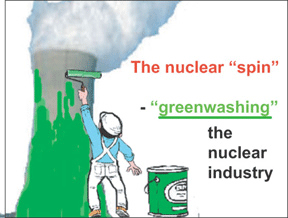 South Australian government announces Community Sustainability Grants. Premier, the Hon Mike Rann said, “The Government of South Australia is pleased to be partnering with Conservation SA to help communities become more resilient so that they can readily respond to climate change.
“Climate change is a real issue that affects everyone, and programs like this will give South Australians the opportunity to be part of the local solution.”
Community groups and non-government organisations are invited to apply for small (up to $3,000) or medium (up to $10,000) grants
USA public losing trust in nuclear power authorities
while nuclear plants have permits that allow them to emit material into surface water and the air, they do not have permits that let them release material to groundwater, which is where the tritium is going..
Has Trust Leaked Away With the Tritium? NYTimes.com, By MATTHEW L. WALD, April 20, 2010, A panel of experts convened on Tuesday by the Nuclear Regulatory Commission to discuss how the agency should approach tritium leaks at reactors suggested that the biggest risk that nuclear operators faced was the erosion of public trust…. Continue reading

Kentucky legal case over radiation contamination
The Kentucky Supreme Court ruled then that the landowners don’t have to prove they were actually harmed to sue past contractors for trespassing by allowing contaminants to spread beyond the plant.
The high court also held that land devaluation by intentional trespassing is a recognized measure of damages once actual injury is determined. There is injury if groundwater is contaminated and it can’t be consumed.
Ky. landowners settle lawsuit over uranium leaks, BusinessWeek, By BRETT BARROUQUERE 21 April 2010, !LOUISVILLE, Ky.A group of landowners have settled in a long-running lawsuit for $1.75 million over allegations that water leaks from a western Kentucky uranium enrichment plant devalued property values….compensating between 70 and 80 homeowners for the devaluation of their property because of radiation contamination….. Continue reading
Radioactive poisoning and water exploitation in Niger
Niger: French State-Owned Company ‘Poisoning’ Poor | Coalition Against Nuclear Energy, Julio Godoy, April 2010, Paris — Recent research by Greenpeace suggests that French state-owned company Areva’s public claims of decontamination of populated areas near uranium mines in Niger are false. High radio-activity persists in towns and rural areas near the mines, affecting some 80,000 people… Continue reading
Uranium poisoning of Native Americans’ land
Secret plan to permit higher levels of ionising radiation
“This critical debate is taking place entirely behind closed doors because this plan is ‘guidance’ and does not require public notice as a regulation would,”

(USA) Radiation Exposure Debate Rages Inside EPA Plan to Radically Hike Post-Accident Radiation in Food & Water Sparks Hot Dissent, YubaNet.com, By: Public Employees for Environmental Responsibility (PEER)Washington, DC Apr. 5, 2010 – A plan awaiting approval by the U.S. Environmental Protection Agency that would dramatically increase permissible radioactive releases in drinking water, Continue reading
U.S. EPA warns on water risks with in situ uranium mining
a major hurdle for dozens of proposed in-situ uranium proposals in the region
Water concerns delay Wyoming uranium projects, 30 march 2010, The U.S. Environmental Protection Agency has told the Nuclear Regulatory Commission to go back to the drawing board with its site-specific environmental reviews of three proposed in-situ uranium mines in Wyoming. Continue reading
Navajo’s Radioactive Legacy from Uranium Mining
Toxic legacy for tribes, High Country News, Caitlin Sislin | Mar 26, 2010 Earlier this month, the 10th Circuit Court of Appeals approved a controversial permit for uranium mining operations at sites in Church Rock, New Mexico. The operation includes a site associated with the largest release of liquid radioactive waste in United States History — a catastrophe which continues, a generation later, to negatively impact the lives and health of Navajo people residing near the spill site. Continue reading

1 This month
17 October, Free Public Talk on Nuclear Issues in South Australia
David Noonan will speak on public interest concerns over the new Roxby Downs Indenture Act 2026 on BHP copper-uranium mining and ore processing in SA, and on how AUKUS may face SA with a High-Level nuclear waste agenda.
Dr Jim Green will discuss international developments in the field of nuclear power including ‘small modular reactors’ and Generation 4 ‘advanced’ nuclear reactor concepts.


Help Aunty Sue Protect Her Land and Sacred Sites From Destructive Rocket Testing.
.

Australians deserve the truth
about
AUKUS – https://aukuspublicinquiry.com/

PETITION – To: Prime Minister Anthony Albanese and the Australian Labor Government

of the week – Australians for War Powers Reform (AWPR)
To see nuclear-related stories in greater depth and intensity

