Court hears uranium protesters locked in container
Court hears uranium protestors locked in container ABC News By Candice Marcu Oct 8, 2009 A civil trial has started in the SA Supreme Court over police treatment of protesters at an outback uranium mine. Continue reading
BHP Billiton tight-lipped about virtual shut-down of Olympic Dam
 Accident slashes Olympic Dam output – THE AUSTRALIAN Matt Chambers | October 08, 2009
BHP Billiton’s giant Olympic Dam underground mine in South Australia could be running at less than half capacity for months after a mechanical failure sent a full load of ore plummeting to the bottom of its 800m-deep main shaft. Continue reading
AREVA spins nuclear to kids

 AREVA never misses an opportunity to get the uranium/nuclear soft sell out to kids.
And, apparently the South Australia Museum and the S.A. govt are right behind them. Continue reading
Australian uranium part of global toxic waste problem
Mining uranium fuels a massive toxic problem Scott Ludlam 6th October 2009, The mining and export of Australian uranium only digs us deeper into the unsolvable conundrum of nuclear waste – while also supporting the growth of nuclear weapons, the Australian Greens say. Continue reading
Rudd govt must reinstate Racial Discrimination Act
Dump racist intervention measures: QC WA Today Tara Ravens October 7, 2009 – A leading human rights lawyer says the federal government must rework or scrap racist elements of the intervention program in remote indigenous communities and honour Australia’s obligations under international law. Continue reading
Review – Gareth Evans – weak sop, and so on
 Well, well, Gareth Evans, ? champion of nuclear disarmament has now come out in favour of Australia taking in everybody else’s dirty washing – i.e. nuclear wastes. I always though he was a weak sop, anyway.
Australia’s Paladin uranium company hopes nobody is noticing that it mucks up Malawi’s drinking water, and that it attacks the Malawi Catholic Commission for Peace and Justice – (bet it wouldn’t dare have a go at Australia’s)
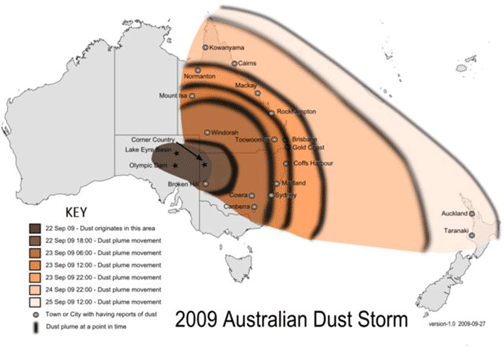
BHP is lying low – hoping we’ll all forget about the predicted dust storms, as we have apparently forgotten about Maralinga. Russia plans to join forces with Cameco, in Australia uranium mining.
The nuclear industry is quietly worrying about the falling uranium price, and dimming prospects for commercial nuclear power – hence the increased nuclear hype. Marshall islanders fear sea level rise, to add to their radiation-induced problems.
Some really interesting ideas coming on in how energy efficiency, and smart grids, combining with renewables have great potential for Australia’s energy future. That’s some of the week that has been………….
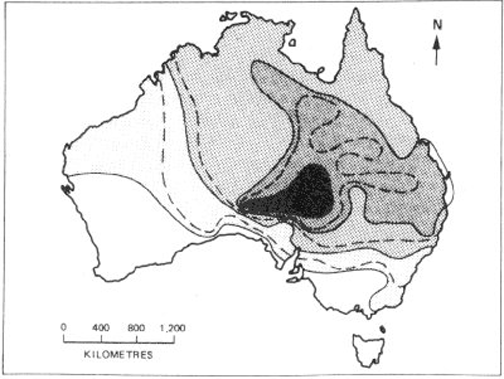
Maralinga’s radioactive fallout 1963 and ? 2009
Radioactive problems remain in Hunters Hill
Radioactive homes need rules Science Alert 05 October 2009
There are serious gaps in how Australia deals with the problem of radiation contamination of suburban homes, a leading lawyer told the CleanUp 09 conference in Adelaide on 30 September. Continue reading
Uranium policy a hypocrisy
Uranium policy a hypocrisy The Age DAVID NOONAN October 5, 2009
…………Unfortunately, Australia can never credibly lead on nuclear non-proliferation and disarmament while spreading nuclear risks as one of the world’s largest uranium suppliers. Continue reading
BHP keeps mum on early uranium shipment to China
BHP ships first uranium from SA
The Age BARRY FITZGERALD
October 1, 2009
“……………..BHP would not give details on the shipment, which was made possible by the 2006 agreement between the former Howard government and Beijing on a nuclear safeguards pact. Continue reading
Uranium industry keeps up is myth about price rising
Fortune-telling thrives in the uranium/nuclear industry.
Faced with the facts of a glut of uranium, a failing commercial nuclear industry – what do they do? Well – just predict a boom – just alittle bit further on…..
Toro looks beyond uranium slump THE AUSTRALIAN Stephen Bell October 05, 2009 Article from: Dow Jones Newswires TORO Energy remains confident its $162 million Wiluna uranium project in Western Australia is economically viable, despite a sustained downturn in uranium prices…………..
Spot prices for the nuclear fuel fell last week to about $US42 ($48) a pound, down from a record high of $US136 in June 2007, prompting media speculation that many Australian uranium mining hopefuls would struggle.
Paladin calls Catholic Commission a paid ‘puppet’ of Western corporations
Australian uranium firm condemns Malawi NGOs
Trading Room BLANTYRE, Oct 2 AFP
October 03 2009,
Australia firm Paladin has dismissed allegations of contamination from a northern Malawi uranium mine, telling MPs that two rights groups have been paid funds to discredit its operations. Continue reading
Fine depleted uranium travels far in winds
Australia ‘uranium’ dust concerns
muzzylogic Oct 3, 2009 ‘Environmentalists have raised concerns that another giant dust storm blowing its way across eastern Australia may contain radioactive particles. Continue reading
Maralinga lingers on with radioactivity
Australia, dust storms and the fallout Britain left behindIdealist.ws 1 Oct 09 “………What is Maralinga? How did plutonium get there?
In the 1950s and 1960s, Australia was the host of a handful of U.K.-sponsored atmospheric nuclear tests and related nuclear experiments on the Montel Bello Islands (off the northwest coast) and at Emu Field and Maralinga, both located in the Great Victoria Desert in South Australia. At Maralinga2 between 1957 and 1963, the U.K. conducted several plutonium dispersal experiments, dubbed ‘minor trials’ (very similar to the ones conducted at the Nevada Test Site; see: safety experiments), which scattered radioactivity (tens of pounds of Plutonium 239) far and wide into the bush.
Through the 1990s, the Emu and Maralinga sites were physically blocked off by a 100-mile radius security zone, which might have been a good enough barrier for un-remediated (not cleaned up) nuclear sites but in reality is no match for a dust storm the size of several hurricanes. (If the same sized-radius were blocked off around the Nevada Test Site, it would force the evacuation of Las Vegas.)
Although the ‘Maralinga Rehabilitation Project’ – finished in 2000 – cleaned up some of the ‘minor trial’ plutonium, not all of the plutonium is cleaned up and the waste burial practices have been SERIOUSLY3 called into question mostly because the plutonium was buried only 3 to 4 meters deep. Australia’s Senator Lyn Allison noted in 2003: “No matter how many reports are produced, the fact of the matter is that 22kg of plutonium is buried in simple, unlined earth trenches, some of it just a couple of metres below the surface.” The Sunday Age article titled “Agenda – Maralinga’s Afterlife” on May 11, 2003, stated that: ‘The vitrification method was abandoned by MARTAC three-quarters of the way through the project, in favour of the much cheaper trench-method. Most of the waste – including broken-up vitrified material – was then buried in unlined pits covered with just three metres of clean soil. The rest was left on the desert surface. As a result, an area the size of metropolitan London – 300 square kilometres – remains infected with lethal plutonium that will stay active for a quarter of a million years.’ That section of land is dubbed the ‘North West Plume,’ located northwest of Taranaki and contaminated largely from the ‘Vixen B’ trials …………. Australian authorities have denied there is any radiological health problem with the red dust………………………………. Although it is commendable that ARPANSA acknowledged that radioactive material was in the red dust that coated most of the populated areas in Australia and New Zealand, ARPANSA’s Burns is saying more to allay fears than educating Australians about the consequences of their actual radiation exposure to the dust…………… Even if the winds significantly diluted and reduced the concentration of the Maralinga soil-laden plutonium in the red-dusty air, it will still be extremely toxic because it takes just one millionth of a gram of plutonium to deliver a lethal dose and even more minute quantities (billionths of a gram) might induce cancer. Theoretically, even a single atom (particle) of plutonium has the ability, from its extremely strong alpha radiation (like a very strong, mini X-ray machine), to produce free radicals and alter DNA in our body’s cells – both are precursors to cancerous growth.
Since any population exposure to radiation increases the risk of cancer in a population, the dispersion of plutonium dust from Maralinga over thousands of miles of populated Australia has increased Aussie’s cancer burden………. In the Southern Hemisphere, wherever this red dust is now lingering, if it is brought down to Earth by rain it will contaminate surface areas (shingles, pavement, cars, crops, etc…) and water supplies as long as the radiation’s half-life, which can be hundreds or thousands of years. Ingesting radiation from contaminated foodstuffs and water constitutes the greatest danger from radiation exposure. http://idealist.ws/australia.php
Russian uranium company to join Cameco in Central Australia
Russia‘s ARMZ in talks with Cameco on uranium mining
MOSCOW, Oct 1 (Reuters) – State-controlled Russian uranium miner ARMZ Holding is in talks with Canada’s Cameco Corp (CCO.TO) on possible mining joint ventures in Australia and Africa, the company’s deputy head said on Thursday…… The idea arose, he said, because a joint venture with Cameco in Russia had stalled due to laws limiting foreign access to strategic mineral resources. (Reporting by Polina Devitt, writing by Robin Paxton, editing by Maria Kiselyova) http://www.reuters.com/article/euMergersNews/idUSL112565120091001
1 This month

of the week – Australians for War Powers Reform (AWPR)
To see nuclear-related stories in greater depth and intensity
 Antinuclear