The dangers of U.S. nuclear powered ships, military equipment, in Darwin
 Weigh up all the costs of greater US defence role SMH, Jan Thornley, 14 Nov 11 Your [Sydney Morning Herald’s] front page juxtaposition of disturbing information on the continuing radioactive contamination at Maralinga and the imminent announcement of the US military expanding its presence in Australia should be a warning to us all (”Greens fury at US build-up”, ”Ten years after the all-clear, Maralinga is still toxic”, November 12-13).
Fifty-five years ago we allowed British nuclear weapons tests on Australian soil, which has left this toxic, dangerous legacy for the health of people and the environment. We should be aware of the cloak of secrecy and lack of debate that surrounded the planning and decision making for this sorry chapter in our history. We are entitled to open and transparent information of all potential risks Australia may face by hosting US defence personnel and equipment at facilities here.
Questions must be answered – for example, on the inherent dangers of nuclear-powered and armed vessels in our ports; uranium-based munitions for aircraft and tanks; the use of hazardous depleted uranium weaponry, and the possible adverse effects and ecological harm of the American military escalation in Australia. These questions should be vigorously debated in our Parliament and media as part of an informed, democratic process. http://www.smh.com.au/national/letters/iran-a-tragedy-of-the-wests-own-making-20111113-1ndx3.html#ixzz1djIWVyRf
Indonesia not happy about planned big USA military base in Darwin
”Psychologically, it is not easy to have such a big presence on the doorstep, people in Indonesia still look at Australia with suspicion about hidden motives,”
Indonesia wants answers on US military plans, The Age, Daniel Flitton and Jessica Wright, November 12 2011 INDONESIA will seek an urgent explanation from Prime Minister Julia Gillard about plans to station US marines in Darwin, questioning the need for a military build-up on the country’s doorstep. Continue reading
Kevin Rudd’s contradictory messages on nuclear disarmament
 Anti-nuclear Rudd urged US to keep arsenal for deterrence, The Age, Daniel Flitton November 14, 2011 KEVIN Rudd’s public ambition as prime minister to help rid the world of nuclear weapons was secretly tempered by private messages urging the US to preserve a ”reliable” and ”credible” atomic arsenal, newly declassified documents reveal.
Mr Rudd made a campaign against nuclear weapons a hallmark of his foreign policy while in the top job, saying Australia had to reclaim credentials for the ”ultimate objective of a nuclear weapons-free world”. This chimed with hopes of then incoming US President Barack Obama, who pledged to put nuclear disarmament back on the global agenda.
But reflecting the dilemma of pushing for disarmament but not fully trusting other countries to keep any such bargain, Australia urged its American ally to hang on to its nuclear weapons for ”deterrence”…..
The submission is one of a bundle of secret defence documents obtained by the International Campaign to Abolish Nuclear Weapons under freedom of information law. Defence officials acknowledged the human cost of a nuclear war would be ”staggering” but said without a time frame for eradicating atomic weapons – and with ”complex and prolonged” negotiations likely in the meantime – the nuclear option should remain. Continue reading
While USA sells nuclear technology to China, Australia gets USA military base against China
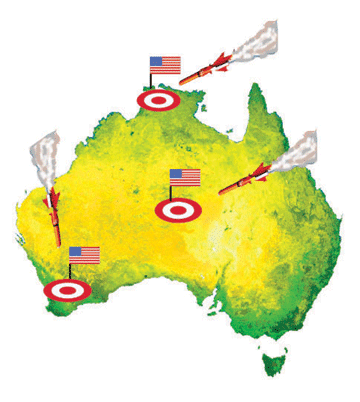 The full range of U.S. naval ships is expected to rotate through the joint facilities, stopping for exercises as well as repairs and other shore work. Naval aircraft also will have access to a base in Darwin.
The increased U.S. presence will be a rotating force, one person said. In September, Australian Defence Minister Stephen Smith said the enhance cooperation would be “more ships in, ships out; more planes in, planes out; more troops in, troops out.”….
U.S. to Build Up Military in Australia, WSJ, By LAURA MECKLER, WASHINGTON, 12 Nov 11—President Barack Obama will announce an accord for a new and permanent U.S. military presence in Australia when he visits next week, a step aimed at countering China’s influence and reasserting U.S. interest in the region, said people familiar with his plans. Continue reading
Australia’s Maralinga veterans and Aboriginals paid the price for nuclear bomb testing
 Finally they can heal together, Adelaide Now, Bryan Littlely, From:The Advertiser, November 12, 2011 THEY are snapshots from a secret time. An insight into a life in one of the harshest and most secure places in Australia. The men who took these photographs at Maralinga during the series of British nuclear testing and clean-up from 1952 to 1967 carry them proudly. Most also carry another legacy of this land and the controversial atomic testing that went on here.
Cancers and other conditions linked to the radiation, plutonium, burilium-laced lands that were left after the testing has claimed the lives of many of the men who were at Maralinga. In 1985, a survey found that of the 12,500 people involved in the British nuclear testing program in Australia, 11,000 had died. Hundreds of Maralinga-Tjarutja people were also forced from their homeland during the testing.
Few of the veterans remain today but the handful who have gone back to Maralinga for the Remembrance Day reunion have done so with the blessing of the traditional owners, so the two groups of people for
whom Section 400 is so significant can heal together…. Australian Nuclear Veterans Association founder Avon Hudson, the Maralinga whistleblower and advocate for compensation claims for the men, said there were only about 50 members of that association left.
“We’re nearly buggered … most of our members are old buggers like me and we are dropping off the perch,” Mr Hudson, 74, said. “We can get a bit of healing coming back here. It brings back a lot of sad memories because almost all my mates are dead but it is mixed feelings because I have a lot of good memories, too.”…
“We were sent on to that Taranaki ground zero site to test some stuff… nobody knew it was contaminated,” he said…..
http://www.adelaidenow.com.au/news/south-australia/finally-they-can-heal-together/story-e6frea83-1226193206591
Another USA military base for Australia
“This current global situation is characterised by John Bellamy Foster as “the attempts of Washington to restore and expand its global hegemony, using its military power to enhance its economic position”…….When imperial power starts to fade, as was the case with Britain’s in the early 20th century, it seems that Australian polticians’ response is to tie us ever closer to the sinking ship”….“potentially the deadliest period in the history of imperialism.” If we sow this wind in Darwin, then we’ll reap the whirlwind…..”
US Marines to have Darwin base: expert reactions, The Conversation, 11 November 2011, http://theconversation.edu.au/us-marines-to-have-darwin-base-expert-reactions-4260 The Labor Government will reportedly allow the US to permanently base American Marines in Darwin.
If this goes ahead, Australia will join a long list of countries around the world that host American soldiers, including former US colonies such as the Philippines and Cuba, its vanquished WWII foes, Japan and Germany, and scores of other countries. What does it mean for Australia?…
Dr Kelvin McQueen, Faculty of The Professions, School of Education, University of New England:
There are disturbing reports that the Gillard government is giving the US Marines a base in Darwin. Not since the Vietnam War will Australia have seen such an invasion of US miltary personnel into its territory. But it’s 35 years since that war ended, so what is the threat to both the US and Australia that necessitates a Marine base in our northern capital? Continue reading
Australia does little for nuclear disarmament, just follows American line
The Rudd and Gillard governments, like those before them, have taken a cautious approach to nuclear non-proliferation and disarmament. They have been unwilling to push for anything more than the United States will accept. Indeed, Australia’s policies perfectly mirror those of our powerful nuclear-armed ally…
For years, the International Campaign to Abolish Nuclear Weapons has urged the Australian government to join the international mainstream in supporting negotiations on a comprehensive nuclear weapons ban – a
nuclear weapons convention. But it has refused to do so, ..
Australia driving the push for nuclear disarmament? Hardly ! Crikey.com November 11, 2011 by Tim Wright Fifteen years ago in The Hague, the International Court of Justice – the highest legal authority in the world – handed down one of its most
contentious advisory opinions. To the chagrin of the nuclear powers, it declared that all governments are legally obliged to disarm, and todo so without unreasonable delay.
“The destructive power of nuclear weapons,” the court remarked, “cannot be contained in either space or time. They have the potential to destroy all civilisation and the entire ecosystem of the planet.” It observed that radiation released by a nuclear explosion would affect health, agriculture and natural resources, and pose “a serious
danger to future generations”. Continue reading
Anti nuclear protest against Obama at Darwin, Australia
 Local activists plan Obama protest News.com.au 10 Nov 11 LOCAL activists angry at
 US military bases in Australia are planning to protest US President Barack Obama’s trip to Darwin next week. Justin Tutty from Darwin Residents Against War says he expects at least 20 locals to stage a peaceful protest near Parliament when Mr Obama arrives on Thursday.
“Our message is that we don’t want US bases, we don’t want US nuclear warships in Darwin Harbour and we don’t want US troops in Darwin,” Mr Tutty said. There has been speculation Mr Obama will use the visit to make an announcement relating to increasing the US military presence in the Northern Territory.
Australian Defence Minister Stephen Smith recently foreshadowed increasing the number of joint training exercises with America in Darwin and the US storing more equipment in the city for disaster and humanitarian assistance.
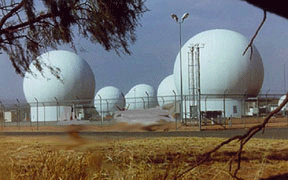 Already the US and Australia jointly run the Pine Gap spy base near Alice Springs in the Northern

Territory. Mr Tutty said there was little information about what a greater US presence in Northern Territory would mean.
“They have talked about a pre-positioning base and we are very sceptical about the nature of the base because of all the lies we have been told about Pine Gap,” Mr Tutty said.”For so many years they told us that Pine Gap was a communications base, but in the last few years it has come out about its offensive role and it was used to direct dozens of attacks on Iraq.” http://www.news.com.au/breaking-news/national/local-activists-plan-obama-protest/story-e6frfku9-1226190123963#ixzz1dLAjnMoG
Obama’s Australian visit is vital to USA’s military industrial complex
Obama’s Australia visit vital says White House, Herald Sun by:By Erica Werner in Washington , November 10, 2011 US President Barack Obama is about to embark on a nine-day trip to Hawaii, Australia and Indonesia that will take him away from Washington at an important time, but White House officials say its all about US jobs.
The trip also will underscore the economic, political and security importance of the fast-growing Asia-Pacific region, which the US sees as critical to American interests in coming years.
“The President’s No.1 priority is job creation, and our efforts to create American jobs are tied very directly to our engagement in the Asia-Pacific,” said Ben Rhodes, a White House deputy national security adviser.
“Increasingly the centre of gravity in the 21st century is going to make the Asia-Pacific critical to all of our interests,” Mr Rhodes said.
Mr Obama leaves on Friday for Hawaii, where the US will host the Asia-Pacific Economic Co-operation summit, bringing together 21 member nations which together comprise 40 per cent of the world’s population. From there, he makes a long-delayed visit to Australia…
 In Australia, the President visits the capital, Canberra, as well as Darwin, site of an Australian military base, where discussion is expected to focus on an emerging defence agreement that would let the US to expand its military presence in Australia….
Kim Beazley, Australia’s ambassador to the US, said in an interview today …”Australia’s geographic location is becoming increasingly important to the US.”…http://www.heraldsun.com.au/news/breaking-news/obamas-australia-visit-vital-says-white-house/story-e6frf7ko-1226190900495
Australian government not seriously opposed to nuclear weapons proliferation?
Christina Macpherson 31 Oct 11. These two motions to strengthen Australia’s stand against nuclear weapons proliferation were soundly defeated in the Senate today. It would seem that both Labor and Liberal parties are well in the grip of the nuclear corporate lobby. (However, the Government did reaffirm the current policy of not selling uranium to countries that have not signed the Nuclear Non Proliferation Treaty)
In the Australian Senate today Senator Scott Ludlam moved:
That the Senate: welcomes efforts taken by the Government to advance nuclear disarmament diplomacy, including the establishment of the International Commission on Nuclear Non-proliferation and Disarmament and the request for the Joint Standing Committee on Treaties to undertake an inquiry into the nuclear non-proliferation and disarmament treaties involving Australia; and
calls on the Government to support the United Nations General Assembly resolution on the Advisory Opinion of the International Court of Justice on the Legality of the Threat or Use of Nuclear Weapons.
That the Senate— (a) congratulates the Government for maintaining Australia’s longstanding policy of predicating bilateral nuclear cooperation agreements on the condition of membership to the Treaty on the Non-Proliferation of Nuclear Weapons; and (b) calls on the Government to identify the countries to which it will not permit the sale of uranium.

USA ramps up its military machine in Australia
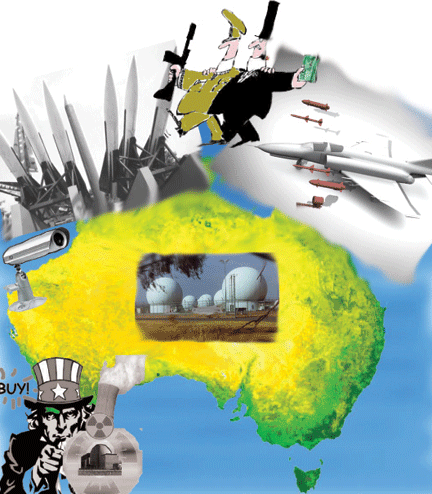 Defence set to give US greater military access Brendan Nicholson, Defence Editor The Australian * September 06, 2011 TEAMS of US and Australian officials are finalising a series of agreements, to be signed at this month’s AUSMIN summit, that will give US forces greater access to Australian military bases.
Shared facilities are expected to include HMAS Stirling naval base in Western Australia, an army base in Townsville as the primary location for operations, the port of Darwin and the Bradshaw Field Training Area in the Northern Territory.
The agreements, a key focus of this year’s talks on defence and foreign affairs issues in San Francisco, will mean the Americans will not just be offered space on a base, they will be there with what Defence calls “full knowledge and concurrence” with full access to intelligence and maintenance facilities…..
The agreement will be similar to that covering the joint intelligence-gathering facilities such as Pine Gap.
Defence set to give US greater military access | The Australian
Australian company Silex Sytems involved in dangerous nuclear technology
 Security fears over laser-enriched uranium, New Scientist 23 August 2011 by Jeff Hecht It’s pretty hard to disguise the fact you are enriching uranium, whether for use in nuclear power stations or bombs. Now a method that uses lasers to complete the process could make it more efficient – and easier to hide.
General Electric and Hitachi are joining forces to build a laser facility in Wilmington, North Carolina, powerful enough to produce more than 1000 tonnes of enriched fuel every year….
The current approach was developed only 10 years ago by an Australian company called Silex.General Electric-Hitachi have now licensed Silex’s technology. The original process was hampered by inefficient lasers but the fact that GE-Hitachi are prepared to go ahead with a full-scale plant suggests they have developed a more efficient laser.
Why is the idea so controversial?
A key concern is that the high efficiency of a laser enrichment process would reduce energy requirements, allowing a uranium enrichment plant to be smaller and more distant from power sources. That would make it harder to detect using satellite imagery. Such a small plant could also be used to make enriched uranium for atomic bombs – with little chance of being spotted.
What happens next?
The US Nuclear Regulatory Commission is scheduled to review the proposal on 30 June 2012. If the NRC approves the plan, a joint venture called Global Laser Enrichment would build the plant in six stages, eventually reaching a capacity of 6 million work units, a standard measure of enrichment capacity. If the product was standard-grade reactor fuel, the facility could produce more than 1000 tonnes a year…..http://www.newscientist.com/article/dn20819-briefing-security-fears-over-laserenriched-uranium.html
Australia’s role in nuclear non proliferation means no uranium sales to India
 The precedent set by nuclear trade with India increases the risk of other countries pulling out of the NPT, building nuclear weapons and doing so with the expectation that civil nuclear trade would continue.
Nuclear trade with India risks boosting arms race, The West Australian, By Scott Ludlam June 13th, 2011, Australia’s long-standing policy to not sell uranium to nations refusing to sign the Nuclear Non-Proliferation Treaty must not change.
Nuclear trade with India would undermine the fundamental principle of the global non-proliferation regime – the principle that signatories to the NPT can engage in international nuclear trade for their civil nuclear programs while countries which remain outside the NPT are excluded from civil nuclear trade. Continue reading
Australia’s Future Fund needs legal advice on investing in nuclear weapons
“The Future Fund was applauded for divesting in cluster munitions manufacturers. The Fund’s investments in nuclear weapons are clearly untenable.
“The board must seek urgent legal advice and promptly reconsider this investment decision.”
Future Fund must seek urgent legal advice on nuclear weapons – and divest Scott Ludlam 26th May 2011, The Federal Government’s Future Fund is clearly violating its own policies and cutting across Australia’s international legal obligations by investing in companies that manufacture nuclear weapons, the Australian Greens said today. Continue reading
Australia’s Future Fund invests in nuclear weapons
Australia investing in nuclear arms, The Age, Dan Oakes, May 26, 2011 THE federal government’s $74 billion Future Fund is investing Australian taxpayers’ money in foreign companies that make components for nuclear weapons.
Records obtained under freedom of information laws show the fund has $135.4 million invested in 15 companies involved in the design, production and maintenance of nuclear weapons for the United States, Britain, France and India.
About $3.8 million of this is invested in Larsen & Toubro, a Mumbai-based company involved in building a fleet of nuclear-armed submarines for India. The company has also helped test a launch system for India’s nuclear missiles.Any investment involving the production of nuclear weapons for India is particularly controversial because New Delhi is not a signatory to the nuclear non-proliferation treaty…… Australia investing in nuclear arms
1 This month
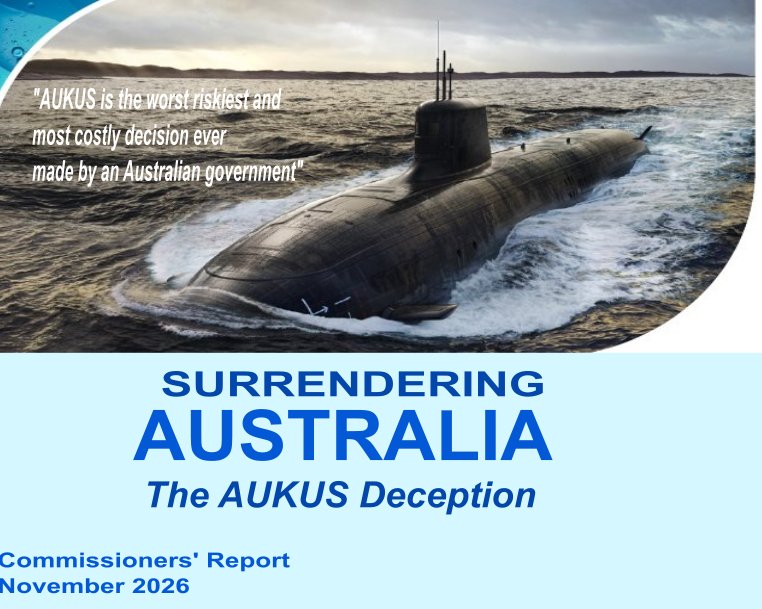
Read the Public Inquiry Report, the Commissioners’ report, Surrendering Australia: The AUKUS Deception is available to download for free at aukuspublicinquiry.com. Or just watch the replay of the National Press Club Luncheon.
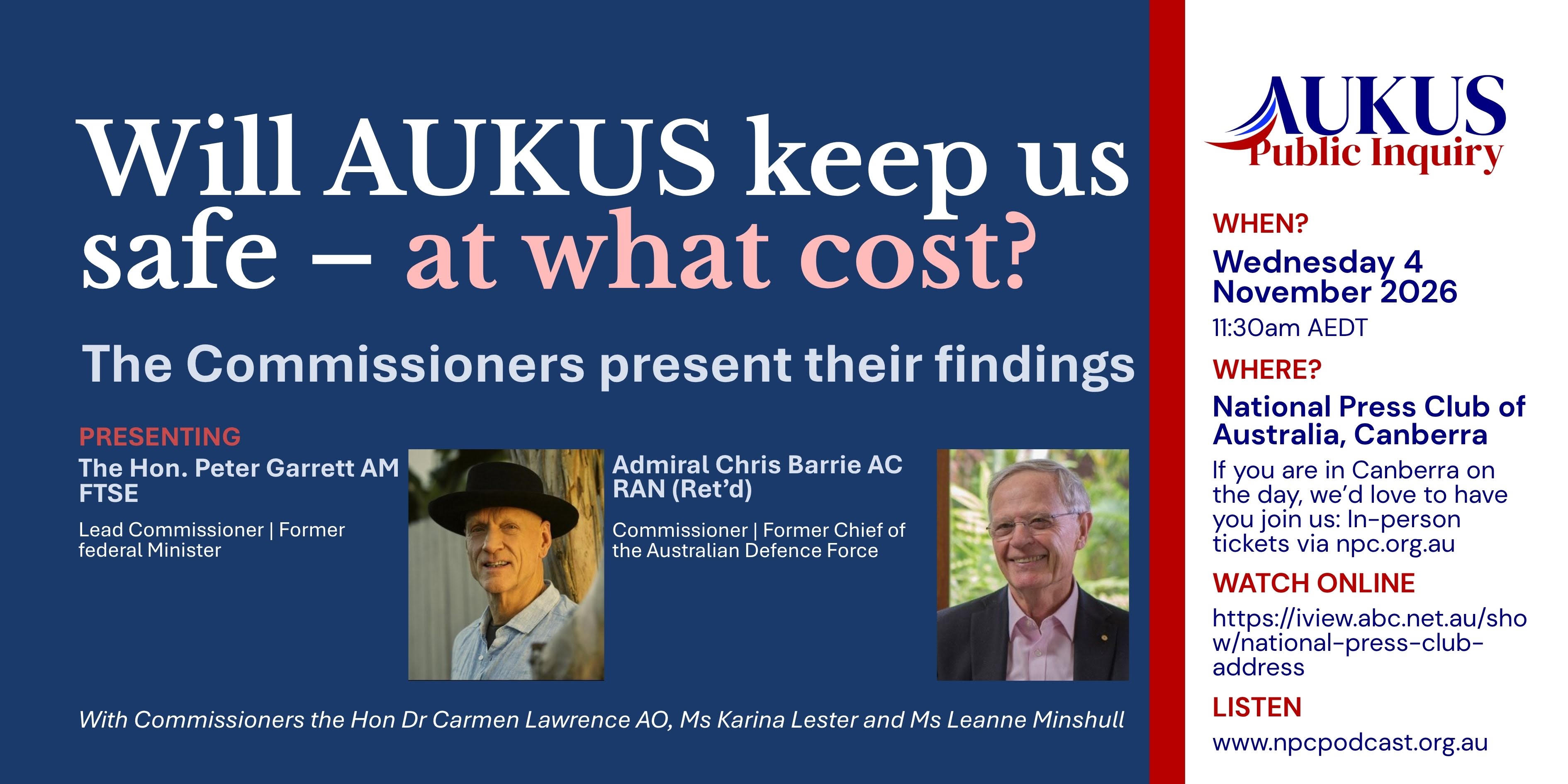
4 November – Will AUKUS keep us safe – at what cost?
the Commissioners of the AUKUS Public Inquiry present their findings at the National Press Club of Australia in Canberra. iview.abc.net.au/show/national-press-club-address
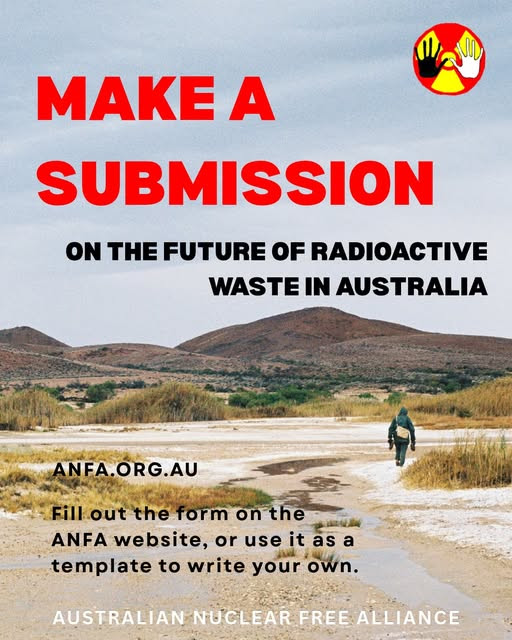
Submissions to the federal government’s new draft framework close on the 13th November 2026.
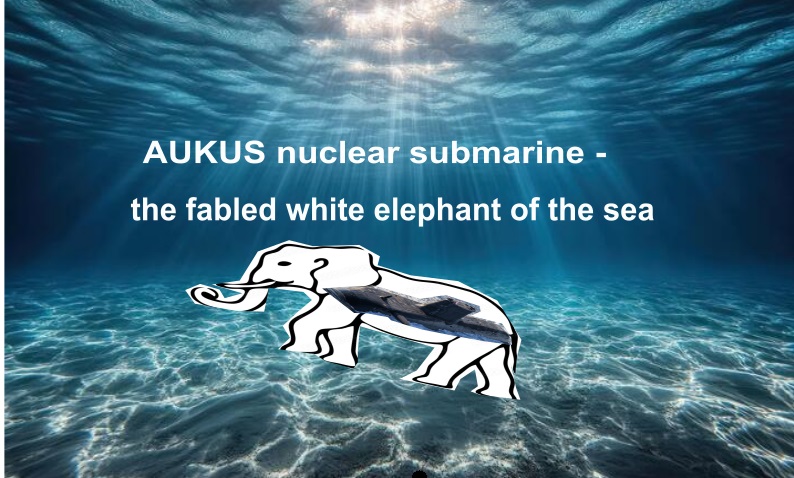
Australians deserve the truth
about
AUKUS – https://aukuspublicinquiry.com/

PETITION – To: Prime Minister Anthony Albanese and the Australian Labor Government

of the week – Australians for War Powers Reform (AWPR)
To see nuclear-related stories in greater depth and intensity

