 Mr Fraser said. “The Cold War was still in progress. It was a different world. “We’ve gotten far too close to the Americans.”……
In 1985, the then PM Bob Hawke withdrew support for the missile tests after a meeting with US Secretary of State George Shultz.
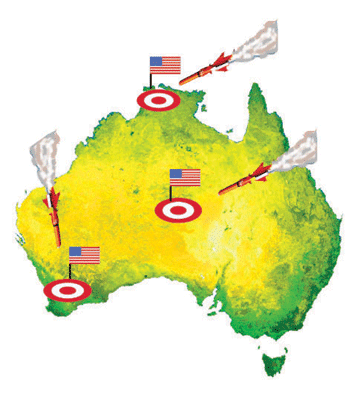
US planned to fire missile at Australia, secret Cabinet papers from 1980s reveal By  Samantha Maiden The Sunday Telegraph January 01, 2012
- Fraser agreed for US missiles to be fired at Australia
- Were to be fired into Tasman Sea off Cape Pillar
A SECRET US plan to test MX missiles by firing them from California to the coast of Australia was signed off on by then prime minister Malcolm Fraser. And it can be revealed that the federal Cabinet agreed to keep the intercontinental ballistic missile tests secret because it was “preferable for the matter not to become an election issue”. Continue reading
Australia’s part in the USA war machine, and the arms bazaar
 Happy Christmas (the war is not over) The Drum, Kellie Tranter 22 Dec 11 “……..You’ll be chuffed to know our country is doing its bit for ‘world peace’ this Christmas.
The Australian Army is preparing for longer “campaigns”; we voted against Palestine’s admission to the UNESCO and we lobbied to weaken the international ban on cluster bomb munitions.
We also decided to sell uranium to India, a country standing outside the Nuclear Non-Proliferation Treaty, a country whose nuclear program is stimulated by its neighbour (Pakistan) having the fastest-growing nuclear weapons program in the world, and a country whose government has been prepared to bribe MPs to secure the votes for a nuclear future, as evidenced by the Indo-US nuclear deal in 2008.
Last but not least, Australia was the fourth largest purchaser of US arms in the 2011 fiscal year.
Tune into the radio for the morning history trivia question. Seldom does a day pass when the answer doesn’t relate to the beginning of a war, the fighting of a war, the ending of a war or some remembrance of a war. Is mankind preordained to a fate of perpetual war mongering?
Mainstream media reports “voila”, the end of the Iraq war, as promised. But the public announcements don’t mention that the United States has left behind in Iraq the world’s largest “embassy”, housing 16,000 people. Or that private security contractors (which may include the infamous Blackwater, renamed Xe and now Academi) will be returning to Iraq because the United States government failed to negotiate immunity for its troops or to renegotiate the Status Of Forces Agreement which requires all US forces to be gone from Iraq by January 1, 2012. And we don’t hear a peep about the rules of engagement for private US security contractors.
But are the US soldiers going home? Or are they joining the US and NATO forces who allegedly have landed outside of Syria and are training militants to overthrow the regime of president Bashar al-Assad. Don’t worry about that – it’s Christmas time: we’ll just have to wait for the White House to spin the bottle on the world map to find out which country our young soldiers will go to next. Syria? Iran? China?
In the spirit of “dealing toughly with your banker” earlier this year the Pentagon revealed a new battle concept – The Air Sea Battle concept- which reportedly is the “start of what defence officialssay is the early stage of a new Cold War-style military posture toward China”.
Naturally Australia and the United States each attempted to reassure China that expanding military US ties with Australia are not aimed at containing China, and so far China has remained rather stiff upper lipped, but wars are fought on borrowed money so it will be interesting to see how US Treasury Bonds go (or don’t). Guan Jianzhong, the head of China’s biggest ratings agency, Dagong Global Credit Rating, offered a fairly frank assessment of the US economy.
But fortunately we should be kept safe and warm this Christmas by the Australian Intelligence Community. ASIO costs us $438 million per year, but we have the Australian Secret Intelligence Service, the Office of National Assessments, the Defence Intelligence Organisation, and the Defence Imagery & Geospatial Organisation as well! And the list is growing: the relatively newCyber Security Operations Centre is housed inside the Defence Signals Directorate, an organisation that partners with the United States National Security Agency, now notorious for itsOrwellian domestic spying program…. http://www.abc.net.au/unleashed/3742938.html
Definitely no nuclear submarines for Australia
 Navy chief rules out nuclear subs, Canberra Times, BY DAVID ELLERY, 17 Dec, 2011 Nuclear submarines are off the menu for the Royal Australian Navy, according to its chief, Vice-Admiral Ray Griggs….Admiral Griggs told an Australian Strategic Policy Institute dinner in Canberra on Thursday night, ”In terms of nuclear submarines the Government position has been very clear – it has been consistently [that] the only thing that is ruled out is nuclear.”
Red Cross and Red Crescent gaining international support towards a Nuclear Weapons Convention

Since 1945, the Red Cross and Red Crescent Movement have consistently voiced deep concerns about these weapons of mass destruction and the need for the prohibition of their use. Its role in developing the International Humanitarian Law led to the creation of the Additional Protocols to the Geneva Conventions, the universal rules of war, in 1977. As many as 194 nations of the world, including Australia, have ratified the four Geneva Conventions.
RED CROSS MOVEMENT WANTS NUKES ABOLISHED By Neena Bhandari IDN-InDepth NewsAnalysis, 10 Dec 11 SYDNEY – Even as Australia’s ruling Labour revoked early December its long standing party policy banning uranium sales to India and Pakistan was swift to stake its claim too, the disarmament movement received a boost with the International Red Cross and Red Crescent Movement adopting a resolution to work towards a legally binding global convention on nuclear abolition.
The Australian Red Cross (ARC) had worked with the Japanese and Norwegian Red Cross to draft the resolution early 2011, which was passed in Geneva on November 26. The decision to support the initiative was taken by the Council of Delegates of the Movement comprising representatives of the International Committee of the Red Cross(ICRC), the 187 Red Cross and Red Crescent National Societies and the International Federation.
“We were overwhelmed by our colleagues in a range of countries from Iran, Jordan and Lebanon to Mozambique, Malaysia and Samoa amongst others, who co-sponsored and supported the Red Cross Movement’s resolution to urge governments to never use these horrible weapons again. It shows that the resolution has traction and there is a global sense that the Red Cross Movement needs to speak out on this vital issue of nuclear abolition,” ARC’s Head of International Law and Principles, Dr Helen Durham, told IDN. Continue reading
Australia wants uranium money – never mind that it goes to nuclear weapons

states – the U.S., U.K., China, France, Russia – although not one of them takes seriously its obligation under the Non-Proliferation Treaty (NPT) to pursue disarmament in good faith.
policy and binding Labor platform policy. That’s pretty low. Continue reading
First uranium to India, now military ties – Australia-India
India trip follows Australian ruling party’s uranium backflip, Radio Australia, December 7, 2011 Only days after the ruling Australian Labor Party ended its ban on possible uranium sales to India – Australia’s Defence Minister Stephen Smith will visit New Delhi and Mumbai for talks on greater military cooperation….
It’s Mr Smith’s fourth ministerial visit to India but his first in the Defence portfolio and he is emphatic that India’s nuclear neighbour and arch rival, Pakistan, will not be getting any Australian uranium.
http://www.radioaustralia.net.au/connectasia/stories/201112/s3385778.htm
India ramps up “China killer” nuclear missiles, As Australia’s Labor government ready to sell uranium to India
 India’s muscle flexing comes at a sensitive juncture for Australia, too.
At the Australian Labor Party’s national conference this weekend, one of the pre-eminent agenda items is a motion to end the ban on selling uranium to India.
a new market offering high-grade uranium ore for India’s civilian reactors frees up the country’s limited indigenous supplies for boosting its military program.
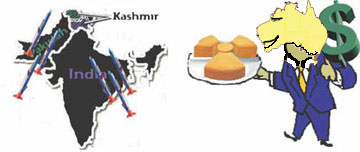
India to test new missile dubbed ‘the China killer’, The Age 3 Dec 11, Given the incendiary moniker ”the China killer” by the more sensationalist press, India’s newest nuclear-capable missile will be its most powerful yet, and an unmistakable signal to its neighbours.
Agni V – formally named after the Hindu god of fire and acceptor of sacrifices – is set to be tested within three months. It will be capable of carrying a nuclear warhead 5000 kilometres, meaning it can reach not only Beijing and Shanghai, but all of northern China. India’s existing arsenal can already reach every corner of Pakistan…. Continue reading
Lack of principle in Australia selling uranium to nuclear-armed India, no proper safeguards
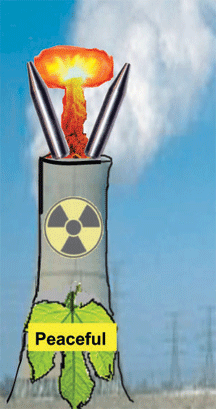 The alternative course for Australia is to side with the large majority of the world’s countries who want to re-establish and reinforce the principle that nuclear trade should be restricted to countries that have signed the Non-Proliferation Treaty and take seriously their non-proliferation and disarmament commitments.
We could take a principled rather than an unprincipled approach. We could lead rather than follow.
Safeguarding uranium exports to India Online Opinion , Dr Jim Green, 1 Dec 11 A big part of the PR pitch for uranium sales to nuclear-armed India is the assertion that ‘strict’ safeguards will ‘ensure’ peaceful use of Australian uranium. Sadly, it’s just PR.
The claim sits uncomfortably with the reality that safeguards are based on occasional inspections of some nuclear plants by the International Atomic Energy Agency (IAEA). The claim sits even more uncomfortably with the observations of recently-retired IAEA chief Mohamed El Baradei that the Agency’s basic rights of inspection are “fairly limited”, the safeguards system suffers from “vulnerabilities” and efforts to improve it have been “half-hearted”, and the system operates on a “shoestring budget…comparable to a local police department”. Continue reading
Australia to join USA-India defence pact – antagonising China
 U.S. officials have been particularly pushing Canberra to commit additionally to construction of a new fleet of 12 powerful missile submarines — possibly of U.S. design — in what would be the country’s largest sole defence acquisition.
URANIUM SALES TO INDIA…Rudd told the Australian Financial Review that a looming weekend vote and expected approval by Australia’s ruling Labor Party to drop a longstanding ban on uranium sales to non-Nuclear Proliferation Treaty countries like India could help clear the way for formation of a new pact.
 Australia backs security pact with U.S., India, By Rob Taylor, Additional reporting by Sui-Lee Wee in Beijing, Editing by Ed Davies and Jonathan Thatcher), CANBERRA | Wed Nov 30, 2011 (Reuters) – Australia’s foreign minister on Wednesday backed the formation of a security pact with India and the United States, a tie-up that could fuel China’s worries of being fenced in by wary neighbors.
It is the latest move by Australia to take a bigger role in the region’s security. Earlier this month, it agreed to host a de facto U.S. base in the north of the country which would provide military reach into southeast Asia and the South China Sea, where China has disputes with several other states over sovereignty…..
It was unclear why Rudd, a Mandarin-speaking Sinophile, would risk irritating Australia’s top trade partner China which is already nervous that Obama’s latest diplomatic push into the Asia-Pacific is part of broader U.S. policy to encircle it…..
prominent Chinese military commentator, People’s Liberation Army Major General Luo Yuan, said this week that Washington was clearly trying to fence in Beijing. Continue reading
Australian company SILEX’s laser uranium enrichment technology – risks of nuclear weapons proliferation
 many of the good things GE is using to make a case about Silex—less use of resources and electricity and increased efficiency—are actually negatives that make it easier for rogue states to hide clandestine plants…..methods for the production and use of nuclear materials that would be more difficult to detect,” the report states
New Uranium Enrichment Technology Alarms Aviation Week, By Kristin Majcher Washington 23 Nov 11 General Electric says it has successfully tested a faster, cheaper way to produce nuclear reactor fuel, and is planning to commercialize the technology by building a facility in Wilmington, N.C. While the prospect of saving resources to generate energy at a lower price sounds like a breakthrough, scientists are concerned that the top-secret method of enrichment that GE is using will indirectly elevate proliferation risks around the world, thus inspiring rogue states to develop their own laser enrichment facilities for nuclear
weapons.
The enrichment technology is the Separation of Isotopes by Laser Excitation (Silex). It was developed by Silex of Australia in 1992. The technology company USEC funded early research on Silex, but abandoned it in favor of focusing on centrifuge enrichment. In 2006, GE signed an exclusive agreement to commercialize and license the technology and spearhead further research and development. Continue reading
Australia will lose all Non Proliferation credibility in selling uranium to India
India continues to give assurances that imported materials are solely for civilian use, yet it refuses to sign the Comprehensive Test Ban Treaty and is yet to ratify the International Atomic Energy Safeguards Agreement.
Blindly following bad US policy is neither in our best interests nor the world’s. It would be a terrible compromise of our nation’s principles, and put at risk our enviable reputation as a responsible global citizen for very little short-term gain.
Gillard’s uranium-to-India play is a dangerous sellout, SMH, Senator Gavin Marshall, November 21, 2011 Australia risks contributing to the India-Pakistan nuclear arms race.
NEXT month’s ALP national conference will be asked to make a decision of global importance: whether to back Prime Minister Julia Gillard’s call for Australia to export uranium to India. Australia must decide whether to stand with the vast majority of nations in supporting the principle of nuclear disarmament, or to stand with those who continue to undermine it.
India is not the responsible nuclear citizen that many would have us believe. It has a long history of broken promises and reckless conduct relating to its nuclear programs. Continue reading
Australia has four options on nuclear disarmament and uranium sales
Promises and U-turns of the nuclear kind, The Drum, Jim Green, 19 Nov 11“…..What steps could Australia take to extricate us from the current mess – the South Asian nuclear arms race, and the broader problem of nuclear proliferation?
Option #1 is to leave uranium in the ground. It’s not as radical an idea as it might sound. Uranium accounts for a paltry 0.3 per cent of national export revenue and 0.03 per cent of Australian jobs. Few would notice if the industry vanished and still fewer would miss it.
Option #2 is to apply current government policy – restricting supply to countries that have signed the NPT. A variation of that option would be to restrict supply to NPT signatories that are serious about their non-proliferation and disarmament obligations – that would require a rethink of supply to, for example, the US and China since they have not ratified the CTBT. Continue reading
USA militarisation in Australia is disturbing to China
The Global Times, a tabloid owned by the Communist Party’s People’s Daily newspaper, hit hard upon the theme of  besiegement. It quoted a People’s Liberation Army major general as saying that the expanded U.S. training and deployment base inAustralia was one of a series of U.S. installations to “encircle China from the north to the south of the Asia-Pacific region.”….

 Beijing is wary of Obama’s assertive China policy , Taiwan News, By CHRISTOPHER BODEEN Associated Press 2011-11-18 President Barack Obama‘s sudden moves to contest rising Chinese power are setting this capital on edge, even if in public the response has been muted.
During his ongoing nine-day swing through the Asia-Pacific region, Obama has already unveiled a plan for an expanded U.S. Marines presence in Australia, advocated a new free-trade area that leaves China out, and called on Beijing not to buck the current world order.
The Beijing government is trying to understand the shift, tasking academic experts to review the initiatives and submit options on how to respond. Continue reading
Questions: nuclear submarines for Darwin? Greens, China, Indonesia – all want answers
We need more details of US build-up: Brown, SMH, 17 Nov 11, Australian Greens leader Bob Brown fears nuclear submarines could be stationed off the coast of Australia as part of a US military build-up in the Top End……
The expansion of the existing collaboration between the Australian Defence Force and the US Marine Corps and US Air Force will allow America to enhance its presence in the Asia-Pacific region
Senator Brown wants to see more details of the deal, announced jointly by Prime Minister Julia Gillard and US President Barack Obama on Wednesday. He also wants a parliamentary debate on the deal. “I object to Australian people and parliament not knowing what the details are,” Senator Brown told ABC radio on Thursday. Continue reading
Darwin U.S. military base opens the way for cluster munitions and nuclear-powered vessels
 probability cluster munitions will be stockpiled in Darwin since there are known plans for the US to base a number of B-52 bombers historically used to deploy cluster bombs. It is already known that nuclear weapons will not be permitted onto Australian territory, but a number of the US’ naval fleet are nuclear-powered vessels which will be allowed…….
Both acts would result in Australia violating the spirit and intent of the Convention—to eliminate cluster munitions and the harm they cause for all time. And both are likely to occur as a result of the US base in Darwin.
Theorising Darwin: US may stockpile and transit cluster munitions Crikey, November 17, 2011 , by NAJ Taylor, A US military ‘base’ in Darwin will necessitate foreign weapons systems and armaments being stockpiled, retained and transited on and in Australian territory (spun as a “rotational deployment” – for China? I’ll use base until I know better).
Whilst long-standing and committed allies, Australia and the United States hold different positions on many matters relating to both arms control and humanitarian law. One recent normative development where the US and Australia’s views have diverged is the ban on cluster bombs, Continue reading
1 This month
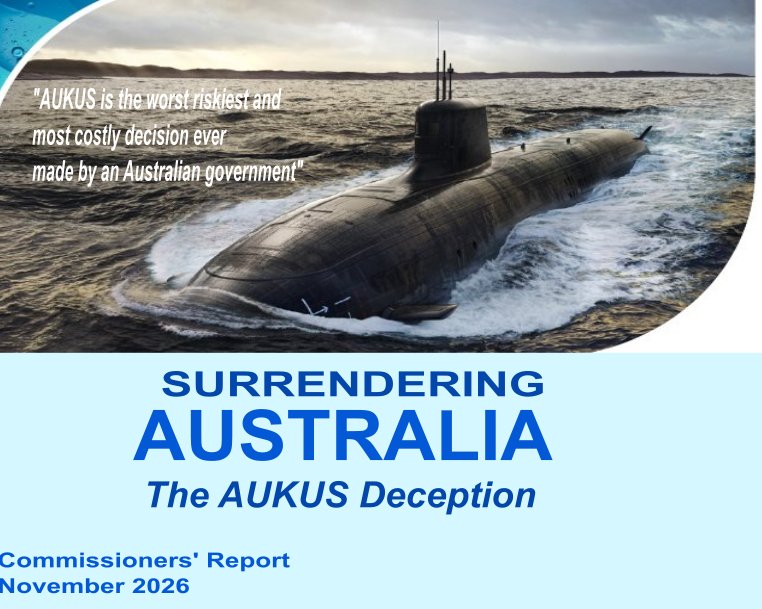
Read the Public Inquiry Report, the Commissioners’ report, Surrendering Australia: The AUKUS Deception is available to download for free at aukuspublicinquiry.com. Or just watch the replay of the National Press Club Luncheon.

4 November – Will AUKUS keep us safe – at what cost?
the Commissioners of the AUKUS Public Inquiry present their findings at the National Press Club of Australia in Canberra. iview.abc.net.au/show/national-press-club-address
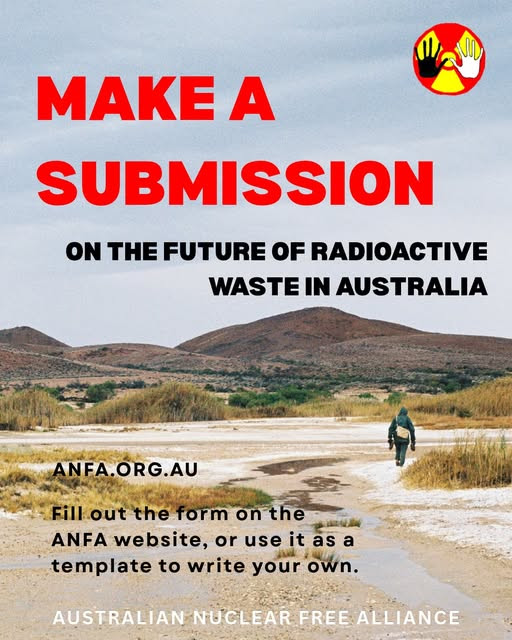
Submissions to the federal government’s new draft framework close on the 13th November 2026.
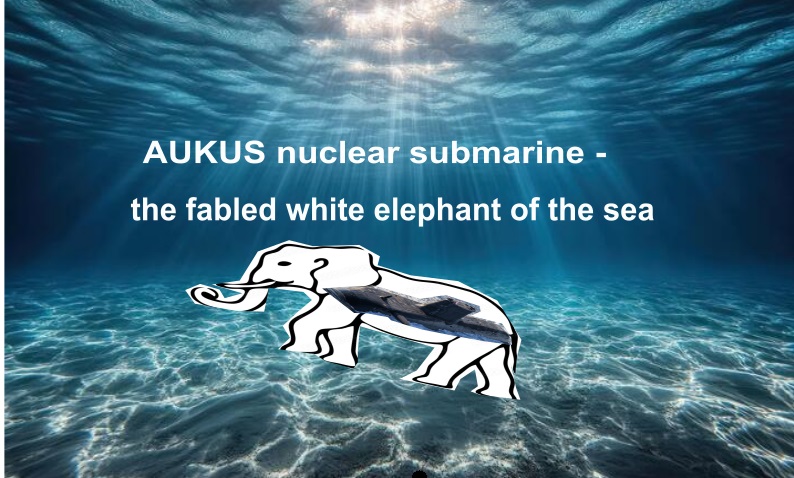
Australians deserve the truth
about
AUKUS – https://aukuspublicinquiry.com/

PETITION – To: Prime Minister Anthony Albanese and the Australian Labor Government

of the week – Australians for War Powers Reform (AWPR)
To see nuclear-related stories in greater depth and intensity

