Review: resources tax, India’s dilemma, oil gusher
 Australia: a seemingly quiet week. Obama cancels visit to Australia. Mainstream media continue to ignore Senator Scott Ludlam’s penetrating questioning on matters nuclear – (the taxpayer funded Uranium Council lobby, Muckaty nuclear waste plan, nuclear weapons proliferation..) BHP and Rio spend a sizable little of their massive profits to fight the govt’s super profit resources tax. These corporations fear that other countries might take up the idea too. Union push against health danger of uranium mining.
International: Dow Chemical Company escapes justice after 25 years, and hundreds of thousands of deaths from the Bhopal gas disaster. A portent for India’s nuclear energy future? Meanwhile USA seeks to prosecute BP over oil spill. U.S looks like getting useless Climate legislation. Pointless debate over nuclear bombing as a solution to BP’s oil gush .
The definitive story on nuclear power and health
I recommend that you download, print off, and study at your leisure, the complete article – from
Evatt Foundation: Publication: Nuclear power & public health – 31 May 2010
Nuclear power & public health, Evatt Foundation:, By Peter Karamoskos, 31 May 2010“… there is a linear dose-response relationship between exposure to ionizing radiation and the development of solid cancers in humans. It is unlikely that there is a threshold below which cancers are not induced.” – National Academy of Science, BEIR VII report, 2006
“We need to develop a very firm commitment to the elimination of nuclear power as a source of energy on the earth.” – Russell Train, former US Environmental Protection Agency administrator, 1977″
[t]he [economic] failure of the U.S. nuclear power program ranks as the largest managerial disaster in business history, a disaster on a monumental scale.” – Forbes, 1985
Introduction
The public health implications for a resurgence of nuclear power appear to have taken a subordinate position to the economic and global warming arguments that the industry has advanced to justify its expansion. The purpose of this essay therefore is several-fold: to review the scientific evidence for public health impacts of nuclear power, to assess occupational hazards faced by nuclear industry workers involved in the nuclear fuel cycle, to assess the evidence for nuclear reactor safety and critically challenge the underlying assumptions which may be less than adequate. It will also examine the public health risks of spent fuel from nuclear power reactors. The common thread linking these safety issues is the risk posed to public health by ionising radiation and in particular the cancer risk. The nuclear industry and our understanding of radioactive health hazards, developed in tandem during the twentieth century, however, the relationship to this day has always been uneasy and often in conflict. A brief historical narrative of this joint evolution is reviewed as it is essential to understanding the context and scope of the public health issues at the heart of the nuclear power debate.
If we are to believe the nuclear industry, nuclear power is both safe and vital to our future, yet over half a century of nuclear power has proven both contentions as false……
Evatt Foundation: Publication: Nuclear power & public health – 31 May 2010
Why nuking the BP oil gusher is the worst possible action
Nuclear Follies: How Not To Stem the BP Oil Gusher, Daily Kos:, by Page van der Linden 7 June 2010, “…….Never has it been more apparent that there’s a lot of misunderstanding (deliberate or otherwise) regarding nuclear weapons than recently. I’m talking about the appalling, misguided idea that we can “just nuke” the BP oil gusher and it will some how “be okay”.Here’s the Global Security Newswire’s “Quote of the Day” from June 3, 2010:
The use of a nuclear weapon to stop the BP oil gusher is not an option. It is, in fact, the worst possible thing we could do. Here’s why. Continue reading

Leading Australian law firms take up case against Muckaty nuclear waste dump
Maurice Blackburn, Julian Burnside, charged with waste dump action 3 June 2010 | by The New Lawyer THE Commonwealth Government and the Northern Land
Council will face a Federal Court legal challenge over plans for a radioactive waste dump in the Northern Territory.Maurice Blackburn Lawyers is working with NSW law firm Surry Partners, and Julian Burnside QC, to commence proceedings challenging the nomination of the Indigenous land, at Muckaty Station near Tennant Creek. Continue reading
French nuclear firm secretly got UK subsidy for waste disposal
They know full well that the economics of nuclear don’t stack up and that new reactors will only ever happen if the British taxpayer is forced yet again to carry the atomic can.”

EDF ran secret lobbying campaign to reduce nuclear waste disposal levy• Reactors builder won big concessions on key issues• Rethink on costs is in effect a subsidy, says Greenpeace Tim Webb guardian.co.uk, Wednesday 2 June 2010
The nuclear industry is being offered what campaigners claim is a taxpayer subsidy on the disposal costs of waste from new reactors following a secret lobbying campaign, the Guardian has learned. Continue reading
The eternal danger of nuclear wastes
THE NUCLEAR INDUSTRY AND RADIOACTIVE WASTES – our theme for June 2010. “The question whether one generation of men has a right to bind another, seems never to have been started either on this or our side of the water. Yet it is a question of such consequences as not only to merit decision, but place also, among the fundamental principles of every government.” – Thomas Jefferson, September 6, 1789
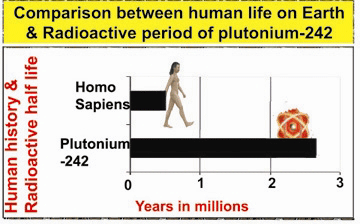
Half-life is the period of time it takes for a radioisotope atom to degrade to a state having half of its original intensity
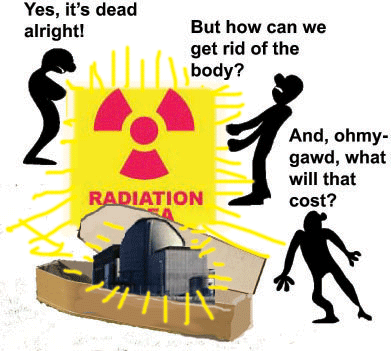
As you can see the continued production, use, and dumping of such waste materials as depleted uranium and plutonium, into the world’s air, land, and water leaves a permanent problem for our children, grandchildren. great-grand-children ….

Workers exposed to radioactive polonium at BHP uranium mine
“These high readings should trigger further investigation and individual testing for polonium in the body,

Roxby’s radioactive risk, The Independent Weekly. HENDRIK GOUT04 Jun, 2010 Mining giant BHP Billiton is risking the lives of its staff and employees at Olympic Dam in South Australia by exposing them to unsafe levels of radiation, according to a company whistleblower. Continue reading
U.S. govt rejects idea of nuclear bomb to fix oil spill as “crazy”
Nuclear Option on Gulf Oil Spill? No Way, U.S. Says, NYTimes.com, By WILLIAM J. BROAD : June 2, 2010 The chatter began weeks ago as armchair engineers brainstormed for ways to stop the torrent of oil spilling into the Gulf of Mexico: What about nuking the well?….
Stephanie Mueller, a spokeswoman for the Energy Department, said that neither Energy Secretary, Steven Chu nor anyone else was thinking about a nuclear blast under the gulf. The nuclear option was not — and never had been — on the table, federal officials said.“It’s crazy,” one senior official said.
Government and private nuclear experts agreed that using a nuclear bomb would be not only risky technically, with unknown and possibly disastrous consequences from radiation, but also unwise geopolitically — it would violate arms treaties that the United States has signed and championed over the decades and do so at a time when President Obama is pushing for global nuclear disarmament.Nuclear Option on Gulf Oil Spill? No Way, U.S. Says – NYTimes.com
America’s legal mess over nuclear wastes
 Solutions Remain Few on Issue of Nuclear- Waste Storage WSJ.com, JUNE 1, 2010 By REBECCA SMITH “……….Utilities have filed more than 70 lawsuits against the government accusing it of breach of contract because it hasn’t taken the waste. So far, $1.3 billion has been paid out. The Department of Justice estimates the liability will top $12 billion if a waste facility is not opened by 2020…….utilities continue to contribute $770 million a year to a Nuclear Waste Fund to pay for a permanent repository that now isn’t even on the drawing board.In April, a group of utilities sued the federal government, demanding that these storage fees be suspended. Ellen Ginsberg, general counsel of the Nuclear Energy Institute, a trade group, says, “We don’t want to pay any more fees until the government has a waste plan.” Solutions Remain Few on Issue of Nuclear- Waste Storage – WSJ.com
Legal case: Aboriginal owners do not want nuclear waste dump on their land
Mr Newhouse says his clients do not want compensation but for the nomination of the site to be withdrawn.

NT nuclear waste dump faces legal challenge. ABC News (Australian Broadcasting Corporation), By Jane Bardon and Gina Marich Jun 3, 2010 A legal challenge to the Federal Government’s plan to establish a national nuclear waste dump in the Northern Territory has been taken to the Federal Court. Continue reading
Uranium mill project in doubt, unable to pay cleanup costs
Cash-strapped Energy Fuels can pay for uranium mill but not for clean up « Colorado Independent, 2 June 2010, Gulf spill underlines need for companies to put aside vast sums in advance By David O. Williams 6/2/10 12 A Canadian company looking to build the first new uranium mill in the United States in nearly three decades is burning through cash at a rate that could leave it broke right about the time it hopes to secure its final approvals from Colorado public health officials. Continue reading
Secrecy about nuclear wastes, and Australia’s hypocrisy
This website might well give the impression that it is anti-American, anti-British etc, – especially on the subject of nuclear wastes.
But – spare a thought for those two countries. At least the nuclear waste subject is RAISED there. (That’s how we can publish it)
Very hard to get a few lines about Russia’s nuclear wastes.
As for China, France and also a few other countries (India, Korea, European states , Israel...) – well there’s nary a word about their nuclear wastes! What do they do with radioactive wastes? It’s a worry. And it seems to me to be complete lunacy for countries like Australia to piously claim safety policy, while selling uranium to such countries.
Britain’s multibillion black hole in nuclear waste costs
Chris Huhne warns of £4bn black hole in nuclear power budget, guardian.co.uk, Patrick Wintour, 1 June 2010
“………Britain is facing a £4bn black hole in unavoidable nuclear decommissioning and waste costs, Chris Huhne, the energy and climate change secretary disclosed tonight. The decommissioning costs over the next four years revealed by officials to Huhne are so serious that he has already flagged the crisis up to the cabinet. Continue reading
Gulf oil disaster is bad news for uranium industry
One virtually certain outcome of the environmental disaster currently blackening the Gulf of Mexico is that federal regulators will take a harder line on enforcement of environmental regulations. Uranium miners are likely to be particularly hard hit because there isn’t a person in the US who doesn’t fear the consequences of radiation exposure….Playing fast and loose with the environment is no longer a winning strategy.
Uranium Miners Get Some Good News and Some Bad 24/7 Wall St., Paul Ausick, June 1, 2010 “….The first installment of the investment will help USEC to continue its deployment of its American Centrifuge Plant which produces enriched uranium for use in nuclear power generation. The cash will also help support USEC’s $2 billion loan guarantee application with the US Department of Energy.
The not-so-good news for uranium companies was delivered Continue reading
Review: hypocrisy on uranium and nuclear industry
Australia: what a load of hypocrisy is going on. about the Resources Tax! BHP saying that Olympic Dam uranium mine’s expansion is threatened. Of course it is! – By the collapse of the uranium market ! ANSTO forced to admit its safety failures. And, we wait to see if Peter Garrett will be able to promote AREVA’s uranium mining in Koongarra, while he still poses as Minister for Environment
International: hypocrisy as the closing Nuclear Non Proliferation conference promotes the nuclear industry, as pro-nukes suggest nuke bombing the oil spill, as the industry touts new, little, thorium reactors. All in a desperate bid to keep the “peaceful” nuclear industry afloat, as nuclear reactors age and close down, while new ones just aren’t getting built, except in secretive totalitarian states, such as China
1 This month
15 April – Zoom –Nuclear Power is Not the Solution
Apr 15, 2026 01:00 AM in Canberra, Melbourne, Sydney

Join the International Physicians for the Prevention of Nuclear War (IPPNW) on Tuesday, April 14th for a timely webinar exploring the risks associated with nuclear power and challenging the myth that it offers a simple, safe, carbon-free solution to the climate crisis

of the week – Australians for War Powers Reform (AWPR)
To see nuclear-related stories in greater depth and intensity
 Antinuclear