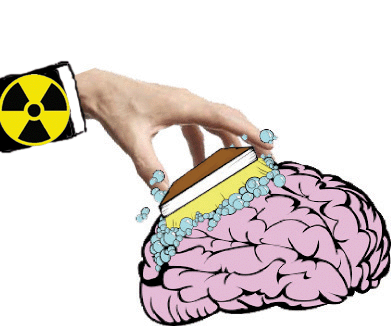
 Challenging the Great Divide in a David and Goliath struggle
Sovereign Union – First Nations Asserting Sovereignty, by Ghillar, Michael Anderson
Jun 4th, 2018
‘What is currently and actively going on without our Peoples’ full realisation
is the struggle between, on the one hand, grassroots Peoples and their leadership,
who are beginning to assert their pre-existing and continuing sovereign status
as linguistically based Nations, whose Countries are occupied
by the Australian/British colonialist administrators and, on the other hand,
the assimilated two-bob-mob conditioned by the colonised mindset
who are attempting to derail the sovereignty movement.
Only yesterday at Warmun, Turkey Creek, Kimberley Land Council
presenters were challenged by people asserting their sovereign position,
only to be told sovereignty was a ‘load of rubbish’ but this was
strongly refuted by Elders and the younger generations.
This situation at Warmun is developing fast.
‘The complex and grimy underbelly of Australia is gradually being exposed for the world to see.
Meanwhile in the international arena, diplomats under the instruction of the
executive Commonwealth government falsely pretend that Australia is an independent Nation.
The Australians sitting in the UN are there at the behest of Britain
and are mere puppets to the United States and Britain.
‘These puppets, in the guise of the Australian State,
hide the fact that there is a major struggle for sovereign title
to this island continent, now known as Australia, These colonial puppets
know they have no legitimacy while ever our sovereign First Nations continue
to exist and our Law if the Law of the Land, always was, always will be.
‘On this most recent journey to the Kimberley,
I was alerted to the very real fact of the enormous destruction and desecration
that is looming without our people knowing what is coming.
….
’
The WALKOUT from the
corrupt Referendum process at
Yullara and the statements we made clearly
had an impact upon the government sitting in Canberra, because they were forced to realise that there
was NOT a true consensus on the proposed constitutional inclusion. The actual
‘Uluru Statement’
must have sent shock waves that propelled the government to abandon its enthusiasm for a referendum.’It is now clear that, because of the
WALKOUT, the government became aware that the
leadership for this
Constitutional inclusion had failed, because the grassroots people
saw through the con and did not want to be included in a racist colonial constitution belonging to Britain.
‘The impact that the WALKOUT had on those present created a situation that scared the organisers,
who clearly lost the complete overview of their original intentions, which the government know of.
The final document that was concluded came completely out of left field and
the government realised mere symbolism was never going to be accepted. … Continue reading →
June 6, 2018
Posted by Christina Macpherson |
aboriginal issues, AUSTRALIA - NATIONAL |
1 Comment
AdnyamathanhaTraditional Land Association (ATLA) RNTBC Email ceo@atla.com.au ICN 3734 ABN 14 146 238 567 PO Box 4014 Port Augusta 5700 Ph 0429900222 29/5/2018
 To. Minister Canavan PO Box 6100 Senate Parliament House Canberra ACT 2600
per email senator.canavan@aph.gov.au Minister Canavan [Minister.Canavan@industry.gov.au]
Dear Minister
I again write to you with regards to your departments treatment of ATLA.
I have already stated on numerous occasions, ATLA is the prescribed body corporate in terms ofour Native Title and we are an Aboriginal Regional Authority with the State Government and recognised as the peak organisation with regards to any heritage issues in our area. We are the representative body for Adnyamathanha people.
However, your department continues to use divide and conquer tactics with regards to the nuclear waste dump in our land.
We raised very grave concerns in relation to the Heritage Assessment and we had no choice but to pull out of this very early in the process. We have no faith in the process or the assessment and we will not accept any findings from this flawed non-inclusive process.
You visited our land recently and didn’t even contact ATLA.
It is not true that Bruce Wilson tried to contact me, I have had no communication with him in relation to your visit. The first I knew about you being here was when I was told you were meeting with individual Adnyamathanha people at Mamma Lou’s café in Port Augusta, that is only about 500 metres from my office in Port Augusta! You then added to the insult by entering our land with no contact with us.
I call on you as Minister to tell the truth and remove these lies from your website.
ATLA is a vital part of this whole process we are the Traditional Owners and we say NO!
Now you are going to hold some sort of vote for the people who live very close to Wallerberdina, however, this is Adnyamathanha land and ALL Adnyamathanha people must get the chance to vote.
I demand you include all Adnyamathanha people who are on the electoral roll in this vote!
This process has been flawed from the start, you continue to ignore our concerns and opposition to this dump and the very least you can do is include us in the vote. I believe there are at least 1500 Adnyamathanha people eligible to vote.
This is our land, ATLA is the peak body, show us respect as the Traditional Owners.
Please take action on this matter with some urgency and include Adnyamathanha people in the vote.
Yours sincerely
Vince Coulthard, CEO
May 30, 2018
Posted by Christina Macpherson |
aboriginal issues, AUSTRALIA - NATIONAL, Federal nuclear waste dump, politics |
Leave a comment
‘We the leaders of the Wangan and Jagalingou Traditional Owners.
We are the Traditional Owners of the land where mining giant Adani want to build the Carmichael coal mine.
‘Our people have said no four times to a miserly land deal offered by Adani in exchange for the destruction of our homelands. We have been opposing Adani and holding them off since 2012.
‘Our resistance has nothing to do with dollars. No amount of money or promises from a deceitful corporation can stop us standing strong in defence of Wangan and Jagalingou lands and waters and sacred sites.
‘But Adani are ruthless. They have used the dirtiest tactics to undermine our right to say no, and manufacture a phony “Indigenous Land Use Agreement”.
‘Right now we’re fighting against Adani’s shoddy tactics and their sham “agreement” in court.
The judge could hand down a decision any day now. But it won’t end there.
‘Can you sign our petition to stand with us against Adani?
‘We are willing to fight Adani all the way to the High Court to protect our environment and sacred sites.
We are working for a positive future for our people on our country. We won’t stand by and watch its destruction for coal.
‘Adani are relentlessly pressuring the Queensland government to clear our Native Title rights out of the way — and as the clock ticks and Adani gets more desperate, it will only intensify.
‘So we need to show Adani and our Governments that they can’t fake or force our consent.
‘We have never given our consent to Adani to destroy our country, and we never will.
Our land is our living law; we are connected to it through our ancestors and our culture. Without it we will cease to exist as a people.
‘Our people have been leading a courageous fight against a cashed-up mining giant with politicians in its pockets, and top end of town lawyers to argue away its collusion, bad faith and dishonesty.
‘We’re calling time on this. It’s time for Adani to walk away.
‘Sign our petition to tell Adani No means No. ‘Adani can’t keep bullying us, or pretending they have our consent. Consent is written in our hearts and minds, and the truth is we have said no. Time and again.. ‘And we shouldn’t have to keep saying it.
Adani haven’t been able to put money on the table for this project or even say when they’ll start digging. They’ve given nothing to our people, or to the people of Queensland and Australia, except a bunch of false promises. The smart money and honest commentators know Adani’s Carmichael mine is going nowhere.
‘But still our rights are at extreme risk. The Queensland Government could yield to this corrupt polluting corporation and “legally” rip up our Native Title, just so they can say they have their final “approval”.
‘We continue to hold the line and have many tens of thousands of supporters in Australia
and around the world, but we need more. We need to build a more powerful movement,
standing in solidarity with us, to take on Adani’s wealth, political influence and dirty tricks.
‘Sign our petition to support our fight against Adani.
‘We are in the fight of our lives. Adani have shown a relentless determination to use unjust legal maneouvres to trample our rights. But this fight is bigger than Adani. It’s about the rights that all Aboriginal people have to say no to dirty extractive industries that profit from our traditional homelands. It’s about our right under international law to be free from discrimination, and to choose our own economic future.
‘We have a vision for our people that’s sustainable. We want economic independence, and to make a future on our country that is respectful of the land and uplifting for our people.
We want to invest in solar energy and other new clean enterprises. We don’t want scraps from a corrupt corporation looking to profit from the permanent destruction of our culture, or meagre handouts and low paid dirty jobs that require us to give up our human rights.
‘When we say No to Adani, we mean No. We hope you’ll stand with us.
‘Support our fight: wanganjagalingou.com.au/our-fight/
‘Adrian Burragubba, cultural leader and senior spokesperson with Murrawah Johnson, Youth spokesperson and Linda Bobongie, W&J Council Chairperson
for the Wangan and Jagalingou Traditional Owners Council’ northcoastvoices.blogspot.com.au/2018/05/wangan-and-jagalingou-traditional.html
May 30, 2018
Posted by Christina Macpherson |
aboriginal issues, Queensland |
Leave a comment
‘The statement is a proposal of constitutional reform that would establish
a constitutionally enshrined First Nations representative body to advise parliament
on policy affecting Indigenous peoples and
commit Australia to a process of truth-telling of its colonial history
through the establishment of a Makarrata commission.’
Calla Wahlquist
@callapilla 26 May 2018
‘While politicians have been demeaning it,
Aboriginal and Torres Strait Islander people have been having their own discussions.
‘The Uluru statement canvas, escorted by Uluru delegate and
Torres Strait man of Badhulgau and Kulkalaig heritage Thomas Mayor,
has traversed the northern half of the country and made its way down the east coast to Melbourne,
stopping in at community meetings, festivals, morning teas and business gatherings. …
‘It’s a slow, grassroots process, funded thanks to Mayor’s role as the
NT branch secretary of the Maritime Union of Australia
– although strictly it’s outside the union’s remit
– but the reception has been overwhelmingly positive.
‘“I still have hope because I’ve been travelling around with the Uluru statement
and everywhere I go there’s more and more support,” he said.
‘“I see momentum building.
And when you explain to people how many similar moments of hope
there have been throughout our history and how we have continued to struggle,
and how this particular time we’re not going to take no for an answer,
and how this statement is just going to keep travelling until we get what we seek,
I think that we can get enough pressure there so that
those aspirations can be achieved.”
‘Other working groups have been convened across the country.
On Saturday the statement and Mayor will be in Turnbull’s Sydney harbourside electorate of Wentworth,
one of the wealthiest in Australia, for a door-knocking campaign aiming to convince people to
lobby their local member to change his mind.
‘They will also aim to counter misinformation about the proposal,
which Mayor said is easily done once people hear the true intent
behind the proposed reforms. … ‘
Read more of Calla’s extensive, thought-provoking & interesting article:
www.theguardian.com/australia-news/2018/may/26/a-year-on-the-key-goal-of-uluru-statement-remains-elusive
May 27, 2018
Posted by Christina Macpherson |
aboriginal issues, AUSTRALIA - NATIONAL |
Leave a comment
Gerry Georgatos @GerryGeorgatosle’ 14 Mar 2018
‘We know that notifying an Aboriginal legal service
when an Aboriginal person is arrested saves lives and costs little.
The lack of nationwide action is unacceptable
‘The CNS has been championed by the federal Minister for Indigenous Affairs, Senator Nigel Scullion.
We have had a number of conversations about the CNS and he gets it,
he understands the need for it to be rolled out nationally.
‘He saved the CNS in NSW and the ACT by funding it to mid-2019,
pulling together the $1.8m out of his portfolio,
even though it was the responsibility of other portfolio holders.
‘The CNS has also been championed by WA’s Senator Sue Lines
who knows how desperately her home state needs it.
‘The Western Australian state Labor party has committed to implementing the CNS when elected.
It is time every state and territory does the right thing and implements the CNS.
There is no greater legacy than to save lives.
‘I will wrap up with the words of members of Ms Dhu’s family. Uncle Shaun Harris said,
“We do not want this to happen to anyone else.
Our families are heartbroken and the pain has not left us.”
Ms Dhu’s mother, Della Roe, said,
“My daughter should be with us today.
Her loss haunts me each day and it will remain but it will give me
at least an ounce of peace to see the CNS implemented.”’
www.theguardian.com/commentisfree/2016/sep/15/the-custody-notification-system-saves-aboriginal-lives-why-isnt-it-national
May 24, 2018
Posted by Christina Macpherson |
aboriginal issues, AUSTRALIA - NATIONAL |
Leave a comment
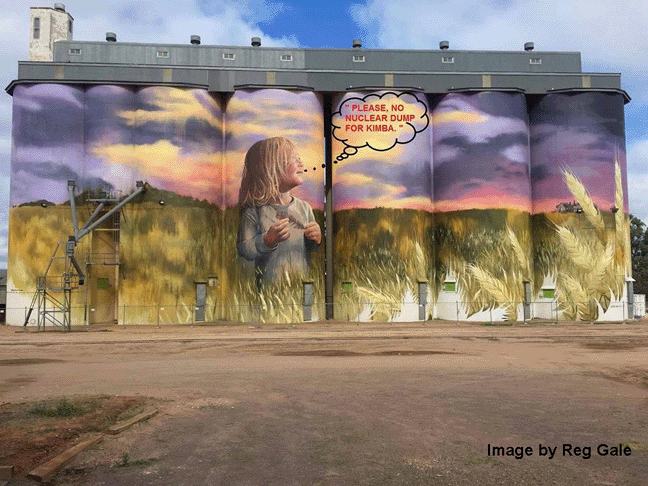
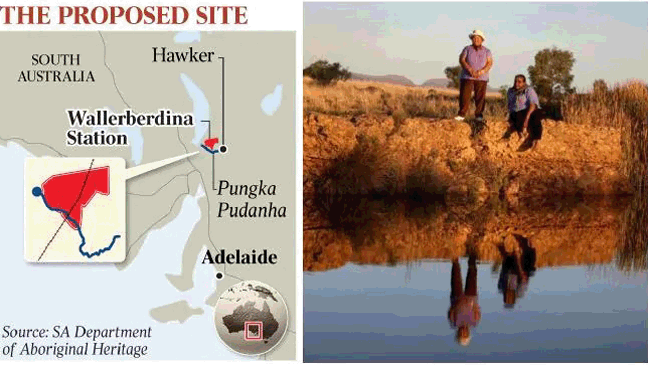
EXTRACT from: A journey to the heart of the anti-nuclear resistance in Australia: Radioactive Exposure Tour 2018, NUCLEAR MONITOR Author: Ray Acheson ‒ NM859.4719, May 2018 “……The federal government of Australia wants to build a facility to store and dispose of radioactive waste in South Australia, either at Wallerberdina Station near Hawker or on farming land in Kimba.
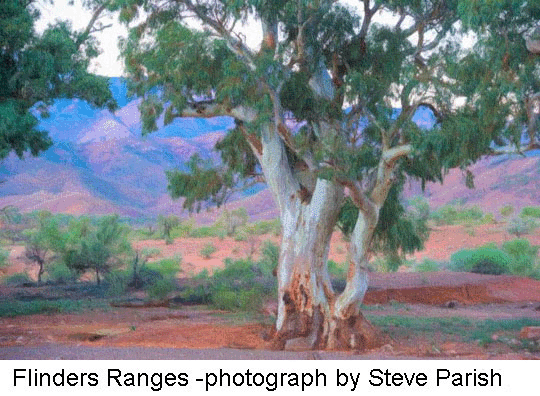
Wallerberdina Station is located in the Flinders Ranges, the largest mountain range in South Australia, 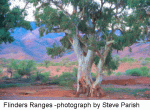 540 million years old. Approaching from the north on our drive down from Lake Eyre can only be described as breathtaking. The red dirt, the brown and green bush, and the ever-changing purples, blues, and reds of the mountains themselves are some of the most complex and stunning scenes one can likely see in the world.
Most people might find it shocking that the federal government would want to put a nuclear waste dump smack in the middle of this landscape. But after visiting other sites on the Rad Tour, it was only yet another disappointment ‒ and another point of resistance.
What is known is that the Wallerberdina site is of great cultural, historical, and spiritual significance to  the Adnyamathanha people. It borders the Yappala Indigenous Protected Area, which is a crucial location for biodiversity in the Flinders Ranges. Its unique ecosystem provides a refuge for many native species of flora and fauna, contains many archaeological sites as well as the first registered Aboriginal Songline of its type in Australia, and is home to Pungka Pudanha, a natural spring and sacred woman’s site.
In case that isn’t enough, the area is a known floodplain. Our travels around the proposed site contained ample evidence of previous floods that sent massive trees rushing down the plain, smashing into each other and into various bridges and other built objects. The last big flood occurred in 2006.
The Adnyamathanha Traditional Owners were not consulted before their land was nominated for consideration by the government for the waste dump. “Through this area are registered cultural heritage sites and places of huge importance to our family, our history and our future,” wrote Adnyamathanha Traditional Owners in a 2015 statement. “We don’t want a nuclear waste dump here on our country and worry that if the waste comes here it will harm our environment and muda (our lore, our creation, our everything).”

We met Adnyamathanha Traditional Owners Vivianne and Regina McKenzie, and Tony Clark, at the proposed site. They invited us into the Yappala Indigenous Protected Area to view the floodplains and swim in the beautiful Pungka Pudanha. We’d just been camping at Wilpena Pound in the Flinders Ranges National Park only a few kilometres away. It is impossible to understand the government’s rationale for wanting to build a toxic waste dump on this land so cherished by its Traditional Owners, local communities, and tourists alike.

The McKenzies have been working tirelessly to prevent the proposed dump from being established, as have other local activists. Fortunately, they have some serious recent successes to inspire them. In 2015, the federal government announced a plan to import 138,000 tonnes of high-level nuclear waste from around the world to South Australia as a commercial enterprise. But Traditional Owners began protesting immediately, arguing that the so-called consultations were not accessible and that misinformation was rife. In 2016, a Citizen’s Jury, established by then Premier Jay Weatherill and made up of 350 people, deliberated over evidence and information. In November that year, two-thirds of the Jury rejected “under any circumstances” the plan to import or store high-level waste.24 They cited lack of Aboriginal consent, unsubstantiated economic assumptions and projections, and lack of confidence in the governmental proposal’s validity.
Other battles against proposed nuclear waste dumps have been fought and won in South Australia. From 1998 to 2004, the Kupa Piti Kungka Tjuta, a council of senior Aboriginal women from northern South Australia, successfully campaigned against a proposed national nuclear waste dump near Woomera. In an open letter in 2004, the Kungkas wrote: “People said that you can’t win against the Government. Just a few women. We just kept talking and telling them to get their ears out of their pockets and listen. We never said we were going to give up. Government has big money to buy their way out but we never gave up.”
Connected communities
The attempts by the Australian government and the nuclear industry to impose a waste dump in the Flinders Ranges, just like their attempts to impose waste dumps and uranium mines elsewhere in the country, or their refusal to compensate victims and survivors of nuclear testing, are all mired with racism. They are rooted in a fundamental dismissal and devaluation of the lives and experiences of indigenous Australians, and of proximity to cities but more importantly, to power.The industry and government’s motivations for imposing nuclear violence on these people and this land are militarism and capitalism.
Profit over people. Weapons over wellbeing. Their capacity for compassion and duty of care has been constrained by chronic short-termism ‒ a total failure to protect future generations. The poison they pull out of the earth, process, sell, allow others to make bombs with, and bury back in the earth, wounds us all now and into the future.
But nuclear weapons are now prohibited under international law. New actors are challenging the possession of nuclear weapons in new ways, and nucleararmed states are facing a challenge like never before.
The nuclear energy industry ‒ and thus the demand for uranium ‒ is declining. Power plants are being shuttered; corporations are facing financial troubles. Dirty and dangerous, the nuclear industry is dying.
This is in no small part due to the relentless resistance against it. This resistance was fierce throughout all of the country we visited, from Woomera up to Lake Eyre, from Roxby Downs to the Flinders Ranges. We listened to stories of those living on this land, we heard their histories, witnessed their actions, and supported their plans…..
https://antinuclear.net/2018/05/12/a-journey-to-the-heart-of-the-anti-nuclear-resistance-in-australia-radioactive-exposure-tour-2018/#more-60401
May 18, 2018
Posted by Christina Macpherson |
aboriginal issues, Federal nuclear waste dump, South Australia |
Leave a comment
ACTU.org.au 11 May 2018
‘The Abbott/Turnbull Government’s racially discriminatory remote work-for-the-dole scheme,
the Community Development Program, has survived another federal budget and
will continue to generate profit from the exploitation of Indigenous labour. …
‘Quotes attributable to
ACTU National Campaign Coordinator
Kara Keys:
‘“By standing by this program the Turnbull Government is declaring that they prefer
to create a system of indentured labour which exploits and
punishes Aboriginal and Torres Strait Islander people
over job creation and community development.’
‘“The fact that many workers in this program are working for organisations and
for-profit businesses in roles that would be paid anywhere else in the country
is an indication that Minister Scullion and the Turnbull government are once again
turning their back on Indigenous workers in favour of businesses and their profits
who are able to access a pool of free labour.’
‘“The Turnbull Government has monetised the exploitation of marginalised Indigenous communities
because it thinks there will be no political consequences. We are determined that there
will be severe consequences for this unconscionable conduct.’
‘“Minister Scullion needs to scrap this discriminatory program and
focus on the economic autonomy and the dignity of paid work in remote communities.
Anything other than the abolition of this program is unacceptable.”’
‘“We welcome the assurances of Minister Scullion’s office that under these changes there will be
‘significant protections to ensure penalties are only applied when they are warranted’ and
the implicit concession that many of the penalties handed out to date
have not met this lowest of all possible standards.’
Media contact: Peter Green
Read more:
www.actu.org.au/actu-media/media-releases/2018/racist-work-for-the-dole-scheme-survives-another-budget
www.actu.org.au/media/1033856/actu-release-180510-cdp.pdf
May 17, 2018
Posted by Christina Macpherson |
aboriginal issues, AUSTRALIA - NATIONAL |
Leave a comment
Author: Cheryl Axleby
‘Cheryl Axleby is a proud Narungga woman with family ties across South Australia.
Cheryl is the co-chair of the National Aboriginal and Torres Strait Islander Legal Services (NATSILS).’
‘Yet again, our people have been let down with this year’s Federal Budget.
‘The investment in our communities is more eroded,
our quality of life more diminished,
our voices and needs more blatantly ignored.
‘While the Budget seeks to commemorate colonisation,
it fails to address its ongoing consequences and the oppression
that our people continue to experience.
‘The most alarming aspects of the Budget further stack the system
against our people and punish people living in poverty.
‘As a co-chair of NATSILS, I have been actively involved in trying to engage with governments
to provide insight and solutions into justice and social issues we face,
and the need for greater investment. It is disheartening that they are not listening,
and actively doing damage to our communities. …
Time for change
‘We remain unheard.
Our national Aboriginal and Torres Strait Islander representative bodies
are not invited to sit at the table with government.
Our communities are not meaningfully involved in the reform process.
And now the poorest amongst us will be punished for the ongoing effects of colonisation.
‘There are solutions.
Many of these were set out by our organisations in the 2016 Redfern Statement.
Now we continue to wait for the Government to act on their commitment to
“do things with us, not to us”.’
Read more of Cheryl Axleby‘s significant, comprehensive & thought-provoking article
under the following themes: Housing; Welfare & CDP; Closing the Gap; Justice:
indigenousx.com.au/cheryl-axleby-budget-ignores-solutions/
May 13, 2018
Posted by Christina Macpherson |
aboriginal issues, AUSTRALIA - NATIONAL |
Leave a comment
‘Mostly Indigenous remote jobseekers still need to work more than
double hours of non-remote jobseekers for same income’
‘An overhaul of the remote work-for-the-dole scheme announced in the federal budget
has been criticised for maintaining racist and discriminatory requirements
on its majority Indigenous participants. …
‘Adrianne Walters, a senior lawyer at the Human Rights Law Centre, said
it was “mind-boggling” that the difference in requirements remained,
albeit slightly modified.
‘“Equal pay for equal work is a core tenet of Australian society.
The federal government must eliminate the blatantly discriminatory requirement,
which sees people in remote Aboriginal and Torres Strait Islander communities
forced to work more hours for the same basic Centrelink payment as people in cities,”
Walters said. … ‘
Helen Davidson & Christopher Knaus:
www.theguardian.com/australia-news/2018/may/11/blatantly-discriminatory-changes-to-remote-work-for-dole-scheme-criticised
May 12, 2018
Posted by Christina Macpherson |
aboriginal issues, AUSTRALIA - NATIONAL |
Leave a comment
 Heather Mckenzie Stuart Fight To Stop Nuclear Waste Dump In Flinders Ranges SA, 5 May Why is ANSTO and DIIS bringing a yaninjanha yura from Darwahl tribe in NSW to Hawker in the Flinders Ranges, making trouble saying urdnus are the only ones protesting against the proposed nuclear waste dump at Barndioota and are using yuras?
We go to protests and we will keep going to protests we will stand against the vartani. Anyway who gives that man the right to come here and talk in Adnyamathanha country, Wilyaru mirus and Adnyamathanha artuyani yarta. This is our ancestors lands, he has no shame we wouldnt go and talk in his yarta about his country. Dont come here pushing a nuclear waste dump on us, keep the poison in your country. You ANSTO and DIIS keep that yura in his country and let him dribble his rubbish over there in NSW. Hands off our sacred sites and stay in your yarta!! Ps his cultural consultancy means nothing to us, he want to stay at Lucas Heights.
May 5, 2018
Posted by Christina Macpherson |
aboriginal issues, Federal nuclear waste dump, South Australia |
Leave a comment
Land managers in Australia have adopted many of the fire-control practices of the aborigines and have partnered with native people.
While the skill of aborigines with fire had been noted before the giant brushfires – early settlers remarked on the “park-like” nature of the landscape – and studied before, it’s taken on new urgency. That’s why Australian land managers have adopted many of the ideas and partnered with native people as co-managers. The fire practices of the aborigines are also being taught and used in other countries.
Scientists have looked to Australian natives for other insights into the natural world. A team of researchers collaborated with natives based on their observations of kites and falcons that fly with flaming branches from a forest fire to start other fires. It’s well known that birds will hunt mice and lizards as they flee the flames of a wildfire. But stories among indigenous people in northern Australia held that some birds actually started fires by dropping a burning branch in unburned places. Based on this TEK, researchers watched and documented this behavior.
Aboriginal people “don’t see themselves as superior to or separated from animals. They are walking storehouses of knowledge”
 Native Knowledge: What Ecologists Are Learning from Indigenous People https://e360.yale.edu/features/native-knowledge-what-ecologists-are-learning-from-indigenous-people
From Alaska to Australia, scientists are turning to the knowledge of traditional people for a deeper understanding of the natural world. What they are learning is helping them discover more about everything from melting Arctic ice, to protecting fish stocks, to controlling wildfires. BY JIM ROBBINS • APRIL 26, 2018
While he was interviewing Inuit elders in Alaska to find out more about their knowledge of beluga whales and how the mammals might respond to the changing Arctic, researcher Henry Huntington lost track of the conversation as the hunters suddenly switched from the subject of belugas to beavers.
It turned out though, that the hunters were still really talking about whales. There had been an increase in beaver populations, they explained, which had reduced spawning habitat for salmon and other fish, which meant less prey for the belugas and so fewer whales.
“It was a more holistic view of the ecosystem,” said Huntington. And an important tip for whale researchers. “It would be pretty rare for someone studying belugas to be thinking about freshwater ecology.”
Around the globe, researchers are turning to what is known as Traditional Ecological Knowledge (TEK) to fill out an understanding of the natural world. TEK is deep knowledge of a place that has been painstakingly discovered by those who have adapted to it over thousands of years. “People have relied on this detailed knowledge for their survival,” Huntington and a colleague wrote in an article on the subject. “They have literally staked their lives on its accuracy and repeatability.”
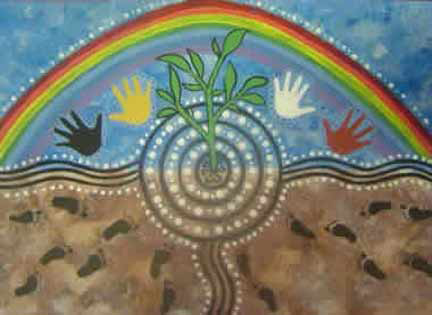
Tapping into this traditional wisdom is playing an outsized role in the Arctic, where change is happening rapidly.
Continue reading →
April 27, 2018
Posted by Christina Macpherson |
aboriginal issues, AUSTRALIA - NATIONAL, culture, environment |
Leave a comment
‘The wreath laying event yesterday at the cenotaph of the WarMemorial caught us by surprise when we realised that many of the older veterans of the modern wars stood still as we passed and applauded our entourage. People should not underestimate what this meant in the long term.
‘This is a monumental shift, because now these veterans will take this back to their tables and begin to ask the right question:
What is the Frontier Wars commemorative presence all about?
‘This is a turning point.’
~ Ghillar, MichaelAnderson, Convener – SovereignUnion 26 April 2018
Ghillar, Michael Anderson, Convener of the Sovereign Union, last surviving member of the
founding four of the Aboriginal Embassy and Leader of the Euahlayi Nation said from Canberra
today:
The success of the 2018 Anzac Day Frontier Wars March in Canberra has given great affirmation
to the old adage that if you say it long enough and represent your message by physically making
your presence known, people do begin to ask questions and begin to search inwardly within
themselves about the truth of the message that we seek to get through to them. … Continue reading →
April 26, 2018
Posted by Christina Macpherson |
aboriginal issues, AUSTRALIA - NATIONAL |
Leave a comment
By Jackie Huggins • 24/04/2018
‘National Congress of Australia’s First Peoples Co-Chair Jackie Huggins
delivered an intervention at the United Nations in New York on April 19
during the 17th Session of the United Nations Permanent Forum on Indigenous Issues (UNPFII).
‘Last week, National Congress Co-Chair Rod Little emphasised the need for
the Australian government to implement UNDRIP during his
engagement with the Commonwealth People’s Forum in London.. …
‘ … we have reached a crisis point in Aboriginal and Torres Strait Islander affairs.
‘The recent Closing the Gap report reveals that only three of the seven targets are on track to be met.
Despite making up 3% of the population, First Peoples comprise 27% of the nation’s prison population,
making Australia’s Indigenous incarceration rates the worst in the world. ….
‘Aboriginal and Torres Strait Islander women are 32 times more likely to be hospitalised
due to family violence than their non-Indigenous counterparts.
‘The most recent statistics on life expectancy reveal the gap between
First Peoples and non-Indigenous Australians is at 10.6 years for males
and 9.5 years for females. …
‘The national rate of Aboriginal and Torres Strait Islander children in out of home care
is 9.8 times the national average. 50% of our people have a disability.
‘Despite widespread criticism, the paternalistic Northern Territory Intervention is continuing …
It has led to … quarantining of 50% of welfare,
the forced participation in work for the dole schemes which pay individuals
far less than an average reward rate …
‘Recently, after commissioning extensive consultations with First People’s
across the nation on constitutional reform, the government flatly rejected
our recommendations in The Statement from The Heart, from Uluru. … ‘
Read more of Jackie‘s comprehensive, informative & insightful article here:
www.themandarin.com.au/91664-australias-first-people-to-the-un-govt-statements-are-hypocritical-in-the-extreme/
April 26, 2018
Posted by Christina Macpherson |
aboriginal issues, AUSTRALIA - NATIONAL |
Leave a comment
 No nuclear waste groups stand together, https://www.eyretribune.com.au/story/5362658/no-nuclear-waste-groups-stand-together/ 24 Apr 18
No nuclear waste dump groups from Kimba and the Flinders Ranges came together in Port Augusta last week in response to the recent announcement by federal Resources Minister Matt Canavan that a community vote for a planned national radioactive waste management facility would begin on August 20.
The groups discussed shared concerns and committed to increase their efforts against the plan including through an open debate featuring the federal department, the Australian Nuclear Science and Technology Organisation (ANSTO), Traditional Owners and public policy and health professionals.
People at the meeting included Adnyamathanha community members, representatives from Kimba, Hawker, Whyalla and Quorn along with members of the Flinders Local Action Group and No Radioactive Waste on Agricultural Land in Kimba or SA.
Peter Woolford from Kimba said the “flawed federal process” was failing the communities.
“Minister Canavan is fast-tracking a plan that does not have broad community support”.
The groups committed to highlight community concern and opposition to the federal plan ahead of the August vote and urged residents in the wider region to stand up and speak out.
Former federal member for Grey Barry Wakelin said it was a national issue, “not something that a regional community should be left to deal with”.
“The current federal plan lacks evidence and poses a threat to our existing industries – we need a better way,” Mr Wakelin said.
“This has been a productive meeting and it is heartening to see regional South Australians stepping up to the challenge, taking action and working together.”
April 25, 2018
Posted by Christina Macpherson |
aboriginal issues, Federal nuclear waste dump, opposition to nuclear, South Australia |
Leave a comment