USA public losing trust in nuclear power authorities
while nuclear plants have permits that allow them to emit material into surface water and the air, they do not have permits that let them release material to groundwater, which is where the tritium is going..
Has Trust Leaked Away With the Tritium? NYTimes.com, By MATTHEW L. WALD, April 20, 2010, A panel of experts convened on Tuesday by the Nuclear Regulatory Commission to discuss how the agency should approach tritium leaks at reactors suggested that the biggest risk that nuclear operators faced was the erosion of public trust…. Continue reading

Kentucky legal case over radiation contamination
The Kentucky Supreme Court ruled then that the landowners don’t have to prove they were actually harmed to sue past contractors for trespassing by allowing contaminants to spread beyond the plant.
The high court also held that land devaluation by intentional trespassing is a recognized measure of damages once actual injury is determined. There is injury if groundwater is contaminated and it can’t be consumed.
Ky. landowners settle lawsuit over uranium leaks, BusinessWeek, By BRETT BARROUQUERE 21 April 2010, !LOUISVILLE, Ky.A group of landowners have settled in a long-running lawsuit for $1.75 million over allegations that water leaks from a western Kentucky uranium enrichment plant devalued property values….compensating between 70 and 80 homeowners for the devaluation of their property because of radiation contamination….. Continue reading
Radioactive poisoning and water exploitation in Niger
Niger: French State-Owned Company ‘Poisoning’ Poor | Coalition Against Nuclear Energy, Julio Godoy, April 2010, Paris — Recent research by Greenpeace suggests that French state-owned company Areva’s public claims of decontamination of populated areas near uranium mines in Niger are false. High radio-activity persists in towns and rural areas near the mines, affecting some 80,000 people… Continue reading
Uranium poisoning of Native Americans’ land
VIDEO, Native America, Discovered and Conquered » Blog Archive » American Indians and uranium poisoning In what might be an example of environmental and economic racism, I believe that more than 50% of the uranium mining in the United States occurs on tribal lands. Tribal lands make up only 1% of the land mass in the lower 48 states. I just heard very disturbing evidence presented on very serious and very significant cancer clusters on the Navajo Nation reservation blamed on water and land contaminated with uranium tailings.Watch this video complied from a conference held on the Hopi Nation in November 2009 about this issue.

Secret plan to permit higher levels of ionising radiation
“This critical debate is taking place entirely behind closed doors because this plan is ‘guidance’ and does not require public notice as a regulation would,”

(USA) Radiation Exposure Debate Rages Inside EPA Plan to Radically Hike Post-Accident Radiation in Food & Water Sparks Hot Dissent, YubaNet.com, By: Public Employees for Environmental Responsibility (PEER)Washington, DC Apr. 5, 2010 – A plan awaiting approval by the U.S. Environmental Protection Agency that would dramatically increase permissible radioactive releases in drinking water, Continue reading
U.S. EPA warns on water risks with in situ uranium mining
a major hurdle for dozens of proposed in-situ uranium proposals in the region
Water concerns delay Wyoming uranium projects, 30 march 2010, The U.S. Environmental Protection Agency has told the Nuclear Regulatory Commission to go back to the drawing board with its site-specific environmental reviews of three proposed in-situ uranium mines in Wyoming. Continue reading
Navajo’s Radioactive Legacy from Uranium Mining
Toxic legacy for tribes, High Country News, Caitlin Sislin | Mar 26, 2010 Earlier this month, the 10th Circuit Court of Appeals approved a controversial permit for uranium mining operations at sites in Church Rock, New Mexico. The operation includes a site associated with the largest release of liquid radioactive waste in United States History — a catastrophe which continues, a generation later, to negatively impact the lives and health of Navajo people residing near the spill site. Continue reading

Gambling Central Australia’s future, with nuclear wastes
A major omission in Dr Switkowski’s comments concerns what effects over thousands of years that leaking and leeching radioactive waste might have upon Australia’s precious subterranean aquifers. For a nation as reliant as we are on underground water, that represents a massive gamble to say the very least.
NUCLEAR UNDER TONES?, Larry Buttrose, 15 March, 2010, “…Dr Switkowski continues: “Eventually spent fuel is transported to a national repository, a well-engineered deep hole in the ground, probably in central Australia.” Continue reading
Biodiversity is for future ages. Uranium mining is short term
When a respected institution known for its measured and considered responses to issues of public importance, such as the Museum, asks the Government to pay attention, it would be foolish to do otherwise.
A time to err on side of conservation, The Advertiser Editorial, March 16, 2010 THERE are certain places in the state and the nation which should be off limits for mining. Continue reading
Muckaty nuclear waste dump plan threatens groundwater
Muckaty station sits above an ancient aquifer which is used by both the aborigines for drinking water and white station owners to water their cattle. It also experiences large intermittent rainfalls during the year.
A heresy is occurring in Australia, anthropologyworks by Helen Caldicott, 8 March 2010, “….the current abuse and desecration of several aboriginal tribes inhabiting their land in the Northern Territory. This land called Muckaty station is conveniently located adjacent to the railway line, constructed recently by Dick Cheney’s former company Halliburton, which bisects Australia connecting Darwin, a port in the north, to Adelaide a port in the south. Continue reading

Uranium mining’s damage to Native Americans
Throughout the Diné Nation, Diné families have been subject to decades of radioactive contamination
Uranium Mining Begins Near Grand Canyon: Thousands of Claims Threaten Public Health & Sacred Lands :: Peace, Earth & Justice News Feb 24, 2010 Grand Canyon, AZ — In defiance of legal challenges and a U.S. Government moratorium, Canadian company Denison Mines has started mining uranium on the north rim of the Grand Canyon. Continue reading

Water, not money, might kill off nuclear industry
 Water could the be issue that sinks this project, or it could be numerous other funding and safety issues related to nuclear power.
Water Issues Derailing Nuclear Power in Utah SpeakEasy by Tara Lohan , February 26, 2010 Nuclear power has been a hot topic these past few weeks with Vermont’s leaking reactor, Continue reading
BHP’s Yeelirrie uranium mining poses riskes to groundwater, and to biodiversity
the report had “glazed over” a lot of the research into the mine’s
BHP uranium report unveils risks, MICHAEL BENNETT, The West Australian February 27, 2010,
BHP Billiton documents have revealed the company’s proposed $17 billion Yeelirrie uranium mine could threaten vulnerable animal species previously found in the area. Continue reading
Water issues could finish nuclear industry
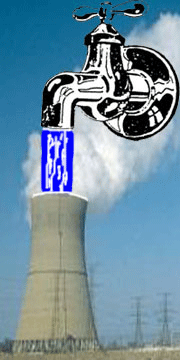
Water could the be issue that sinks this project
Water Issues Derailing Nuclear Power in Utah SpeakEasy by Tara Lohan February 26, 2010 Nuclear power has been a hot topic these past few weeks with Vermont’s leaking reactor, Georgia’s plans for new ones (thanks to Obama), and the press’s blind approval of all things nuclear. ….
While there are lots of reasons that nuclear power is a bad idea, residents in Utah are particularly concerned about water. Waldholz writes: Continue reading
Renewable energy is viable for South Africa and the world
“Contrary to what Eskom says, South African winds are constant and predictable. South Africa has an almost perfect wind regime,” he said.

‘Renewable energy is viable’ Times LIVE (Africa) Feb 21, 2010 By ZWELI MOKGATA Eddie O’Connor is adamant that 90% of the world’s electricity could easily come from renewable sources by 2050 if only world governments would commit to key energy policies in time. Continue reading
1 This month
7 April – WEBINAR – Australia and the Doomsday Clock – Preventing nuclear war through NoFirstUse and other policies
Online | Tuesday April 7, 4:00-5:30pm, Australian Eastern Time / 8:00-9:30am Central Europe Time
– Access the registration link
15 April – Zoom –Nuclear Power is Not the Solution
Apr 15, 2026 01:00 AM in Canberra, Melbourne, Sydney

Join the International Physicians for the Prevention of Nuclear War (IPPNW) on Tuesday, April 14th for a timely webinar exploring the risks associated with nuclear power and challenging the myth that it offers a simple, safe, carbon-free solution to the climate crisis

21 April Webinar: No Nuclear Weapons in Australia
Start: 2026-04-21 18:00:00 UTC Canberra, Melbourne, Sydney (GMT+10:00)
End: 2026-04-21 19:30:00 UTC Canberra, Melbourne, Sydney (GMT+10:00)
Event Type: Virtual
A virtual link will be communicated before the event.
Host Contact Info: australia@icanw.org

of the week – Australians for War Powers Reform (AWPR)
To see nuclear-related stories in greater depth and intensity
 Antinuclear