Marius Kloppers – Australia’s new Climate Change Minister?
described Kloppers as the climate change minister who wasn’t voted in by the public.
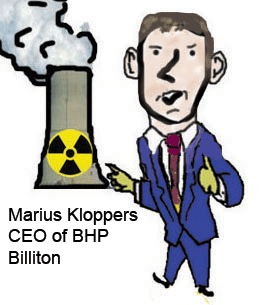
Kloppers under fire, The Age, September 22, 2010 AN ONLINE entrepreneur has accused the federal government of kowtowing to the boss of Australia’s biggest company. Continue reading
Coal and nuclear lobbies at odds now?
 For decades the fossil fuel lobby has been using their very effective tactic of “sowing doubt” about global warming and climate change. It has worked well for them – to “Divide and Conquer” public opinion.
Now – it could be their undoing. Their plan was surely to keep coal going until a smooth transition to nuclear.
Well – it hasn’t worked. While the fossil fuel lobby tries to discredit global warming, their previous ally, the nuclear lobby, now says that human-caused climate change is real!
“Divide and Conquer” now seems to be working against these lobbies, as their own doubts rebound against them.
Meanwhile – reality is coming home to the nuclear/uranium lobby – as the nuclear industry stalls in USA, UK, Germany, France, India, .. The more experience a country has had with nuclear technology, the more opposition arises to it.
Uranium interests, not the public’s, served by BHP’s Marius Kloppers
A tax would favour international nuclear electricity generators and boost pressure to overturn Australia’s ban on nuclear generators. Both effects would aid BHP’s uranium interests.

BHP Billiton chief Marius Kloppers knows how to look after his shareholders’ interests, Paul Kerin The Australian, September 20, 2010 BHP Billiton chief executive Marius Kloppers’ touting of a carbon tax serves his shareholders’ interests — not the public’s. Continue reading
Australia and China should collaborate on renewable energy
the renewable energy sector needs to be thinking more about how much they can strengthen their collaboration, where they position Australia better in a global low-carbon economy
China tipped to deliver Australia’s energy needs, ABC News (Australian Broadcasting Corporation), 20 Sept 10, By Sarah Clarke The WWF says Australia has the opportunity to ramp up its role in the booming renewable energy market. Continue reading
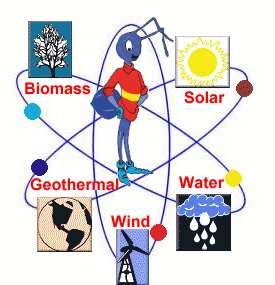


Protest Oct 10 against coal, for renewables
Protesters will also call for a “just transition” away from coal for workers in the industry …[meaning that coal workers] would be guaranteed “green jobs”, through the development of renewable energy and energy-efficiency manufacturing facilities.

Protest to target Hazelwood, Green Left Weekly, September 18, 2010 By Chris Peterson, Melbourne, On October 10, climate activists will converge on the Hazelwood power station in the Latrobe Valley in eastern Victoria. They will use mirrors to try to create Victoria’s “first solar thermal power” station at the Hazelwood gate, to show solar is a viable alternative……….. Continue reading

Western Australia the logical place for Solar Power
The WA coalition argues that the state with the best solar radiation in Australia should be leading the country in solar generation and argues that a 5 per cent solar target for 2020, underpinned by an FiT set by auction, would unlock more than $4 billion of investment to install some 1060MW of capacity.

Solar’s western promise Business Spectator Giles Parkinson , 20 Sep 2010 The solar energy industry has virtually given up on the federal government providing a mechanism for the roll-out of utility-scale solar installations across the country, and is instead focusing its efforts on individual states. Continue reading
Competitive Solar Feed-In Tariff – Australian Capital Territory
The territory will be the first to implement the FiT for commercial premises (warehouse and office buildings), and anticipates that up to 240MW of solar could be installed, generating the equivalent of 25 per cent of its total energy consumption.

Solar’s western promise Business Spectator Giles Parkinson , 20 Sep 2010 “……Feed in tariffs for small-scale solar average around 45c per kilowatt hour (more expensive in some states), but the solar industry estimates competitive large-scale solar would only need a tariff of around 20c/kwh, decreasing over time. Continue reading
BHP Billiton’s Marius Kloppers’ strategy for uranium
Bear in mind too that BHP has its foot on the world’s biggest uranium deposit, at Olympic Dam in South Australia……..Olympic Dam, currently in the planning stages for a huge expansion, was key to BHP’s strategy to limit the impact of the resources rent tax and clearly it is central to its future energy strategy.
Kloppers plays strategic card by backing a carbon tax, Sydney Morning Herald, Ian Verrender, September 18, 2010 “……Kloppers is no fool. Quite the contrary. Softly spoken with an uncharacteristically lilting Afrikaans accent, the youthful head of BHP Billiton is a master strategist, not just when it comes to commerce and digging holes but in the not-so-gentle art of political persuasion…. Continue reading
Australia’s future prosperity depends on action on climate change
It is also important that climate change action is understood as an opportunity for structural economic reform and for building long-term economic prosperity….Early action delivers first-mover advantage and reduces the risk of economic exclusion in carbon-intensive industries when the transition to a lower carbon economy eventually takes place…..

Dear PM: risks are worth it in reform | The Australian, 18 Sept 10, David Hetherington “………..Although survival will be a preoccupation, the Gillard government cannot ignore the long-term policy challenges facing the country…. Continue reading
The plot thickens in promotion of Olympic Dam Uranium Mine
Last month the Australian government set up a Mines Tax policy team. It is led by Don Argus, former chairman of uranium miner BHP Billiton. Other members are former uranium company Rio Tinto executive David Klingner, Erica Smyth, chairman of uranium explorer Toro Energy.
So, Australia’s mining tax policy is guided by uranium mining representatives.
And now, in a bold statement in facvour of a carbon tax, BHP Billiton’s Chief Executice officer Marius Kloppers sets the scene for BHP to increase its influence over Australia’s government.
It all sounds so good. But note that, in supporting action on Climate change, Kloppers promotes “alternative” energies to take over from coal.
I’ll bet that “alternative” will turn out to be one of those words like “renewable” and “clean” that are applied to nuclear power. And all in such good timing, as BHP Billiton is desperate to get its Olympic Dam uranium mine expansion happening.
BHP’s Marius Kloppers accused of having “nuclear agenda”
Business Spectator, Sept 16 10, “……Liberal senator Cory Bernardi said Mr Kloppers was speaking out of self-interest because BHP Billiton was keen to pursue a nuclear agenda.”In sharemarket parlance, people talk up their own book and that’s what Mr Kloppers is doing,” he told Sky News, adding the resources giant’s chief executive officer was pushing alternative sources of energy such as uranium. Greens welcome Kloppers’ remarks | News | Business Spectator
BHP Billiton’s Marius Kloppers puts the case for carbon price
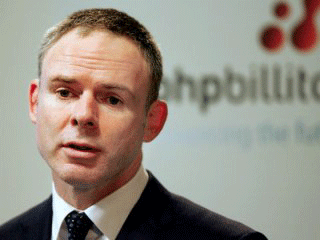 He noted that up to 90 percent of carbon emissions contributed by the countries electricity sector were largely caused by coal fired power stations across Australia as he asserted that we “will need to look beyond just coal towards the full spectrum of available energy solutions.”
BHP chief urges nation to look for alternatives in light of carbon price concerns – International Business Times, By Yumi Roxas | September 16, 2010 BHP chief urges nation to look for alternatives in light of carbon price concerns…… Continue reading
Australian Greens support BHP chief’s carbon price statement
Senator Brown said the businessman’s remarks legitimised the federal government’s promised climate change committee of MPs and experts that will work towards pricing carbon.

Greens welcome Kloppers’ remarks Business Spectator, 16 Sep 2010 BHP Billiton Ltd chief executive Marius Kloppers’ support for a carbon price is music to the ears of Australian Greens leader Bob Brown. Continue reading
World Bank waking up to the need for a new energy economy
“The biggest hurdle is we still don’t value financially the environmental and social damage we’re doing with our current fossil-fuel economy. The economist’s term for that is “the externalities” – the things we’re not including in our calculus. Everything from the negative impacts of floods, sea-level rise, drought….”
Signs of Energy at the World Bank – NYTimes.com September 14, 2010, By ANDREW C. REVKIN – quoting Daniel Kammen, chief technical specialist for renewable energy and energy efficiency at the World Bank…… Continue reading

Greg Combet, Australia’s new Climate Minister keen on coal
how we can achieve in the longer term things like carbon capture and storage for coal-fired power stations.”

New Australia climate minister backs coal – Sept 13 (Reuters) – Australia’s new climate change minister, Greg Combet, believes the country’s coal sector has a future under government policies, .. Continue reading
1 This month

of the week – Australians for War Powers Reform (AWPR)
To see nuclear-related stories in greater depth and intensity
 Antinuclear