Arkaroola uranium mining threatens rare frog species
Mining worries as frog species found – ABC News (Australian Broadcasting Corporation), 16 June 2010, The owner of Arkaroola Wilderness Sanctuary says discovery of a new frog species is yet another reason to be wary of mining in the Flinders Ranges region of outback South Australia.Scientists say it is the first new species to be identified in SA in 45 years.The species was found this month at Arkaroola, where Marathon Resources is involved in a uranium exploration project at Mount Gee.Sanctuary owner Marg Sprigg says she is worried Marathon’s initial drilling program could lead to it getting a full drilling licence later in the year.”I’m a geologist, I’m not against mining but I don’t think you have to mine everywhere and there were a lot of geologists who put in submissions saying ‘leave Arkaroola alone, it is too special, it’s a brilliant geological teaching laboratory’.”Ms Sprigg says mining could prevent more unique species being found in the Flinders Ranges.
Mining worries as frog species found – ABC News (Australian Broadcasting Corporation)
Ranger uranium mine’ s salty leak into freshwater creek
Uranium mine caused abnormal salt levels in Kakadu creek – ABC News (Australian Broadcasting
Corporation) 12 June 2010, The company that operates the Ranger uranium mine has confirmed higher-than-normal salt levels in a creek in Kakadu National Park is a result of its operations.Energy Resources of Australia (ERA) has investigated two salinity spikes in Magela Creek downstream of the mine in April.Chief executive Rob Atkinson says run-off water from the mine had flowed into the creek….

Ranger uranium mine water poorly monitored
Stringent Water Monitoring Needed at Uranium Mine: Greens | theangle.org. 27 May 21010, The Australian Greens have called for better water monitoring methods to be implemented in the wake of allegations that contamination of creek systems has occurred near the Ranger Uranium Mine in the Northern Territory. Continue reading
Uranium mine’s radioactive leak raises doubts on Cameco’s planned mine close to Alice Springs
 No clean water, no Alice Springs. Is a uranium mine worth the risk? Judging by the experience of the Mirrar people in Kakadu — no way.
Kakadu’s tainted water is a no-go for Alice Springs, The Age, Jess Abrahams, Arid Lands Environment Centre, Alice Springs, 25 May 2010, URANIUM mining is not a safe or sustainable industry for Australia.The Ranger mine is meant to epitomise world’s best practice.But a poorly engineered dam apparently collapsed, spilling 6 million litres of radioactive water into the Gulungul Creek, which flows into Kakadu. Is this the best the uranium mining industry can manage?
Here in Alice Springs, Canadian company Cameco wants to dig a uranium mine at Angela Pamela, just over 10 kilometres from the southern outskirts of town. Continue reading
Uranium mining radioactively pollutes Kakadu National Park
Mine fears grow as pollutants flow to Kakadu, Sydney Morning Herald, LINDSAY MURDOCH May 24, 2010
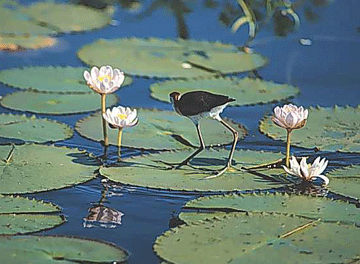
MILLIONS of litres of radioactive water from the Ranger uranium mine have flowed into internationally acclaimed and World Heritage-listed wetlands in Kakadu National Park. Continue reading
Save Arkaroola Wilderness Sanctuary from uranium mining, says Liberal Senator
Arkaroola too precious to mine: Minchin , The Independent Weekly, 14 May, 2010 South Australia’s Arkaroola Wilderness Sanctuary is too precious to turn over to uranium mining, South Australian Senator Nick Minchin says.
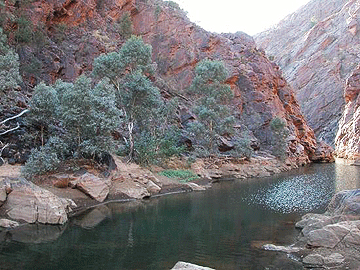
The Liberal Senator says he is appalled that the Australian Workers Union is in favour of opening the sanctuary to the uranium industry. Continue reading
Uranium dust from Australia’s mines blown to Antarctica
Australian uranium dust found in Antarctic ice ABC News (Australian Broadcasting Corporation) 3 May, 2010, An ice core from the Antarctic bears traces of uranium that may have been carried by the wind from Australian mines in 1995, a glacier expert has told a Chilean newspaper.

The minuscule amounts of the radioactive element “correspond to a year (1995) when Australia increased its uranium production,” Ricardo Jana, who participates in an international research effort in the frozen continent, told El Mercurio daily.He said scientists theorise the uranium particles were carried by the wind from Australia and deposited in the northern part of the Antarctic’s Detroit peninsula. Australian uranium dust found in Antarctic ice – ABC News (Australian Broadcasting Corporati
Quiet progress of People for a Nuclear Free Australia
 More than half the battle, in getting rid of the toxic uranium , nuclear power, and nuclear weapons industries, is in informing people, about the true nature of the dangers, and financial waste involved.
This is an uphill battle in Australia, as we head off into Third World colonial status, pursuing the short term greed of the “resources boom” . The major political parties are subservient to polluting corporations. The mainstream media is closely allied to mining interests. Australia still has its cultural, colonial cringe – resulting in public ignorance and apathy about the nuclear issue.
People for a Nuclear Free Australia (PFNA) are changing this. By well planned educational materials, the facts are being placed before doctors and other professionals, trade unionists, and members of parliament. The Australian Electrical Trades Union has just produced an excellent film which documents the health implications of uranium mining both to the miners and their families who live near the mines.
To learn more about PFNA, or to contribute to their educational effort, go to http://pnfa.com.au
Sydney’s radioactive residential area will still be “hot” indefinitely
because of the extremely high radioactivity levels in the waste, it may be difficult to dump it

Clean-up deadline missed, Sydney Morning Herald BRIAN ROBINS, March 19, 2010, THE planned clean-up of the radioactive site at Hunters Hill is facing an indefinite delay. The government has missed its own deadline to begin the clean-up, and is yet to even start on the necessary paperwork….. Continue reading
Gambling Central Australia’s future, with nuclear wastes
NUCLEAR UNDER TONES?, Larry Buttrose, 15 March, 2010, “…Dr Switkowski continues: “Eventually spent fuel is transported to a national repository, a well-engineered deep hole in the ground, probably in central Australia.” Continue reading
Biodiversity is for future ages. Uranium mining is short term
When a respected institution known for its measured and considered responses to issues of public importance, such as the Museum, asks the Government to pay attention, it would be foolish to do otherwise.
A time to err on side of conservation, The Advertiser Editorial, March 16, 2010 THERE are certain places in the state and the nation which should be off limits for mining. Continue reading
South Australia’s museum rejects uranium mining in wilderness areas
The museum says the biodiversity evaluation in Seeking a Balance is “greatly flawed”.
South Australian mining plan would potentially kill off species Adelaide Now, Cameron England,
March 15, 2010 A STATE Government plan which would allow mining in sensitive parts of the Northern Flinders Ranges is “greatly flawed” and should be “rejected totally”, the SA Museum says. Continue reading
Radioactive waste dumped in Kakadu National Park
Toxic waste dump in Kakadu, Northern Territory News , NIGEL ADLAM, March 13th, 2010
THE equivalent of six Olympic-size swimming pools of radioactive soil and mining equipment has been buried in Kakadu National Park.Parks Australia said it was not nuclear waste and the level of radioactivity was low.
The soil and equipment had been stored in shipping containers.
It has now been put in containers with a structural life of 1000 years and buried four metres down.
BHP’s Yeelirrie uranium mining poses riskes to groundwater, and to biodiversity
the report had “glazed over” a lot of the research into the mine’s
BHP uranium report unveils risks, MICHAEL BENNETT, The West Australian February 27, 2010,
BHP Billiton documents have revealed the company’s proposed $17 billion Yeelirrie uranium mine could threaten vulnerable animal species previously found in the area. Continue reading
Uranium mining’s damage to the Australian environment
The impact of nuclear testing on the Australian environment | Blog About All 16 Feb 2010 “.……..In the case of Rum Jungle, the pollution of the surrounding environment was quite severe with run off from the tailing damns causing extensive damage in the East Finniss river for several kilometres away from the sight of the mine. Continue reading
1 This month

of the week – Australians for War Powers Reform (AWPR)
To see nuclear-related stories in greater depth and intensity
 Antinuclear